Six Sigma is a disciplined, data-driven methodology and project management strategy designed to improve process performance, eliminate defects, and minimize variation. Pioneered at Motorola in the 1980s, it aims for a near-perfection standard of no more than 3.4 defects per million opportunities (DPMO). It is often used in combination with Lean principles (Lean Six Sigma) to simultaneously eliminate waste and reduce variation.
Six Sigma Project Management Summary
Six Sigma project management relies on a structured, five-phase framework known as DMAIC (pronounced “duh-may-ick”) for improving existing processes:
Define: Identify the project goals and customer deliverables (Critical to Quality – CTQ).
Measure: Quantify the current process performance and gather baseline data.
Analyze: Determine the root causes of defects and variation.
Improve: Implement and verify solutions that eliminate the root causes.
Control: Standardize the new process and implement monitoring to ensure long-term sustainability.
Key Project Roles (The Belt System):
White/Yellow Belt: Basic awareness and team members.
Green Belt: Leads projects, assists Black Belts.
Black Belt: Leads complex projects, acts as change agent.
Master Black Belt: Coaches Black/Green Belts, oversees strategy.
Detailed Historical Timeline by Era and Year
Pre-1980s: Foundational Quality Efforts
1799: Eli Whitney introduces the concept of interchangeable parts (standardization) to produce muskets, reducing variation.
1920s: Walter Shewhart at Bell Laboratories shows that 3-sigma process control is necessary to reduce variation.
1950s: Toyota Production System (TPS) develops to create efficiency and quality.
1980s: Origin and Development (The Motorola Era)
1981: Motorola leadership (Bob Galvin) initiates a push for increased quality, arguing that traditional 3-sigma defects (thousands) were insufficient, prompting a push for DPMO.
1985: Engineer Bill Smith pens a paper proposing the term and methodology of Six Sigma.
1986: Bill Smith officially introduces Six Sigma at Motorola, with Mikel Harry and Bob Galvin as co-contributors.
1987: Motorola formally founds the Six Sigma improvement program, targeting a 10-fold reduction in defects.
1988: Motorola receives the first Malcolm Baldrige National Quality Award.
1989: Motorola establishes the Six Sigma Research Institute.
1990s: Expansion and Standardization (The GE/Allied Signal Era)
1990: Motorola introduces the concept of Black Belts to formally lead improvement projects.
1993: Motorola registers Six Sigma as a trademark.
1994: AlliedSignal adopts Six Sigma, with CEO Larry Bossidy leading the effort.
1995: Jack Welch adopts Six Sigma at General Electric (GE), optimizing the DMAIC approach and boosting its popularity.
Late 1990s: Over 2/3 of Fortune 500 companies start Six Sigma initiatives.
2000s: Integration with Lean (The Lean Six Sigma Era)
2000s: Global adoption of Six Sigma by companies like Sony, Jaguar, Samsung, and Adidas.
2002: Michael George publishes “Lean Six Sigma,” combining the speed of Lean (waste reduction) with the quality of Six Sigma (variation reduction).
Mid-2000s: Six Sigma expands beyond manufacturing into services, healthcare, and finance.
2010s – Present: Digitalization and Advanced Analytics
2010s: Integration of data-driven Six Sigma with technology, including real-time monitoring and advanced data analytics.
Present: Incorporation of Big Data, Machine Learning, and AI to enhance analytical capabilities and predictive maintenance within the DMAIC framework.
Key Contributors to Six Sigma
Bill Smith: “Father of Six Sigma,” developed the concept at Motorola.
Bob Galvin: CEO of Motorola, supported and pushed the adoption of the methodology.
Mikel Harry: Co-developed the methodology and helped establish the Six Sigma Institute.
Jack Welch: Former CEO of GE, championed the strategy, proving its power outside of manufacturing.
Larry Bossidy: CEO of Allied Signal, instrumental in early adoption.
Six Sigma project management summary and detailed historical timeline by era and year
Scrum is an Agile framework for managing complex, innovative product development through small, cross-functional teams working iteratively in short time-boxes called Sprints. Inspired by a 1986 “rugby” approach to product development, it was formalized in the early 1990s by Jeff Sutherland and Ken Schwaber to improve team productivity and deliver value quickly.
Scrum is based on empiricism—transparency, inspection, and adaptation—and is defined by specific roles (Product Owner, Scrum Master, Developers), events (Sprint Planning, Daily Scrum, Sprint Review, Retrospective), and artifacts (Product Backlog, Sprint Backlog, Increment).
Detailed Historical Timeline
The Conceptual Era (Pre-1990s)
1986: Takeuchi and Nonaka publish “The New New Product Development Game” in Harvard Business Review. They introduce the “rugby” approach—a team working together, passing the ball back and forth, to increase speed and flexibility.
Scrum Takes Shape (1990–1999)
1993: First Scrum implementation: Jeff Sutherland, John Scumniotales, and Jeff McKenna at Easel Corporation apply these concepts to software development.
1995: Ken Schwaber and Jeff Sutherland present a paper, “The SCRUM Development Process,” at the Object-Oriented Programming, Systems, Languages & Applications (OOPSLA) conference in Austin, Texas, formally introducing the framework.
1996: Ken Schwaber and Mike Beedle refine the process, focusing on software development.
1999: Mike Beedle, Martine Devos, Yonat Sharon, Ken Schwaber, and Jeff Sutherland publish “SCRUM: An extension pattern language for hyperproductive software development”.
Agile and Formalization (2000–2009)
2001: Ken Schwaber, Jeff Sutherland, and 15 others create the “Agile Manifesto” in Snowbird, Utah. Schwaber and Beedle publish the first book on Scrum: Agile Software Development with Scrum.
2002: Ken Schwaber, Mike Cohn, and Esther Derby found the Scrum Alliance to provide certifications.
2004: Ken Schwaber publishes Agile Project Management with Scrum.
2006: Jeff Sutherland founds Scrum Inc..
2009: Ken Schwaber leaves the Scrum Alliance and founds Scrum.org to provide Professional Scrum accreditation.
The Scrum Guide Era (2010–Present)
2010: First “Scrum Guide” is published by Ken Schwaber and Jeff Sutherland to define the framework, often revised in subsequent years (2011, 2013, 2016, 2017).
2017: PRINCE2 Agile is published, adding governance layers for organizations using Scrum.
2020: The latest Scrum Guide (November 2020) is released, focusing on a more minimal, less prescriptive definition, introducing the “Product Goal” and changing “Development Team” to “Developers”.
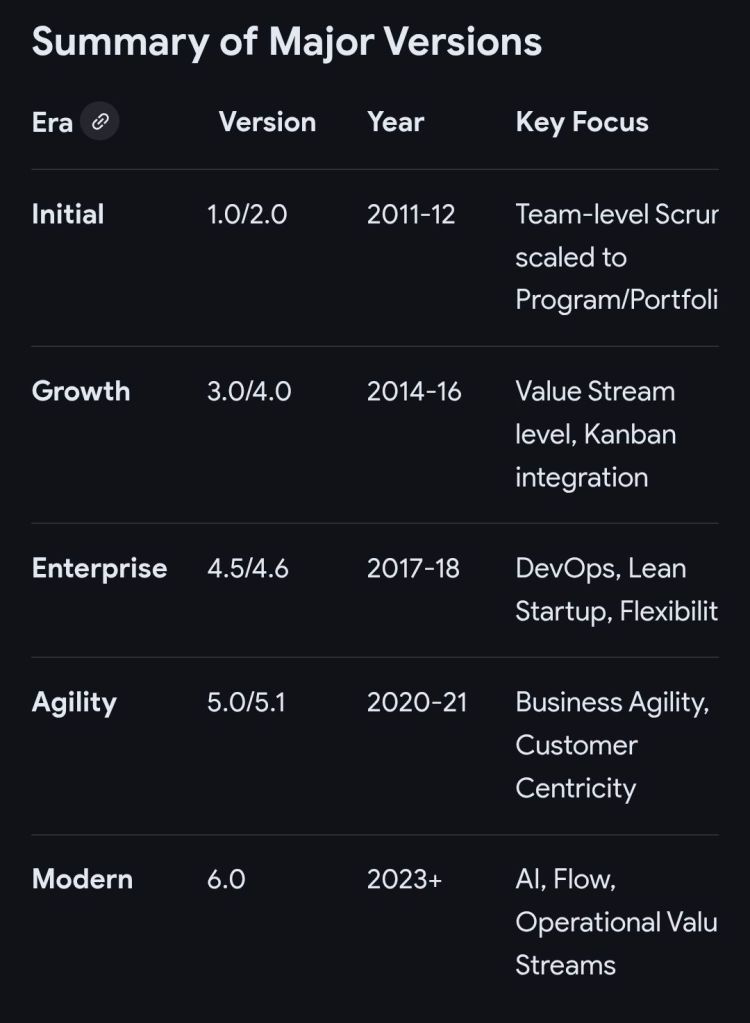
The Scaled Agile Framework (SAFe) is a set of organization and workflow patterns intended to guide enterprises in scaling lean and agile practices across large-scale software and systems development. Created by Dean Leffingwell in 2011, it combines Agile development, Lean product development, and systems thinking to enable alignment, collaboration, and delivery across hundreds or thousands of practitioners.
SAFe Project Management Summary
SAFe structures project management across multiple levels to bring agility to the enterprise:
Team Level: Scrum or Kanban teams operate in 2-week iterations (sprints) to deliver working software.
Program Level (Agile Release Train – ART): A “team of teams” (typically 50-125+ people) aligns to a common mission, planning, and releasing together on a fixed cadence, usually via Program Increments (PIs) lasting 8–12 weeks.
Portfolio Level: Aligns strategy to execution, managing investment themes (Epics) through Lean Portfolio Management.
Core Values & Principles: SAFe is grounded in 10 principles (e.g., “Take an economic view,” “Apply systems thinking”) and four core values: Alignment, Built-in Quality, Transparency, and Program Execution.
Historical Timeline by Era and Version
The evolution of SAFe tracks the growing need for business agility and faster delivery in complex organizations.
1. Foundation & Initial Concept (2007–2010)
2007–2008: Dean Leffingwell publishes Scaling Software Agility, laying the foundation for enterprise agile patterns.
2010:Agile Software Requirements is published, bridging Agile with enterprise needs.
2. The Early Years: SAFe 1.0 – 2.0 (2011–2013)
2011:SAFe 1.0 released, initially termed “Agile Enterprise Big Picture,” focusing on applying Scrum/XP at scale.
2012:SAFe 2.0 (October) released to restructure portfolio and program levels.
2013: Initial refinements to the “Big Picture” to better integrate lean principles.
3. Expansion: SAFe 3.0 – 4.0 (2014–2016)
2014:SAFe 3.0 introduced, introducing more emphasis on DevOps and faster, value-driven delivery.
2016:SAFe 4.0 launched, introducing a dedicated “Value Stream” level for larger, complex systems and enhancing Kanban adoption.
2017:SAFe 4.5 released, emphasizing Lean Startup techniques, Lean UX, and faster, more flexible “Essential SAFe” configuration.
2018:SAFe 4.6 updated to further incorporate the “Five Core Competencies of the Lean Enterprise”.
5. Business Agility Era: SAFe 5.0 – 5.1 (2020–2021)
2020:SAFe 5.0 (January) released, focusing on “Business Agility,” expanding agile principles beyond IT to the entire business (Human Resources, Finance, etc.).
2021:SAFe 5.1 introduced, with enhanced focus on distributed teams, DevOps, and Accelerate metrics.
6. AI & Continuous Learning Era: SAFe 6.0 (2023–Present)
2023:SAFe 6.0 (March) released, providing updated guidance on AI, Big Data, and Cloud technologies, while enhancing flow-based planning and accelerating value delivery.
2024/2025: Focus on “AI-Empowered” SAFe, integrating artificial intelligence into the framework’s roles and ceremonies.
SAFe Scaled Agile Framework summary and detailed historical timeline by era and year
PRINCE2 (PRojects IN Controlled Environments) is a structured, process-based project management methodology focusing on organization, control, and business justification. Originating from UK government IT standards in the 1970s, it has evolved into a globally recognized, tailorable standard used in over 150 countries for projects across various industries.
PRINCE2 Project Management Summary
Core Philosophy: Continued Business Justification (projects must make sense financially), Manage by Exception (delegating authority within limits), and Product-Based Planning.
Seven Principles: Projects must have continued business justification, learn from experience, define roles and responsibilities, manage by stages, manage by exception, focus on products, and tailor to suit the project.
Seven Processes: Starting a Project, Directing a Project, Initiating a Project, Controlling a Stage, Managing Product Delivery, Managing a Stage Boundary, and Closing a Project.
Key Themes: Business Case, Organization, Quality, Plans, Risk, Change, and Progress.
Main Benefits: Provides a common language, clear accountability, defined roles, and tailored, consistent documentation.
Detailed Historical Timeline (1975–2023+)
Era 1: The PROMPT Origins (1975–1988)
1975: Simpact Systems Ltd develops PROMPT (Project Resource Organisation Management and Planning Techniques) in response to IT projects running over time and budget. PROMPT II introduces a phased approach (Initiation, Specification, Design, Development, Installation, Operation).
Era 2: The PRINCE Birth (1989–1995)
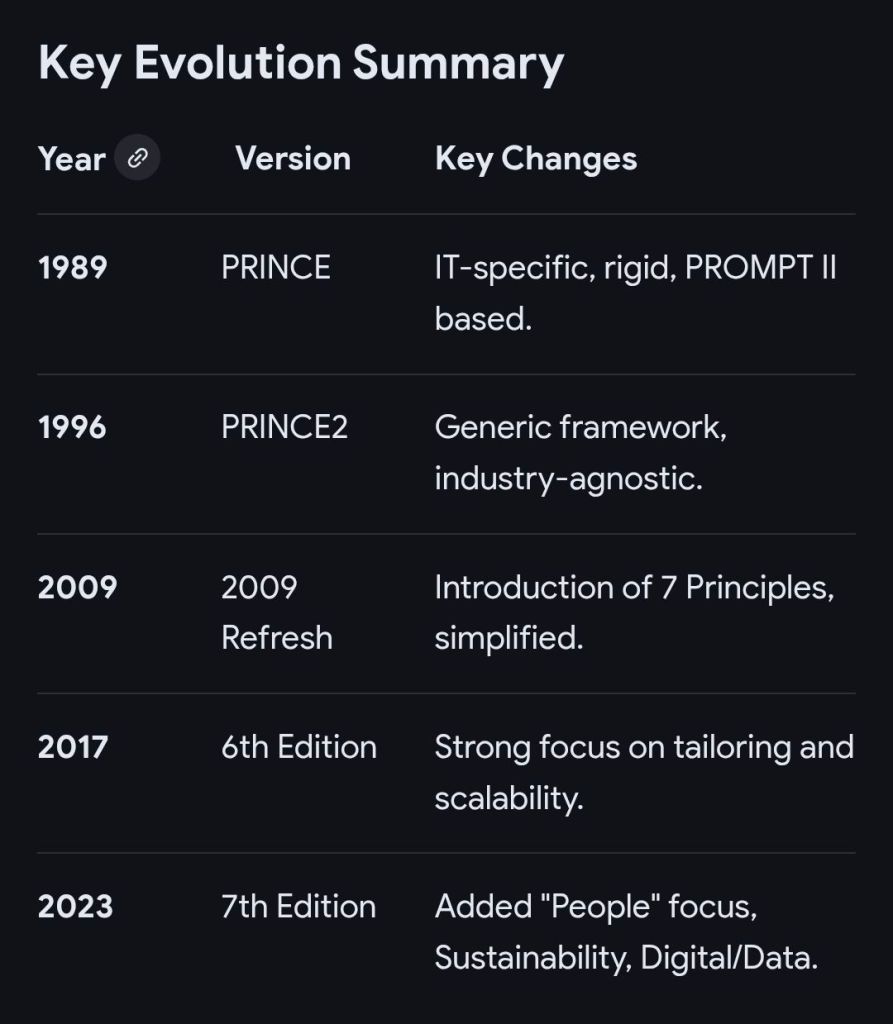
April 1989: The UK Central Computer and Telecommunications Agency (CCTA) adopts PROMPT II as the standard for IT projects, renaming it PRINCE (initially “PROMPT II IN the CCTA Environment”).
1990: PRINCE is released into the public domain and widely adopted by the private sector for non-IT projects, although it is perceived as too rigid for small projects.
Era 3: The Birth of PRINCE2 (1996–2008)
1996:PRINCE2 is published by the CCTA. It is rewritten for broader use (not just IT), removing jargon to become a generic project management framework.
1998: PRINCE2 begins undergoing revisions based on user feedback.
2000: The Office of Government Commerce (OGC) becomes the owner of PRINCE2.
2002: The international user community begins consultative updates to the method.
Era 4: The Modern Revision Era (2009–2022)
2009:PRINCE2: 2009 Refresh is released by the OGC. This major revision simplifies the method, makes it more customizable, and introduces the seven core principles.
2013: Ownership transfers from the UK Cabinet Office to AXELOS Ltd, a joint venture between the UK Government and Capita.
2017:PRINCE2 2017 Update is published, focusing on increased flexibility, scalability, and better tailoring guidance.
2018: PRINCE2 Agile is launched, bringing a governance layer to agile delivery methods like Scrum and Kanban.
2020: PRINCE2 2017 is renamed “PRINCE2 6th Edition”.
2021: PeopleCert becomes the sole owner of AXELOS and PRINCE2.
Era 5: The Current Era (2023–Present)
September 2023:PRINCE2 7th Edition is released. The update introduces a “People” element, focusing on change management and team leadership, along with new guidance on Sustainability, Commercial, and Digital & Data management.
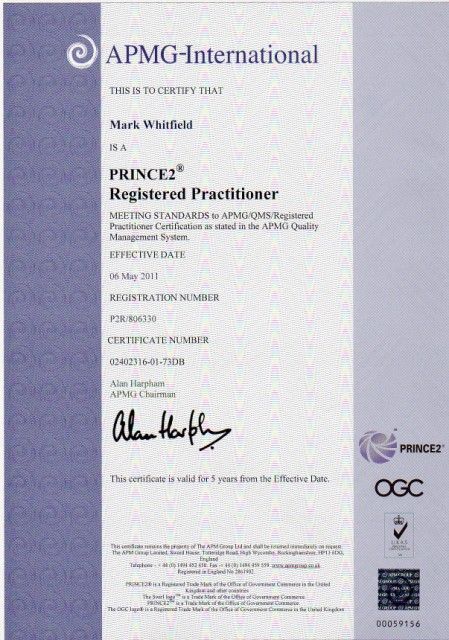
PRINCE2 Key Evolution SummaryMay 2011 – Registered PRINCE2 Practitioner with ILX, Mark Whitfield
PRINCE2 (PRojects IN Controlled Environments) Overview and Timeline by Year
Project Management Professional (PMP) history, as guided by the Project Management Institute (PMI), tracks the evolution from ancient craft systems to a modern, standardized profession combining predictive, agile, and hybrid approaches. Modern project management as a formal discipline emerged in the 1950s, with PMP certification officially launching in 1984.
Summary of Project Management Eras
Pre-1950s (Craft Era): Large-scale construction (Pyramids, Great Wall) relied on master builders, intuitive planning, and heavy labor.
1950s-1960s (Birth of Modern PM): Scheduling tools (CPM, PERT) and the Work Breakdown Structure (WBS) were developed for defense and construction.
1969-1980s (Standardization Era): PMI was founded, and the PMP certification was introduced to create a shared professional language.
1990s-2000s (Digital & Agile Era): Project software matured, the PMBOK Guide was published, and Agile techniques began reshaping software development.
2010s-Present (Hybrid & AI Era): Focus on flexibility, stakeholder management, hybrid approaches, and AI integration.
Detailed Historical Timeline
Ancient to Early 20th Century: Foundations
2570 BC: Completion of the Great Pyramid of Giza, showing advanced resource planning.
208 BC: Construction of the Great Wall of China, demonstrating large-scale logistical management.
1917: Henry Gantt develops the Gantt Chart, a cornerstone of project scheduling.
1950s-1960s: Birth of Modern Project Management
1957-1958: Development of key scheduling tools, Critical Path Method (CPM) and Program Evaluation Review Technique (PERT).
1962: WBS approach mandated by the U.S. Department of Defense.
1969:Project Management Institute (PMI) founded in Pennsylvania to standardize the profession.
1970s-1980s: Professionalization and Certification
1975: Publication of The Mythical Man-Month by Fred Brooks, identifying software project risks.
1984:First PMP certification exam administered by PMI.
1986: Takeuchi and Nonaka introduce “Scrum” as a project management style.
1987: First PMBOK Guide published as a white paper.
The PMBOK (Project Management Body of Knowledge) Guide, published by the Project Management Institute (PMI), is the globally recognized standard for project management best practices. Its evolution reflects the shift from rigid, industrial-era scheduling to flexible, value-driven, and hybrid methodologies.
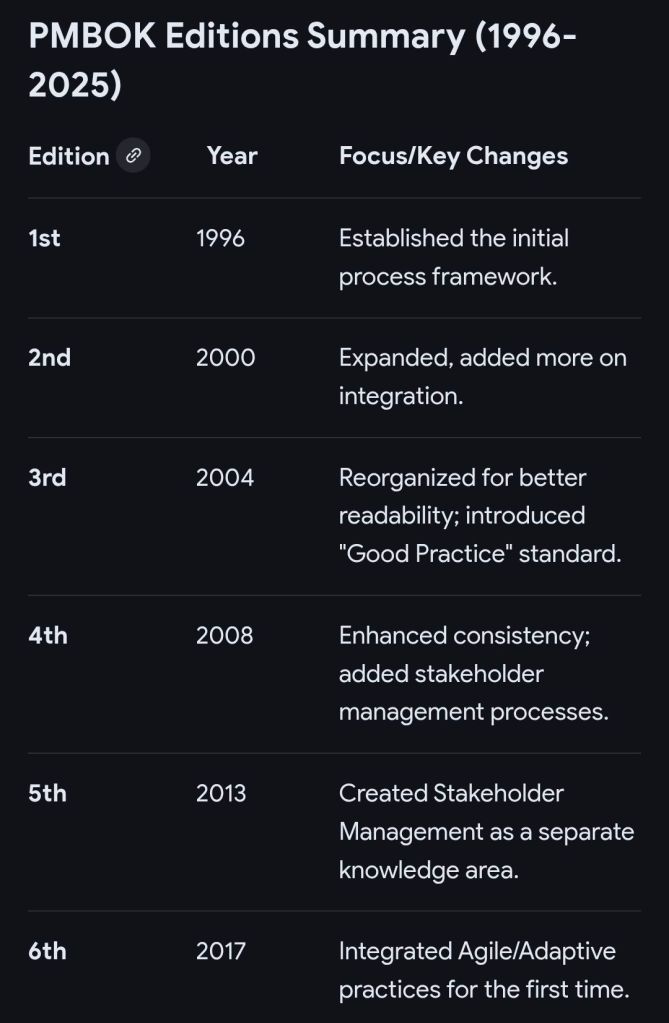
Summary of PMBOK Evolution
1980s (Origins): PMI sought to standardize knowledge, starting with a white paper in 1983 and the first “Body of Knowledge” document in 1987.
1996 (1st Edition): The first official PMBOK Guide was published, introducing a foundational process framework.
2000s (Expansion): The 2nd (2000) and 3rd (2004) editions expanded on integration and finalized the standard for project management.
2010s (Integration): The 4th (2008) and 5th (2012) editions added stakeholder management and aligned with enterprise needs. The 6th Edition (2017) formally bridged predictive (waterfall) and agile practices.
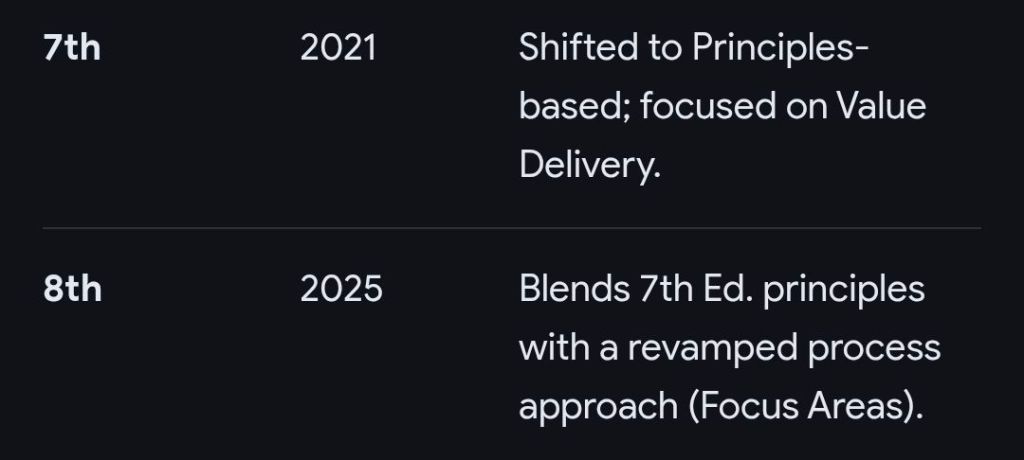
2020s (Transformation): The 7th Edition (2021) marked a massive shift from process-based to principle-based, focusing on project outcomes rather than just outputs. The 8th Edition (2025) reintroduces practical, tailored process guidance alongside principles.
Detailed Historical Timeline by Era and Year
Ancient Era to Pre-Modern (Before 1950s)
2570 BC: Completion of the Great Pyramid of Giza, requiring complex organization, planning, and control.
208 BC: Construction of the Great Wall of China, demonstrating massive, orchestrated labour management.
1917: Henry Gantt developed the Gantt chart, a foundational scheduling tool still used today.
The Foundation Era (1950s – 1960s)
1956: American Association of Cost Engineers (now AACE International) formed.
1957: Critical Path Method (CPM) invented by Dupont.
1958: Program Evaluation and Review Technique (PERT) developed by the U.S. Navy for the Polaris missile program.
1962: U.S. Dept of Defense mandated the Work Breakdown Structure (WBS) approach.
1969:Project Management Institute (PMI) founded to promote the profession and set standards.
The Formalization Era (1970s – 1980s)
1975: PROMPTII method created (later becoming PRINCE).
1984: Dr. Eliyahu M. Goldratt introduced the Theory of Constraints (TOC) in his book “The Goal”.
1986: Scrum named as a project management style.
1987:First PMBOK Guide published by PMI as a white paper, attempting to standardize practices.
The Standardization Era (1990s – 2000s)
1991: Navy A-12 Avenger II Program cancelled due to poor performance detected by EVM.
1996:1st Edition of the PMBOK Guide released, establishing it as the foundational standard.
Large-Scale Scrum (LeSS) is a product management framework designed to scale the principles and purpose of Scrum across multiple teams working on a single product. Unlike other scaling frameworks that add complex layers of management, LeSS focuses on “descaling” organisational complexity by maintaining a single Product Owner and one unified Product Backlog for up to eight teams (Basic LeSS) or thousands of people (LeSS Huge).
Historical Timeline of LeSS
The development of LeSS followed the maturation of Scrum and the need for a simplified way to apply it to large-scale, multi-site environments.
Era 1: Pre-Framework Foundation (1986–2004)
1986: The term “Scrum” is first used in a management context by Hirotaka Takeuchi and Ikujiro Nonaka in their Harvard Business Review article, “The New New Product Development Game”.
1993–1995: Jeff Sutherland and Ken Schwaber formalise Scrum as a practical software development framework.
2001: The Agile Manifesto is authored, setting the cultural stage for lightweight scaling methods.
2002: The Scrum Alliance is founded to promote and standardise Scrum training.
Era 2: Conception and Early Implementation (2005–2007)
2005: Craig Larman and Bas Vodde begin collaborating at Nokia Siemens Networks. They start combining their experiences to address the challenges of multi-site, large-scale agile development, laying the groundwork for what would become the LeSS framework.
2005–2007: The principles are tested and refined in large-scale environments at companies like Nokia, Xerox, and Siemens.
Era 3: Formalisation and Publication (2008–2015)
2008: The first major book detailing these practices, Scaling Lean & Agile Development: Thinking and Organizational Tools for Large-Scale Scrum, is published by Larman and Vodde.
2014: The official LeSS.works website is launched to provide a centralized hub for LeSS rules, principles, and guides.
2015: LeSS is increasingly recognized as a major scaling framework alongside others like SAFe and Nexus.
Era 4: Consolidation and Modern Scaling (2016–Present)
2016: The third book, Large-Scale Scrum: More with LeSS, is published, distilling the framework into its most essential rules and guides.
2017–Present: LeSS adoption expands globally into diverse sectors including finance (JP Morgan), telecom, and large-scale hardware-software systems.
2020s: Continuous evolution of “LeSS Huge” cases, showing the framework’s ability to support up to 2,500 people working on a single integrated product.
Core Principles Summary
LeSS is guided by 10 core principles that differentiate it from other frameworks:
Large-Scale Scrum is Scrum: It is not a “new” version but Scrum applied to many teams.
Empirical Process Control: Reliance on transparency, inspection, and adaptation.
More with LeSS: Scaling by removing roles and artifacts rather than adding them.
Whole-Product Focus: One Product Backlog and one Product Owner regardless of team count.
Systems Thinking: Optimising the whole system rather than individual team performance.
LeSS Large-Scale Scrum project management summary and detailed historical timeline by era and year
Lean Project Management is a strategic methodology aimed at maximizing customer value while minimizing waste, derived primarily from the Toyota Production System (TPS). It focuses on efficient workflows, continuous improvement (Kaizen), and delivering high-quality results in smaller, faster increments.
Summary of Core Principles
Define Value: Identify what the customer is willing to pay for.
Map the Value Stream: Analyze all steps required to produce the product/service and eliminate non-value-added steps (waste).
Create Flow: Ensure tasks move smoothly without bottlenecks or interruptions.
Establish Pull: Produce only what is needed, when it is needed, based on customer demand.
Seek Perfection (Kaizen): Continuously improve processes to reduce waste further.
Detailed Historical Timeline: The Evolution of Lean
The origins of Lean span from early American mass production to post-war Japanese necessity, maturing into a global management philosophy.
Era 1: Pre-Lean & Industrial Foundations (1890s–1920s)
Early 1900s: Frank and Lillian Gilbreth develop motion studies to reduce wasted movement, laying the groundwork for waste elimination.
1913: Henry Ford pioneers “Flow Production” at his Highland Park factory, combining standardized interchangeable parts with the moving assembly line to create continuous flow.
Era 2: The Birth of Toyota Production System (1920s–1945)
1924: Sakichi Toyoda invents an automatic loom (Jidoka) that stops when a thread breaks, introducing the concept of autonomation (automation with a human touch).
1937: Kiichiro Toyoda creates the automotive division of Toyota Loom Works, adopting Ford’s flow techniques while focusing on adapting to a small-demand market.
1939-1945: Wartime shortages force Japanese industry to focus on resourceful, fast production.
Era 3: Development of TPS (1945–1970s)
1948–1975: Toyota engineers Taiichi Ohno and Eiji Toyoda develop the Toyota Production System (TPS).
1950: Eiji Toyoda visits US factories but realizes they must adapt to a low-volume, high-variety environment, leading to the “supermarket” system.
1954: Just-in-Time (JIT) production is implemented, shifting production scheduling from forecasts to real demand.
1962: The TPS system is deployed across all Toyota plants.
Era 4: International Adoption & “Lean” Coined (1970s–1990s)
Hybrid Project Management (HPM) is a tailored approach that combines structured, predictive methods—most commonly Waterfall—with flexible, iterative methods like Agile to maximize efficiency, speed, and control. As organizations face increasingly complex, rapid-change environments, HPM allows for detailed upfront planning of scope and budget, while utilizing sprints for development and stakeholder feedback.
Summary of Hybrid Project Management
Definition: A blended approach merging Waterfall’s discipline with Agile’s adaptability.
Why It Emerged: To bridge the gap between rigid traditional methods and the high-speed needs of modern, often digital, projects.
Core Characteristics:
Predictive Planning: Upfront requirement gathering and high-level scheduling (Waterfall).
Adaptive Execution: Iterative development, Scrum ceremonies, or Kanban workflows (Agile).
Fit-for-Purpose: Tailoring the project lifecycle to specific organizational, technical, or regulatory needs rather than using a one-size-fits-all framework.
When to Use: Projects requiring high predictability for deliverables/compliance (e.g., infrastructure) but requiring flexibility in implementation (e.g., software).
Benefits: Increased speed, improved resource management, and higher adaptability to change.
The history of project management shows a progression from early manual techniques to structured “Golden Age” methodologies, eventually diversifying into Agile before merging into modern Hybrid approaches.
I. Pre-Modern Era (Before 1950) – The Birth of Structure
~2570 BC: Completion of the Great Pyramid of Giza, demonstrating early massive-scale planning.
1910s:Henry Gantt develops the Gantt chart, introducing visual scheduling for tasks, dependencies, and timelines.
1931: Hoover Dam project uses early scheduling techniques.
II. The “Golden Age” (1950s-1960s) – Introduction of Predictive Methods
1956: The American Association of Cost Engineers (now AACE International) is formed.
1957: DuPont Corp develops the Critical Path Method (CPM) to manage complex, repetitive projects.
1958:Program Evaluation and Review Technique (PERT) is developed by the US Navy for the Polaris missile project, focusing on handling uncertainty in task durations.
1960s: Formalization of the Waterfall method.
1962: US Department of Defense mandates the Work Breakdown Structure (WBS).
1969:Project Management Institute (PMI) is founded, establishing a standard profession.
III. The “Silver Age” (1970s-1980s) – Diversification & Lean
1970: Winston Royce publishes the first formal description of the Waterfall process.
1975: PROMPTII method created (the ancestor to PRINCE).
1978: Toyota Production System, including early Kanban and Lean principles, gains attention.
1984:Theory of Constraints (TOC) introduced by Eliyahu Goldratt.
1986: Takeuchi and Nonaka define Scrum as a new product development game.
1987: PMI publishes the first Guide to the Project Management Body of Knowledge (PMBOK Guide).
IV. The Digital Age & Agile Revolution (1990s-2000s) – Flexibility
1991: Crystal Clear Agile methodology developed.
1995: Jeff Sutherland and Ken Schwaber formalize Scrum.
2001:Agile Manifesto published, accelerating the shift toward iterative software development.
2000s: Proliferation of project management software (Microsoft Project, Jira, Asana).
V. The Hybrid Era (2010s-Present) – Tailored Integration
2010s:Hybrid Methodologies gain popularity, bridging the gap between Waterfall’s rigid structure for milestones and Agile’s flexibility for development.
2015-2018: Increased adoption of “ScrumBan” (Scrum + Kanban) and early “Agile-Waterfall” hybrid models.
2020s:COVID-19 pandemic acts as a catalyst, forcing remote work and accelerating hybrid adoption for greater resilience.
2021-2024: Shift towards “fit-for-purpose” approaches, where projects combine predictive and adaptive lifecycles based on risk and complexity.
2024: PMI data shows traditional predictive methods decreasing, while hybrid methodologies rise significantly (over 57% increase) as the dominant project management trend.
2025+: Integration of Artificial Intelligence (AI) and automated tools into hybrid frameworks to further refine efficiency.
Hybrid HPM project management summary and detailed historical timeline by era and year
Extreme Programming (XP) is a prominent, disciplined Agile software development framework designed to improve software quality and responsiveness to changing customer requirements. Developed by Kent Beck in the mid-1990s, it focuses on taking beneficial engineering practices—such as pair programming, testing, and continuous integration—to “extreme” levels.
Project Management Summary: Core XP Components
XP differs from other Agile methods by focusing intensely on technical engineering practices alongside project management techniques.
Core Values: Communication, Simplicity, Feedback, Courage, and Respect.
Key Practices: Pair Programming, Test-Driven Development (TDD), Collective Ownership, Continuous Integration, Refactoring, and Small Releases.
Project Management Focus:
The Planning Game: Combines business priorities with technical estimates to determine what to build next.
Small Releases: Frequent, working software releases (often 1–2 weeks) to gather rapid customer feedback.
On-site Customer: A customer representative works with the team to provide instant feedback and clarify requirements.
Sustainable Pace: Limiting work weeks to 40 hours to avoid burnout and maintain quality.
Detailed Historical Timeline of XP
Era 1: Origins and The Chrysler C3 Project (1993–1996)
1993: Chrysler launches the Comprehensive Compensation System (C3) project to upgrade payroll software, which struggles for years.
March 1996:Kent Beck is brought in to lead the C3 project. To salvage the project, Beck starts encouraging team members to adopt a set of technical practices he developed based on his experiences.
1996:Ward Cunningham heavily influences the development of early XP concepts, particularly the “metaphor”.
1996: The project begins adopting daily meetings, pair programming, and TDD.
Era 2: Formalization and “Embracing Change” (1997–2000)
1997: Ron Jeffries is brought in to coach the C3 team, helping solidify the practices.
1998: The term “Extreme Programming” becomes widely discussed within the Smalltalk and Object-Oriented programming communities.
October 1999: Kent Beck publishes Extreme Programming Explained: Embrace Change, formally defining the framework.
February 2000: Daimler-Benz acquires Chrysler and cancels the C3 project after 7 years of work. Despite cancellation, the methodology proved that it could produce working, high-quality software, just not fast enough to overcome the legacy backlog.
Era 3: Rise of Agile and Expansion (2001–2005)
February 2001: Kent Beck and Ron Jeffries are among the 17 developers who draft the Manifesto for Agile Software Development at Snowbird, Utah. XP is recognized as one of the foundational “Agile” methods.
2001: The first Agile Alliance conference is held. XP is considered the dominant agile methodology during this period.
2002–2003: XP gains global popularity; numerous books are published expanding on the core 12 practices.
2004: The second edition of Extreme Programming Explained is released, shifting focus from 12 rigid practices to more adaptive principles.
Era 4: Integration with DevOps and Continuous Delivery (2006–Present)
2006-2010: As Scrum gains popularity for general project management, XP practices like TDD and Pair Programming become the “standard” technical practices for high-performing teams, often blended with Scrum (ScrumXP).
2010s: The rise of DevOps and continuous delivery, which inherently requires XP practices like CI/CD (Continuous Integration/Continuous Delivery).
2020-2026: While fewer companies identify strictly as doing “XP,” its technical practices are considered essential to modern software development and are integrated into almost all Agile methodologies to ensure quality and speed.
Extreme Programming XP project management summary and detailed historical timeline by era and year
Agile project management is an iterative, incremental approach to project management that focuses on flexibility, continuous improvement, and rapid delivery of value. Unlike the linear “Waterfall” approach, Agile breaks projects into small, time-boxed cycles (sprints or iterations) to allow for frequent feedback and adaptation to changing requirements.
Summary of Agile Project Management
Core Values: Individuals/interactions over tools, working software over documentation, customer collaboration over negotiation, and responding to change over following a plan.
Key Techniques: Sprints, daily stand-up meetings, visual control (Kanban boards), and user stories.
Primary Benefits: Increased adaptability, higher quality through continuous testing, faster ROI, and better team collaboration.
Common Frameworks: Scrum, Kanban, Extreme Programming (XP), Crystal, and Dynamic Systems Development Method (DSDM).
Detailed Historical Timeline of Agile (1950s–Present)
1. The Pre-Agile Era: Iterative Roots (1950s–1980s)
Before “Agile” was a term, software pioneers experimented with iterative approaches to break away from linear, heavy-documentation processes.
1957: Gerald M. Weinberg begins experimenting with incremental development at IBM.
1968: “Conway’s Law” is coined, highlighting the impact of organizational communication on system design.
1970s: Barry Boehm proposes “Wideband Delphi,” a forerunner to modern estimation techniques like Planning Poker.
1985: Tom Gilb introduces the “Evolutionary Delivery Model” (Evo), focusing on small, incremental releases.
1986: Takeuchi and Nonaka publish “The New New Product Development Game” in Harvard Business Review, describing a rugby-like approach that inspires Scrum.
1988: Scott Schultz describes timeboxing in “Rapid Iterative Production Prototyping”.
2. The Birth of “Lightweight” Methods (1990s)
Practitioners, frustrated with the “Waterfall” approach, created new, faster methodologies, often called “lightweight” methods.
1991: James Martin releases Rapid Application Development (RAD), popularizing prototyping and iterative feedback.
1993: Jeff Sutherland, John Scumniotales, and Jeff McKenna develop the first Scrum framework at Easel Corporation.
1994: The Dynamic Systems Development Method (DSDM) is created to provide structure to RAD.
1995: Ken Schwaber and Jeff Sutherland co-present the Scrum methodology at the OOPSLA Conference.
1996: Kent Beck develops Extreme Programming (XP) at Chrysler; Jon Kern, Ivan Joseph, and Peter Coad create Feature-Driven Development (FDD).
1997: Ken Schwaber describes the “Daily Scrum”.
1998: The Chrysler Goes to Extremes case study popularizes XP practices like pair programming and three-week iterations.
3. The Agile Manifesto and Formalization (2000s)
2000: A group of 17 thought leaders meets in Oregon to discuss lightweight development, setting the stage for the Manifesto.
2001 (Feb): The 17 developers meet at Snowbird, Utah, to formulate the “Manifesto for Agile Software Development”.
2001 (Late): The Agile Alliance is formed to support the community.
2004: Ken Schwaber and Mike Beedle publish Agile Software Development with Scrum; Jim Highsmith publishes Agile Project Management.
2009: Kanban gains significant traction in the IT sector, focusing on continuous flow.
4. Mainstream Adoption and Scaling (2010s)
2010s: Real-life success metrics and case studies accompany Agile, driving adoption above 50%.
2011: The Agile Alliance holds “Agile2011” to reflect on ten years of the Manifesto.
2012-2015: Large-scale adoption accelerates, prompting the creation of frameworks like SAFe (Scaled Agile Framework) and LeSS (Large-Scale Scrum).
Kanban is a visual project management framework used to implement lean and agile methodologies, focusing on reducing waste, managing work-in-progress (WIP), and ensuring continuous, high-quality flow. Originating from Japanese manufacturing in the 1940s, it has evolved into a dominant, flexible system for knowledge work, software development, and everyday task management, characterized by “pulling” work only when capacity allows.
Summary of Kanban Project Management
Definition: “Kanban” is Japanese for “signboard” or “visual card”. It is a system for managing work as it moves through a process.
Core Principles: Visualize workflow, limit work-in-progress (WIP), manage flow, make process policies explicit, and improve collaboratively.
Key Components: Kanban Board (visual representation), Kanban Cards (work items), and Columns (workflow stages like To Do, Doing, Done).
Key Benefits: Increased visibility of bottlenecks, improved team focus, flexibility in priorities, and reduced waste (overproduction/excess inventory).
“Pull” System: Work is only started when a downstream team member “pulls” a new card, preventing overburdening.
Detailed Historical Timeline
Era 1: Roots & Conceptualization (1600s – 1930s)
1600s (Edo Period): The term “Kanban” originates, referring to signboards used by Japanese shops to attract customers and distinguish their services, representing the need to communicate content clearly.
1920s: Sakichi Toyoda, founder of Toyoda Automatic Loom Works, invents automatic looms that stop if a thread breaks, establishing the “jidoka” (automation with a human touch) principle.
1930s: Toyota releases its first automobiles, with manufacturing heavily influenced by American assembly line methods.
Era 2: Toyota Production System (1940s – 1990s)
Late 1940s:Taiichi Ohno, an industrial engineer at Toyota, develops the “Just-in-Time” (JIT) production system to minimize waste and inventory costs while increasing manufacturing efficiency.
1953: Toyota applies supermarket-style “pull” logic to its main plant machine shop, using cards to signal demand and replenish materials.
1956: Ohno visits American supermarkets and studies how shelf-stocking relies on customer demand to trigger replenishment.
1963: The Kanban system is officially implemented and adopted across all Toyota factories.
1973–1978: Ohno publishes the principles of the Toyota Production System, popularizing Lean Manufacturing.
Era 3: Transition to Knowledge Work (2000s)
2001: The Agile Manifesto is published, highlighting the need for faster software development, which Kanban later helps achieve.
2003: Mary and Tom Poppendieck publish “Lean Software Development: An Agile Toolkit,” mapping manufacturing principles to IT.
2004:David J. Anderson applies “pull system” principles to Microsoft’s XIT Sustaining Engineering group, creating the “Kanban Method”.
2005: David Anderson implements the first Kanban system for change request management at Corbis.
2007: Anderson introduces Kanban to the Agile community at the Agile 2007 conference. Karl Scotland introduces Kanban to Yahoo!.
2008: The “kanbandev” Yahoo! group is formed, fostering community development of virtual kanban systems.
Era 4: Modernization and Global Adoption (2009 – Present)
2009: Corey Ladas publishes “Scrumban,” exploring the mix of Scrum and Kanban. The first Lean Kanban conference is held in Miami.
2009 (Summer): Jim Benson begins developing Personal Kanban, applying the methodology to personal organization.
2010: Anderson publishes “Kanban: Successful Evolutionary Change for Your Technology Business”, cementing the framework in tech management.
2011: Jim Benson and Tonianne DeMaria Barry publish “Personal Kanban”.
2016:“Essential Kanban Condensed” is published by David Anderson and Andy Carmichael, distilling the method into five core practices.
2020s: Digital Kanban tools become industry standard for remote work, and adoption spreads to non-tech industries like marketing, human resources, and law.
Kanban project management summary and detailed historical timeline by era and year
Waterfall project management is a linear, sequential methodology where progress flows steadily downward through defined phases, much like a physical waterfall. In this model, each stage—such as requirements, design, implementation, and testing—must be fully completed and approved before the next one begins.
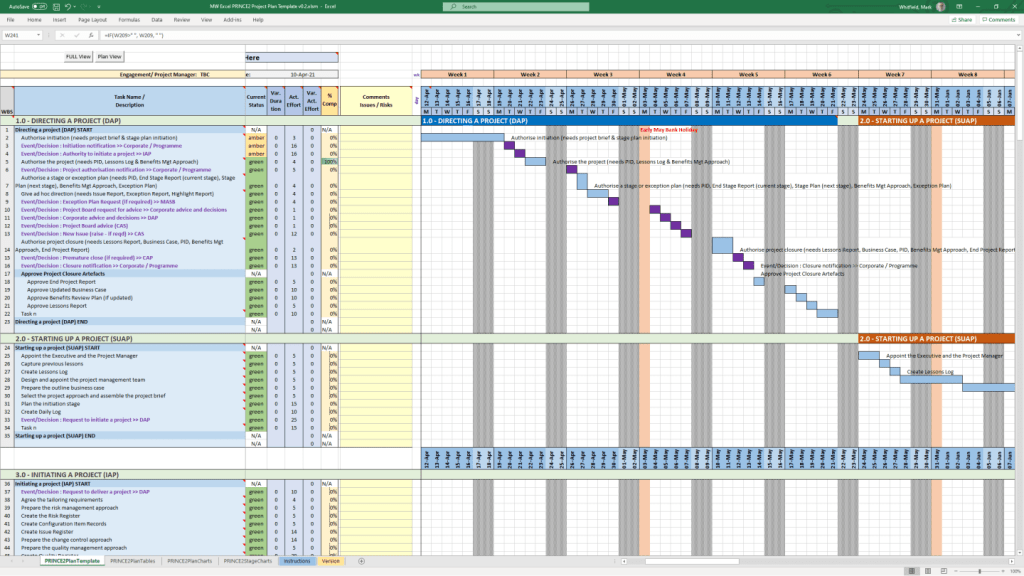
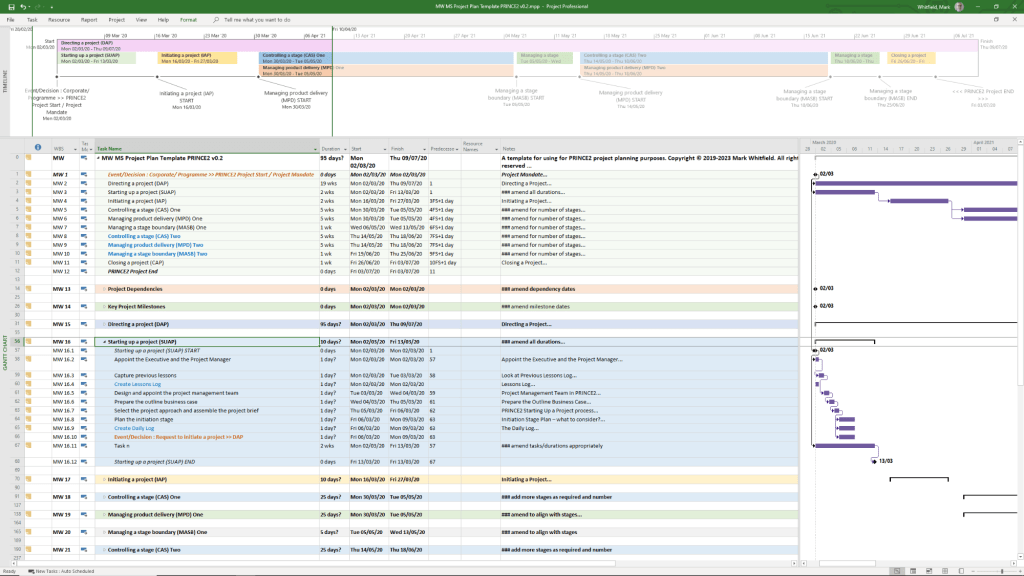
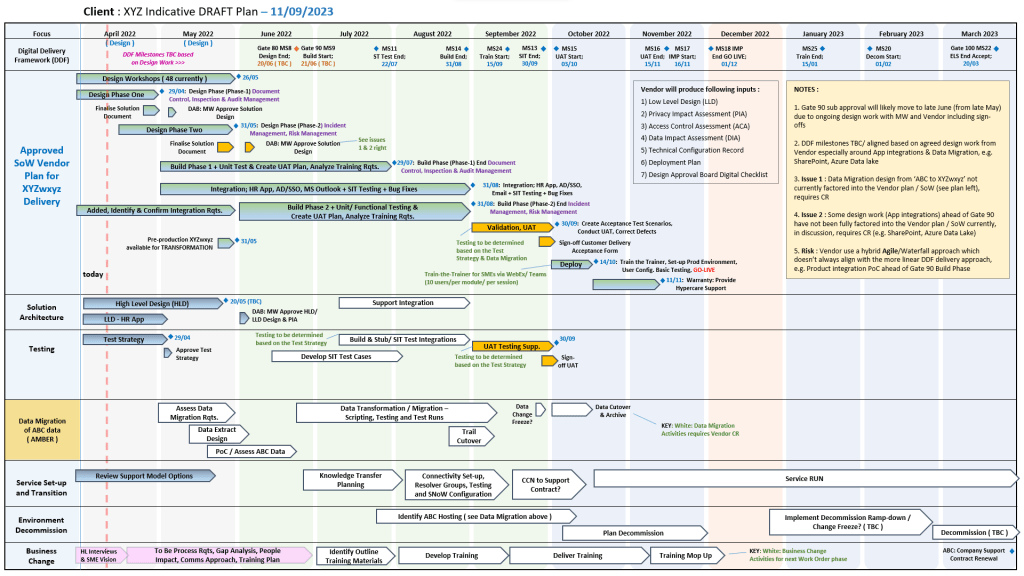
Waterfall Project Plans, .xls and .mpp file formats respectively
Core Characteristics
Sequential Design: No overlapping phases; each “cascades” into the next.
Documentation-Driven: Extensive upfront planning and detailed records are required at every step.
Fixed Scope: Requirements are gathered at the start, making the project’s timeline and budget highly predictable but difficult to change.
Specialised Use: Best suited for regulated industries like aerospace, construction, and healthcare, where changes are costly or safety is paramount.
Historical Timeline by Era and Year
The following timeline tracks Waterfall from its origins in post-WWII engineering to its current role in hybrid project management.
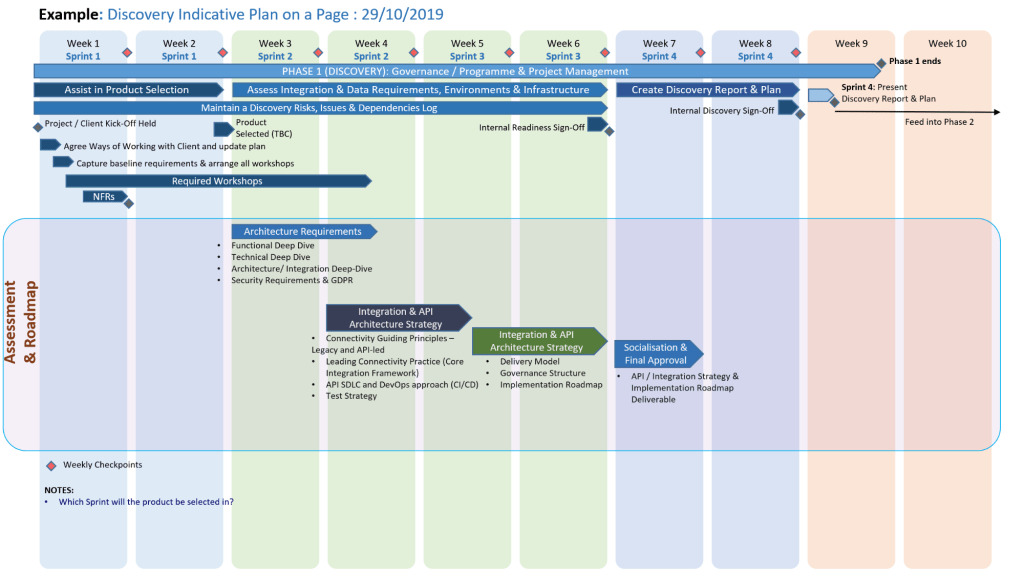
Examples, Waterfall Plan On a Page POaP in MS PowerPoint format
The Pre-Formal Era (1950s – 1969)
Software development adopted structured, sequential approaches from engineering, largely driven by complex, high-risk projects.
1956: Herbert D. Benington documented a sequential process for the SAGE project, establishing the technical roots.
Late 1960s: NASA applied linear, rigid methodologies to Apollo missions, setting a precedent for high-stakes, documentation-heavy development.
1968: The NATO Software Engineering Conference highlighted the “software crisis,” prompting a push for formal, disciplined development models.
The Formalisation Era (1970 – 1979)
The model was officially, yet ironically, described and named.
1970: Dr. Winston W. Royce published his foundational paper on managing large software systems, often cited as the origin of the “Waterfall” model, though he originally presented it as a cautionary, flawed approach.
1976: T.E. Bell and T.A. Thayer likely first used the term “Waterfall” in literature.
The Institutional Era (1980 – 1999)
Waterfall became the mandatory standard for large-scale, complex projects.
1985: The U.S. DoD mandated DOD-STD-2167, cementing Waterfall as the standard for military software.
1989: The UK Government introduced PRINCE2, deeply influenced by Waterfall principles.
1994: The U.S. DoD formally abandoned strict Waterfall mandates for more flexible methods.
The Modern & Hybrid Era (2000 – Present)
Waterfall transitioned from the default standard to a specialised methodology.
2001: The Agile Manifesto marked a shift toward iterative development, reducing Waterfall’s dominance.
Present Day: It remains vital in regulated sectors (e.g., aerospace) and is often combined with Agile in hybrid approaches.
Waterfall project management is a linear, sequential methodology
Click on the link in the website banner above to purchase example, editable template project plans shown and many others.
Oracle Forms triggers are event-handlers written in PL/SQL (originally a proprietary step-based language) that execute in response to specific events within an application, such as mouse clicks, data entry, or database transactions. They allow developers to augment or replace default processing behavior.
The evolution of Oracle Forms is defined by its transition from character-mode terminals to graphical user interfaces (GUI) and eventually to web-based and cloud architectures.
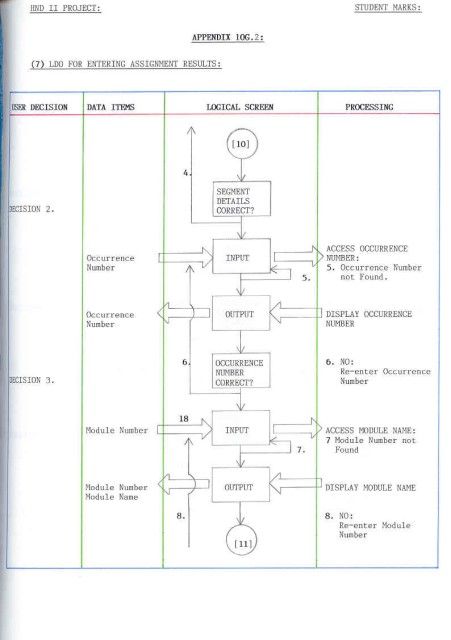
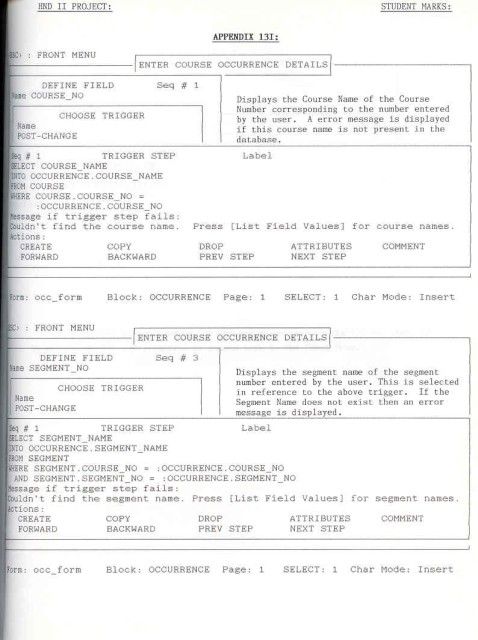
HND Oracle SQL forms design example 2, 1990
Era 1: The Character Mode & Macro Era (1979 – 1980s)
In this era, applications were designed for text-only terminals like the VT220. Logic was primitive and lacked the structural flow of modern programming.
1979 – Interactive Application Facility (IAF): The earliest form of the tool, consisting of a compiler (IAG) and a runtime interpreter (IAP).
1984 – FastForms / SQL*Forms 2.0: Renamed during the Oracle v4/v5 database era.
Trigger Detail: Triggers did not use PL/SQL. They used a proprietary language based on trigger steps. To achieve logic like an IF statement, developers had to jump between steps based on the success or failure of a SQL statement.
1987 – SQL*Forms 2.3: A significant improvement that introduced procedural capabilities via EXEMACRO CASE for more complex logic.
Era 2: The PL/SQL & GUI Revolution (Late 1980s – 1990s)
This period marked the shift toward modern programming standards and the Windows operating system.
1988 – SQL*Forms 3.0: The first version to support PL/SQL within triggers. This replaced the old step-based triggers with block-structured code.
1993 – Oracle Forms 4.0: The first true GUI-based version, supporting checkboxes, radio groups, and mouse-based interactions.
1994 – Oracle Forms 4.5: A “quantum leap” in the product’s history.
Trigger Detail: Introduced GUI-based triggers (e.g., WHEN-MOUSE-CLICK) and a modern IDE with an Object Navigator and Code Editor.
Era 3: The Web & Internet Era (Late 1990s – 2010s)
As the internet grew, Oracle pivoted to a three-tier architecture where forms ran in web browsers via Java.
1999 – Oracle Forms 6i: The ‘i’ stood for Internet. It introduced the Forms Server, allowing forms to run in a browser using a Java applet.
2002 – Oracle Forms 9i: Officially dropped support for client-server and character-mode deployment. Triggers began to support Java integration via imported Java classes.
2004 – Oracle Forms 10g: Integrated more deeply with J2EE and web services.
2009 – Oracle Forms 11g: Introduced external events and JavaScript support, allowing triggers to interact with web-based elements.
Era 4: Modern Cloud & Standalone Era (2015 – Present)
The current focus is on maintaining legacy reliability while adapting to modern infrastructure without a browser dependency.
2015 – Oracle Forms 12c: Introduced Java Web Start (JWS) and standalone modes, allowing applications to run without a parent browser.
2023 – Oracle Forms 12.2.1.19: Released with features like automatic language detection and browser-less launching (FSAL).
2024 – Oracle Forms 14.1.2: The latest stable release (skipping version 13), featuring modernized widgets and support for REST data sources.
2025/2026 – Transition Period: Long-time product advocates have left Oracle, signaling a shift toward sustaining mode where users are encouraged to modernize toward Oracle APEX.
Oracle Forms SQL triggers, event-handlers historical timeline by era
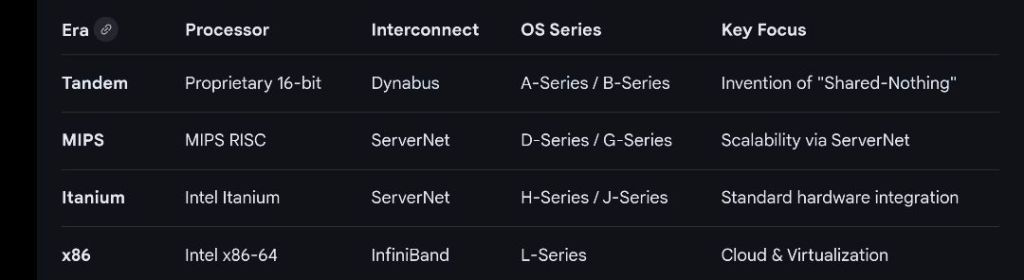
The HPE NonStop architecture is defined by its “shared-nothing” design, where every hardware and software component is redundant and operates independently to ensure 100% operational continuity. For over 40 years, it has evolved through four distinct hardware eras while maintaining upward software compatibility.
1. The Tandem Era (1974–1997): Proprietary Foundations
Architecture Approach: Founded by James Treybig, Tandem introduced the first commercial fault-tolerant system using a proprietary 16-bit stack-based architecture.
Key Technical Milestones:
1976 (NonStop I/T16): Introduced the Dynabus, a custom inter-processor backplane, and the Guardian OS, which used message-passing instead of shared memory to isolate faults.
1981–1983 (NonStop II & TXP): Introduced 32-bit addressing and the Transaction Monitoring Facility (TMF), which allowed applications to be fault-tolerant without specialized coding.
1986–1989 (VLX & Cyclone): Scaled to the mainframe market with ECL gate-array chips and the first fault-tolerant relational database, NonStop SQL.
2. The MIPS Era (1991–2004): Migration to RISC
Architecture Approach: To keep pace with industry performance, Tandem transitioned from proprietary processors to off-the-shelf MIPS RISC processors while emulating the original instruction set for compatibility.
Key Technical Milestones:
1991 (Cyclone/R): The first MIPS-based system.
1997 (Himalaya S-Series): Replaced Dynabus with ServerNet, a high-speed system interconnect that later evolved into the industry-standard InfiniBand.
Ownership Shift: Compaq acquired Tandem in 1997, and HP merged with Compaq in 2002.
3. The Itanium Era (2005–2013): HP Integrity NonStop
Architecture Approach: Branded as Integrity NonStop (NonStop i), this era moved the platform to Intel Itanium processors.
Key Technical Milestones:
2005 (NS-series/J-series): Focused on “NonStop Advanced Architecture” (NSAA), leveraging standard HP server components to lower costs while maintaining Availability Level 4 (AL4).
Technical Commentary: While powerful, the reliance on Itanium’s EPIC architecture eventually limited growth as the industry consolidated around x86-64.
4. The Modern HPE Era (2014–Present): x86-64 & Virtualization
Architecture Approach: Shifted to standard Intel x86-64 processors (NonStop X), fully decoupling the software stack from proprietary hardware.
Key Technical Milestones:
2014 (NonStop X/TNS/X): Introduced the L-series operating system. The architecture transitioned to a standard InfiniBand fabric for inter-processor communication.
2017–2020 (vNS): Launched Virtualized NonStop (vNS), allowing the environment to run on standard hypervisors like VMware, bringing fault tolerance to private and hybrid clouds.
2025 (NS9 X5): Modern systems now support up to 8 TB of RAM and are integrated into the HPE GreenLake consumption-based cloud model.
Pascal is a historically significant imperative and procedural programming language designed by Niklaus Wirth between 1968 and 1969. It was created to encourage structured programming and efficient data structuring, serving as a clean, disciplined alternative to more complex languages of the time like ALGOL 60 and FORTRAN.
Key Features and Overview
Strong Typing: Every variable must have a defined type (e.g., Integer, Real, Boolean, Char), and the compiler strictly enforces these to prevent errors during execution.
Rich Data Structures: Pascal introduced built-in support for complex types including records, sets, enumerations, subranges, and pointers.
Structured Control: It uses clear, English-like keywords such as begin, end, if-then-else, and while to organize program logic into manageable blocks.
Educational Focus: Originally intended as a teaching tool, it became the global standard for introductory computer science courses for nearly two decades.
Historical Timeline of Pascal
The Foundation Era (1960s)
1964–1966: Niklaus Wirth joins the IFIP Working Group to design a successor to ALGOL 60. His “pragmatic” proposal is rejected in favour of the more complex ALGOL 68.
1966: Wirth implements his proposal at Stanford as ALGOL W, which introduces many concepts later found in Pascal.
1968: Wirth begins designing a new language at ETH Zurich, naming it Pascal after the 17th-century mathematician Blaise Pascal.
The Emergence Era (1970–1979)
1970: The first Pascal compiler becomes operational on the CDC 6000 mainframe, and the official language definition is published.
1971: Formal announcement of Pascal appears in Communications of the ACM.
1972: The first successful port to another system (ICL 1900) is completed by Welsh and Quinn.
1973: The Pascal-P kit (P-code) is released, providing a portable intermediate code that allows Pascal to be easily ported to different hardware.
1975: The UCSD Pascal system is developed at the University of California, San Diego, eventually bringing the language to microcomputers like the Apple II.
1979: Apple releases Apple Pascal, licensing the UCSD p-System for its platforms.
The Dominance Era (1980–1989)
1983: ISO 7185:1983 is published, establishing the first international standard for Pascal.
1983: Borland International releases Turbo Pascal 1.0. Priced at $49.95, its extreme speed and integrated environment revolutionize PC programming.
1985: Apple introduces Object Pascal on the Macintosh to support object-oriented programming.
1989: Borland adds object-oriented features to Turbo Pascal 5.5, adopting the Apple Object Pascal extensions.
The Transition and Legacy Era (1990–Present)
1990: The Extended Pascal standard (ISO/IEC 10206) is released, adding modularity and separate compilation.
1995: Borland releases Delphi, a Rapid Application Development (RAD) tool based on Object Pascal, designed for the Windows graphical interface.
1997: The open-source Free Pascal compiler (originally FPK Pascal) emerges to provide a cross-platform alternative to commercial tools.
1999: Pascal is replaced by C++ as the official language for the AP Computer Science exam, marking the end of its educational dominance.
Present: Pascal remains active through projects like Lazarus (an open-source IDE for Free Pascal) and continued updates to Embarcadero Delphi for Windows, macOS, Android, and iOS development.
Pascal is a historically significant, high-level, and statically typed programming language designed in the late 1960s by Niklaus Wirth. Its primary technical goal was to encourage structured programming—a disciplined approach that uses clear, logical sequences and data structuring to make code more readable and reliable.
Technical Insights
The technical architecture of Pascal is built on a few core pillars that distinguish it from its contemporaries like C or FORTRAN:
Strong Typing: Unlike many early languages, Pascal is strongly typed, meaning data types cannot be mixed or converted without explicit instruction. This reduces runtime errors by catching type mismatches during compilation.
Block-Structured Design: Programs are organized into clear blocks (using BEGIN and END), including nested procedures and functions. This hierarchical structure allows for precise control over variable scope.
Unique Data Structures: Pascal introduced native support for sets (representing mathematical sets as bit vectors) and variant records, which allow different fields to overlap in memory to save space.
One-Pass Compilation: The strict ordering of declarations (constants, then types, then variables, then procedures) was originally designed to allow the compiler to process the entire program in a single pass.
General Programming Approach
Pascal enforces a “think before you code” philosophy through its rigid syntax and organizational requirements:
Top-Down Design: The language encourages breaking complex problems into smaller, manageable sub-tasks (procedures and functions).
Explicit Declarations: Every variable must be declared in a specific VAR section before the executable code begins. This prevents the “spaghetti code” common in earlier languages.
Algorithmic Focus: Because the syntax is so close to pseudo-code, the approach focuses heavily on the logic of the algorithm rather than language-specific “tricks”.
Parameter Passing Control: Developers have explicit control over how data moves; using the VAR keyword allows passing by reference (modifying the original variable), while omitting it passes by value (working on a copy).
Modern Relevance
While its peak in education was the 1980s and 90s, Pascal evolved into Object Pascal, which powers modern tools:
Delphi: A popular IDE by Embarcadero Technologies used for rapid application development (RAD) on Windows, macOS, and mobile.
Free Pascal (FPC) & Lazarus: Open-source alternatives that bring modern features like generics and anonymous methods to the language.



 PROject Templates