Download Templates for Project Management | FREE Upgrades & Additions
Author: Mark Whitfield
Welcome to my site!
After graduating in Computing in 1990, I accepted a position as a programmer at a Runcorn based software house specialising in electronic banking software, namely sp/ARCHITECT-BANK on Tandem Computers (now HPE NonStop). This was before the internet became more prevalent and so the notion of enabling desktop access to company accounts for inter-account transfers and book keeping was still quite a cutting edge idea (and smartphones only ever hinted at in Space 1999). The company was called The Software Partnership (which was taken over by Deluxe Data in 1994).
I spent 5 years in Runcorn developing code for SP/ARCHITECT for various banks like TSB, Bank of Scotland, Rabobank and Girofon (Denmark) to name but a few. I then moved onto a software house in Salford Quays for further bank facing projects. After a further 23 years in the IT industry and now a Senior IT Project Manager (both Agile and Waterfall delivery), I thought I would echo out my Career Profile in this corner of the internet for quick and easy access.
Critical Chain Project Management (CCPM) represents a paradigm shift in how timelines are managed, moving away from traditional task-based safety to system-wide buffers. Its history is deeply rooted in the Theory of Constraints (TOC) and evolved through four primary eras of modern project management.
The Foundations: Pre-1958
Before the formal creation of CCPM, the industry relied on “craft-based” approaches and the early Gantt Chart (1910s) to visualize task durations. During this era, projects like the Hoover Dam (1931) and the Manhattan Project proved that large-scale coordination was possible, but they lacked a systematic way to handle resource constraints or project-wide uncertainty.
The Traditional Era: 1958 – 1979
This period saw the birth of the “Critical Path,” the ancestor of the “Critical Chain.”
1957: The Critical Path Method (CPM) was invented by the DuPont Corporation to manage chemical plant maintenance.
1958: The Program Evaluation Review Technique (PERT) was developed for the U.S. Navy’s Polaris Project, introducing probabilistic task durations.
The Limitation: While these methods identified the longest sequence of tasks, they often ignored resource availability, leading to frequent delays and “multitasking” inefficiencies.
The Conceptual Era: 1980 – 1994
The theoretical seeds for CCPM were planted during the rise of the personal computer and the introduction of a new management philosophy.
1984:Dr Eliyahu M. Goldratt published his seminal business novel, The Goal, introducing the Theory of Constraints (TOC).
Core Principle: Goldratt argued that every system has at least one constraint that limits its output. Managing this “bottleneck” is the key to overall performance.
Focus Shift: Organizations began looking at “flow” rather than just individual task completion.
The CCPM Era: 1995 – Present
CCPM was formally introduced as a distinct methodology to address the failures of traditional CPM.
1997: Goldratt published the book “Critical Chain”, officially launching the method.
Key Innovations: Unlike CPM, the Critical Chain accounts for both task dependencies and resource constraints. It replaced individual task “safety margins” with:
Project Buffers: A collective time safety net placed at the end of the project.
Feeding Buffers: Placed where non-critical tasks feed into the critical chain to prevent delays.
Fever Charts: A new visual tool for tracking buffer consumption rather than just task deadlines.
Modern Integration: In the 21st century, CCPM has been integrated with Agile and Lean practices to help organizations manage multi-project pipelines and global resource pools.
Critical Chain Project Management (CCPM) timelines differ from traditional methods by shifting safety margins from individual tasks to strategic buffers at the end of the project or at integration points. This approach accounts for both task dependencies and resource constraints to determine the “Critical Chain”—the true longest path in a project.
Core Components of a CCPM Timeline
The Critical Chain: The longest sequence of dependent tasks, adjusted for resource availability.
Aggressive Task Estimates: Tasks are estimated at a 50% confidence level (how long it takes if things go well) rather than the traditional 90% (safe) estimate.
Project Buffer: A single aggregate buffer placed at the very end of the project to protect the final delivery date.
Feeding Buffers: Placed at points where non-critical task sequences (feeding chains) merge into the critical chain, preventing delays in minor tasks from affecting the main timeline.
Resource Buffers: Virtual markers or alerts placed before critical tasks to ensure that key resources (people or equipment) are ready to start exactly when needed.
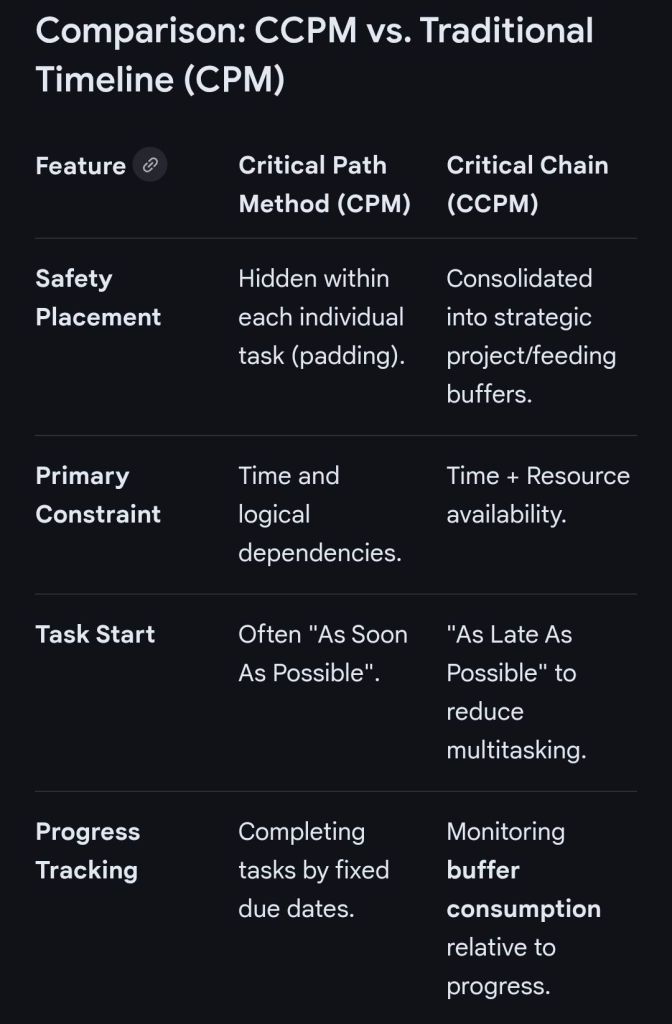
CCPM versus Traditional Timeline (CPM)
Implementing a CCPM Timeline
Identify the Critical Path: Map the logical sequence of tasks.
Level Resources: Adjust the schedule so no single resource is over-allocated, transforming the path into a Critical Chain.
Strip Task Padding: Reduce task durations by roughly 50% to eliminate “Student Syndrome” (procrastinating until the last minute).
Insert Buffers: Add a Project Buffer (typically 50% of the chain’s length) at the end and Feeding Buffers where non-critical paths merge.
Monitor via Fever Chart: Use a Fever Chart to track if the buffer is being consumed faster than tasks are being completed.
Critical Chain Project Management (CCPM) Overview and Timeline
The Critical Path Method (CPM) is a mathematical algorithm used for scheduling a set of project activities. It identifies the longest sequence of dependent tasks required to complete a project, which in turn determines the shortest possible duration to finish it.
Timeline of the Critical Path Method
The evolution of CPM is categorised into four primary eras, moving from manual mathematical foundations to modern AI-driven automation.
1. Pre-Formalisation Era (1940s – Early 1950s)
1940–1943: DuPont develops precursor techniques for scheduling that are applied to the Manhattan Project.
Early 1950s: Growing complexity in industrial plants leads to “scheduling crises,” where traditional Gantt charts are no longer sufficient for managing thousands of interdependent tasks.
2. The Development & Mainframe Era (1956 – 1969)
1956: Morgan R. Walker of DuPont and James E. Kelley Jr. of Remington Rand begin collaborative research to improve plant maintenance scheduling.
1957–1958: The duo formalises the Critical Path Method (CPM).
1958: The U.S. Navy and Booz Allen Hamilton develop the Program Evaluation and Review Technique (PERT) for the Polaris missile program; it is from this project that the term “critical path” is actually coined.
1959: The first computer-based CPM is implemented on a UNIVAC mainframe, allowing DuPont to reduce plant maintenance downtime from 125 to 78 hours.
1966: CPM is used for the first time in a massive skyscraper project for the construction of the World Trade Center Twin Towers in New York City.
3. The PC Revolution & Methodology Expansion (1970s – 1999)
1970s: Dedicated project management software companies like Oracle (then Software Development Laboratories) begin to emerge.
1984: Eliyahu M. Goldratt introduces the Theory of Constraints (TOC), which later influences the development of the Critical Chain.
1980s: The advent of the Personal Computer (PC) makes CPM accessible to smaller companies, moving it away from expensive, bulky mainframes.
1997: Eliyahu M. Goldratt introduces Critical Chain Project Management (CCPM), a more sophisticated evolution of CPM that accounts for resource constraints and buffers.
4. Modern Era: Digital Integration & AI (2000 – Present)
2000s–2010s: CPM becomes a standard feature in cloud-based tools like Asana, Wrike, and Microsoft Project, allowing for real-time schedule updates.
2020: The COVID-19 pandemic accelerates the adoption of virtual project management tools, where CPM is used to manage remote, globally distributed teams.
2025–Present:Artificial Intelligence is increasingly used to predict risks and automatically calculate “crashing” scenarios (reducing task duration to shorten the overall project) based on historical data.
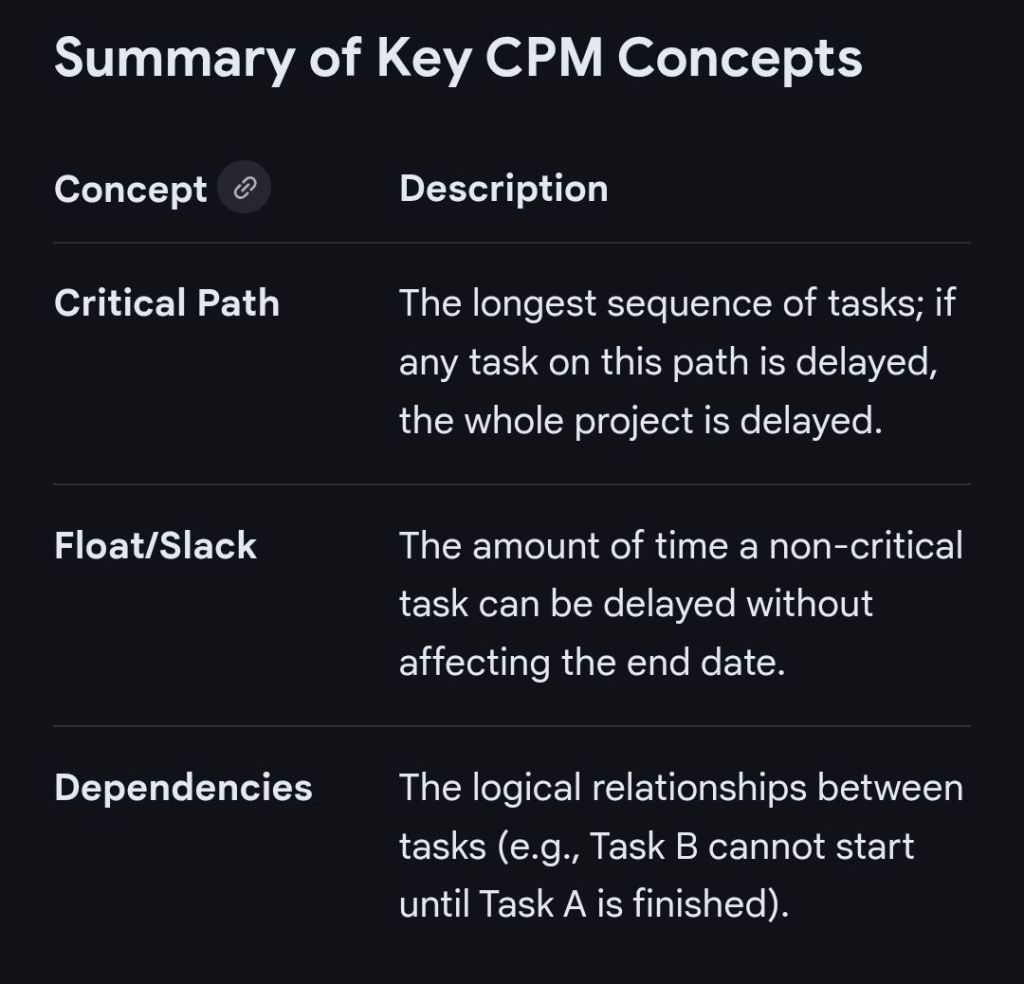
Summary of Key CPM Concepts
Critical Path Method CPM Overview and Timeline by year
The Program Evaluation and Review Technique (PERT) is a statistical project management tool designed to analyse and represent the tasks involved in completing a project. It is particularly effective for large-scale, complex, and non-routine initiatives—such as Research and Development (R&D)—where task durations are uncertain.
Overview of PERT
Purpose: To identify the critical path and the minimum time required to complete a project.
Core Mechanism: Uses a three-point estimation method for each task:
Optimistic time (O): The shortest possible time.
Most likely time (M): The most realistic duration.
Pessimistic time (P): The longest time if major setbacks occur.
Formula: The Expected Time () is calculated as .
Visualisation: Tasks are represented as nodes (circles or rectangles) and dependencies as arrows.
Timeline History by Era
The history of PERT is defined by its transition from a secretive Cold War military tool to a foundational standard in global project management.
1. The Era of Inception (1956–1959)
This era was marked by the urgent need for a massive deterrent during the Cold War.
1956: The Polaris Project (Fleet Ballistic Missile program) began, facing the immense challenge of building nuclear-powered submarines capable of launching solid-propellant missiles.
1958: PERT was officially developed by the U.S. Navy Special Projects Office, specifically by Charles E. Clark. It was initially called “Program Evaluation Research Task”.
1958: Around the same time, the Critical Path Method (CPM) was independently developed by the DuPont Corporation.
1959: The technique was renamed to “Program Evaluation and Review Technique”.
2. The Era of Expansion & Mandates (1960–1975)
During this period, PERT moved from military use into government mandates and international visibility.
1960: The Polaris program, managed via PERT, achieved its first successful underwater launch and was completed 18 months to two years ahead of schedule.
1962: The U.S. Department of Defense mandated the Work Breakdown Structure (WBS) as part of the PERT approach for all future projects of this size.
1965–1968: One of the first large-scale civilian applications of PERT occurred during the planning of the Winter Olympic Games in Grenoble, France.
Late 1960s: PERT was adopted by major public programs globally, including the UK’s nuclear power programs and Sweden’s fighter jet development.
3. The Era of Professionalization (1976–1999)
Project management began to coalesce into a formal academic and professional discipline.
1987: The Project Management Institute (PMI) published the first PMBOK Guide (Project Management Body of Knowledge), which included and standardised PERT and CPM concepts.
1989: Earned Value Management (EVM), which grew out of early PERT/Cost frameworks, became a mandatory part of U.S. government procurement.
1998: The PMBOK Guide was recognised as a standard by the American National Standards Institute (ANSI).
4. The Modern Era (2000–Present)
PERT has transitioned from hand-drawn charts to being integrated into digital ecosystems.
2000s: PERT concepts became core features in project management software (like Microsoft Project), where the math is often automated behind the user interface.
2020s: Emerging trends include AI-enhanced estimations, where machine learning algorithms analyse historical project data to generate the optimistic, pessimistic, and most likely time estimates more accurately than human experts.
Program Evaluation and Review Technique (PERT) Timeline by era and year
Henry Gantt (1861–1919) was an American mechanical engineer and management consultant who revolutionized project management by introducing visual tools to track work against time. A close associate of Frederick Taylor, he humanized “scientific management” by focusing on employee motivation and social responsibility alongside industrial efficiency.
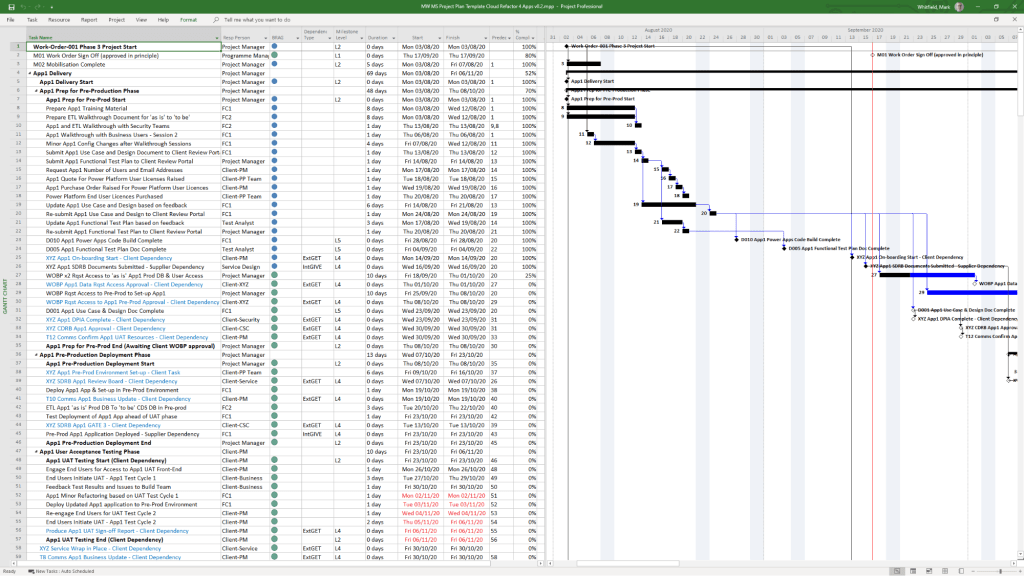
Gantt Chart in MS Project, templates can be downloaded at website banner link
Overview of Henry Gantt’s Contributions
The Gantt Chart: His most famous invention, a horizontal bar chart that illustrates a project schedule, including task durations and progress.
Task and Bonus System: A wage system that guaranteed a base rate but offered bonuses to workers who exceeded daily production goals.
Social Responsibility: He argued that businesses have a moral obligation to the welfare of the society in which they operate, not just to their owners.
Industrial Efficiency: He advocated for using scientific analysis to eliminate “chance and accidents” in manufacturing.
Comprehensive Gantt Timeline History
Era 1: Pre-Gantt & Early Origins (1765–1896)
1765: Joseph Priestley creates early timeline charts, which some consider the conceptual distant ancestors of the Gantt chart.
1896: Polish engineer Karol Adamiecki develops the “Harmonogram,” a precursor that displayed interdependent processes. However, he published it only in Polish and Russian, limiting its global recognition.
Era 2: The Henry Gantt Era (1903–1919)
1903: Henry Gantt develops his first version of a production chart for the American Locomotive Company.
1910–1915: Gantt refines and popularizes his chart through articles and his book Work, Wages and Profits (1910).
1917–1918: At the request of General William Crozier, Gantt charts are used to manage massive military production for the U.S. during World War I.
1919: Henry Gantt passes away.
Era 3: Global Adoption & Infrastructure (1920s–1970s)
1922: Wallace Clark, a colleague of Gantt, publishes The Gantt Chart: A Working Tool of Management, leading to international adoption.
1929: Walter Polakov introduces Gantt charts to the Soviet Union for their First Five Year Plan.
1931–1936: Gantt charts are used on massive infrastructure projects like the Hoover Dam and later the U.S. Interstate highway system.
1940s: Extensively used for logistics and military project management during World War II.
1950s: Become a staple in the construction and engineering industries; the first digital predecessors like PERT and Critical Path Method (CPM) emerge.
Era 4: The Digital Revolution (1980s–Present)
1980s: The advent of personal computers allows project managers to create and update charts without redrawing them by hand.
1990s: Software like Microsoft Project adds “link lines” to display complex dependencies between tasks.
2000s–2010s: Web-based and cloud-based applications (like Jira or Asana) integrate Gantt charts for real-time team collaboration.
Present: Modern tools use AI to automate chart maintenance and predict risks based on historical data.
Gantt Chart Detailed Timeline History by Era and Year
Research Machines (now RM plc) has a long-standing history as a primary provider of technology for the UK education sector. Founded in 1973, the company transitioned from a hobbyist component supplier to a leading manufacturer of educational microcomputers and networking systems.
Overview of Research Machines “LINK”
The LINK designation primarily referred to the RM Link 480Z, introduced in 1982. It was designed as a lower-cost, diskless network station that could “link” into a chain, typically using a more powerful 380Z as a file server. This system was one of three chosen for the UK government’s 1982 Educational Scheme.
Timeline History by Era and Device
The Founding Era (1973–1976)
1973: Founded as Research Machines Limited in Oxford by Mike Fischer and Mike O’Regan.
1974: Operated under the name Sintel, a mail-order supplier of electronic components for hobbyists.
The Z80 Era (1977–1984)
1977: Launched the RML 380Z, an 8-bit microcomputer based on the Zilog Z80 processor. It typically ran the CP/M operating system and was often housed in a distinctive large black metal case.
1982: Introduced the RM Link 480Z.
Purpose: Designed as a diskless network node for schools.
Networking: Used the proprietary CHAIN Network or Z-Net to connect to a 380Z file server.
Hardware: Featured a Z80 CPU and up to 256 KB of bank-switched RAM. Early models had black metal cases, later replaced by cream plastic.
The Nimbus & PC Transition (1985–1990s)
1985: Launched the RM Nimbus PC-186, using the Intel 80186 processor. While not fully IBM-compatible, it could run early versions of Microsoft Windows (up to 3.0).
1986: Released the RM AX (using the Intel 80286), often used as a file server for Nimbus networks.
Late 1980s: Introduced the M Series (PC-286/386) and S Series (PC-386 and later), which were fully IBM PC compatible.
The PC Era & Diversification (1994–Present)
1994: Floated on the London Stock Exchange as RM plc.
1997: Introduced the C Series of computers for schools.
2003: Launched the F Series (blue chassis) pre-installed with Windows XP.
2010: Released a new line of black and silver RM computers for Windows 7.
Current: RM has pivoted from hardware manufacturing to becoming a global EdTech solutions provider, focusing on digital assessment (RM Ava) and managed IT services.
Research Machines Limited, Link Timeline History by Era and Device
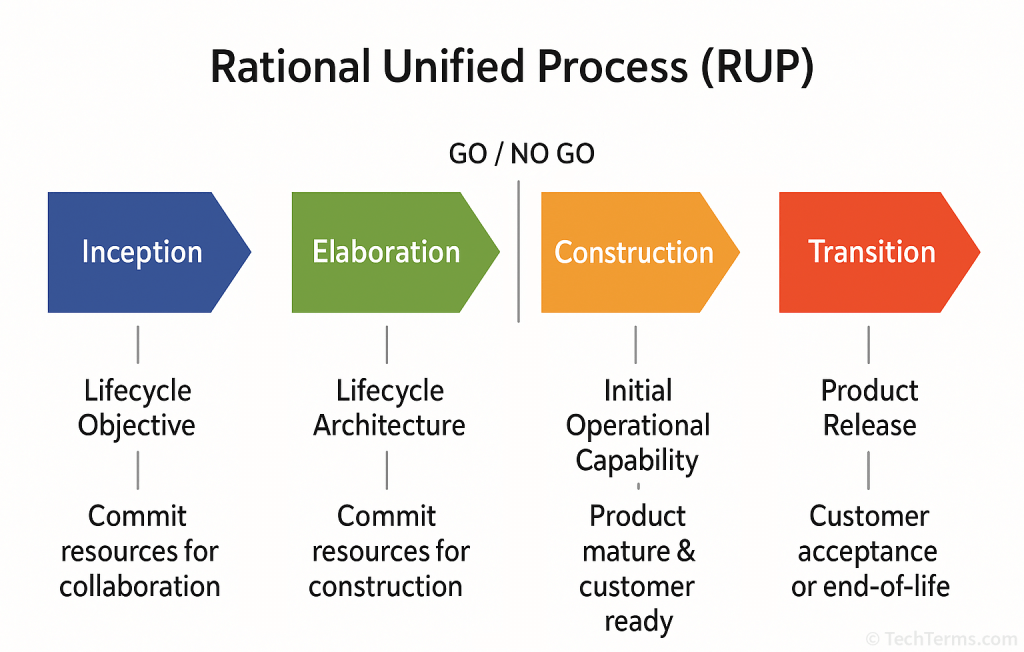
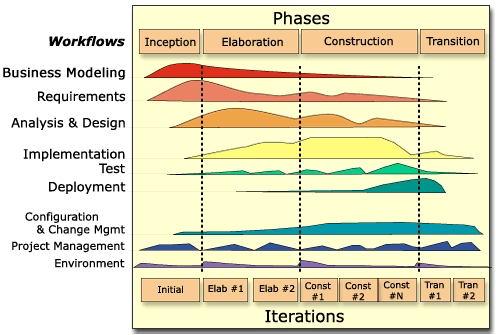
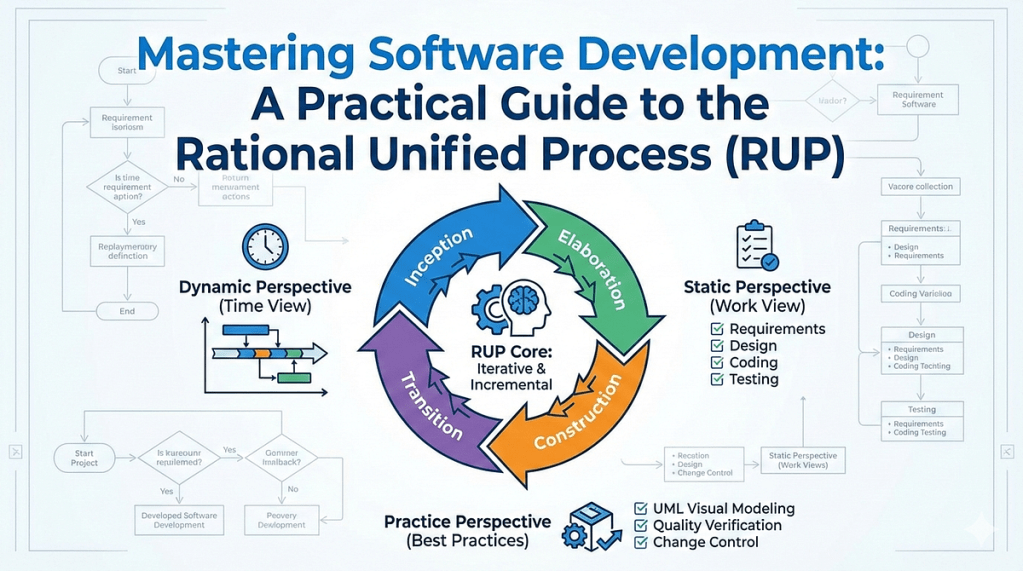
The Rational Unified Process (RUP) timeline is a two-dimensional framework where the horizontal axis represents time (divided into phases and iterations) and the vertical axis represents work/activities (divided into disciplines).
Rational Unified Process, RUP
The process is structured into four sequential phases, each culminating in a major milestone where the project’s progress is assessed before moving forward.
RUP Phases, Iterations and Workflows
RUP Project Phases and Milestones
Each phase of the RUP lifecycle has a specific objective and a corresponding milestone.
Inception Phase
Goal: Define project scope, identify business risks, and establish the Business Case.
Milestone: Lifecycle Objective Milestone – Stakeholders agree on scope and cost/schedule estimates.
Elaboration Phase
Goal: Analyze requirements in detail and design a stable Software Architecture.
Milestone: Lifecycle Architecture Milestone – The architecture is validated and major risks are mitigated.
Construction Phase
Goal: Build the software system by developing and testing all components and features.
Milestone: Initial Operational Capability Milestone – A product is ready for beta testing by users.
Transition Phase
Goal: Deploy the software to the end users and perform final Beta Testing and training.
Milestone: Product Release Milestone – The development cycle is finished and the product is formally accepted.
Detailed Iteration Timeline
Within each phase, work is performed in iterations (typically lasting 2 to 6 weeks). Each iteration is a mini-lifecycle that includes:
Requirements Analysis: Refining what needs to be built.
Design: Modeling the system architecture and components.
Implementation: Writing the code for specific features.
Testing: Verifying the quality of the iteration’s output.
Assessment: Evaluating the iteration against its planned goals.
ISO 9001 is founded on seven core Quality Management Principles (QMPs) designed to guide organisations toward improved performance and consistent quality. Its history is a progression from rigid, procedure-heavy military-style standards to flexible, risk-based management systems.
Core Principles of ISO 9001:2015
These seven principles form the foundation of the current standard:
Customer Focus: Meeting and exceeding customer expectations is the primary focus to drive loyalty and revenue.
Leadership: Leaders at all levels establish unity of purpose and direction, creating an environment where people are engaged.
Engagement of People: Competent, empowered, and engaged people across all levels are essential to enhance the organisation’s value.
Process Approach: Understanding activities as interrelated processes that function as a coherent system leads to more predictable results.
Improvement: A permanent objective of every successful organisation is the continual improvement of its performance.
Evidence-based Decision Making: Decisions based on the analysis and evaluation of data are more likely to produce desired results.
Relationship Management: Managing relationships with interested parties, such as suppliers and partners, optimizes their impact on performance.
Detailed Timeline History
The evolution of ISO 9001 can be categorised into four distinct eras:
1. The Pre-ISO Foundations (1950s – 1986)
1959: US and UK military departments establish MIL-SPECS for procurement.
1969: NATO AQAP standards are introduced for defense industry mutual recognition.
1971: The British Standards Institution (BSI) releases BS 9000 for the electronics industry.
1979: BS 5750 is published in the UK, becoming the first general-purpose quality management standard for industry.
2. The Procedural & Quality Assurance Era (1987 – 1999)
1987 (ISO 9001:1987): First international publication. Focused on quality assurance through procedural controls and final product inspections. Three models existed: 9001 (Design/Production), 9002 (Production), and 9003 (Inspection).
1994 (ISO 9001:1994): First revision. Shifted focus toward preventative actions rather than just checking finished products. However, it remained “document-heavy,” often leading to excessive bureaucracy.
3. The Process Management Era (2000 – 2014)
2000 (ISO 9001:2000): A major overhaul. Consolidated ISO 9001, 9002, and 9003 into a single standard. Introduced the Process Approach and the original eight Quality Management Principles.
2008 (ISO 9001:2008): A minor update focusing on clarification and consistency with other standards like ISO 14001 (Environment). No new requirements were added.
4. The Risk-Based & Strategy Era (2015 – Present)
2015 (ISO 9001:2015): Introduced Risk-Based Thinking and the High-Level Structure (HLS) to ease integration with other management systems. It reduced prescriptive documentation requirements, focusing instead on organisational context and leadership accountability.
2026 (Upcoming): The next major revision is currently under development (target: September 2026), expected to address digitalisation, sustainability (ESG), and climate change.
ISO 9001 Quality Assurance Detailed Timeline History by year
The history of the General Data Protection Regulation (GDPR) spans several decades, evolving from early privacy concepts to a globally adopted gold standard for data protection.
The Early Era: Foundations of Privacy (1890–1990)
1890: The “Right to Privacy” concept is first articulated in the USA by Warren and Brandeis.
1950: The European Convention on Human Rights is established, protecting the right to respect for private and family life.
1970: The German state of Hesse passes the world’s first data protection law.
1973: Sweden enacts the first national Data Protection Act.
1980: The OECD issues privacy principles to harmonise international data flows.
1981: Convention 108 is signed, becoming the first legally binding international treaty for data protection.
The Directive Era: Pre-Internet Regulation (1995–2011)
1995: The EU adopts the Data Protection Directive (95/46/EC), setting minimum standards for member states.
This resume summarizes the career of Mark Whitfield, a Senior IT Project Manager with over 30 years of experience specializing in digital and software development lifecycles, cloud migrations, and HP NonStop systems.
Core Focus: Senior Project Management for Digital/ Software Development Lifecycles (SDLC).
Expertise: Transitioning from a technical background in programming (pre-2000) to senior leadership in large-scale projects for global blue-chip companies.
Key Skills & Competencies
Methodologies: PRINCE2 Practitioner, Agile (Scrum/ Kanban), Waterfall, ITIL, ISO QA.
Project Controls: MS Project, Budget & Burn Tracking, GDPR compliance, Supplier & Stakeholder Management, Statement of Work (SoW).
Technical Proficiencies:
Platforms: HP NonStop (Tandem), Cloud Migration (Hybrid).
Languages (Historical): C/C++, Java, COBOL85, TAL, TACL, SCOBOL, SQL, MS SQL.
Utilities: PATHWAY, SCF, FUP, INSPECT, XPNET.
Professional Experience
Senior IT Project Manager (Various Projects):
Managed large-scale solutions for clients including Jaguar Land Rover (JLR), Heathrow, Royal Mail Group (RMG), NATS, and Euroclear.
Extensive work within the financial sector for Bank of England, Barclays, HSBC, Santander, Standard Chartered, Deutsche Bank, and Global Payments.
Government and public sector projects for Defra, UKEF, Welsh Water, and Scottish Water.
Early Career (Programmer / Technical Lead):
1990 – 1995: Programmer at The Software Partnership (later Deluxe Data) in Runcorn, specializing in electronic banking software (sp/ARCHITECT-BANK) on Tandem Mainframe Computers.
Education & Certifications
Degree: Higher National Diploma (HND) in Computing (Distinction, Graduated 1990).
BASIC (Beginner’s All-purpose Symbolic Instruction Code) was designed to make computing accessible to non-scientists, evolving from a simple teaching tool into the foundational language of the personal computer revolution.
The Academic Era (1964–1974)
1964: Invention at Dartmouth. John Kemeny and Thomas Kurtz created BASIC at Dartmouth College to allow students in non-technical fields to use computers.
1964: First Execution. The first BASIC program ran on 1 May 1964, on a GE-225 mainframe.
Philosophy of Simplicity. It featured an intuitive, English-like syntax and was originally a “compile-and-run” language rather than a slow interpreter.
Time-Sharing. BASIC was designed for the Dartmouth Time-Sharing System (DTSS), allowing multiple users to program simultaneously from different terminals.
The Home Computer Revolution (1975–1980s)
1975: Altair BASIC. Bill Gates and Paul Allen developed a BASIC interpreter for the MITS Altair 8800, which became Microsoft’s first product.
The “De Facto” Standard. By the late 1970s, BASIC was pre-installed in the ROM of almost every major home computer, including the Apple II, Commodore PET, and TRS-80.
Interpreted vs. Compiled. To save memory (often limited to 4KB), these versions were typically “interpreted,” meaning the computer translated code line-by-line during execution.
Hobbyist Culture. Magazines and books published “type-in” programs, allowing millions of users to learn coding by manually entering BASIC code.
The Professionalization & Decline (Mid-1980s–1990)
Structured Evolution. Microsoft released QuickBASIC (1985), which introduced structured syntax (removing the need for line numbers) and a compiler for faster performance.
Rise of C and Pascal. Professional developers began shifting toward more powerful languages like C and Pascal as hardware became capable of supporting them.
Shift to Applications. As pre-written commercial software became common, the average user stopped writing their own programs in BASIC.
The Visual & Enterprise Era (1991–Present)
1991: Visual Basic (VB). Microsoft combined BASIC with a graphical user interface (GUI) designer, allowing developers to “drag and drop” buttons and forms.
Dominance in Business. By 1998, an estimated two-thirds of Windows business applications were built using Visual Basic 6.0.
2002: Visual Basic .NET. Microsoft transitioned the language to the .NET framework, turning it into a fully object-oriented language.
Modern Status. While C# has surpassed it in popularity, VB.NET remains a stable, maintained language used heavily for maintaining legacy systems and Office automation.
BASIC programming language timeline history by year
The VAX (Virtual Address Extension) computer family, produced by Digital Equipment Corporation (DEC) from 1977 to 2000, is considered the quintessential 32-bit Complex Instruction Set Computing (CISC) architecture.
The Formative Years (1970s)
1976: Development begins on the VAX-11 architecture as a 32-bit successor to the successful 16-bit PDP-11 series.
1977: On 25 October, DEC announces the VAX-11/780 (code-named “Star”), the first system to implement the VAX architecture.
1978: The first VAX-11/780 systems ship with VMS 1.0 (Virtual Memory System).
Expansion and Innovation (1980–1984)
1980: Introduction of the VAX-11/750 (code-named “Comet”), the first LSI (Large Scale Integration) VAX.
1982: Launch of the VAX-11/730 (“Nebula”) and the dual-processor VAX-11/782 (“Atlas”).
1983: Introduction of VAXcluster technology, allowing multiple VAX systems to share storage and be managed as a single system.
1984: The VAX-11/785 and the high-end VAX 8600 (“Venus”) are introduced. This year also marks the debut of the MicroVAX I and VAXstation I, bringing VAX power to desktop workstations.
The Microprocessor Era (1985–1989)
1985: Launch of the MicroVAX II, featuring the first “VAX-on-a-chip”.
1986: Introduction of the VAX 8800 and 8200/8300 series. Local Area VAXcluster (LAVC) extends clustering to smaller workgroups.
1987: The VAXstation 2000 and MicroVAX 3500/3600 are released, the latter being the first to use the CVAX chip.
1988: Introduction of the VAX 6200 series and VMS 5.0.
1989: The VAX 9000 mainframe is announced, designed to compete directly with IBM’s most powerful systems. The MicroVAX 3100 and VAX 6000-400 are also launched.
The Transition to Alpha (1990–2000)
1990: Launch of the VAX 4000 series and the fault-tolerant VAXft 3000. DEC announces “OpenVMS”.
1991: The VAX 6000-600 is released, featuring the NVAX chip.
1992: Introduction of the VAX 7000 and 10000 series, the final high-end VAX systems. DEC begins transitioning to the 64-bit Alpha AXP architecture.
1999–2000: Sales of new VAX systems officially end, though support continues for decades.
The VAX (Virtual Address eXtension) computer family, produced by Digital Equipment Corporation (DEC), represents one of the most successful 32-bit architectures in computing history.
The Early Era: Origins and VAX-11 (1975–1984)
Designed to overcome the 16-bit memory limitations of the PDP-11, this era established VAX as the industry standard for superminicomputers.
1975: VAX 32-bit architecture first proposed.
1977: The VAX-11/780 (code-named “Star”) is introduced; it becomes the first commercially successful model and the baseline for “VAX MIPS” performance.
1980:VAX-11/750, the first 32-bit minicomputer using LSI technology.
1981:VAX-11/782, the first dual-processor VAX.
1982:VAX-11/730, the first to fit in a single cabinet.
1984:VAX-11/785 (most powerful VAX-11) and the high-end VAX 8600 are released.
The Expansion Era: MicroVAX and Workstations (1984–1989)
DEC miniaturized the architecture, bringing VAX power to desktops and departmental servers.
1984:MicroVAX I and VAXstation I introduced, bringing VAX to the workstation market.
1985:MicroVAX II (the “VAX-on-a-chip”) and VAXstation II extend performance to personal-sized systems.
1986:VAX 8200/8300 (mid-range) and VAX 8800 (high-end) introduce the VAXBI bus and dual-processor support.
1987:VAXstation 2000 and MicroVAX 3500/3600 launched.
1988:VAX 6200 series (first small systems to run Symmetric Multiprocessing) and the VAX 8840 (4-processor VAX) are released.
The Late Era: Mainframes and Transition (1989–2000)
DEC attempted to compete with mainframes while eventually transitioning to the 64-bit Alpha RISC architecture.
1989:VAX 9000 introduced as a mainframe-class machine, though its complexity led to commercial challenges.
1990:VAX 4000 series (replacing MicroVAX) and the fault-tolerant VAXft debuted.
1992:VAX 7000/10000 systems launched using the NVAX single-chip CPU; DEC introduces the 64-bit Alpha (RISC) as the successor to VAX.
1993–1996: Continued releases of VAX 4000 models (e.g., Model 705A) as legacy support.
2000: Compaq (which acquired DEC) officially announces the discontinuation of the remaining VAX models.
VAX Computer Family, Virtual Address Extension, Timeline History by year
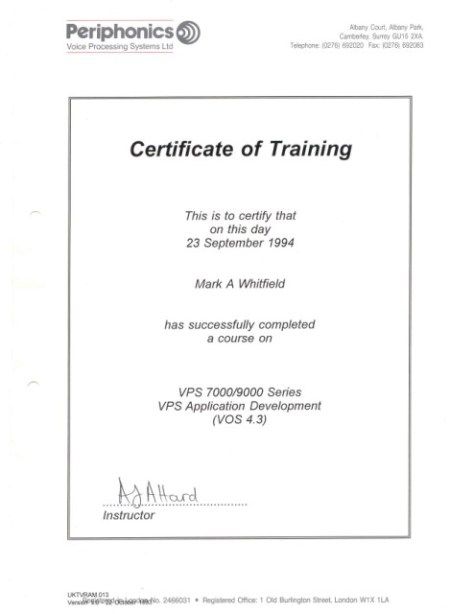
Periphonics Corporation, founded in 1969, was a pioneer in the Interactive Voice Response (IVR) industry. The company evolved from a boutique voice response manufacturer into a key subsidiary of global telecommunications giant Nortel Networks by the late 1990s.
Founding & Early Era (1969 – 1979)
1969: Periphonics Corporation is co-founded in Bohemia, New York, by S. Thomas Emerson, who served as the original CTO.
Early 1970s: The company focused on manufacturing early computerized voice response systems.
1974: S. Thomas Emerson is named “Inventor of the Year” by the U.S. Patent Office for his work in computer technology.
Expansion & Market Leadership (1980 – 1998)
1983: Periphonics deployed the first-ever voice “call tree” (IVR system).
1980s: The company became a subsidiary of Exxon Corporation during a period of diversification by the oil giant into technology.
1991: Periphonics Limited (UK) is established to expand operations into the European market.
1992: Supplied and installed voice processing systems for the Emirates Telecommunications Corporation.
1998: Launched CallSponsor CT, a major computer telephony product that integrated IVR, skills-based routing, and call blending into a single suite.
The Nortel Era & Beyond (1999 – 2009)
1999: Nortel Networks acquires Periphonics Corp for approximately $435 million to bolster its e-commerce and internet-based service offerings.
2001: Nortel rebrands the core Periphonics technology as the Nortel Speech Server.
2005: Periphonics Limited (UK division) enters a declaration of solvency and begins liquidation as part of Nortel’s broader restructuring.
2009: Following Nortel’s bankruptcy, the assets and legacy Periphonics technologies were sold off to various telecommunications firms.
Key Products Through the Eras
Early Voice Response Units (VRUs): Proprietary hardware-based systems for high-energy physics data acquisition and early banking.
IVR “Call Trees” (1983): The foundational technology for modern automated phone menus.
CallSponsor CT (1998): A turnkey “computer telephony” suite designed to reduce installation and debugging times for call centres.
Nortel Speech Server (2000s): The evolved version of Periphonics technology integrated into Nortel’s digital network infrastructure.
Periphonics Corporation, founded in 1969, was a pioneer in the Interactive Voice Response (IVR) industry
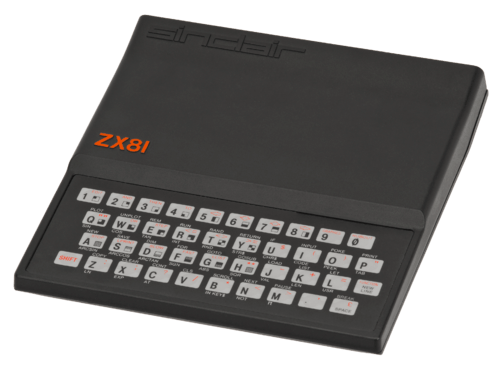
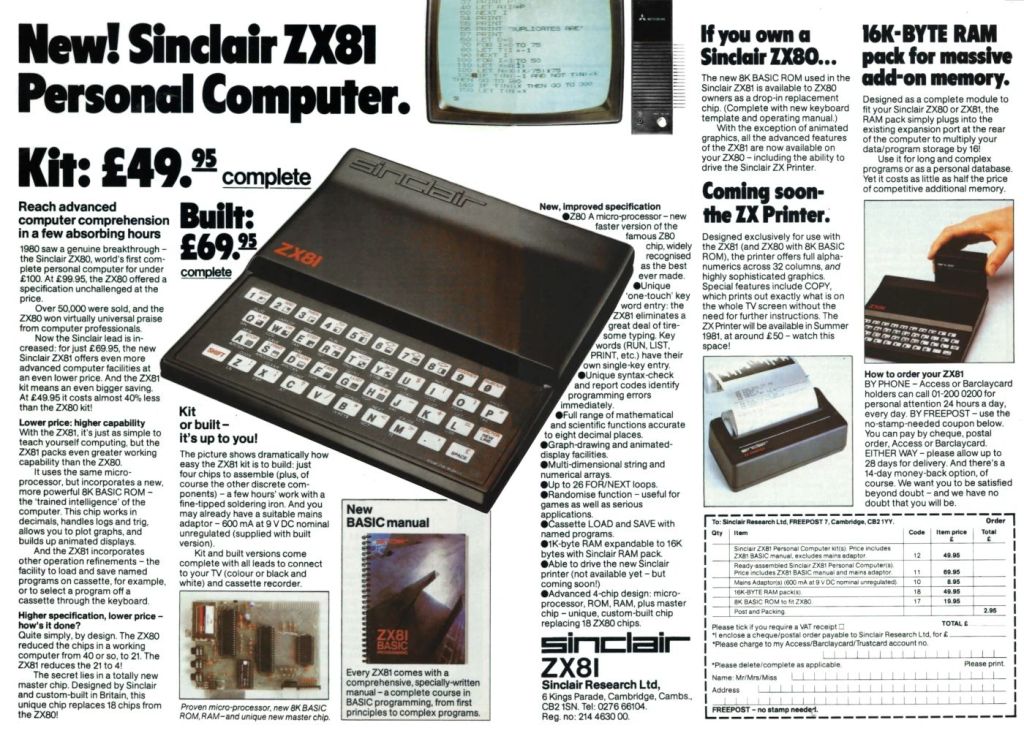
The Sinclair ZX81 was a seminal moment in home computing, launched in March 1981 as the successor to the ZX80. It was designed by Sinclair Research to be a low-cost entry point into computing, famously costing less than £70 (or £50 as a self-assembly kit).
ZX81 Home Computer
Development & Launch (1980–1981)
Autumn 1980: Most of the ZX81’s software was completed, with the remainder of the year spent writing the manual and finalizing hardware.
5 March 1981: Official UK launch at an introductory price of £49.95 for the kit and £69.95 for the pre-assembled machine.
October 1981: Launched in the United States at $149.95 assembled and $99.95 in kit form.
November 1981: The ZX Printer was released for £49.95, expanding the system’s capabilities.
ZX81 Home Computer article
Market Success & Expansion (1982)
January 1982: Over 300,000 units had been sold via mail order. American sales reached 15,000 units per month.
February 1982: Production reached 40,000 units per month to keep up with massive global demand.
July 1982: Timex Sinclair 1000 launched in the US as a licensed version of the ZX81, featuring 2KB of RAM (double the original’s 1KB).
1982 Peripheral Boom: Numerous third-party upgrades were released, including the Memopak 64K RAM expansion and various replacement “real” keyboards to solve the frustration of the original membrane design.
The Shift to Spectrum & Decline (1982–1986)
23 April 1982: Sinclair launched the ZX Spectrum, the colour-capable successor that would eventually overshadow the ZX81.
1983: Total production of the ZX81 surpassed 1.5 million units worldwide.
1984: The ZX81 was officially discontinued as Sinclair focused on the Spectrum and the ill-fated Sinclair QL.
7 April 1986: Following financial difficulties, Sinclair Research’s computer assets were sold to Amstrad for £5 million.
The timeline of the BBC Micro and the Computer Project (CLP) represents a pivotal era in British computing, moving from early industrial machines to a generation-defining home computer.
Pre-Launch & The Need for Literacy (1974–1980)
1974:Ceefax launches as the world’s first teletext service, introducing interactive TV concepts.
1978:Acorn Computers is founded in Cambridge; the BBC initiates its Computer Project to address the UK’s lack of digital preparedness.
1979: A BBC report warns that the silicon chip will radically change the workplace, prompting the need for a national awareness campaign.
1980: After the “New Brain” computer project fails to meet requirements, the BBC searches for a British manufacturer to build a custom machine.
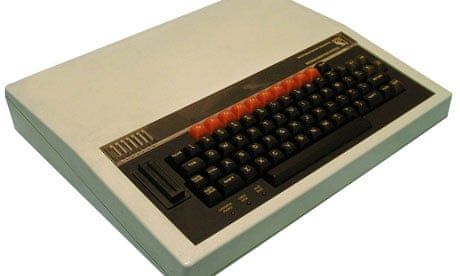
BBC Micro Home Computer
The Golden Era: The BBC Micro (1981–1985)
1981:Acorn wins the contract in March with its “Proton” prototype. The BBC Micro Model A (£299) and Model B (£399) are officially launched in December.
1982: The BBC Computer Literacy Project (CLP) formally launches with the TV series The Computer Programme. Over 500,000 machines are sold this year as the “Beeb” enters most UK schools.
1983: The Acorn Electron is launched in August as a budget-friendly home version of the BBC Micro. New series Making the Most of the Micro begins.
1984: High-speed expansion continues; 1,000 dealers operate in the US, and production reaches thousands of units per month in India and Mexico.
1985: The BBC Micro achieves its goal: at least one machine is present in every British school.
Expansion & The Move to 16-Bit (1986–1990s)
1986: Launch of the Domesday Project, a massive digital snapshot of Britain stored on Laservision discs and accessed via BBC Micros.
1987: The Acorn Archimedes is launched, introducing the revolutionary RISC architecture (the precursor to modern ARM chips).
1989: The official CLP project concludes after nearly a decade of programming and hardware releases. The domain bbc.co.uk is registered.
1997: The BBC website is established, transitioning the corporation’s digital focus from hardware to the internet.
The Modern Legacy (2016–Present)
2016: The BBC micro:bit is released—a pocket-sized, programmable computer distributed free to one million Year 7 students to continue the legacy of coding literacy.
2018: The BBC Computer Literacy Project Archive is made public, allowing users to watch old programmes and run original 8-bit software in modern browsers.
BBC Micro Home Computer and the Computer Project (CLP) timeline


 PROject Templates
