HPE NonStop architecture (Tandem Computers) by Era and Year

Mark Whitfield invested many years in the HPE NonStop field from 1990. The HPE NonStop architecture (originally Tandem Computers) is a legendary fault-tolerant system known for 100% continuous availability. The platform’s hardware and software execution evolved across six distinct eras and processor transitions:

1. The Tandem Founding Era (1976–1981)

  • Years: 1976–1981
  • Processors: Proprietary 16-bit stack processors (e.g., Tandem/16, NonStop II)
  • Architecture: The foundational “shared-nothing” parallel architecture. Featured redundant components (processors, disks, power supplies) connected by a proprietary dual-bus (Dynabus). The operating system provided instant automated failover.

2. The Cyclone & Early RISC Era (1981–1996)

  • Years: 1981–1996
  • Processors: Proprietary non-RISC (NonStop Cyclone) & MIPS R-series RISC
  • Architecture: Expanded into 32-bit computing. To keep pace with industry performance, Tandem transitioned from proprietary processors to off-the-shelf MIPS RISC processors while heavily emulating the original instruction set for compatibility.

3. The Himalaya/ServerNet Era (1997–2004)

  • Years: 1997–2004
  • Processors: MIPS R-series
  • Architecture: Replaced the legacy Dynabus with ServerNet, a high-speed system interconnect that served as an early precursor to modern networking fabrics. (Compaq acquired Tandem in 1997, which subsequently merged with HP in 2002).

4. The Integrity Itanium Era (2005–2013)

  • Years: 2005–2013
  • Processors: Intel Itanium (TNS/E)
  • Architecture: Branded as HP Integrity NonStop (NonStop i). The platform moved off proprietary silicon to standard Intel Itanium processors. This was driven by the “NonStop Advanced Architecture” (NSAA), lowering hardware costs while maintaining Availability Level 4 (AL4) standards.

5. The NonStop X (x86-64) Era (2014–Present)

  • Years: 2014–2026
  • Processors: Intel Xeon x86-64 (TNS/X)
  • Architecture: Fully decoupled the OS from proprietary hardware by shifting to standard Intel x86-64 processors and InfiniBand fabric. The latest compute nodes (such as the NS5 X5 and NS9 X5) utilize modern Intel Xeon Scalable processors to maintain maximum Availability Level 4 (AL4) workloads.

6. The Virtualized NonStop Era (Present)

  • Years: 2015–Present
  • Processors: Virtual Machines / Cloud / x86
  • Architecture: HPE extended the platform to support Virtualized NonStop Software, allowing fault-tolerant enterprise workloads to run entirely in private clouds via standard VMware or hybrid architectures, independent of specific physical servers.
HPE NonStop article by Mark Whitfield in 2013, working for Insider Technologies Limited in Salford Quays

Functional BA vs Technical BA vs Product BA

Functional BA vs Technical BA vs Product BA

While all three roles fall under the “Business Analyst” umbrella, they differ in their primary focus: Functional BAs translate business needs into user requirements, Technical BAs focus on system architecture and integration, and Product BAs drive the product’s market value and long-term strategy.

1. Functional BA (The ‘Business’ Translator)

The Functional BA acts as the primary bridge between business stakeholders and the IT delivery team. They focus on what the business needs to achieve and how users will interact with the system.

  • Core Focus: Business processes, stakeholder communication, and end-user experience.
  • Day-to-day Responsibilities: Gathering requirements, mapping out user journeys, defining acceptance criteria, and creating process flow diagrams.
  • Key Skills: Stakeholder management, requirements elicitation, and deep domain knowledge (e.g., finance, healthcare).

2. Technical BA (The ‘System’ Architect)

The Technical BA bridges the gap between the functional requirements and the software development team. They focus on how the system will be built, ensuring the proposed solution is technically feasible, scalable, and secure.

  • Core Focus: System architecture, data flow, integrations, and non-functional requirements (like performance).
  • Day-to-day Responsibilities: Defining API structures, mapping data models, documenting system interfaces, and writing complex technical user stories.
  • Key Skills: Understanding of system integrations, database structures, basic coding logic, and system-to-system communication.

3. Product BA (The ‘Value’ Strategist)

The Product BA merges business analysis with product management principles. Rather than just fulfilling requested requirements, they focus on why a product or feature should be built, ensuring it aligns with overarching company goals and delivers tangible ROI.

  • Core Focus: Product strategy, feature prioritization, market viability, and user adoption.
  • Day-to-day Responsibilities: Conducting market research, managing the product backlog, defining Key Performance Indicators (KPIs), and analyzing user feedback/metrics.
  • Key Skills: Product discovery, data analysis, competitive analysis, and strategic roadmapping.

PMBOK Guide 8th Edition

PMBOK Guide 8th Edition

The PMBOK Guide 8th Edition is an integrated, value-driven framework that bridges the high-level principles of the 7th edition with the practical, process-oriented structure of older editions. It reintroduces 40 non-prescriptive processes alongside six core principles and seven performance domains.

📚 The Structure: Two Books in One

Similar to its predecessors, the printed volume of the 8th Edition includes two integrated publications:

  1. The Standard for Project Management: An official ANSI standard that focuses on strategic alignment, value delivery systems, and global applicability.
  2. A Guide to the Project Management Body of Knowledge (PMBOK Guide): The practical handbook containing the processes, tools, techniques, and tailoring considerations.

🟢 The 6 Core Principles

The 8th Edition streamlines the 12 principles from the 7th edition into six actionable pillars designed to guide professional behavior and mindset:

  • Adopt a Holistic View: Think in terms of systems and understand how a project integrates with organizational strategy.
  • Focus on Value: Direct efforts toward long-term outcomes and net-positive benefits rather than just output production.
  • Build Accountable Leadership: Cultivate a culture of transparency, clear responsibilities, and high-performance teamwork.
  • Embed Quality: Ensure quality processes and continuous improvement are woven into every phase of the work.
  • Integrate Sustainability: Consider the long-term environmental, social, and economic impacts of project delivery.
  • Build Empowered Teams: Foster environments where team members are supported, trusted, and empowered to solve problems.

🔵 The 7 Performance Domains

These represent key areas of practice, serving as the technical “what” of your project:

  1. Governance: Setting the rules, decision frameworks, and oversight mechanisms.
  2. Scope: Defining boundaries, deliverables, and requirements.
  3. Schedule: Managing timeframes, milestones, and critical paths.
  4. Finance: Budgeting, forecasting, and cost management.
  5. Stakeholders: Managing expectations, engagement, and communications.
  6. Resources: Allocating people, equipment, and physical/material assets.
  7. Risks: Identifying, analyzing, and mitigating uncertainties.

🟠 The 40 Evolved Processes & Focus Areas

A highly praised update in the 8th edition is the return of process guidance. To offer structured “how-to” guidance without becoming rigid, the processes are grouped into five Focus Areas (replacing the traditional Process Groups):

  • Initiating
  • Planning
  • Executing
  • Monitoring & Controlling
  • Closing

Across these five focus areas, there are 40 non-prescriptive processes that detail the typical inputs, tools, techniques, and outputs (ITTOs). The guide includes explicit tailoring advice on how to adapt these processes for predictive, hybrid, and agile environments.


💡 Key Modern Additions

Reflecting over 48,000 global practitioner data points, the 8th Edition expands coverage into modern project environments:

  • Artificial Intelligence (AI): Guidance on using AI and data analytics in project management.
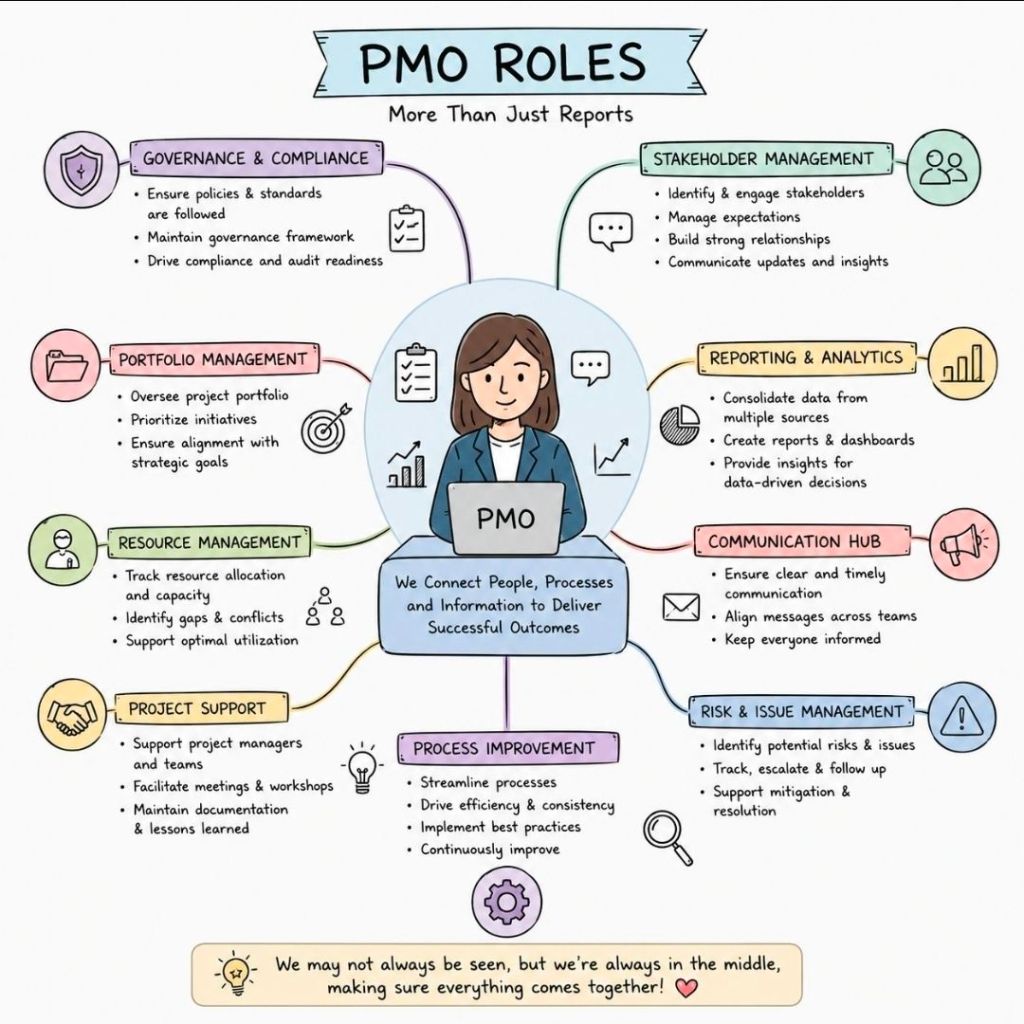
  • Project Management Offices (PMOs): Expanded focus on PMO structures and strategic value alignment.
  • Procurement & Contracting: Modernized contracting types, dispute resolution, and vendor management.

📝 PMP Exam Note

If you are planning to take the PMP exam, make sure to check the official PMI PMP Certification Overview for the most up-to-date Exam Content Outline (ECO). The exam relies heavily on the ECO, and the 8th Edition guide serves as foundational reference material.

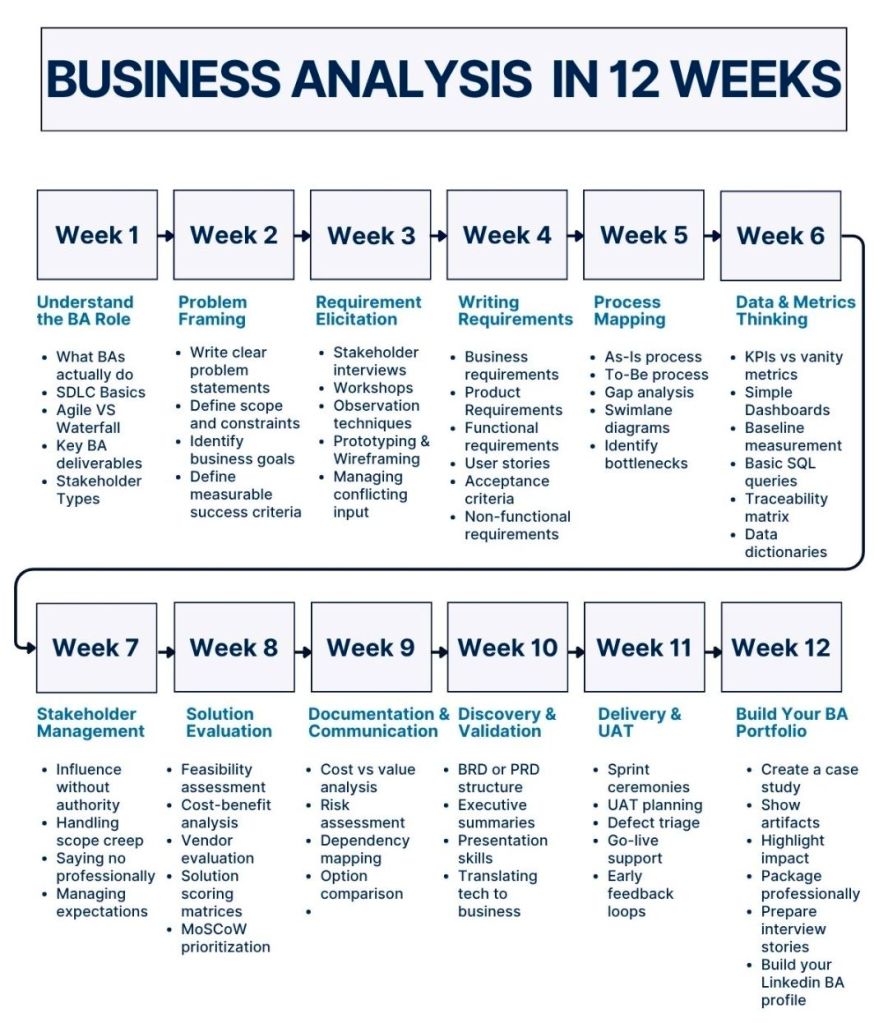
Business Analysis (BA) from week to week, across an example project

Business Analysis (BA) from week to week, across an example project

Another example;

Business Analysis (BA) across an example project—like building a custom mobile app—follows a dynamic, week-to-week lifecycle. It shifts focus from initial high-level strategy and stakeholder alignment to granular requirements, testing support, and post-launch evaluation.

Here is how a typical BA lifecycle breaks down across an example 8-week project timeline:

Week 1: Project Kickoff & Discovery

  • Focus: Understanding the business problem and setting boundaries.
  • Activities:
    • Facilitating kickoff workshops with key stakeholders.
    • Creating a Business Case or Vision Document to define the “why.”
    • Identifying key project sponsors, users, and subject matter experts (SMEs).

Week 2: Stakeholder Engagement & Elicitation

  • Focus: Extracting needs from the people who matter.
  • Activities:
    • Conducting interviews, surveys, and Focus Groups to gather initial wants and needs.
    • Mapping out high-level Business Processes (current “As-Is” workflows and future “To-Be” workflows).

Week 3: Analysis & Requirements Definition

  • Focus: Turning raw data into structured requirements.
  • Activities:
    • Writing user stories and establishing Acceptance Criteria (often using the Given-When-Then format).
    • Creating documentation like process models, wireframes, and data dictionaries.

Week 4: Prioritization & Scope Management

  • Focus: Deciding what gets built first.
  • Activities:
    • Facilitating prioritization sessions using frameworks like the MoSCoW Method (Must have, Should have, Could have, Won’t have).
    • Defining the Minimum Viable Product (MVP) to prevent scope creep.

Week 5: Backlog Refinement & Solution Design

  • Focus: Preparing work for the development team.
  • Activities:
    • Refining the product backlog alongside the Product Owner.
    • Working directly with UI/UX designers and technical architects to ensure designs align with business rules.

Week 6: Development Support & Clarification

  • Focus: Answering daily questions and unblocking the team.
  • Activities:
    • Hosting Agile ceremonies like Sprint Planning and Daily Stand-ups.
    • Clarifying edge cases and adjusting requirements if technical constraints arise during development.

Week 7: Testing & Validation

  • Focus: Ensuring the solution works and meets business needs.
  • Activities:
    • Assisting Quality Assurance (QA) teams by explaining acceptance criteria.
    • Facilitating User Acceptance Testing (UAT) with real business users to sign off on the software.

Week 8: Deployment & Post-Implementation Review

  • Focus: Launching the product and measuring success.
  • Activities:
    • Helping prepare training materials, user manuals, and release notes.
    • Conducting a Retrospective to identify process improvements for the next project phase.

Centiun is a UK-based IT consultancy and Microsoft AI Cloud Partner

Centiun is a UK-based IT consultancy and Microsoft AI Cloud Partner specializing in digital transformation, Microsoft Dynamics 365, and Power Platform solutions.

Centiun is a UK-based IT consultancy and Microsoft AI Cloud Partner

Headquartered in Cheadle, Cheshire, the company delivers expert solution architecture, implementation, and managed support to public and private sector organizations.

Executive Staff & Leadership

  • Kieran Gerard Holmes: Director and Principal Solution Architect. A senior Microsoft expert with certifications across Dynamics 365, Power Platform, and Microsoft AI.
  • Wider Consulting Team: The company is built around a close-knit, highly qualified team of Microsoft Certified Professionals (MCPs) and Solutions Architects who focus on mid-market and enterprise digital change.
NHS, End User Services

Timeline Breakdown by Year

Centiun has grown rapidly in the cloud and AI solutions space. Key milestones include:

  • 2025 (Company Foundation & Initial Certifications)
    • October 30, 2025: Centiun Limited was officially incorporated, establishing its registered headquarters at Cheadle Royal Business Park in Cheshire.
    • Late 2025: Secured nationally recognized Cyber Essentials certification and completed registration with the Information Commissioner’s Office (ICO) for secure data management compliance.
    • Late 2025: Began publishing specialized insight articles focused on legacy app modernization and driving intelligent, data-driven decisions via Microsoft Power BI.
  • 2026 (Expansion & AI Solutions)
    • Early 2026: Positioned itself as a strategic Microsoft SME partner providing personalized digital transformations, cloud migrations, and technical governance.
    • Spring 2026: Expanded consulting efforts into “Agentic Customer Experience (CX)”—advising organizations on how to implement Microsoft Copilot, AI agents, and Dynamics 365 Contact Center workflows.
    • Spring/Summer 2026: Continued to build digital footprints across public bodies, healthcare, non-profit, and financial services sectors.

To explore how their architects can assist with your Microsoft transformations, request a consultation or view their technology resources on the Centiun website.

Centiun is a UK-based IT consultancy and Microsoft AI Cloud Partner

Barclays Business Master II (BBM II), Tandem Computers (HPE NonStop) & sp/ARCHITECT

These terms map directly to the foundational 1990s technology stack behind Barclays Business Master II (BBM II), one of the UK’s earliest enterprise electronic desktop banking platforms.

Before the mainstream internet, this corporate banking infrastructure relied on specialized high-availability mainframe software to process secure corporate transactions.

🧱 Architectural Component Breakdown

  • Barclays Business Master (BBM / BBM II): A landmark corporate desktop electronic banking solution developed by Barclays Bank. It allowed businesses to dial directly into the bank to perform inter-account transfers, check balances, and automate book-keeping long before web browser banking became standard.
  • sp/ARCHITECT (or sp/ARCHITECT-BANK): The core electronic banking software package that powered BBM. It was originally engineered in the late 1980s and early 1990s by The Software Partnership (a UK-based fintech software house based in Runcorn that was later acquired by Deluxe Data). It eventually evolved into the widely known CONNEX advantage payment solution.
  • NonStop (Tandem Computers): The underlying hardware and operating system environment. Because banking infrastructure requires absolute uptime, sp/ARCHITECT was built to run on Tandem NonStop fault-tolerant computers (now HPE NonStop). These systems utilize a unique “shared-nothing” architecture to ensure zero transactional data loss.

💻 Legacy Technical Environment

During the era when BBM was deployed across Barclays’ tech hubs (such as Knutsford), developers working on this specific stack utilized highly specialized mainframe tools:

  • Languages: Code for sp/ARCHITECT was primarily written in TAL (Transaction Application Language) or COBOL85, which were native to the Tandem platform.
  • Interfaces: Early implementations integrated desktop client interactions with the Tandem host via middleware components like Tandem Pathway and Remote Server Call (RSC) facilities.

Barclays Business Master II (BBM II), Tandem Computers (HPE NonStop) & sp/ARCHITECT

I was assigned by Deluxe Data (International Operations), to the BBM II project between 1992 – 93.

mark whitfield thesoftwarepartnershipwingatehousenorthwaysmall

Deluxe Data, Wingate House, Northway, Runcorn

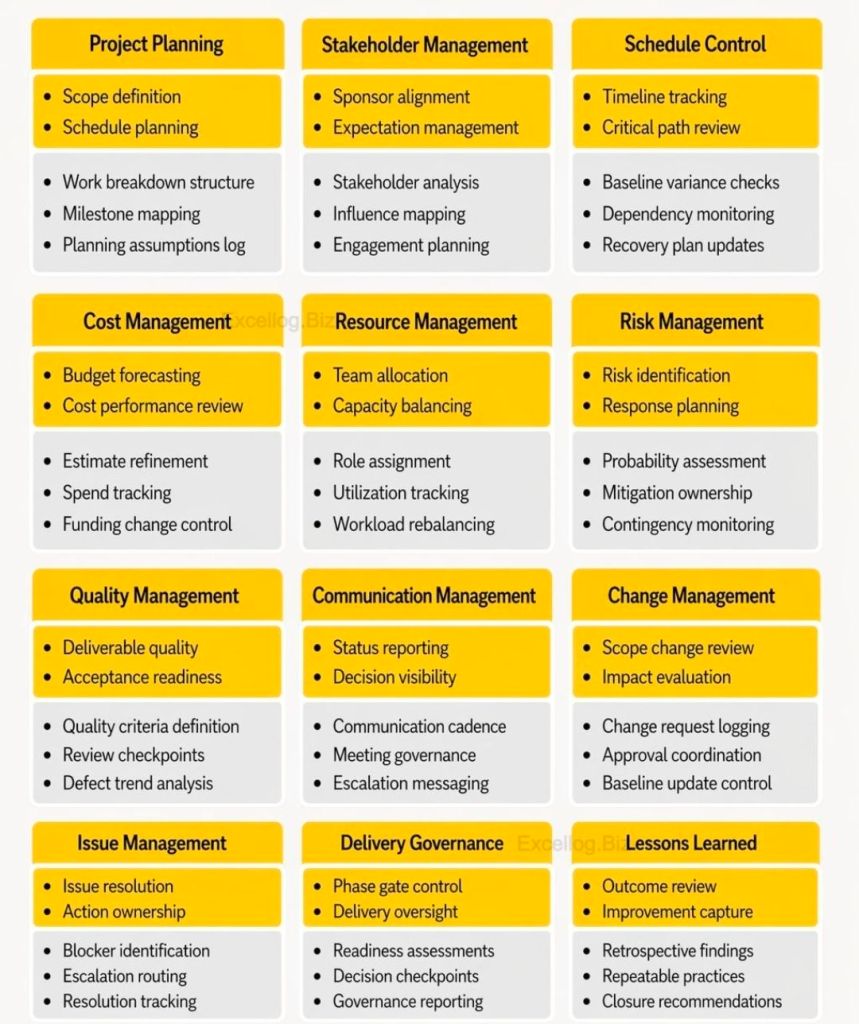
Types of Project Management for Successful Project Delivery

Types of Project Management for Successful Project Delivery

BITUG BIG SIG

The BITUG BIG SIG 2026 event is scheduled for Thursday, 4 June 2026.

Organized by the British Isles NonStop User Group (BITUG), this annual conference gathers HPE NonStop professionals, partners, and vendors across the region.

Event Details

  • Date: Thursday, 4 June 2026.
  • Location: Trinity House, London.
  • Key Focus Areas: HPE NonStop architecture roadmaps, technical breakout tracks, data security, and specialized data resiliency updates.
  • Attendees: The conference hosts end-users, system administrators, and developers, alongside community sponsors such as comforte, XYPRO, and ETI-NET.

Program Highlights

  • Breakout Tracks: Strategic vendor sessions outlining software developments and architectural security.
  • Networking: Collaborative environments allowing users to connect directly with senior HPE executives and product experts.
  • Admission: Complimentary registration is available for active end-user members. Official ticket registration and full session listings are hosted on the BITUG Big SIG Event Page.
The BITUG BIG SIG 2026 event is scheduled for Thursday, 4 June 2026.
The BITUG BIG SIG 2026 event is scheduled for Thursday, 4 June 2026

The BITUG BigSIG 2026 conference, hosted by the British Isles Tandem User Group at Trinity House, London, brings together the premier vendors within the HPE NonStop ecosystem. Key participating vendors and sponsors focus on data integration, compliance, zero-trust security, storage, and infrastructure management tailored for mission-critical enterprise systems.

The primary vendors participating in the 2026 HPE NonStop ecosystem event are organized by their specialization below.

🛡️ Data Security & Cyber Resilience

  • comforte AG: Serving as a key event sponsor, comforte AG hosts dedicated breakout sessions demonstrating tokenization strategies designed to secure sensitive data elements and enhance corporate data usability without breaking downstream application logic.
  • XYPRO Technology Corporation: A long-standing HPE NonStop security partner delivering compliance management, real-time threat detection, and risk mitigation tools. They focus heavily on enabling Zero-Trust architectures and automating compliance reporting for frameworks like PCI-DSS.
  • CSP (Compliance Systems Platforms): Specializes in vulnerability management, security hardening, and automated security compliance checking. They provide the administrative tools required to monitor audit logs and secure environments against internal and external threats.

🔄 Data Replication & Continuity

  • NTI (Network Technologies International): Presenting active strategies for multi-platform data distribution. NTI highlights methods for data movement away from legacy Oracle GoldenGate setups while integrating real-time HPE NonStop compute platforms with enterprise IT and agentic AI pipelines.
  • Gravic, Inc.: Promotes its HPE Shadowbase software line. Gravic focuses on high-availability business continuity, active-active data replication, data validation, and real-time streaming analytics for global telecommunications and financial exchanges.

💾 Backup, Storage & Infrastructure Management

  • ETI-NET: Showcases technical advancements inside its Sentinel and BackBox VTC software suites. ETI-NET’s 2026 showcase highlights immutable data tiering, object-locking architectures designed to resist ransomware, and AI/ML-driven anomaly detection within data backups.
  • TCM Solutions: Focuses on physical and virtual NonStop optimization. TCM specializes in hardware management, KVM hypervisor integrations for Virtualized NonStop environments, and transitioning infrastructure architecture over high-performance fabrics like InfiniBand.

💳 Application Modernization & Payments

  • OmniPayments: Showcases cloud-adjacent, high-volume payment processing switch architecture. They highlight transaction survivability, fraud prevention integrations, and end-to-end tokenization for multi-channel banking networks.
  • NuWave Technologies: Specializes in middleware solutions that connect HPE NonStop heritage code with modern RESTful web services. They focus heavily on API management as enterprise building blocks to quickly web-enable NonStop applications without rewriting backend logic.
  • 4tech Software: Delivers tactical operational monitoring, system auditing, and database performance management tools designed to keep NonStop SQL applications running with minimal administrative overhead.