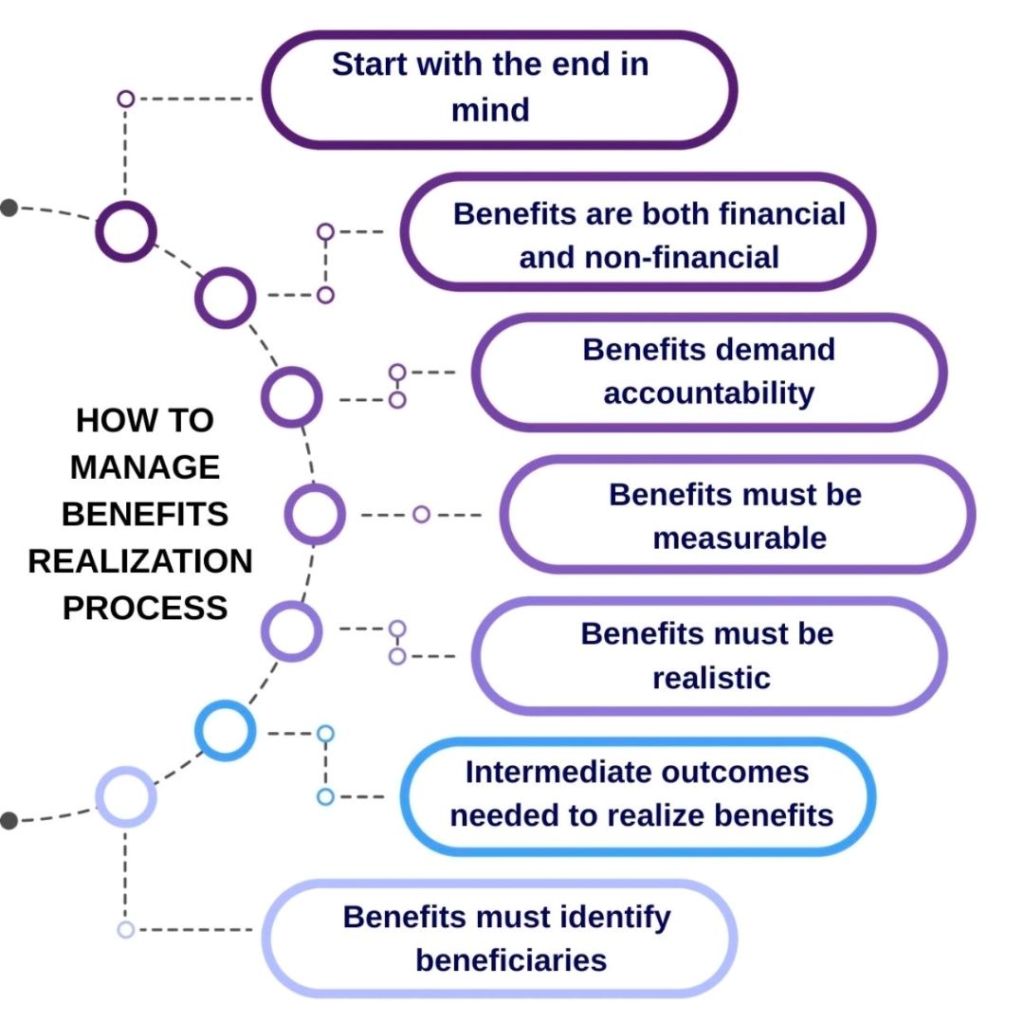
Benefits Realization Process is a structured framework
Benefits Realization Process

The benefits realization process is a structured framework used to ensure that projects and programmes deliver the tangible value and strategic outcomes intended by an organisation. Unlike traditional project management, which focuses on outputs (deliverables like a new software), benefits realization focuses on outcomes (the actual value derived, such as a 10% increase in efficiency). 

Core Stages of the Process

While various frameworks exist, most follow three or four primary stages:

  • 1. Identification: Defining the expected benefits at the start of a project. This involves aligning benefits with the organisation’s strategic goals and identifying “benefit owners” who will be accountable for their delivery.
  • 2. Planning: Developing a Benefits Realization Plan that establishes metrics, Key Performance Indicators (KPIs), and timelines for when benefits will be achieved.
  • 3. Execution & Delivery: Monitoring and managing the project to ensure it stays on track to deliver the planned benefits. This includes managing risks that could negatively impact benefit delivery.
  • 4. Sustainment & Review: Occurring post-project completion, this stage focuses on ensuring benefits are fully realized and sustained over the long term. A final review is conducted to compare actual results against the original business case

Key Components and Tools

  • Benefits Register: A central document used to track and manage all identified benefits, their owners, and their current status.
  • Benefit Profiles: Detailed records for individual benefits, describing what they are, how they will be measured, and who is responsible for them.
  • Benefit Dependency Map (BDM): A visual tool showing the links between project outputs, organizational changes, and final strategic objectives.
  • Benefit Owners: Individuals (usually from the business side) who are accountable for ensuring a specific benefit is achieved and sustained after the project team disbands. 

Why It Matters

Organizations that mature in benefits realization management are significantly more likely to meet their original goals and business intent. It bridges the gap between high-level strategy and tactical project execution, ensuring that investments translate into actual business value

Benefits Realization Process is a structured framework
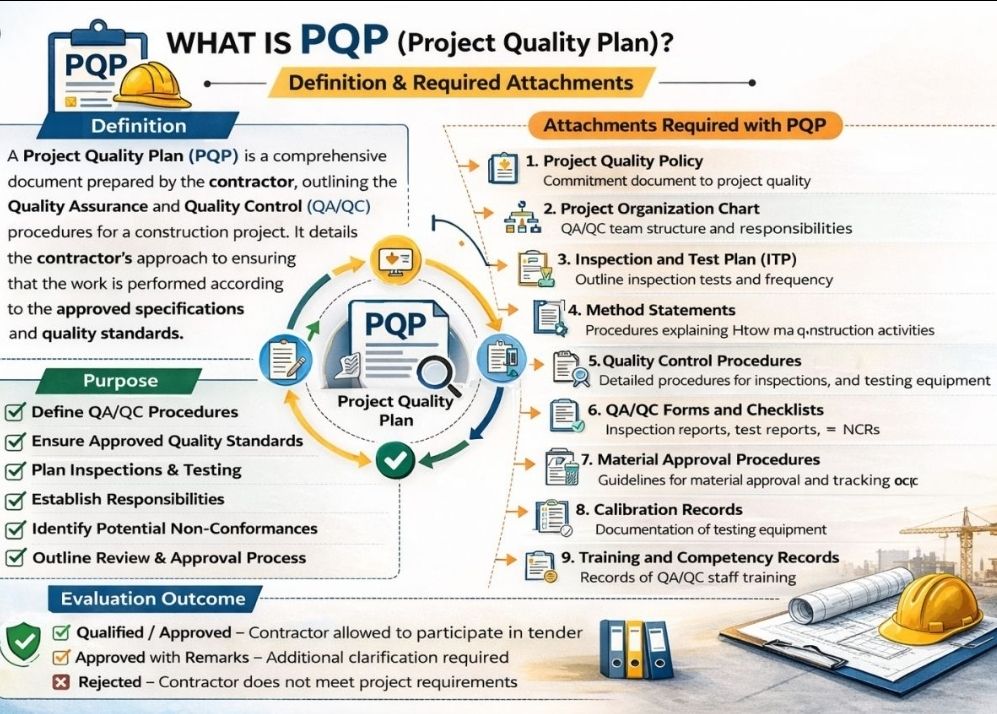
Project Quality Plan PQP in QA/QC Overview

Project Quality Plan PQP in QA/QC Overview

The primary purpose of a Project Quality Plan (PQP) is to define the standards, tools, and processes required to ensure a project’s deliverables are “fit for purpose” and meet all stakeholder expectations. It serves as a strategic roadmap for the project team to maintain consistent quality throughout the project lifecycle rather than treating it as an afterthought. 

Core Objectives

A PQP is designed to achieve several critical goals: 

  • Define “Quality”: Translates vague stakeholder needs into measurable criteria and specific benchmarks.
  • Prevent Defects: Establishes Quality Assurance (QA) processes to proactively “build in” quality from the start, reducing the risk of errors.
  • Detect and Correct Issues: Outlines Quality Control (QC) activities, such as testing and inspections, to identify and fix defects before they reach the customer.
  • Clarify Accountability: Assigns specific roles and responsibilities so every team member knows who is responsible for performing, checking, and approving work.
  • Ensure Compliance: Guarantees the project adheres to relevant internal policies, legal regulations, and industry standards like ISO 9001. 

Strategic Benefits

Implementing a structured quality plan provides tangible advantages for project management: 

  • Reduced Costs and Rework: By catching errors early, the team avoids expensive last-minute fixes and wasted resources.
  • Improved Efficiency: Standardised workflows and clear metrics allow the team to focus on production rather than constant troubleshooting.
  • Increased Stakeholder Trust: Providing objective evidence through audits and reports gives sponsors and clients confidence in the final outcome.
  • Continuous Improvement: The plan often includes feedback loops and lessons-learned processes to refine and enhance quality for future project phases.

Project Quality Plan PQP in QA/QC Overview

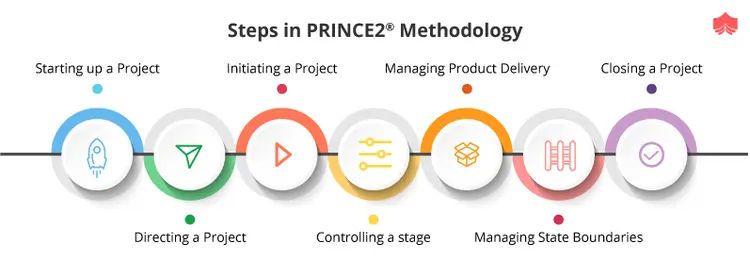
PRINCE2 Management Stages Overview

In PRINCE2, a project is managed through a series of management stages, which are discrete sections of a project that the Project Board authorises at specific decision points. Every PRINCE2 project must have at least two stages: an initiation stage and at least one further delivery stage

PRINCE2 Management Stages Overview

A detailed breakdown of these stages, aligned with the seven core PRINCE2 processes, is provided below. 

1. Starting Up a Project (SU)

This is a pre-project process designed to determine if the project is viable and worthwhile before committing significant resources. 

  • Key Activities:
    • Appointing the Executive and Project Manager.
    • Developing an Outline Business Case.
    • Creating a Project Brief which defines objectives and scope.
    • Planning the initiation stage itself. 

2. Initiating a Project (IP)

This represents the first management stage of the project. It establishes the firm foundation for the project’s execution. 

  • Key Activities:
    • Creating the Project Initiation Documentation (PID), which includes the full Business Case, Project Plan, and management strategies for risk, quality, and communication.
    • Setting up project controls and refining the project approach.
    • Securing formal approval from the Project Board to proceed. 

3. Directing a Project (DP)

This is an ongoing process that spans the entire project lifecycle, focusing on high-level decision-making by the Project Board. 

  • Key Activities:
    • Authorising the project to start and approving each subsequent stage.
    • Giving ad hoc direction and advice to the Project Manager.
    • Making the final “stop/proceed” decisions at stage boundaries.

4. Controlling a Stage (CS)

This covers the day-to-day management of each delivery stage by the Project Manager. 

  • Key Activities:
    • Assigning work to teams via Work Packages.
    • Monitoring progress and managing risks and issues.
    • Reporting status to the Project Board through Highlight Reports

5. Managing Product Delivery (MP)

This process manages the link between the Project Manager and the Team Managers who are actually building the products

  • Key Activities:
    • Teams accepting and executing Work Packages.
    • Ensuring work meets the specified quality standards.
    • Delivering completed and tested products back to the Project Manager. 

6. Managing a Stage Boundary (SB)

This occurs at the end of each stage (except the final one) to help the Project Board decide whether to continue. 

  • Key Activities:
    • Reporting on the performance of the current stage.
    • Creating a detailed Stage Plan for the next stage.
    • Updating the overall Project Plan and Business Case with the latest information. 

7. Closing a Project (CP)

This is the final part of the last management stage, ensuring the project is shut down in a controlled manner. 

  • Key Activities:
    • Confirming all products have been accepted by the customer.
    • Capturing Lessons Learned for future projects.
    • Preparing an End Project Report to evaluate performance against the original plan.

PRINCE2 Management Stages Overview

Jackson Structured Programming (JSP) Timeline  by year

Jackson Structured Programming (JSP) was developed by British software consultant Michael A. Jackson to provide a rigorous, data-driven alternative to the intuitive “top-down” methods prevalent in the 1970s. Its evolution is characterized by a transition from micro-level program design to macro-level system architecture. 

The Early 1970s: Foundation and Invention

  • 1970: Michael Jackson founded his firm, Michael Jackson Systems Limited, to fully develop a new program design methodology.
  • 1974: The name Jackson Structured Programming (JSP) was coined by the company’s Swedish licensee.
  • 1975: Jackson published the seminal book Principles of Program Design, which formally documented the JSP method and is now considered a classic. 

The Late 1970s: Standardisation and Expansion

  • 1977: JSP reached global recognition, being taught in universities and used across Europe, the US, and Asia.
  • Government Adoption: The UK government adopted JSP as its standard program design method under the name SDM (System Development Methodology).
  • Industry Use: Large organisations like the World Health Organization (WHO) began using JSP as a standard for specifying programs. 

The 1980s: Evolution into System Development (JSD)

  • 1980: Jackson published JSP, A Practical Method of Program Design, further refining the technique for practical industry use.
  • 1982–1983: Jackson, along with John Cameron, introduced Jackson System Development (JSD). While JSP focused on individual programs, JSD expanded these principles to entire systems.
  • Integration: JSD was widely incorporated into the UK’s SSADM (Structured Systems Analysis and Design Method), specifically for entity and event modelling. 

The 1990s to Present: Legacy and Modern Relevance

  • 1990s: Jackson introduced his third major method, Problem Analysis (or the Problem Frames Approach), focusing on requirements and software specifications.
  • Legacy: While JSP has faded from mainstream daily practice due to the rise of Object-Oriented Programming, its core concepts—like deriving program structure from data structures—influenced modern practices like Event Storming in Domain-Driven Design (DDD). 

Jackson Structured Programming (JSP) Timeline  by year

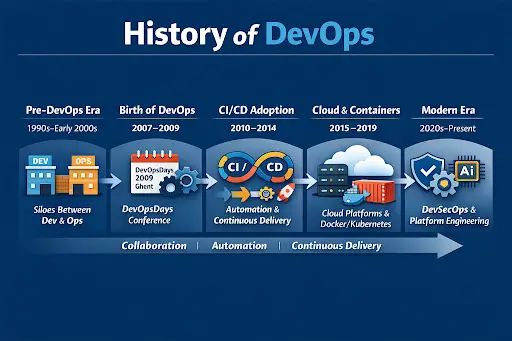
DevOps Development Timeline History Overview

The history of DevOps is a transition from siloed development and operations teams toward a unified culture of automation and collaboration

Timeline History of DevOps

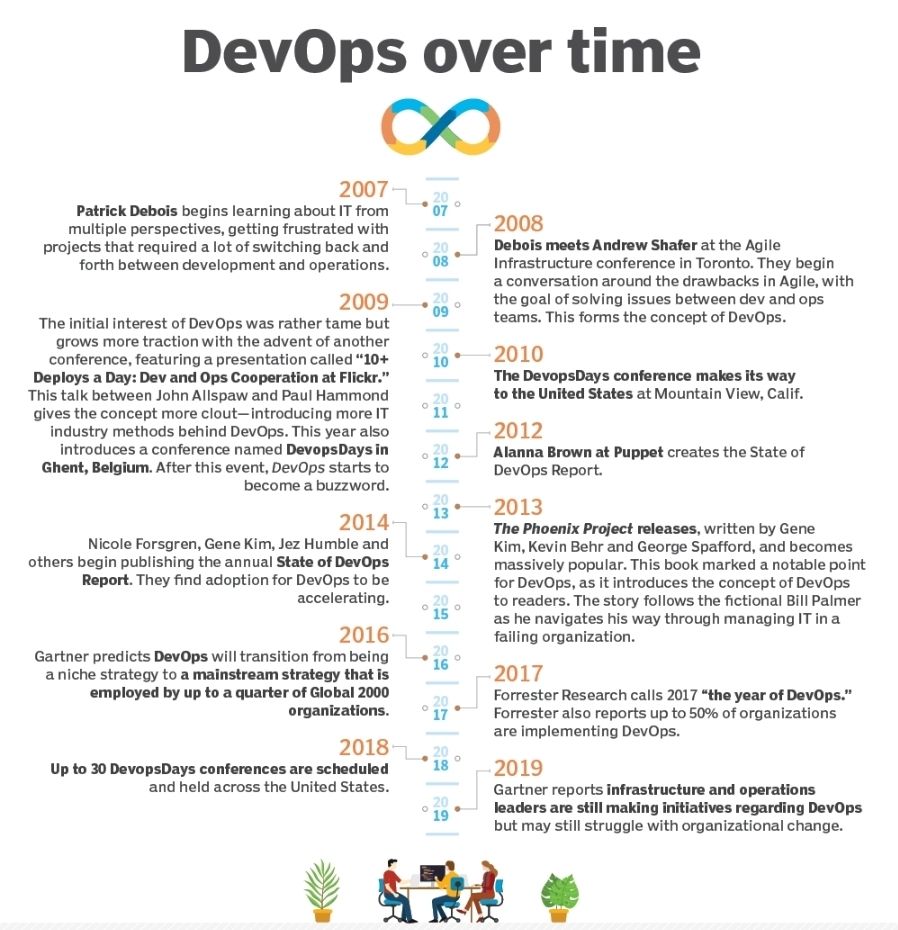
Pre-DevOps & Foundations (2001–2008)

  • 2001: The Agile Manifesto is published, laying the groundwork for iterative software development and cross-functional teamwork.
  • 2006Amazon Web Services (AWS) launches, providing the cloud infrastructure necessary for rapid, automated deployments.
  • 2007: Belgian consultant Patrick Debois begins investigating ways to bridge the gap between development and operations while working on a data centre migration project.
  • 2008: At the Agile conference in Toronto, Andrew Shafer and Patrick Debois meet and discuss “Agile Infrastructure,” marking the conceptual start of the movement. 

The Emergence of DevOps (2009–2014) 

  • 2009: John Allspaw and Paul Hammond give the legendary talk “10+ Deploys Per Day: Dev and Ops Cooperation at Flickr” at the Velocity Conference.
  • 2009: Patrick Debois organises the first DevOpsDays in Ghent, Belgium, and coins the term “DevOps“.
  • 2011: Analyst firm Gartner officially predicts DevOps will evolve from a niche concept to a mainstream strategy.
  • 2013: The book The Phoenix Project is published, popularising DevOps principles through a fictional narrative of a company’s digital transformation.
  • 2013Docker is released, revolutionising the industry by making containerization accessible and consistent across environments.
  • 2014: The first State of DevOps Report is published by Puppet, providing data-driven evidence of DevOps’ impact on performance. 

Mainstream Adoption & Cloud-Native (2015–2019)

  • 2015: Google releases Kubernetes as an open-source project, establishing the standard for container orchestration.
  • 2015: Major cloud providers launch managed container services, such as Google Kubernetes Engine (GKE).
  • 2017: Security begins “shifting left,” leading to the formalisation of DevSecOps within development pipelines.
  • 2018: The book Accelerate is published, detailing the science behind high-performing DevOps organisations.
  • 2019DevOpsDays celebrates its 10th anniversary with events in over 20 countries, signalling global maturity. 

The AI & Platform Era (2020–2026)

  • 2020: The COVID-19 pandemic accelerates remote work and digital transformation, making DevOps practices essential for enterprise survival.
  • 2023Generative AI begins to be integrated into CI/CD pipelines for automated code generation, testing, and anomaly detection.
  • 2024: The focus shifts to Platform Engineering, aiming to reduce developer cognitive load through Internal Developer Platforms (IDPs).
  • 2025AIOps (Artificial Intelligence for IT Operations) becomes standard for predictive analytics and self-healing infrastructure.
  • 2026: DevOps continues to evolve with a focus on zero-CVE container images and high-demand roles for engineers who can manage AI-driven workflows.
DevOps over time

DevOps Development Timeline History Overview

Trafford Centre, Greater Manchester, Development Timeline

The Trafford Centre, located in Greater Manchester, has evolved from a controversial planning proposal in the 1980s into one of the UK’s largest shopping and leisure destinations. 

Pre-Opening & Construction (1984–1997)

  • 1984: The concept for the Trafford Centre is first conceived by the Manchester Ship Canal Company (later Peel Holdings).
  • 1986: Initial planning permission is sought for the Dumplington site.
  • 1987–1992: A series of public inquiries are held due to significant opposition from local councils and competing shopping centres.
  • 1993: Outline planning permission is granted, though it is immediately challenged in the High Court.
  • 1995: After years of legal battles, the House of Lords officially upholds the planning permission, giving the final go-ahead.
  • 1996: Construction begins on-site in May; by August, the assembly of the massive steel frame starts.
  • 1997: The steel frame is completed, and significant progress is made on the ornate facade and interior. 

The Early Years (1998–2005)

  • 1998: The Trafford Centre officially opens on 10 September with 140,000 visitors on opening day. Key anchors include the first Selfridges store outside London.
  • 1999: The centre gains international attention when Monica Lewinsky visits for a book signing tour.
  • 2001: A major Marks & Spencer store opens.
  • 2005: The four-storey John Lewis & Partners opens in May, replacing the original “Festival Village” area. 

Expansion & Ownership Changes (2006–2019)

  • 2007: The Great Hall dining area opens in March, featuring a 1930s steamship theme and one of the world’s largest chandeliers.
  • 2008: Barton Square (now Trafford Palazzo) opens in March as a dedicated homewares and furniture wing.
  • 2010: LEGOLAND Discovery Centre opens within Barton Square.
  • 2011: Peel Group sells the centre to Capital Shopping Centres (CSC) for £1.6 billion, the largest single property transaction in British history at the time.
  • 2013: Following a corporate rebrand of CSC, the mall is renamed intu Trafford Centre in February; SEA LIFE Manchester also opens this year.
  • 2018: The centre celebrates its 20th anniversary with record footfall. 

Modern Era & Redevelopment (2020–Present) 

  • 2020: Developer Intu Properties enters administration in June. Ownership is transferred to the Canada Pension Plan Investment Board (CPPIB) in December.
  • 2021: Barton Square is legally separated and re-acquired by the original developer, Peel L&P, who rebrands it as Trafford Palazzo.
  • 2022: As part of an overhaul by new asset managers Pradera Lateral, the decorative pool in the Orient is removed.
  • 2023: The centre celebrates its 25th anniversary with a special show headlined by 90s pop group B*Witched.
  • 2024: Major new tenants are announced, including a massive Inditex flagship (Zara, Bershka, and Pull&Bear) taking over the former M&S site.
  • 2025: Significant retail reshuffling continues with the opening of a massive new Zara and the first Sephora in the North of England.

The Trafford Centre is a major shopping and leisure destination in Manchester, famous for its grand Baroque architecture. 

Sunday Hours (Sunday 8 March 2026)

  • Shops: 12:00 PM – 6:00 PM
  • Dining & Leisure: 12:00 PM – 6:00 PM (times for individual venues like the cinema or restaurants may vary) 

Events & Attractions

  • Science Fair: A free family event featuring experiments and robots is currently running until 6:00 PM today.
  • Holi Festival of Colours: A celebration of music and well-being scheduled for Saturday 14 March at Orient Car Park 12.
  • Leisure Hub: Home to an ODEON cinema, SEA LIFE ManchesterParadise Island Adventure Golf, and Namco Funscape

Shopping & Dining

  • Popular Brands: Key stores include SelfridgesJohn LewisZaraApple, and Next.
  • Dining Hubs: The Orient and The Great Hall host over 60 eateries, including Hello Oriental, Archie’sFive Guys, and Wingstop.
  • New for 2026: Standalone stores for The White CompanyShake Shack, and expanded locations for Stradivarius and Foot Asylum are opening this spring. 

Visitor Information

  • Address: The Trafford Centre, Trafford Park, Manchester, M17 8AA.
  • Parking: Over 10,000 free parking spaces are available. Premium Parking options are available for £7.50.
  • Transport: Accessible via the Metrolink tram (Trafford Park line) and dedicated bus routes like the X50 from Manchester City Centre. 

Trafford Centre, Greater Manchester, Development Timeline

Timeline of our Planet and Solar System

The history of our planet and solar system spans roughly 4.6 billion years, evolving from a chaotic cloud of dust into the structured environment we see today. Below is a comprehensive timeline of major milestones from the formation of the Sun to the distant future

The Early Solar System (4.6 – 3.8 Billion Years Ago) 

  • 4.6 Billion Years Ago (BYA): The Sun forms from a collapsing cloud of interstellar gas and dust, likely triggered by a nearby supernova.
  • 4.59 BYA: The giant planets—Jupiter, Saturn, Uranus, and Neptune—begin to form in the outer solar system.
  • 4.5 BYA: The rocky inner planets—Mercury, Venus, Earth, and Mars—form.
  • 4.5 BYA: A Mars-sized body (often called Theia) impacts Earth; the resulting debris coalesces to form the Moon.
  • 4.1 – 3.8 BYA: The Late Heavy Bombardment occurs, where shifting orbits of giant planets send asteroids crashing into the inner planets, likely delivering water and organic molecules to Earth. 

The Rise of Life (3.8 Billion – 500 Million Years Ago)

  • 3.8 – 3.5 BYA: The first life forms (simple single-celled organisms) appear on Earth.
  • 2.5 BYA: Photosynthetic organisms evolve, beginning the Great Oxidation Event, which pumps oxygen into the atmosphere and creates the air we breathe.
  • 1.9 – 1.3 BYA: First eukaryotes (complex cells) and later multicellular life emerge on Earth.
  • 715 – 600 Million Years Ago (MYA): Earth experiences “Snowball Earth” events, where the planet is almost entirely covered in ice.
  • 575 MYA: The ozone layer forms, providing protection from UV radiation and making land habitable. 

Complex Life & Modern Era (541 Million Years Ago – Present) 

  • 541 MYA: The Cambrian Explosion leads to a massive diversification of animal life.
  • 252 MYA: The Permian Extinction (“The Great Dying”) wipes out 95% of life, eventually clearing the way for dinosaurs.
  • 66 MYA: A giant asteroid impacts Earth (Chicxulub), causing the extinction of the dinosaurs and allowing mammals to become dominant.
  • 2 MYA: Early ancestors of humans begin to emerge.
  • 300,000 Years Ago: Homo sapiens (modern humans) appear.
  • 2006: Pluto is reclassified from a planet to a dwarf planet

The Distant Future

  • 5 Billion Years from Now: The Sun will exhaust its hydrogen fuel and begin expanding into a Red Giant.
  • 7.9 Billion Years from Now: The Sun is expected to engulf Mercury and Venus, and possibly Earth.
  • 8 Billion Years from Now: The Sun will shed its outer layers and collapse into a White Dwarf

Timeline of our Planet and Solar System

Best way to optimize SEO Search Engine Optimization for your website

To optimize SEO (Search Engine Optimization), you must align your website with search engine requirements across four foundational pillars: technical performanceon-page structurecontent value, and off-page authority

1. Technical SEO (The Foundation)

Technical optimization ensures search engines can find, crawl, and index your pages. 

  • Improve Page Speed: Use Google PageSpeed Insights to identify bottlenecks; compress images and use modern formats like WebP or AVIF.
  • Enable Mobile-First Design: Ensure your site is fully responsive, as Google prioritizes mobile versions for indexing.
  • Secure with HTTPS: Use an SSL certificate to protect user data and gain a minor ranking boost.
  • Use XML Sitemaps: Submit a sitemap via Google Search Console to help bots discover all your URLs. 

2. On-Page SEO (The Structure)

On-page factors help search engines understand what a specific page is about. 

  • Optimize Meta Tags: Include your primary keyword near the beginning of your Title Tag (under 60 characters) and Meta Description (105-160 characters).
  • Use Descriptive Headings: Structure content with a single H1 for the main title and logical H2/H3 tags for subtopics.
  • Clean URL Slugs: Create short, descriptive URLs that include the target keyword (e.g., /how-to-optimize-seo/).
  • Add Image Alt Text: Write descriptive text for all images to assist both accessibility and image search rankings. 

3. Content Strategy (The Value)

High-quality content is the most influential factor for long-term SEO success. 

  • Keyword Research: Use tools like Ahrefs, Semrush, or Google Keyword Planner to find terms with high volume and low difficulty.
  • Match Search Intent: Identify if users want information, a specific product, or a comparison, and tailor your content to fulfill that exact need.
  • Demonstrate E-E-A-T: Show Experience, Expertise, Authoritativeness, and Trustworthiness by citing original research, expert quotes, and unique insights.
  • Optimize for AI Overviews: Use clear “Key Takeaways” boxes and answer common questions directly to increase chances of being cited by AI search features. 

4. Off-Page SEO (The Authority)

Off-page signals prove your site’s credibility to the rest of the web. 

  • Build High-Quality Backlinks: Earn links from reputable websites through guest posting, digital PR, or creating “linkable assets” like infographics.
  • Internal Linking: Connect related pages within your own site to distribute “link equity” and help users navigate.
  • Manage Online Reputation: For local businesses, maintain an updated Google Business Profile and respond promptly to reviews.

Best way to optimize SEO Search Engine Optimization for your website