Infographic, Human Evolution to Homo Sapiens

Modern humans (Homo sapiens) emerged in Africa approximately 300,000 years ago after millions of years of gradual primate and hominin evolution.
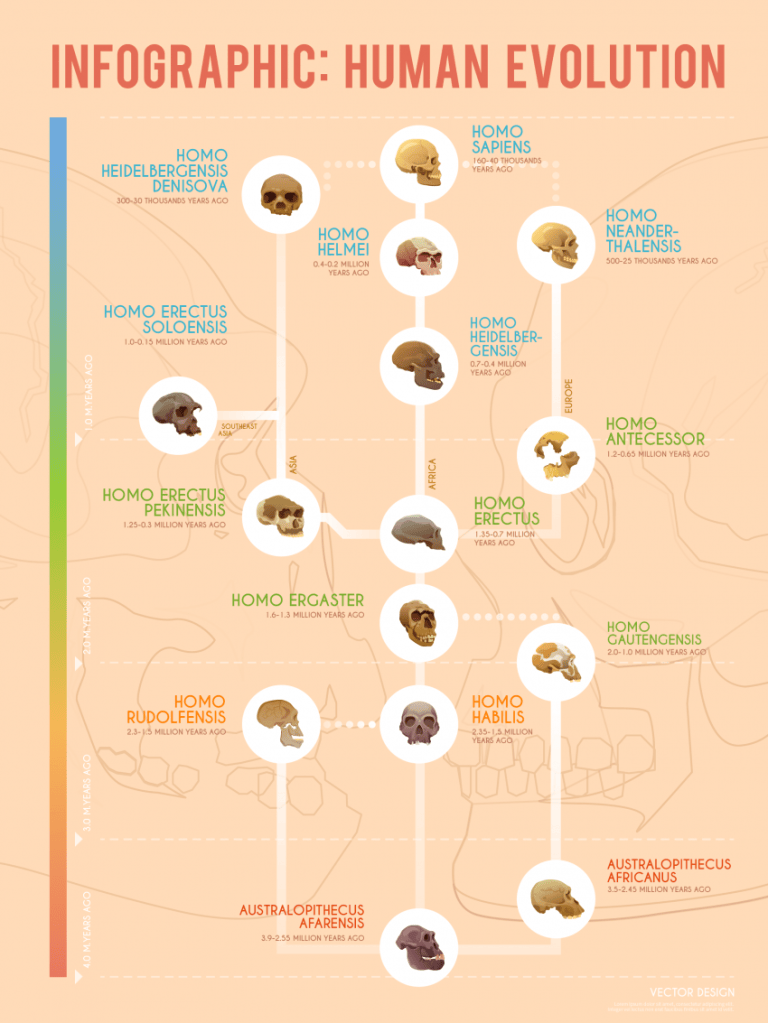
Infographic, Human Evolution to Homo Sapiens

Early Beginnings and Primate Roots

  • 85 million years ago (mya): Primates diverge from other mammalian groups during the Late Cretaceous period.
  • 55 mya: Earliest true primate fossils appear in the Paleocene epoch.
  • 15–20 mya: The ape superfamily diverges from gibbons and other primate lines, leading to early apes like Dryopithecus.
  • 6–7 million years ago (mya): The human lineage (hominins) splits from the ancestors of modern chimpanzees and bonobos in Africa. Sahelanthropus represents one of the earliest known species to begin walking upright (bipedalism).

The Rise of Australopithecines

  • 4–3 mya: Australopithecus species (such as Australopithecus afarensis) thrive in the grasslands of eastern and southern Africa. They walk fully on two legs but retain small, ape-like brain sizes.
  • 3.3 mya: Earliest known stone tool manufacturing begins in Kenya, predating the appearance of the modern human genus (Homo).

The Emergence of the Genus Homo

  • 2.8–2.5 mya: Homo habilis (the “handyman”) appears in Africa. They feature larger brains and systematically manufacture sharp stone flakes and core tools (Oldowan technology).
  • 1.9–1.8 mya: Homo erectus emerges with taller, modern-like body proportions (longer legs, shorter arms). They are the first hominins to migrate out of Africa into Eurasia, master controlled fire, and build basic shelters.

Transition to Modern Humans

  • 700,000–350,000 years ago (kya): Homo heidelbergensis spreads across Africa and Europe. They act as the common ancestral root that branches into Neanderthals in Eurasia and Homo sapiens in Africa.
  • 315,000 years ago: The oldest known anatomical remains of Homo sapiens (including skull fragments and a jawbone) are fossilized in Jebel Irhoud, Morocco. These early modern humans possess near-modern facial features alongside robust skeletal builds.
  • 50,000–40,000 years ago: The Upper Paleolithic revolution sees Homo sapiens develop advanced symbolic behavior, complex art, sophisticated blade toolkits, and widespread global expansion.
Timeline of our Planet and Solar System

The history of our planet and solar system spans roughly 4.6 billion years, evolving from a chaotic cloud of dust into the structured environment we see today. Below is a comprehensive timeline of major milestones from the formation of the Sun to the distant future

The Early Solar System (4.6 – 3.8 Billion Years Ago) 

  • 4.6 Billion Years Ago (BYA): The Sun forms from a collapsing cloud of interstellar gas and dust, likely triggered by a nearby supernova.
  • 4.59 BYA: The giant planets—Jupiter, Saturn, Uranus, and Neptune—begin to form in the outer solar system.
  • 4.5 BYA: The rocky inner planets—Mercury, Venus, Earth, and Mars—form.
  • 4.5 BYA: A Mars-sized body (often called Theia) impacts Earth; the resulting debris coalesces to form the Moon.
  • 4.1 – 3.8 BYA: The Late Heavy Bombardment occurs, where shifting orbits of giant planets send asteroids crashing into the inner planets, likely delivering water and organic molecules to Earth. 

The Rise of Life (3.8 Billion – 500 Million Years Ago)

  • 3.8 – 3.5 BYA: The first life forms (simple single-celled organisms) appear on Earth.
  • 2.5 BYA: Photosynthetic organisms evolve, beginning the Great Oxidation Event, which pumps oxygen into the atmosphere and creates the air we breathe.
  • 1.9 – 1.3 BYA: First eukaryotes (complex cells) and later multicellular life emerge on Earth.
  • 715 – 600 Million Years Ago (MYA): Earth experiences “Snowball Earth” events, where the planet is almost entirely covered in ice.
  • 575 MYA: The ozone layer forms, providing protection from UV radiation and making land habitable. 

Complex Life & Modern Era (541 Million Years Ago – Present) 

  • 541 MYA: The Cambrian Explosion leads to a massive diversification of animal life.
  • 252 MYA: The Permian Extinction (“The Great Dying”) wipes out 95% of life, eventually clearing the way for dinosaurs.
  • 66 MYA: A giant asteroid impacts Earth (Chicxulub), causing the extinction of the dinosaurs and allowing mammals to become dominant.
  • 2 MYA: Early ancestors of humans begin to emerge.
  • 300,000 Years Ago: Homo sapiens (modern humans) appear.
  • 2006: Pluto is reclassified from a planet to a dwarf planet

The Distant Future

  • 5 Billion Years from Now: The Sun will exhaust its hydrogen fuel and begin expanding into a Red Giant.
  • 7.9 Billion Years from Now: The Sun is expected to engulf Mercury and Venus, and possibly Earth.
  • 8 Billion Years from Now: The Sun will shed its outer layers and collapse into a White Dwarf

Timeline of our Planet and Solar System

Bill Bryson’s A Short History of Nearly Everything

Bill Bryson’s A Short History of Nearly Everything

Bill Bryson’s A Short History of Nearly Everything is a journey from the Big Bang to the rise of humanity, focusing not just on what happened, but how we figured it all out. 

Here is a condensed timeline of the major milestones covered in the book, divided by the “Big Ideas” that shaped our understanding of the universe.

1. The Deep Past (The Universe and Earth)

This era covers the transition from “nothing” to a habitable rock.

  • 13.8 Billion Years Ago: The Big Bang. In a fraction of a second, the universe expands from a singularity to a vast expanse.
  • 4.5 Billion Years Ago: The Earth forms from a spinning cloud of gas and dust. Shortly after, a Mars-sized object strikes Earth, creating the Moon.
  • 3.8 Billion Years Ago: The first signs of microbial life appear in the oceans.
  • 700 Million Years Ago: “Snowball Earth”—a period where the planet may have been entirely encased in ice. 

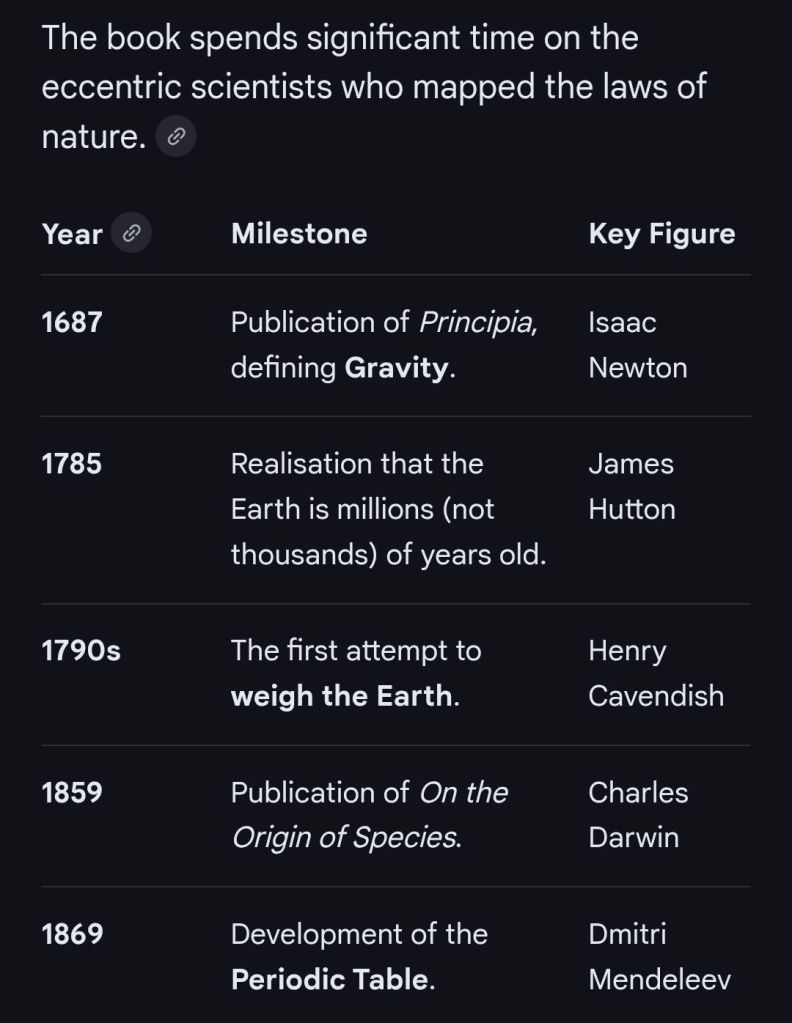
2. The Great Discoveries (17th – 19th Century)


3. The Atomic and Relativistic Age (20th Century)

In this era, science moved from the “visible” world to the subatomic and the cosmic.

  • 1905: Albert Einstein publishes his papers on Special Relativity, proving that E = mc squared.
  • 1911: Ernest Rutherford discovers the nucleus of the atom, realising that atoms are mostly empty space.
  • 1930s: The discovery of Neutrons and the start of the “Particle Zoo.”
  • 1953: Watson, Crick, and Franklin decipher the structure of DNA, the blueprint of life.
  • 1960s: The theory of Plate Tectonics is finally accepted, explaining how continents move. 

4. The Rise of Us (The Biological Timeline)

Bryson highlights how incredibly lucky we are to exist at all, given the history of extinctions. 

  • 540 Million Years Ago: The Cambrian Explosion. A massive burst of complex life forms.
  • 250 Million Years Ago: The Permian Extinction. The “Great Dying” where 95% of all species vanished.
  • 65 Million Years Ago: The KT Event. An asteroid hits the Yucatan Peninsula, ending the reign of the dinosaurs.
  • 100,000 Years Ago: Homo sapiens begin to emerge as the dominant homid species.
  • Present Day: Humans have become a “geological force,” capable of altering the planet’s climate and future. 

Key Themes to Remember

  • Human Fallibility: Much of the “history” is about scientists being wrong, arguing, or losing their notes.
  • The Size of the Void: We live on a tiny, fragile speck in a universe that is mostly “nothing.”
  • The Miracle of Existence: If any one of a billion variables had been slightly different, life as we know it wouldn’t exist. 

“We are an impossibly lucky accident.” — Summary of Bryson’s core philosophy.

A Short History of Nearly Everything by Bill Bryson

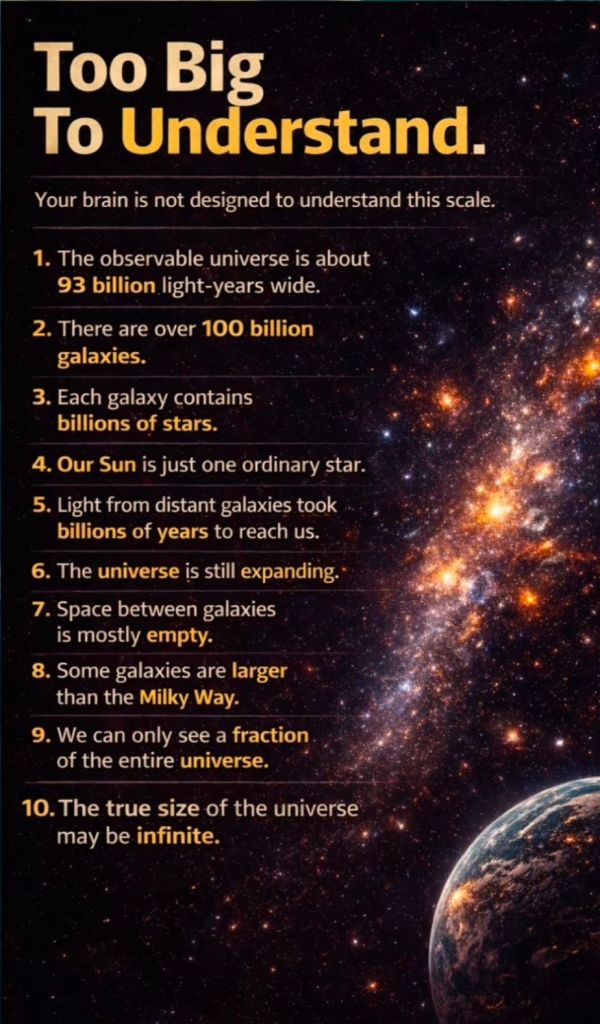
Observable Universe and Beyond

Observable Universe and Beyond