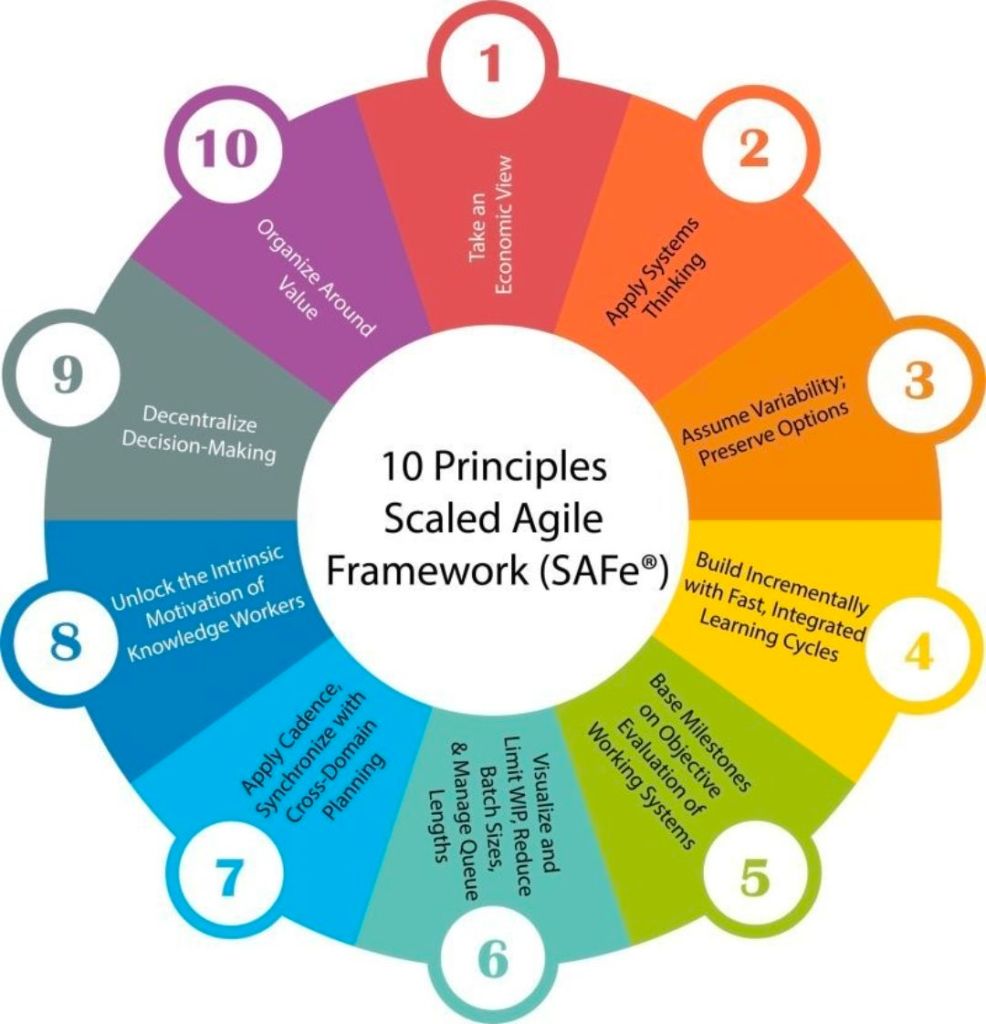
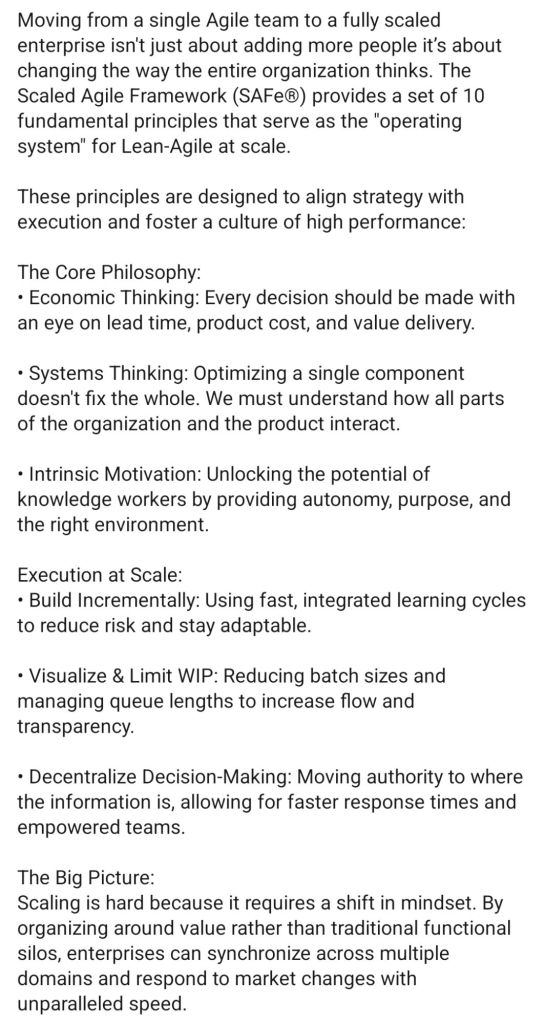
The fundamental difference is scale: Agile Scrum is designed for a single, autonomous team (typically 5–9 people), whereas Scaled Agile Framework (SAFe) is built for the enterprise level to coordinate dozens of teams (50+ people) working toward shared business goals.
Scrum prioritizes team flexibility and speed. Conversely, SAFe trades complete autonomy for centralized alignment, consistency, and structural predictability.
Industry Perspectives on the Trade-offs
While SAFe solves enterprise synchronization challenges, it faces regular scrutiny from product leaders who argue that its highly prescriptive nature can stifle the true spirit of agility.
A popular comment from an agile practitioner on Reddit’s Scrum Community highlights the developer sentiment regarding the process overhead:
“I’ve never seen SAFe implemented without a meeting explosion. More planning, more roles, more acronyms and way more time blocked on calendars.”
Another developer shared a similar perspective on Reddit’s ExperiencedDevs Community:
“Number of meetings have increased 4x. More time is spent for planning to build software than actually building software. Bureaucratic rituals are more important than getting things done.”
Ultimately, SAFe does not replace Scrum. Most organizations implementing SAFe still utilize standard Scrum practices at the team level, leveraging the macro framework solely to manage the dependencies that threaten to derail massive initiatives.
Choosing the Right Approach
Choose Scrum if: You have a small or mid-sized setup, your teams operate independently, you are early in your Agile journey, and your primary pain point is a need for fast market-feedback loops.
Choose SAFe if: You are coordinating 50 to 1,000+ engineers across complex legacy systems, cross-team dependencies frequently delay your releases, and you need strict regulatory compliance or top-down executive alignment.
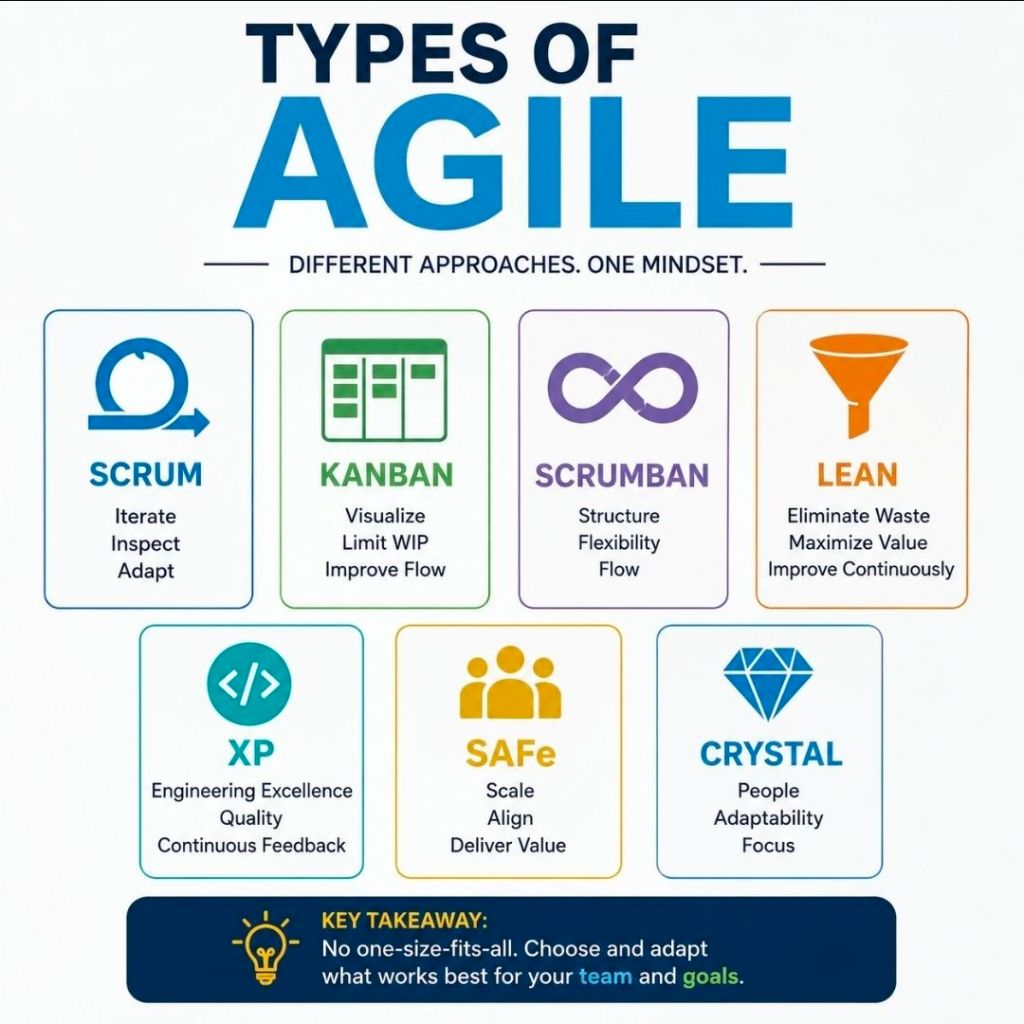
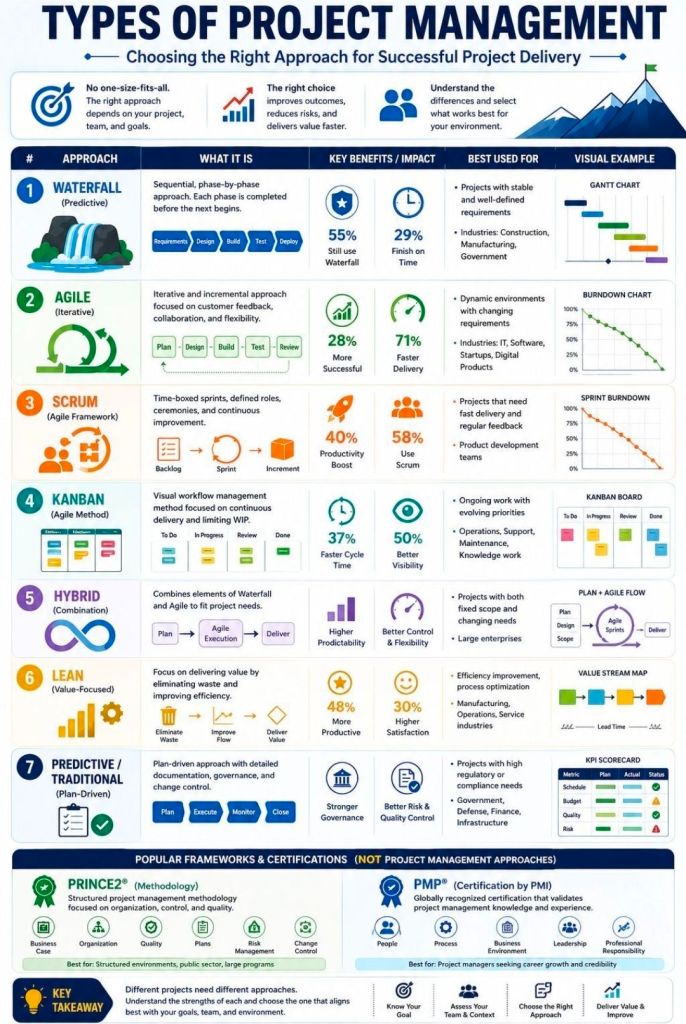
Agile delivery is an iterative approach to project management that focuses on delivering value early, frequently adapting to change, and maintaining continuous customer feedback. Rather than executing a project sequentially, teams break work into small increments to maximize flexibility and product quality.
The most common types and frameworks of agile delivery include the following structured methodologies:
1. Scrum
Scrum is the most widely used agile framework, characterized by highly structured, time-boxed iterations called Sprints (typically 1 to 4 weeks long).
Key Concept: Teams work toward a single, actionable goal during each sprint.
Key Roles: Product Owner (represents the customer), Scrum Master (removes obstacles and enforces the framework), and Developers.
Best For: Projects where requirements change frequently and close collaboration with clients is required.
2. Kanban
Kanban is a visual workflow management system that emphasizes continuous delivery and transparency without strict time-boxed iterations.
Key Concept: Work is tracked on a Kanban board divided into columns (e.g., “To Do,” “In Progress,” “Done”).
Key Roles: Self-organizing teams with a pull-based approach.
Best For: Operational workflows, support/maintenance teams, and organizations that need to limit “work in progress” (WIP) to prevent bottlenecks.
3. Lean Software Development
Adapted from Toyota’s lean manufacturing principles, Lean focuses on maximizing customer value while minimizing waste.
Key Concept: Focuses on “eliminating waste” (anything that doesn’t add value to the end user), amplifying learning, and delivering as fast as possible.
Best For: Optimizing overall organizational workflows and reducing overhead.
4. Extreme Programming (XP)
XP focuses heavily on technical excellence and software engineering practices to boost product quality and responsiveness.
Key Concept: Uses practices like pair programming, test-driven development (TDD), and continuous integration.
Best For: Development teams that need to release updates frequently while maintaining strict quality and low bug rates.
5. Feature-Driven Development (FDD)
FDD is a model-driven approach that is highly structured and focuses on building software in short, feature-by-feature iterations.
Key Concept: Work revolves around creating detailed software models and planning by specific features, which are built one by one.
Best For: Teams that prefer structured, step-by-step processes or environments with traditional hierarchical structures.
6. Scaled Agile Framework (SAFe)
SAFe is designed for larger enterprises that need to align cross-functional, multiple Agile teams toward a single business strategy.
Key Concept: Blends Lean, Agile, and DevOps principles to coordinate alignment, governance, and delivery across a massive scale.
Best For: Large organizations and complex projects requiring multiple teams to coordinate efforts.
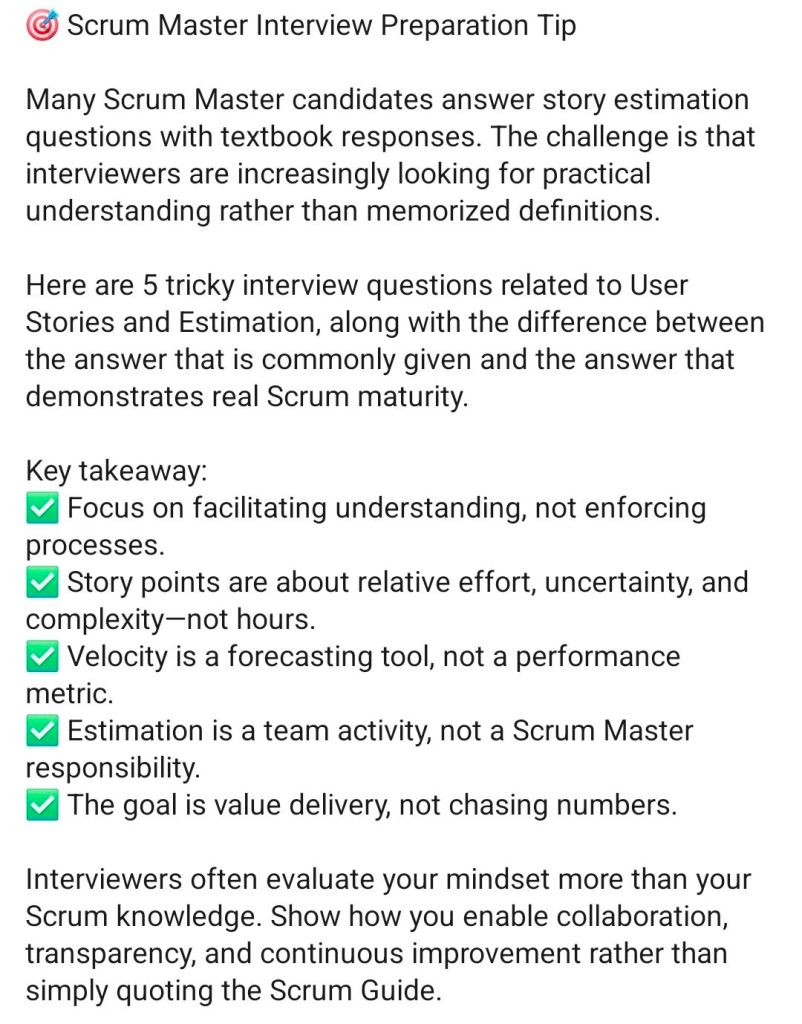
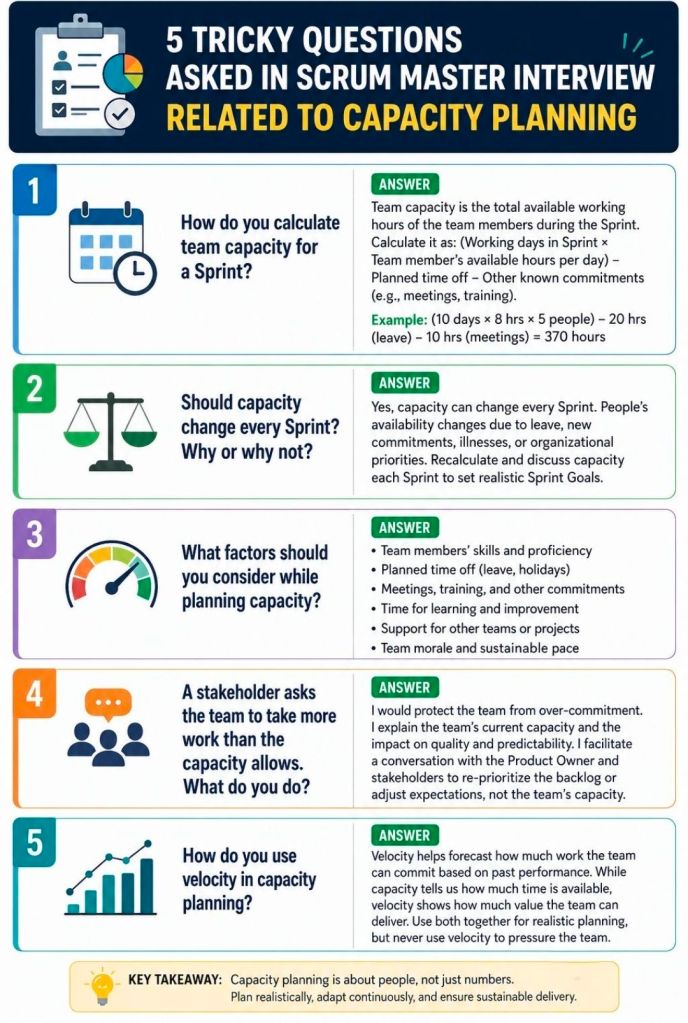
Typical Agile Scrum Master interview questions evaluate your understanding of the Scrum Framework (the 3-5-3 structure), your ability to facilitate continuous improvement, and your soft skills in conflict resolution and servant leadership.
The questions generally fall into four core categories:
1. Scrum Fundamentals & Frameworks
These questions test your technical knowledge of Scrum and how it compares to other frameworks.
Explain Scrum vs. Agile: Agile is the overarching mindset and set of principles; Scrum is a specific, lightweight framework for implementing Agile.
The 3-5-3 structure: What are the three roles (Product Owner, Scrum Master, Developers), five events (Sprint, Sprint Planning, Daily Scrum, Sprint Review, Sprint Retrospective), and three artifacts (Product Backlog, Sprint Backlog, Increment)?
Scaling Agile: What experience do you have scaling Agile (e.g., SAFe, Scrum of Scrums, Nexus) if the organization is large?
2. Facilitation & Coaching
Interviewers want to see how you run events, coach Product Owners, and improve team delivery.
Daily Scrum: What is your approach to running the Daily Scrum, and how do you prevent it from becoming just a status update?
Retrospectives: What specific techniques or games do you use to keep retrospectives fresh and actionable?
Definition of Done (DoD): How do you help a team create and adhere to a clear Definition of Done?
Metrics: How do you track a team’s effectiveness (e.g., velocity, sprint goal success, cycle time, burndown charts)?
3. Behavioral & Situational Scenarios
These “tell me about a time when…” questions assess your real-world experience.
Team Conflict: Can you describe a time when you had to resolve a conflict between team members or between a developer and the Product Owner?
Resistant Teams: What would you do if a team member or stakeholder doesn’t see the value in Scrum ceremonies and refuses to participate?
Management Intervention: How do you handle managers or executives who try to bypass the Scrum process or assign work directly to the developers?
Scope Creep: How do you handle sudden mid-sprint requirement changes or scope creep?
4. Self-Awareness & Servant Leadership
Hiring managers ask these to test your humility and growth mindset.
Your Greatest Failure: Can you share a time you failed as a Scrum Master, and what you learned from the experience?
Protecting the Team: How do you say “no” to leadership or protect the team from external noise while still serving the broader organization?
__________
More Agile Scrum Questions with Example Answers:
Mastering a Scrum Master interview involves demonstrating a deep understanding of servant leadership, the Agile mindset, and hands-on experience navigating team dynamics. Below are the most common interview questions, summarized with strategic, industry-recommended answers to help you stand out.
Core Scrum Framework & Mechanics
Question 1: Explain the 3-5-3 structure of Scrum.
What they’re looking for: A solid foundation in Scrum basics.
Recommended Answer: “Scrum is governed by a ‘3-5-3’ rule: 3 roles (Product Owner, Scrum Master, Developers), 5 events (Sprint, Sprint Planning, Daily Scrum, Sprint Review, Sprint Retrospective), and 3 artifacts (Product Backlog, Sprint Backlog, Increment).”
Question 2: What is the difference between a Product Backlog and a Sprint Backlog?
What they’re looking for: Understanding of backlog management and scope.
Recommended Answer: “The Product Backlog is a continuously evolving, prioritized list of everything needed for the product, owned by the Product Owner. The Sprint Backlog is a subset of the Product Backlog—it’s the specific forecast of items the team commits to delivering during the current sprint.”
Behavioral & Situational Questions
Question 3: How do you handle conflict within the Scrum team?
What they’re looking for: Your facilitation and conflict-resolution skills, avoiding direct intervention where the team can self-manage.
Recommended Answer: “I avoid playing the role of a micromanager. Instead, I facilitate open dialogue and encourage the team to address the conflict directly using the Scrum values of openness and respect. My goal is to guide them to find a mutually agreeable solution while fostering an environment of psychological safety.”
Question 4: What do you do if a team member refuses to adopt Scrum practices?
What they’re looking for: Change management skills and patience.
Recommended Answer: “I first try to understand the root cause of their resistance, as it usually stems from a lack of understanding or fear of change. I would have a private one-on-one conversation to address their concerns. I might pair them with an experienced Agile advocate or use team-building exercises to demonstrate the value of Scrum in a low-pressure way.”
Leadership & Stakeholder Management
Question 5: Tell me about a time you had to challenge leadership or management.
What they’re looking for: The courage to protect the team’s focus and uphold Scrum principles.
Recommended Answer: “I once had a stakeholder attempt to bypass the Product Owner and directly assign high-priority tasks to Developers mid-sprint. I respectfully but firmly challenged this by explaining how breaking the Sprint Goal jeopardizes the team’s focus and the project’s overall velocity. I then helped the stakeholder work with the Product Owner to place the new task in the Product Backlog for the next sprint planning.”
Question 6: How do you measure if your team is truly Agile?
What they’re looking for: Focus on delivering value over measuring arbitrary metrics like velocity.
Recommended Answer: “Velocity is for planning, not for measuring success. I look at outcome-based metrics, such as Sprint Goal success rates, customer satisfaction scores, time-to-market, and the quality of increments. The ultimate measure is whether we are continuously delivering iterative business value to our end users.”
Agile project management is an iterative, adaptive approach that breaks projects down into small, manageable cycles called sprints or iterations. Instead of planning the entire project upfront, teams continuously deliver functional increments, gather immediate feedback, and adapt to changing requirements. It prioritizes team collaboration, customer involvement, and rapid value delivery over rigid documentation and sequential phases.
Comprehensive Timeline Breakdown by Era and Year
Era 1: The Foundational Seeds (1950s – 1980s)
Before “Agile” existed as a formal term, engineers and researchers laid the groundwork through lean manufacturing and early iterative computing.
1957: IBM begins utilizing incremental development concepts under Gerald M. Weinberg.
1958: Software for Project Mercury (NASA’s first human spaceflight program) is developed using rapid half-day iterations.
1970: Dr Winston Royce publishes a paper describing the Waterfall methodology. Paradoxically, he presents it as high-risk, yet it becomes the dominant, rigid corporate framework for decades.
1980: Toyota refines “Just-In-Time” logistics and visual management system concepts, which later directly inspire Kanban and Lean software practices.
1986: Authors Hirotaka Takeuchi and Ikujiro Nonaka publish “The New New Product Development Game” in the Harvard Business Review. They introduce a holistic, “rugby-style” team approach, coining the term “Scrum”.
1988: Dr Barry Boehm introduces the Spiral Model, formalizing risk-driven, iterative lifecycle planning.
Era 2: The “Lightweight” Revolt (1990s)
Driven by frustration over the high failure rates and slow delivery of Waterfall, software pioneers independently build faster, more flexible frameworks.
1991: James Martin formalizes Rapid Application Development (RAD), highlighting timeboxing, prototyping, and active customer involvement.
1993: Jeff Sutherland, John Scumniotales, and Jeff McKenna deploy the very first operational Scrum process at Easel Corporation.
1994: The Dynamic Systems Development Method (DSDM) is launched in the UK, providing one of the earliest structured frameworks for iterative project delivery.
1995: Ken Schwaber and Jeff Sutherland co-present the formal Scrum Framework to the public at the OOPSLA conference.
1996: Kent Beck introduces Extreme Programming (XP), introducing core engineering mechanics like pair programming and test-driven development (TDD).
1997: Jeff De Luca and Peter Coad design Feature-Driven Development (FDD) to focus strictly on client-valued functional results.
Era 3: The Manifesto Moment (2000 – 2001)
The pivotal pivot point where separate iterative movements unite into a single, cohesive global movement.
2000: Pre-meeting alignment occurs. Martin Fowler publishes his definitive article on Continuous Integration (CI), and Extreme Programming teams begin adopting Scrum’s three-question daily standup format.
February 2001: The Agile Manifesto is Born. Seventeen software development pioneers meet at a ski resort in Snowbird, Utah. They discover common ground, author the Manifesto for Agile Software Development, and establish the 4 Core Values and 12 Principles.
Late 2001: The Agile Alliance non-profit is established to safeguard, evolve, and distribute Agile education globally.
Era 4: Mainstream Adoption & Scaling (2002 – 2019)
Agile shifts from a rebellious IT trend into a standard corporate expectation, requiring frameworks that can scale across massive enterprises.
2002: Ken Schwaber co-founds the Scrum Alliance to offer standardized certifications (like Certified ScrumMaster), dramatically accelerating global adoption.
2003: Mary and Tom Poppendieck publish Lean Software Development, cleanly mapping Toyota’s manufacturing efficiencies directly onto digital projects.
2009: The Software Craftsmanship Manifesto is created to ensure technical excellence and code quality are not forgotten during rapid business sprints.
2011: Dean Leffingwell releases the Scaled Agile Framework (SAFe), allowing massive corporate enterprises to align hundreds of agile teams across entire portfolios.
2015: Global project management authorities officially pivot; AXELOS releases PRINCE2 Agile, and the Project Management Institute (PMI) introduces Agile certifications into its core curriculum.
Era 5: Modern Continuous Agility (2020s – Present)
Agile transcends IT entirely, cementing its place as an overarching organizational strategy for business survival in an uncertain world.
2020: The Scrum Guide receives its most significant structural update, streamlining language, eliminating prescriptive micro-management, and focusing intensely on a single, unified team working toward a singular “Product Goal”.
2021–2023: Business Agility explodes. Non-technical departments—including HR, Marketing, Legal, and Finance—broadly restructure their workflows into iterative agile backlogs to manage volatile hybrid work environments.
2024–Present: AI-Driven Agility becomes standard practice. Project management tools use generative AI to automatically draft user stories, estimate team velocity, and dynamically rewrite project sprint backlogs based on real-time market shifts.
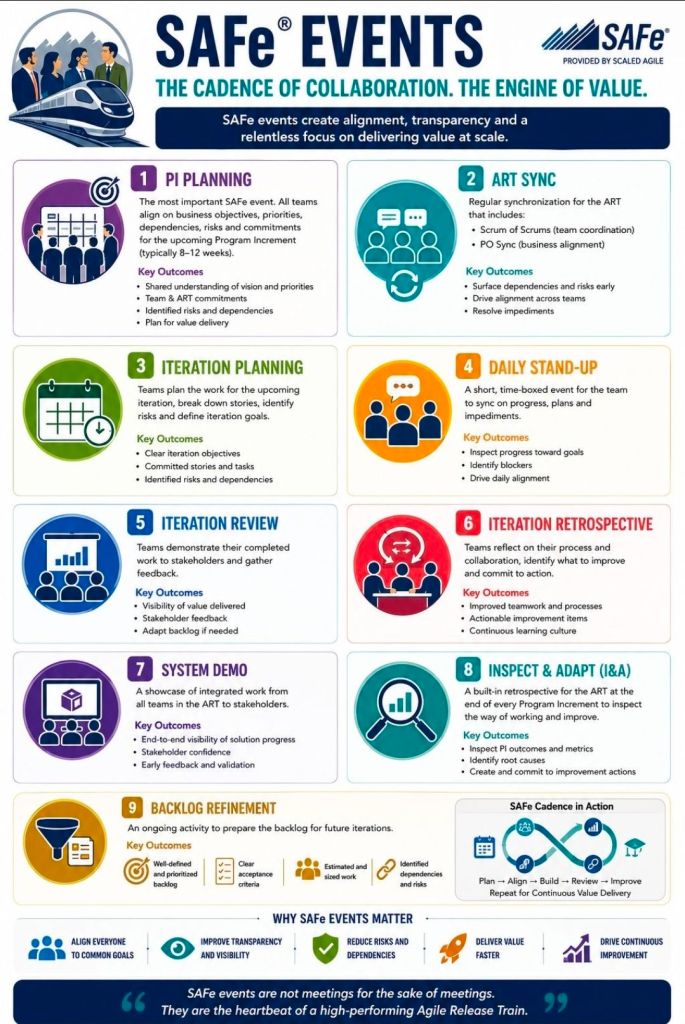
SAFe (Scaled Agile Framework) events are structured, time-boxed ceremonies designed to drive synchronization, alignment, and continuous improvement across different levels of an enterprise.
These events are primarily categorized into Team-level events (which mirror standard Scrum practices) and Agile Release Train (ART) level events (which orchestrate multiple teams working toward a shared goal).
The core events within Essential SAFe are broken down below by organizational layer.
👥 Agile Team-Level Events
These recurrent ceremonies occur inside a short timebox called an Iteration (typically lasting 2 weeks) and focus on local execution.
Iteration Planning: Teams refine the iteration plan, select backlog stories, and commit to a set of Iteration Goals.
Team Sync (Daily Stand-up): A brief, daily 15-minute meeting where team members align on progress, discuss daily goals, and highlight impediments.
Iteration Review: A cadence-based showcase at the end of the iteration where teams demo working software to gather immediate feedback.
Iteration Retrospective: Held at the end of each iteration to reflect on the process, team dynamics, and behaviors to drive relentless improvement.
Backlog Refinement: A weekly meeting where the Product Owner and team flesh out, estimate, and prep user stories for upcoming iterations.
🚊 Agile Release Train (ART) Level Events
These higher-level events drive the Planning Interval (PI), an 8 to 12-week timebox where an entire “train” of 5–12 teams delivers cross-functional value.
PI Planning: The multi-day flagship event of SAFe where all teams, stakeholders, and leaders align on a shared business vision, map dependencies, and commit to PI objectives.
System Demo: A regular event occurring every iteration where the integrated functionality built by the entire ART is demonstrated to stakeholders for feedback.
Coach Sync (formerly Scrum of Scrums): Facilitated by the Release Train Engineer (RTE), Scrum Masters meet to resolve cross-team dependencies, risks, and progress hurdles.
PO Sync: Product Owners and Product Management meet to track milestone progress, manage scope adjustments, and ensure the train remains aligned with business goals.
ART Sync: A combined session of Coach Sync and PO Sync used to streamline communication regarding execution and deployment.
Inspect & Adapt (I&A): A major event held at the end of the PI consisting of a system demo, quantitative measurements, and a problem-solving workshop to implement systemic backlog improvements.
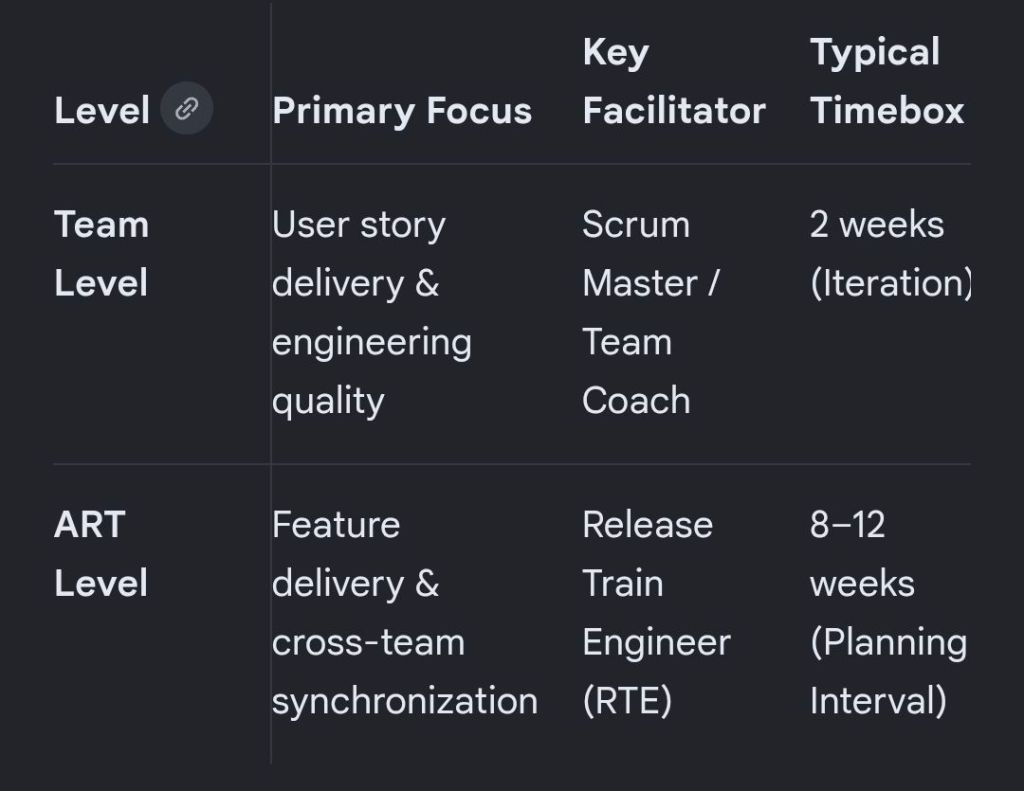
Summary of Differences
For a quick comparison, you can look at how responsibilities scale across the framework:
SAFe (Scaled Agile Framework) events are structured, time-boxed ceremonies designed to drive synchronization, alignment, and continuous improvement across different levels of an enterprise