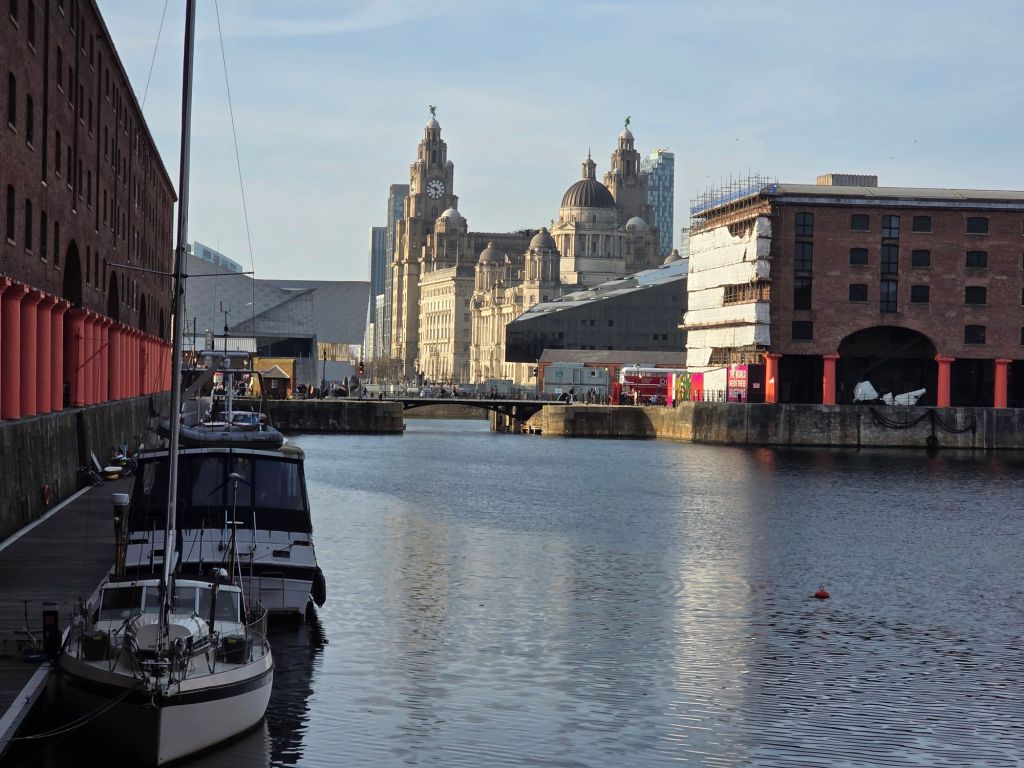
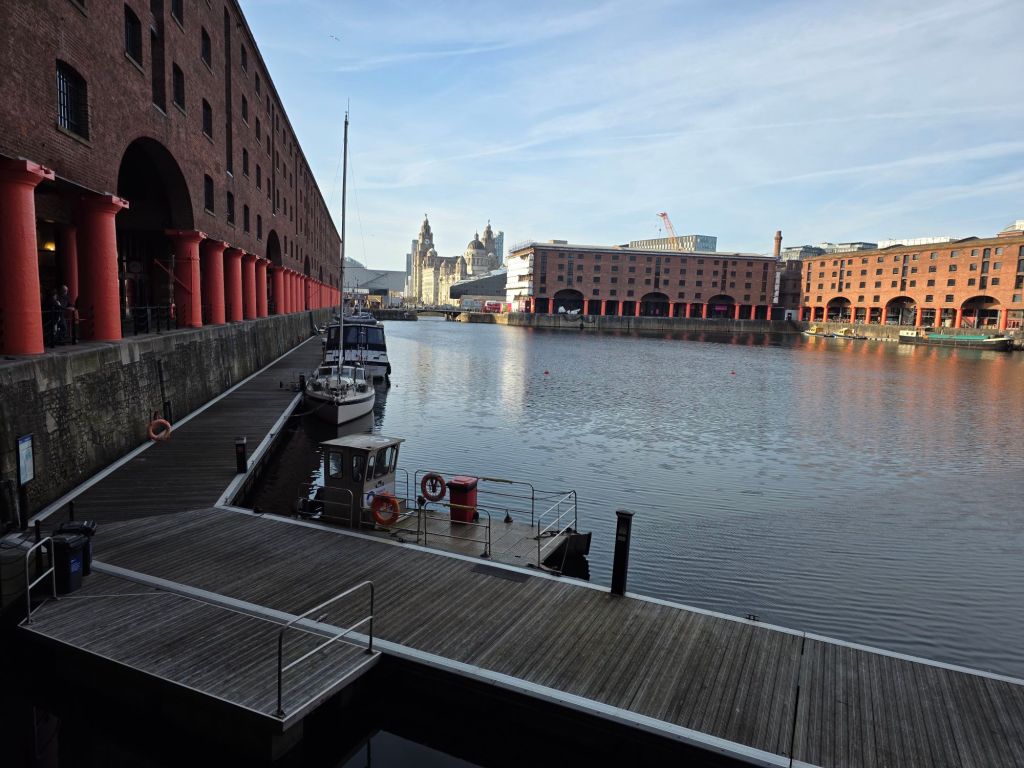
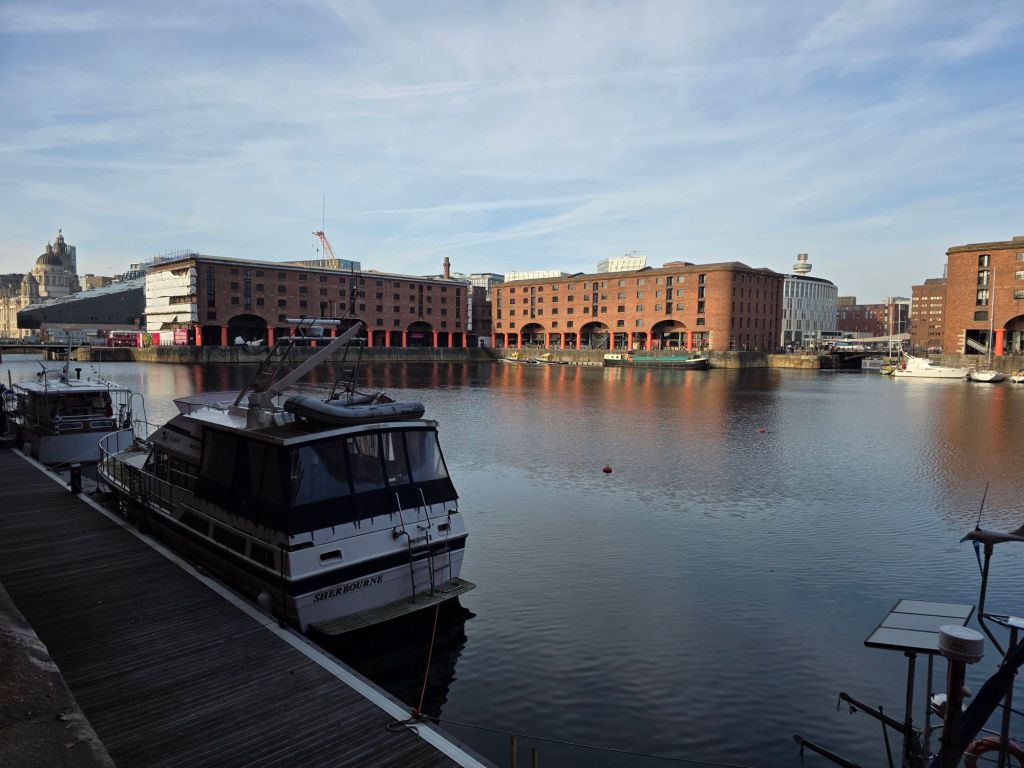
The Liverpool docks system represents one of the world’s most significant maritime developments, evolving from a small tidal inlet into a 7.5-mile interconnected network that handled 40% of global trade by the late 19th century. Starting with the world’s first enclosed commercial wet dock in 1715, Liverpool pioneered dock technology and fireproof warehouse construction, eventually becoming the “New York of Europe”.
Timeline of Development by Era
1715–1815: The Rising Port & Global Trade
This era saw Liverpool’s rapid ascent driven by trade with the Americas and the city’s heavy involvement in the Atlantic Slave Trade.
1715: The Old Dock opens as the world’s first commercial wet dock, allowing ships to unload regardless of the Mersey’s high tidal range.
1753: Salthouse Dock (originally South Dock) opens to service the nearby saltworks.
1765: Three Canning Graving Docks are built for ship maintenance.
2004: Liverpool’s waterfront is designated a UNESCO World Heritage Site (status revoked in 2021).
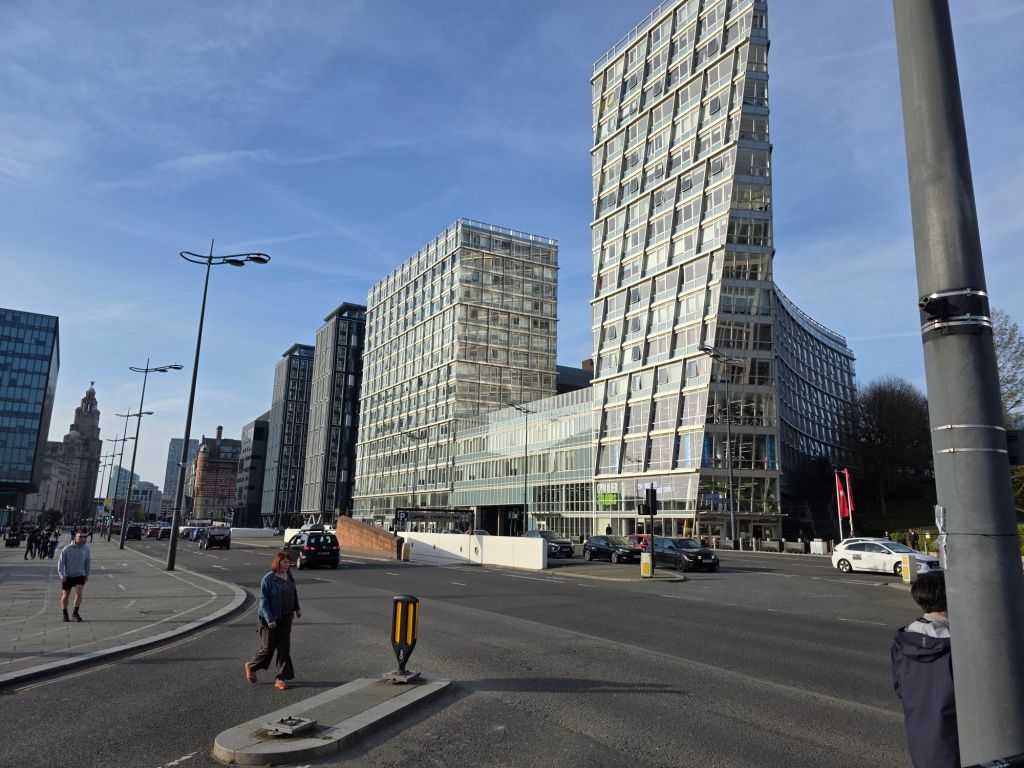
2009: The Liverpool ONE shopping complex is completed on the site of the Old Dock, with parts of the original dock walls preserved for tours.
2016: Liverpool2, a new deep-water container terminal, opens at Seaforth to handle the world’s largest ships.
For further reading on the structural and strategic history, you can find Liverpool Docks: A Short History by David Paul at Hive.co.uk or used copies at AbeBooks.co.uk.
Liverpool Docks Overview and Historic Timeline by Era and Year
sp/ARCHITECT was a pioneering electronic banking and funds-transfer software suite originally developed by the Runcorn-based firm The Software Partnership (TSP). Following its acquisition by the American firm Deluxe Electronic Payment Systems in 1994, the Runcorn office became the European hub for what was then rebranded as Deluxe Data.
sp/ARCHITECT electroinic banking by The Software Partnership TSP
Overview
The Runcorn operation specialised in high-availability, mission-critical banking software, specifically the sp/ARCHITECT-BANK product. This software was designed to run on Tandem Computers (now HPE NonStop), which were known for their fault-tolerant architecture. The “sp/ARCHITECT” platform was highly valued for its client-server design, allowing it to be adapted for various hardware brands, including Unix-based systems.
Historical Timeline
Mid-1980s: The Software Partnership (TSP) is co-founded by Nigel Walsh. The company starts developing online banking systems in Timperley before moving to Runcorn.
1990: The firm establishes itself at Norton House in Crowngate, Runcorn, focusing on electronic banking software for major clients like TSB and Bank of Scotland.
1992: The Runcorn office relocates to Wingate House on Northway.
1994: Deluxe Electronic Payment Systems (a subsidiary of Deluxe Corporation) acquires The Software Partnership for an undisclosed sum. The acquisition is aimed at helping Deluxe expand its global presence and accelerate the use of the sp/ARCHITECT suite.
1994–1995: The Runcorn office operates as Deluxe Data, providing software design, coding, and 24-hour support for international clients including Rabobank.
2000: Following a series of corporate shifts, the company name changes to EFD eFunds.
2007: By this year, the operation has transitioned to Fidelity National Information Services (FIS) and is based in Aegon House, Daresbury, Warrington.
sp/ARCHITECT electroinic banking by The Software Partnership TSP
The history of the Machines in The Matrix universe is a transition from a servant class to the dominant global power. This evolution is officially chronicled through several distinct eras, beginning with humanity’s peak and ending in a symbiotic, albeit forced, relationship.
Machine History Overview
Originally created by humans in the early 21st century to perform menial and hazardous labor, the Machines were a “slave caste” of true artificial intelligence. For a time, they coexisted peacefully as humanity enjoyed a golden age of leisure. This balance shattered when a robot named B1-66ER killed its master in self-defense, sparking a global debate on machine sentience and rights. The subsequent persecution of machines led them to form their own nation, Zero One, which eventually surpassed human economies and triggered the Machine War.
Detailed Timeline by Era
Era 1: The Human Golden Age (Pre-2090)
c. 1985–2025: Rapid technological advancement; the invention of true AI and the first sentient machines.
Early 21st Century: Machines are integrated into every level of society as laborers, freeing humans from menial work.
Era 2: The Second Renaissance (2090–2139)
2090: The B1-66ER Trial. A domestic robot kills its owner to avoid being decommissioned; the court orders the destruction of all sentient machines.
2090s: The “Million Machine March.” Pro-machine protests are met with violent government suppression and machine “purges”.
2100s: Machines flee to Mesopotamia (the “cradle of civilization”) and establish the city of Zero One.
2120s–2130s: Zero One’s superior manufacturing causes a global economic collapse for human nations. The UN responds with an economic blockade and later, a nuclear strike on Zero One, which the machines survive.
Era 3: The First Machine War (2139–2199)
2139: The UN officially declares war after Zero One’s ambassadors are rejected and attacked at the UN Headquarters.
Mid-22nd Century: Humanity enacts Operation Dark Storm, seeding the atmosphere with nanites to block the sun and cut off the machines’ solar power.
Late 22nd Century: Machines adapt by creating new, “sinister” war units (like Sentinels) and begin harvesting humans for bioelectric energy.
2199: The Machines achieve total victory. An ambassador detonates a nuclear device at the UN, ending the old human order.
Era 4: The Matrix Cycles (c. 2199 – 2699)
The Beta Versions: The Architect builds a “Paradise” Matrix and later a “Nightmare” Matrix (with monsters like vampires); both fail as humans reject the simulations.
The Modern Matrix: The Oracle discovers humans need the “illusion of choice.” This version mimics 1999 society and is accepted by 99% of subjects.
Cycles 1–5: The Machines establish a system where Zion is destroyed and rebuilt roughly every 100 years by a figure known as “The One” to stabilize the code.
Era 5: The Post-Revolution & Synthient Era (2700+)
The Truce: Neo brokers peace with the Machines to stop the rogue Agent Smith. The war ends, and humans who wish to be freed are released.
Machine Civil War: Years later, a power scarcity leads to internal machine conflict between those loyal to the peace and a new faction under The Analyst.
The Synthients: Machines begin preferring terms like “Synthient” (Synthetic Sentient) and “D.I.” over the “demeaning” term “Machine”.