

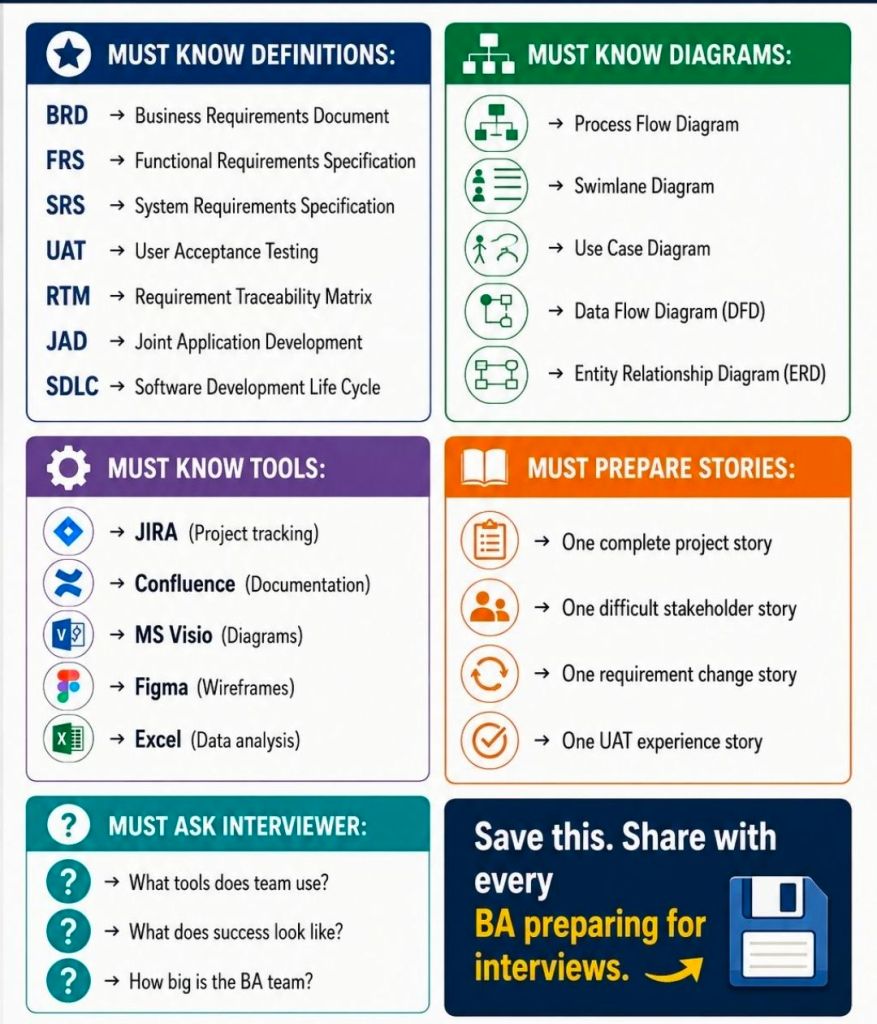
Business Analyst (BA) interview prep focuses on demonstrating how you translate business problems into technical/process solutions. Preparation revolves around three core pillars: competence (technical knowledge), communication (behavioral stories), and cultural fit.
1. Technical & Core Knowledge Prep
Familiarize yourself with the fundamental BA methodologies, documentation, and tools:
- Methodologies: Understand the differences between Agile (Scrum, Kanban, sprints, user stories) and Waterfall (structured phase-gating).
- Documentation: Review how to create a Business Requirements Document (BRD), Functional Requirements Document (FRD), and Software Requirements Specification (SRS).
- Process Modeling: Refresh your knowledge on reading and creating Use Cases, User Stories, and UML diagrams (Activity diagrams, Flowcharts).
- Requirements Gathering: Be ready to discuss techniques like interviews, workshops, prototyping, and document analysis.
2. Behavioral & Scenario Prep (The STAR/STARS Method)
Expect situational questions that require you to tell a story about your past experience. Structure your answers using the STAR method (Situation, Task, Action, Result):
- Conflict Resolution: How do you align stakeholders with opposing views or conflicting priorities?
- Scope Creep: How do you manage a stakeholder requesting major changes midway through a project?
- Ambiguity: Tell me about a time you had to work with limited data or changing requirements.
- Failure/Mistakes: Describe a time you made an analytical error or missed a requirement and how you resolved it.
3. Interview Action Items Checklist
- Work Samples: Bring a physical or digital portfolio containing redacted work samples (e.g., a process flow, user story backlog, or requirements document you’ve built).
- The 30-60-90 Day Plan: Think about how you would approach the first few months on the job. (e.g., Day 1-30: Learn the business domain; Day 31-60: Map current processes; Day 61-90: Identify optimization opportunities.)
- Reverse Questions: Prepare engaging questions to ask the interviewer, such as: “What does success look like in this role in the first 6 months?” or “Can you share more about how BAs collaborate with the technical team here?”


