

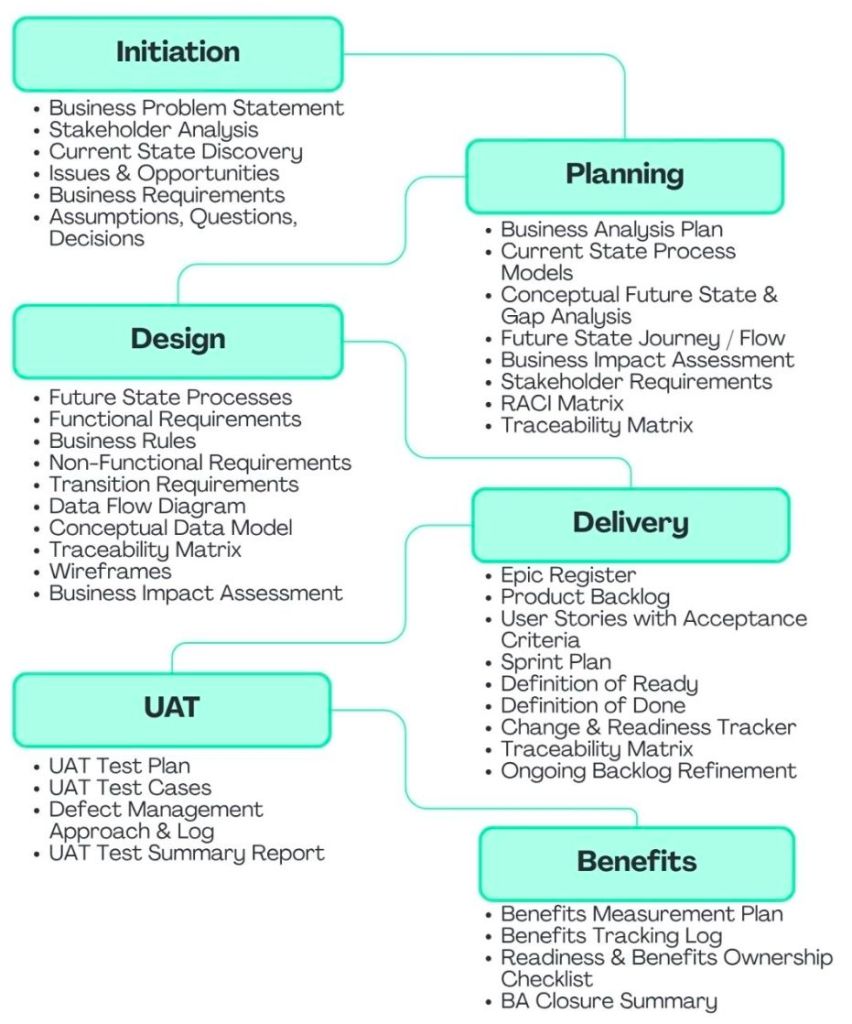
Business analyst deliverables are essential documentation and artifacts produced throughout a project to define business needs, bridge gaps between stakeholders and technical teams, and ensure solutions deliver value. Key deliverables include the Business Case, Stakeholder List, Requirement Packages (BRD/User Stories), Process Models, and Transition Requirements.
Core Business Analyst Deliverables by Phase:
- Initiation/Discovery:
- Business Case: Outlines the justification for the project, including cost-benefit analysis and ROI.
- Problem Statement/Project Scope: Defines the “why” and boundaries of the project.
- Stakeholder Map/Matrix: Identifies key stakeholders and their influence.
- Planning:
- Business Analysis Plan: Outlines the approach, tasks, and techniques to be used.
- Communication Plan: Defines how stakeholders will receive updates.
- Elicitation & Analysis:
- Current State Assessment (As-Is): Documents how processes work today.
- Future State Modeling (To-Be): Visualizes the desired future processes.
- Gap Analysis: Details what needs to change to get from current to future state.
- Business Requirements Document (BRD): A formal document detailing what the business needs to achieve.
- Solution Definition (Design & Implementation):
- Functional/Non-Functional Requirements (SRS): Technical details on how the system should act.
- Use Cases/User Stories: Detailed scenarios of user interactions with the system.
- Prototypes/Wireframes: Visual representations of user interfaces.
- Product Backlog (Agile): A prioritized list of user stories.
- Evaluation & Closure:
- Acceptance Criteria & Test Cases: Defines the criteria for a completed feature.
- Solution Assessment/Validation Report: Evaluates if the delivered solution met the needs.
- Lessons Learned/Closing Report: Documents successes and improvements for future projects.
Key Takeaways:
- Formal vs. Informal: Plan-driven (Waterfall) projects use heavy formal documentation (BRD, SRS), while change-driven (Agile) projects focus on lighter tools like user stories, Jira tickets, and prototypes.
- Value-Driven: Deliverables exist to facilitate communication, align stakeholders, and ensure project success.
Note: The specific deliverables required are usually determined in the initial project planning stage.


