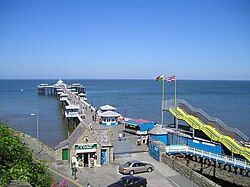
Llandudno Pier, often called the “Queen of Welsh Piers”, is the longest pier in Wales at 2,295 feet (700 metres). It is a Grade II* listed structure renowned for its Victorian and Edwardian elegance, featuring ornate ironwork and classic kiosks.
Llandudno Pier, often called the “Queen of Welsh Piers”, is the longest pier in Wales
Historical Timeline by Era
Early Origins (The Pre-Pier Era)
1858: A short wooden pier (242 ft) was built by the St George’s Harbour and Railway Company to export limestone.
1859: This original structure was severely damaged by the “Royal Charter Storm”.
1860–1875: Though repaired, the wooden pier was too short for steamships except at high tide.
Towyn is a prominent seaside resort in Conwy, North Wales, traditionally known as a tourism hub with a high concentration of holiday parks and a history defined by its relationship with the Irish Sea. Historically, the town is most noted for the catastrophic 1990 floods, which reshaped local coastal defence policy across Britain. Today, it continues to evolve as a key destination for family holidays, with multi-million-pound investments in leisure facilities planned through 2026.
Historical Timeline of Towyn
Early Origins & Parish Formation (1800s)
1800s: Towyn begins developing as a tourism destination, largely due to its proximity to the established hub of Rhyl.
17 June 1873:St Mary’s Church, designed by renowned architect George Edmund Street, is consecrated. It is famous for its distinctive roof tiling.
22 September 1873: The Parish of Towyn is officially created, comprising the township of Towyn and parts of Cegidog Isaf, Bodoryn, and Bodtegwal.
Tourism Growth & Mid-Century Development (1900–1980s)
Early 1900s: The town’s reputation as a “sunny coastline” (from the Welsh word Tywyn for sand dunes) solidifies it as a popular holiday spot.
29 July 1960:Towyn Development Co. Limited is incorporated, marking a period of formalized commercial development in the area.
1960s–1980s: Continued expansion of caravan and holiday parks, making tourism the town’s primary economic engine.
The 1990 Flood Disaster & Recovery
26 February 1990 (11:00 AM): A 400-metre breach of the sea wall occurs due to a 1.5m storm surge, gale-force winds, and high tides.
February – March 1990: Approximately 2,800 properties are flooded across 10 square km; up to 6,000 residents are evacuated.
1 March 1990: Prince Charles and Princess Diana visit the disaster site.
Post-1990: Massive reconstruction of coastal defences begins, utilizing massive rock revetments to absorb wave impact.
Modern Era & Future Outlook (2010–2026)
2011 Census: Towyn’s population is recorded at 2,380.
November 2022:Tir Prince Raceway Ltd purchases the freehold of its 50-acre fairground and race track site, securing long-term investment for the town’s tourism.
August 2023: The Towyn and Kinmel Bay Place Plan is published, focusing on collaborative action for “placemaking” and sustainable transport.
April 2024: Multi-million-pound expansion plans are revealed for major holiday parks, including new leisure complexes.
February 2025: The town marks the 35th anniversary of the 1990 floods with reflections on coastal resilience.
March 2026: Target date for completion of several holiday park upgrades, including new high ropes courses and state-of-the-art leisure facilities.
Towyn overview and detailed annotated timeline history by era and year to 2026
The Trafford Centre, located in Greater Manchester, has evolved from a controversial planning proposal in the 1980s into one of the UK’s largest shopping and leisure destinations.
Pre-Opening & Construction (1984–1997)
1984: The concept for the Trafford Centre is first conceived by the Manchester Ship Canal Company (later Peel Holdings).
1986: Initial planning permission is sought for the Dumplington site.
1987–1992: A series of public inquiries are held due to significant opposition from local councils and competing shopping centres.
1993: Outline planning permission is granted, though it is immediately challenged in the High Court.
1995: After years of legal battles, the House of Lords officially upholds the planning permission, giving the final go-ahead.
1996: Construction begins on-site in May; by August, the assembly of the massive steel frame starts.
1997: The steel frame is completed, and significant progress is made on the ornate facade and interior.
The Early Years (1998–2005)
1998: The Trafford Centre officially opens on 10 September with 140,000 visitors on opening day. Key anchors include the first Selfridges store outside London.
1999: The centre gains international attention when Monica Lewinsky visits for a book signing tour.
2001: A major Marks & Spencer store opens.
2005: The four-storey John Lewis & Partners opens in May, replacing the original “Festival Village” area.
Expansion & Ownership Changes (2006–2019)
2007:The Great Hall dining area opens in March, featuring a 1930s steamship theme and one of the world’s largest chandeliers.
2008:Barton Square (now Trafford Palazzo) opens in March as a dedicated homewares and furniture wing.
2010: LEGOLAND Discovery Centre opens within Barton Square.
2011: Peel Group sells the centre to Capital Shopping Centres (CSC) for £1.6 billion, the largest single property transaction in British history at the time.
2013: Following a corporate rebrand of CSC, the mall is renamed intu Trafford Centre in February; SEA LIFE Manchester also opens this year.
2018: The centre celebrates its 20th anniversary with record footfall.
Modern Era & Redevelopment (2020–Present)
2020: Developer Intu Properties enters administration in June. Ownership is transferred to the Canada Pension Plan Investment Board (CPPIB) in December.
2021: Barton Square is legally separated and re-acquired by the original developer, Peel L&P, who rebrands it as Trafford Palazzo.
2022: As part of an overhaul by new asset managers Pradera Lateral, the decorative pool in the Orient is removed.
2023: The centre celebrates its 25th anniversary with a special show headlined by 90s pop group B*Witched.
2024: Major new tenants are announced, including a massive Inditex flagship (Zara, Bershka, and Pull&Bear) taking over the former M&S site.
2025: Significant retail reshuffling continues with the opening of a massive new Zara and the first Sephora in the North of England.
The Trafford Centre is a major shopping and leisure destination in Manchester, famous for its grand Baroque architecture.
Sunday Hours (Sunday 8 March 2026)
Shops: 12:00 PM – 6:00 PM
Dining & Leisure: 12:00 PM – 6:00 PM (times for individual venues like the cinema or restaurants may vary)
Events & Attractions
Science Fair: A free family event featuring experiments and robots is currently running until 6:00 PM today.
Holi Festival of Colours: A celebration of music and well-being scheduled for Saturday 14 March at Orient Car Park 12.
Leisure Hub: Home to an ODEON cinema, SEA LIFE Manchester, Paradise Island Adventure Golf, and Namco Funscape.
Shopping & Dining
Popular Brands: Key stores include Selfridges, John Lewis, Zara, Apple, and Next.
Dining Hubs:The Orient and The Great Hall host over 60 eateries, including Hello Oriental, Archie’s, Five Guys, and Wingstop.
New for 2026: Standalone stores for The White Company, Shake Shack, and expanded locations for Stradivarius and Foot Asylum are opening this spring.
Manchester’s technical history is defined by its evolution from the world’s first industrial city to a global hub for computing and material science.
18th Century: The Birth of Industry
1733:John Kay invented the Fly Shuttle, a key advancement in weaving.
1761: The Bridgewater Canal opened as Britain’s first man-made waterway independent of rivers, drastically reducing coal costs.
1764–1779:James Hargreaves invented the Spinning Jenny (1764), and Samuel Crompton created the Spinning Mule (1779), allowing for mass textile production.
1783:Richard Arkwright established Manchester’s first steam-powered mill.
1790:Piccadilly Mill became the first in the city to be powered directly by a steam engine.
19th Century: Engineering & Precision
1803:John Dalton published his Atomic Theory at the Manchester Literary & Philosophical Society.
Bolton’s evolution from a small moorland settlement to a world-leading industrial powerhouse and modern metropolitan borough is marked by these key milestones:
Bolton’s technical and industrial evolution shifted it from a medieval market town to a global leader in cotton spinning and engineering, before transitioning into a modern educational and service hub.
Bolton’s transformation was driven by local inventors whose technical breakthroughs redefined the textile industry.
1779:Samuel Crompton invented the Spinning Mule at Hall i’ th’ Wood, combining earlier technologies to produce high-quality yarn.
1780: The town’s first spinning mill opened, marking the start of large-scale mechanised production.
1820:Thomas Bonsor Crompton patented a method for continuously drying paper, a major technical breakthrough for the local paper industry.
1828: One of the world’s first railways, the Bolton and Leigh Railway, opened using George Stephenson’s locomotive “The Witch”.
1873: The Bolton Town Hall opened, a massive Victorian architectural project reflecting the town’s industrial wealth.
Modern Infrastructure & Power (1880 – 1950)
Technical focus shifted toward municipal services, electricity, and the zenith of the cotton industry.
1880: Horse-drawn municipal transport began, followed by a telephone connection between Bolton and Manchester.
1894: The first electric power station opened at Spa Road on October 31st.
1899: The town launched its first electric tram service.
1914: The Back o’ th’ Bank electricity generating station began supplying the town.
1929: Bolton reached its industrial peak with 216 cotton mills in operation.
Education & Re-development (1960s – Present)
As the cotton industry declined, Bolton pivoted toward technical education and retail-led regeneration.
1963: The Bolton Technical College split into Bolton Technical College and the Bolton Institute of Technology (the precursor to the University of Bolton).
Leigh, a historic market town in South Lancashire, evolved from a collection of medieval agricultural townships into a powerhouse of the Industrial Revolution. Below is a timeline of its development.
Early History & Foundations
Ancient Origins: Neolithic stone axes and Bronze Age spearheads suggest activity as early as 1500–1000 BC.
Medieval Growth: The name “Leigh” (Saxon for “meadow” or “pasture”) was recorded as Leech in 1264. The town was the centre of an ecclesiastical parish including the townships of Bedford, Pennington, and Westleigh.
1642: During the English Civil War, local “Chowbenters” (men from nearby Atherton) defeated Royalist troops in a battle at Leigh on 2nd December.
1651: The Earl of Derby spent his final night at the King’s Arms in Leigh before his execution in Bolton.
Industrial Revolution & Expansion
1795: The Bridgewater Canal was extended to Leigh, linking the town to Manchester’s industrial network.
1820: The Leigh Branch Canal opened, connecting the town to the Leeds and Liverpool Canal.
1828: The Bolton and Leigh Railway opened—the first public railway in Lancashire.
1839: The “Leigh Feight” occurred on 14th August, a major Chartist protest and riot involving over 2,000 people.
1850s: The Leigh Union Workhouse was established at Atherleigh.
Late 19th Century: Large multi-storey cotton mills like Leigh Spinners (Grade II*) and Mather Lane Mill (Grade II) transformed the skyline.
Civic Development
1875: The townships of Bedford, Pennington, and Westleigh merged to form the Leigh Local Board.
1894: Leigh became an Urban District.
1899: Leigh was granted a Royal Charter, becoming a Municipal Borough.
1907: The current Leigh Town Hall was completed on Market Street.
1920:Pennington Hall and its grounds were gifted to the people of Leigh, eventually becoming Pennington Park.
Modern Era
1974: Under the Local Government Act 1972, the Municipal Borough was abolished and Leigh became part of the Metropolitan Borough of Wigan in Greater Manchester.
1992: The last coal mines in the area, Bickershaw and Parsonage Collieries, closed on 13th March.
2016: The Leigh-Salford-Manchester Guided Busway opened to provide rapid transit to Manchester city centre.
2023: The Leigh Leopards rugby league team won the Challenge Cup for the first time in 52 years.
Leigh’s history is a classic Lancashire tale of transition from a rural collection of townships to an industrial powerhouse. Here is a timeline of its most significant milestones:
Early Origins & Medieval Period
Stone Age & Roman Era: Archaeological finds in the area include a Stone Age axe in Pennington and a Roman coin in Bedford.
12th Century: The name “Leigh” (from the Old English leah, meaning a woodland clearing) appears in records. The ancient parish originally consisted of six townships: Astley, Atherton, Bedford, Pennington, Tyldesley cum Shakerley, and Westleigh.
1189–1199: Higher Hall, the manor house of Westleigh, dates back to the reign of Richard I.
Conflict & Industrial Revolution
1642: During the English Civil War, local Parliamentarians (the “Chowbenters”) defeated Royalist troops in the Battle of Leigh.
1760s: Local legend attributes the invention of the spinning jenny and the water frame to Thomas Highs of Leigh, marking the start of its textile dominance.
1795–1820: The Bridgewater Canal was extended to Leigh (1795), followed by the Leigh branch of the Leeds and Liverpool Canal (1820), making the town a critical hub for coal and textiles.
1828: The Bolton and Leigh Railway opened for freight, becoming the first public railway in Lancashire.
1839: The “Leigth Feight” occurred on 14 August, when a mob of 2,000 Chartist strikers clashed with troops over high unemployment and living costs.
Civic Development & Modern Era
1875: The townships of Bedford, Pennington, and Westleigh merged to form the Leigh Local Board, officially adopting “Leigh” as the town’s name.
1899:Leigh was granted a Royal Charter to become a Municipal Borough.
1907: The current Leigh Town Hall, designed by J.C. Prestwich, was completed.
1911: The textile industry peaked, with over 6,000 people employed in the town’s mills.
1974: Under local government reorganisation, Leigh ceased to be an independent borough and became part of the Metropolitan Borough of Wigan in Greater Manchester.
2008: The Leigh Sports Village opened, providing a modern home for the Leigh Leopards rugby league team.
2016: The Leigh-Salford-Manchester guided busway opened, re-establishing a rapid transport link to Manchester.
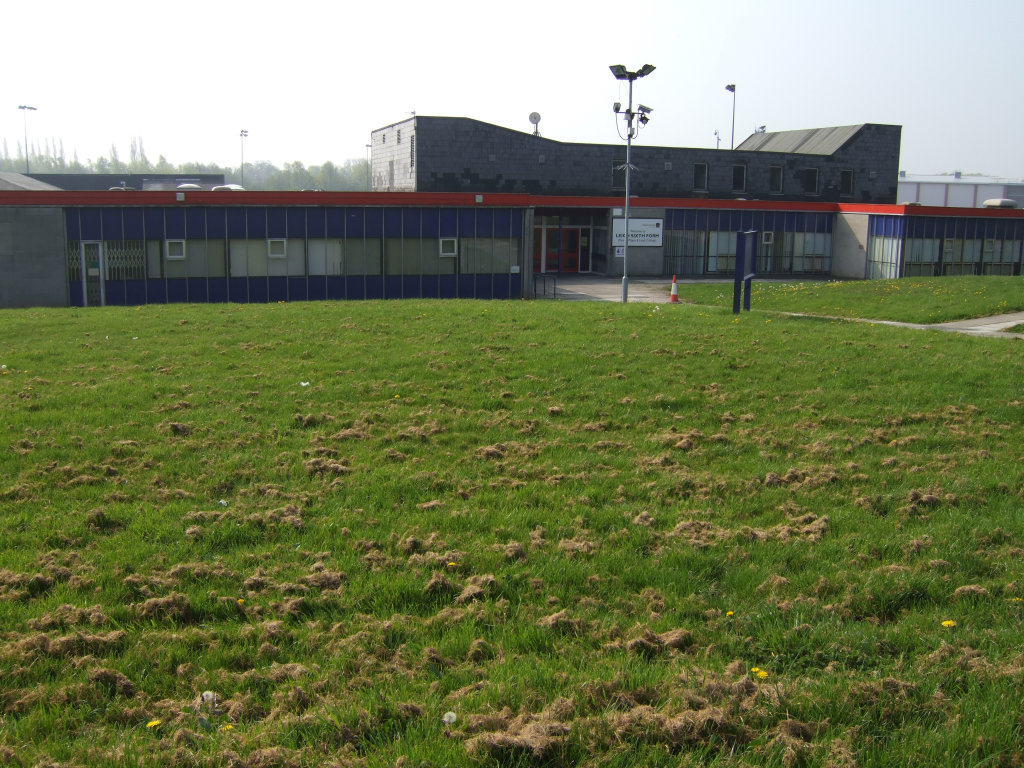
Leigh College, Marshall Street, Leigh, Lancs
Building below demolished 2007 and now rebuilt at the Leigh Sports Village – 1, 2, 3, 4 article by Julie McKiernan courtesy of PastForward, produced by Wigan Archives & Museums, Issue No. 97, August – November 2024, Marking 50 years of the borough, Wigan and Leigh’s local history magazine – Address: Past Forward, Archives, Wigan & Leigh, Leigh Town Hall, Mark Street, Leigh, WN7 1DY
Salford Quays has evolved from a largely empty landscape of racecourses and medieval halls into one of the UK’s most significant urban regeneration projects.
1986–1990: Massive infrastructure programme: polluted dock water is separated by bunds, and a compressed air mixing system (Helixor) is installed to improve water quality.
1987: Introduction of 12,000 coarse fish to the now-cleaned waterways.
1989: Opening of the Mariners Canal to link the Ontario and Erie Basins.
1999: Completion of major bridge works and the Metrolink extension, connecting the Quays to Manchester city centre.