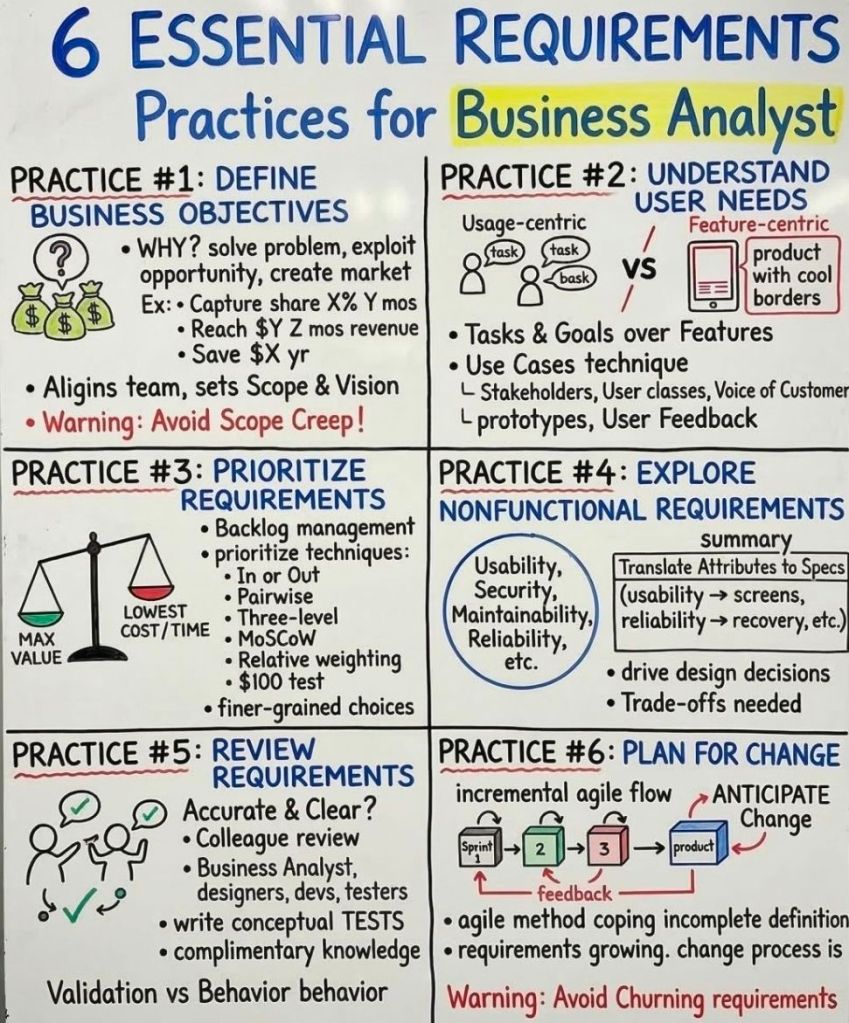
In the PRINCE2 project management methodology, Themes (renamed to Practices in the 7th edition released in 2023) are the seven functional areas of project management that must be addressed continuously throughout the project lifecycle. They provide a structured framework for managing key aspects like cost, risk, and quality to ensure the project remains on track.
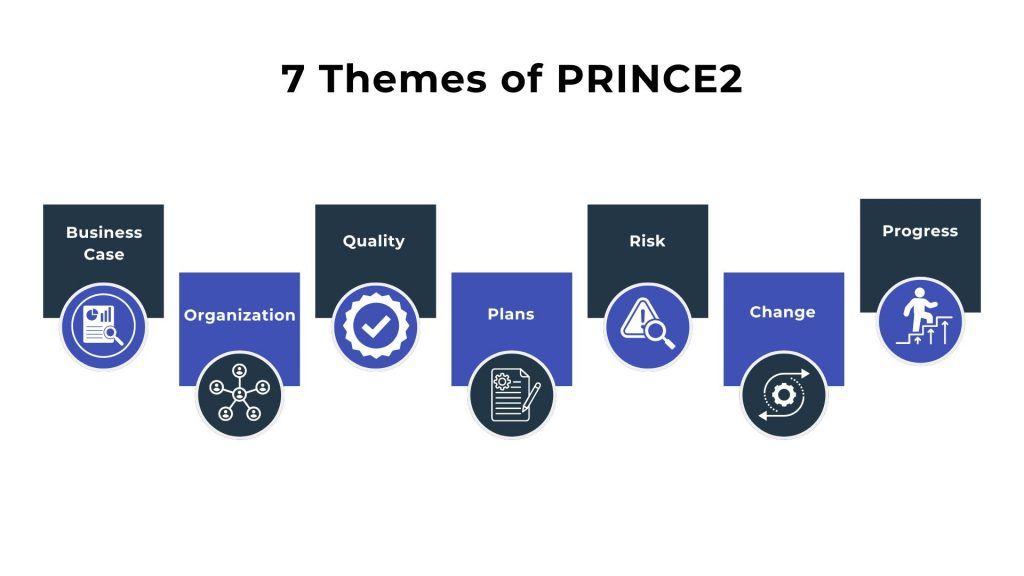
7 Themes / Practices of PRINCE2
Overview of the Seven Themes (Practices)
Business Case: Focuses on the “Why” of the project. It establishes the justification for the investment and ensures the project remains desirable, viable, and achievable.
Organisation: Addresses the “Who” by defining the project’s structure of accountability and responsibilities. It identifies key stakeholders and establishes the project management team.
Quality: Focuses on the “What” by defining the user’s requirements and quality standards. It ensures that deliverables are fit for purpose and meet stakeholder expectations.
Plans: Describes the “How,” “How Much,” and “When”. This theme provides techniques for creating project, stage, and team plans to facilitate communication and control.
Risk: Manages the “What If” by identifying, assessing, and controlling uncertainties that could impact the project’s objectives, whether they are threats or opportunities.
Change (Issues): Deals with the impact of changes and unexpected events. It provides a formal process for capturing, assessing, and controlling requests for change to project baselines.
Progress: Evaluates “Where are we now?” versus “Where are we going?”. It establishes mechanisms to monitor actual achievements against planned outcomes and manage deviations through tolerances.
Key Concepts and Terminology
Continuous Application: Unlike processes, which follow a sequence, themes are applied simultaneously throughout the project.
Tolerances: Each theme uses tolerances (allowable deviations for time, cost, quality, etc.) to support the principle of Manage by Exception.
PRINCE2 7 Updates: The latest edition introduces Sustainability as a 7th performance target and emphasizes People as a core element alongside Principles, Practices, and Processes.
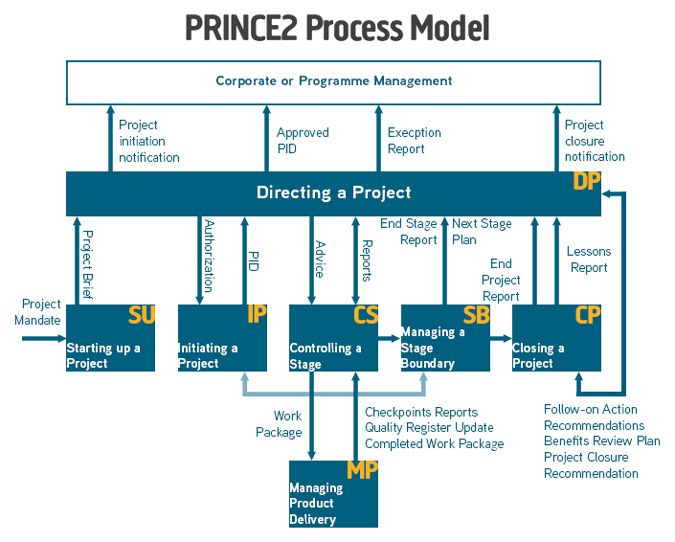
The PRINCE2 process model provides a structured, process-driven roadmap for managing a project from its initial conception to formal closure. It consists of seven core processes that define specific activities, responsibilities, and decision points across the project lifecycle.
The 7 PRINCE2 Processes
The processes are designed to ensure control and align with the project’s management levels:
Starting Up a Project (SU): A pre-project process that filters out unviable ideas. It focuses on confirming if there is a “viable and worthwhile” business case and appoints the Project Manager and Executive.
Directing a Project (DP): Spans the entire project from start to finish. It is the responsibility of the Project Board, which provides strategic oversight, makes key decisions (e.g., authorising stages), and manages by exception.
Initiating a Project (IP): Occurs during the first management stage. It involves detailed planning to establish solid foundations, resulting in the Project Initiation Documentation (PID), which includes the project plan, risk management approach, and full business case.
Controlling a Stage (CS): Focuses on the Project Manager’s day-to-day management of a stage. This includes assigning work to teams, monitoring progress, and dealing with issues or risks within agreed tolerances.
Managing Product Delivery (MP): Governs the link between the Project Manager and Team Managers. It is where the “specialist products” (actual deliverables) are created, quality-checked, and delivered.
Managing a Stage Boundary (SB): Occurs at the end of each management stage (except the final one). The Project Manager reviews the current stage, updates the project plan and business case, and plans the next stage for Board approval.
Closing a Project (CP): Ensures an orderly end to the project. It confirms that objectives have been met, products have been accepted by the user, and lessons are captured before the project is formally disbanded.
Hierarchy of Management Levels
The process model operates across four distinct levels of authority:
Corporate or Programme Management: Sets the initial project mandate.
Directing (Project Board): Responsible for overall governance and major decisions (Directing a Project).
Managing (Project Manager): Handles daily management and stage control (Controlling a Stage, Initiating a Project).
Delivering (Team Members/Managers): Focuses on creating the physical products (Managing Product Delivery).
Key Characteristics
Management Stages: Projects are broken into at least two stages (Initiation and at least one Delivery stage) to provide “stop/go” decision points.
Triggers: Each process is activated by a specific trigger, such as a “Project Mandate” from corporate management to start the SU process.
Management Products: These are documents like the Business Case, Project Brief, and Highlight Reports used to facilitate control and communication.
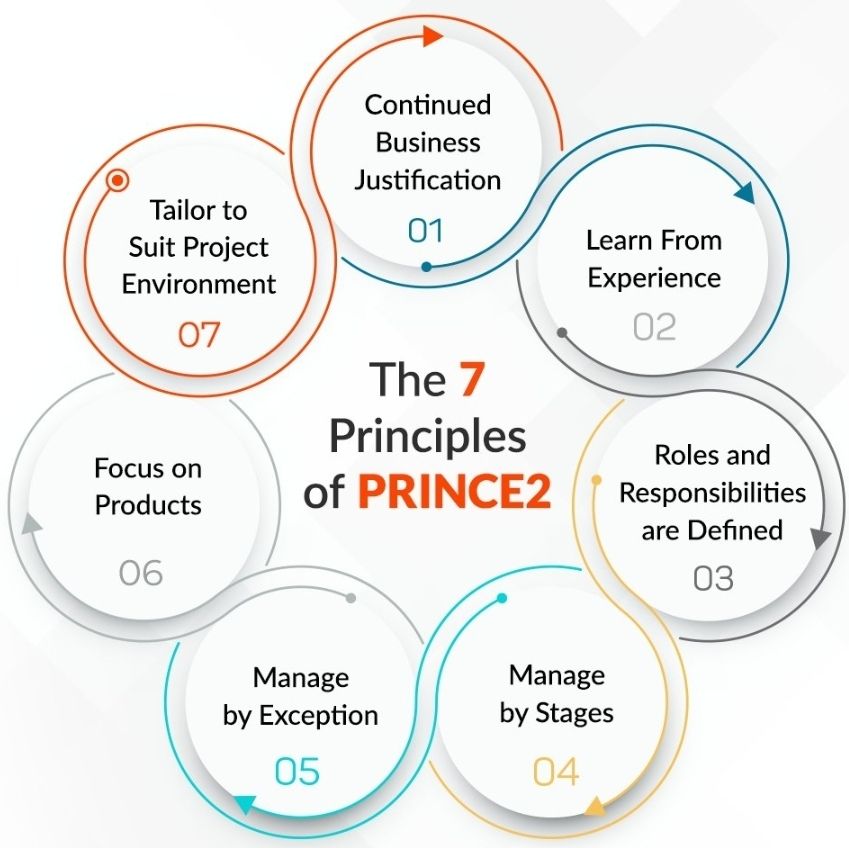
PRINCE2 framework is built on seven core principles
The PRINCE2 (PRojects IN Controlled Environments) framework is built on seven core principles that serve as guiding obligations for any project using this methodology. For a project to be considered a “PRINCE2 project,” all seven must be applied.
Continued Business Justification: A project must have a valid reason to start and must remain justified throughout its lifecycle. This is documented in a Business Case, which is regularly reviewed to ensure the project remains viable, desirable, and achievable.
Learn from Experience: Project teams are required to seek out lessons from previous projects and record new lessons as the current project progresses. A Lessons Log is typically used to capture these insights.
Defined Roles and Responsibilities: Every person involved must understand what is expected of them and who is responsible for specific tasks. PRINCE2 defines a clear management hierarchy: Project Board (Direction), Project Manager (Management), and Team Manager (Delivery).
Manage by Stages: Projects are broken down into manageable chunks called management stages. Each stage acts as a “stop/continue” decision point for the Project Board to assess progress before committing more resources.
Manage by Exception: Senior management (Project Board) only intervenes when the project deviates beyond agreed tolerances for time, cost, quality, scope, risk, or benefits. This empowers the Project Manager while ensuring efficient use of executive time.
Focus on Products: The methodology prioritizes the definition and delivery of high-quality products (outputs) rather than just completing activities. Product descriptions specify the quality criteria and requirements for each deliverable.
Tailor to Suit the Project: PRINCE2 is not a rigid “one-size-fits-all” approach; it must be adapted to the project’s specific scale, complexity, and environment. Tailoring ensures that the controls are appropriate for the level of risk involved.
Towyn is a prominent seaside resort in Conwy, North Wales, traditionally known as a tourism hub with a high concentration of holiday parks and a history defined by its relationship with the Irish Sea. Historically, the town is most noted for the catastrophic 1990 floods, which reshaped local coastal defence policy across Britain. Today, it continues to evolve as a key destination for family holidays, with multi-million-pound investments in leisure facilities planned through 2026.
Historical Timeline of Towyn
Early Origins & Parish Formation (1800s)
1800s: Towyn begins developing as a tourism destination, largely due to its proximity to the established hub of Rhyl.
17 June 1873:St Mary’s Church, designed by renowned architect George Edmund Street, is consecrated. It is famous for its distinctive roof tiling.
22 September 1873: The Parish of Towyn is officially created, comprising the township of Towyn and parts of Cegidog Isaf, Bodoryn, and Bodtegwal.
Tourism Growth & Mid-Century Development (1900–1980s)
Early 1900s: The town’s reputation as a “sunny coastline” (from the Welsh word Tywyn for sand dunes) solidifies it as a popular holiday spot.
29 July 1960:Towyn Development Co. Limited is incorporated, marking a period of formalized commercial development in the area.
1960s–1980s: Continued expansion of caravan and holiday parks, making tourism the town’s primary economic engine.
The 1990 Flood Disaster & Recovery
26 February 1990 (11:00 AM): A 400-metre breach of the sea wall occurs due to a 1.5m storm surge, gale-force winds, and high tides.
February – March 1990: Approximately 2,800 properties are flooded across 10 square km; up to 6,000 residents are evacuated.
1 March 1990: Prince Charles and Princess Diana visit the disaster site.
Post-1990: Massive reconstruction of coastal defences begins, utilizing massive rock revetments to absorb wave impact.
Modern Era & Future Outlook (2010–2026)
2011 Census: Towyn’s population is recorded at 2,380.
November 2022:Tir Prince Raceway Ltd purchases the freehold of its 50-acre fairground and race track site, securing long-term investment for the town’s tourism.
August 2023: The Towyn and Kinmel Bay Place Plan is published, focusing on collaborative action for “placemaking” and sustainable transport.
April 2024: Multi-million-pound expansion plans are revealed for major holiday parks, including new leisure complexes.
February 2025: The town marks the 35th anniversary of the 1990 floods with reflections on coastal resilience.
March 2026: Target date for completion of several holiday park upgrades, including new high ropes courses and state-of-the-art leisure facilities.
Towyn overview and detailed annotated timeline history by era and year to 2026
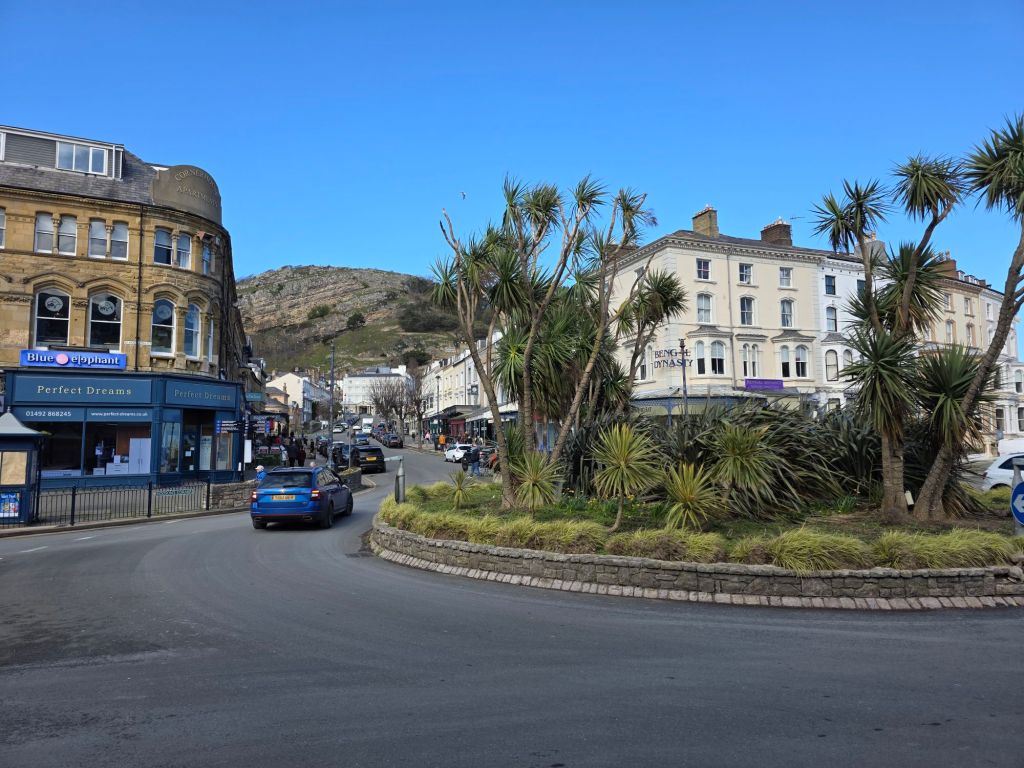
Llandudno, often called the “Queen of the Welsh Watering Places,” is a prominent seaside resort on the Creuddyn Peninsula in North Wales. Planned specifically as a mid-Victorian holiday destination, the town is renowned for its well-preserved 19th-century architecture, sweeping promenade, and the towering limestone headland of the Great Orme.
Town Centre, photo taken March 2026
Historical Timeline by Era
Ancient & Medieval (Prehistory – 1800s)
Bronze Age (c. 2000 BCE): Extensive copper mining begins on the Great Orme; these are now recognized as the world’s oldest known copper mines.
6th Century: St Tudno establishes a church on the Great Orme, giving the town its name (“Church of Saint Tudno”).
1284: King Edward I conveys the Manor of Gogarth to the Bishop of Bangor.
Early 1800s: Kashmiri goats are introduced to the Great Orme, later becoming an iconic symbol of the town.
The Victorian Transformation (1840 – 1901)
1840: St George’s Church is built to serve the growing village.
1848: Architect Owen Williams presents development plans to Lord Mostyn to turn the marshlands into a resort.
1858: The railway branch line from Llandudno Junction opens, making the resort accessible to wealthy tourists from Liverpool and Manchester.
1862: The Great Orme Lighthouse is built by the Mersey Docks and Harbour Board.
1877/1878: The Llandudno Pier opens (700 metres long) and the Marine Drive carriage road around the Great Orme is completed.
1887:Happy Valley is gifted to the town by Lord Mostyn for Queen Victoria’s Golden Jubilee.
1890s: A large Jewish community settles in Llandudno, escaping persecution in Eastern Europe.
Modern & Contemporary (1902 – 2026)
1902: The Great Orme Tramway—the UK’s only cable-operated street tramway—opens.
1914–1918 (WWI): Hotels are converted into hospitals; the 1st (North Wales) Brigade is headquartered here.
1940–1945 (WWII): The town hosts the Coast Artillery School and becomes a haven for those escaping the London Blitz.
1956: The electric tramway service to Colwyn Bay closes.
1963:The Beatles perform in Llandudno; the Welsh National Eisteddfod is held in Happy Valley.
1986: The first Llandudno Victorian Extravaganza is held to celebrate the town’s heritage.
1994/2006: The North Wales Theatre opens, later expanded and renamed Venue Cymru.
2017: A new lifeboat station is completed on the North Shore.
2022: Llandudno officially twins with Champéry, Switzerland.
2023–2026: Venue Cymru becomes the permanent home for the Welsh Open snooker tournament (February).
2026 (Scheduled):
February: Nick Beer 10K (Feb 15) and Welsh Open Snooker (Feb 23–Mar 1).
May: Victorian Extravaganza and Transport Festival (May 2–4).
June: Llandudno Triathlon & Duathlon (Jun 28).
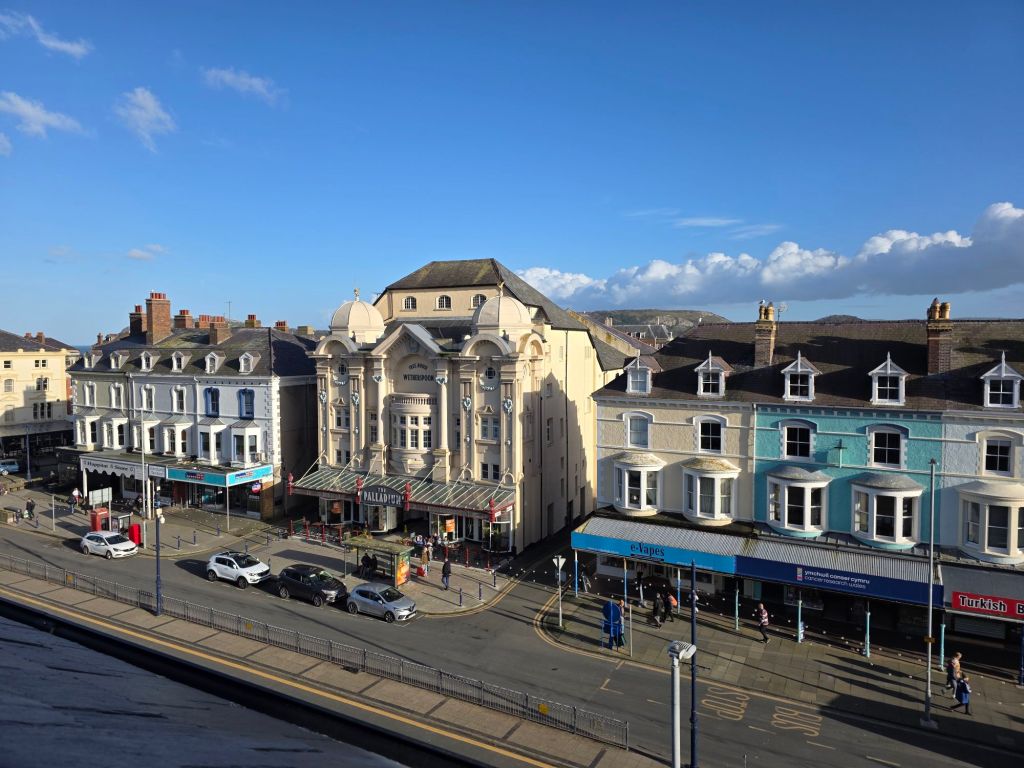
Wetherspoon pub reopens on 22nd August 2001 – photo as of March 2026
The Palladium in Llandudno, a Grade II listed building, was transformed into a JD Wetherspoon pub in 2001. The following timeline outlines its history from its origins as a grand theatre to its current use.
The Palladium Timeline
1920: The Palladium Theatre opens on the site of the former 1894 Market Hall. Designed by Arthur Hewitt, it originally featured 1,500 seats across three levels: stalls, dress circle, and balcony.
1972: The building is subdivided for multi-purpose use. Bingo is introduced in the former stalls area, while a 600-seat cinema occupies the circle area.
1999: The venue, then owned by Apollo Leisure, officially closes on 8th September.
2000: The building is purchased by JD Wetherspoon for conversion into a pub.
2001: Following a restoration project that returns the auditorium to a single open space, the Wetherspoon pub reopens on 22nd August – see picture above taken March 2026.
2012–2013: A significant restoration of the exterior is completed to maintain the building’s historic facade.
2024–2025: Wetherspoon invests approximately £1 million in a major refurbishment, focusing on the preservation and restoration of the heritage ceiling and the proscenium arch.
Visiting The Palladium
Location: Gloddaeth St, Llandudno LL30 2DD
Type: Wetherspoon Pub in a converted Grade II listed theatre.
Features: Retains original theatrical character including painted ceilings, balcony details, and original seating.
Hours: Generally open from 8:00 am daily, closing at midnight or 1:00 am on weekends.