

The transformation of Salford Quays from a major industrial inland port into a vibrant cultural, residential, and digital hub is one of the most successful urban regeneration stories in the UK.
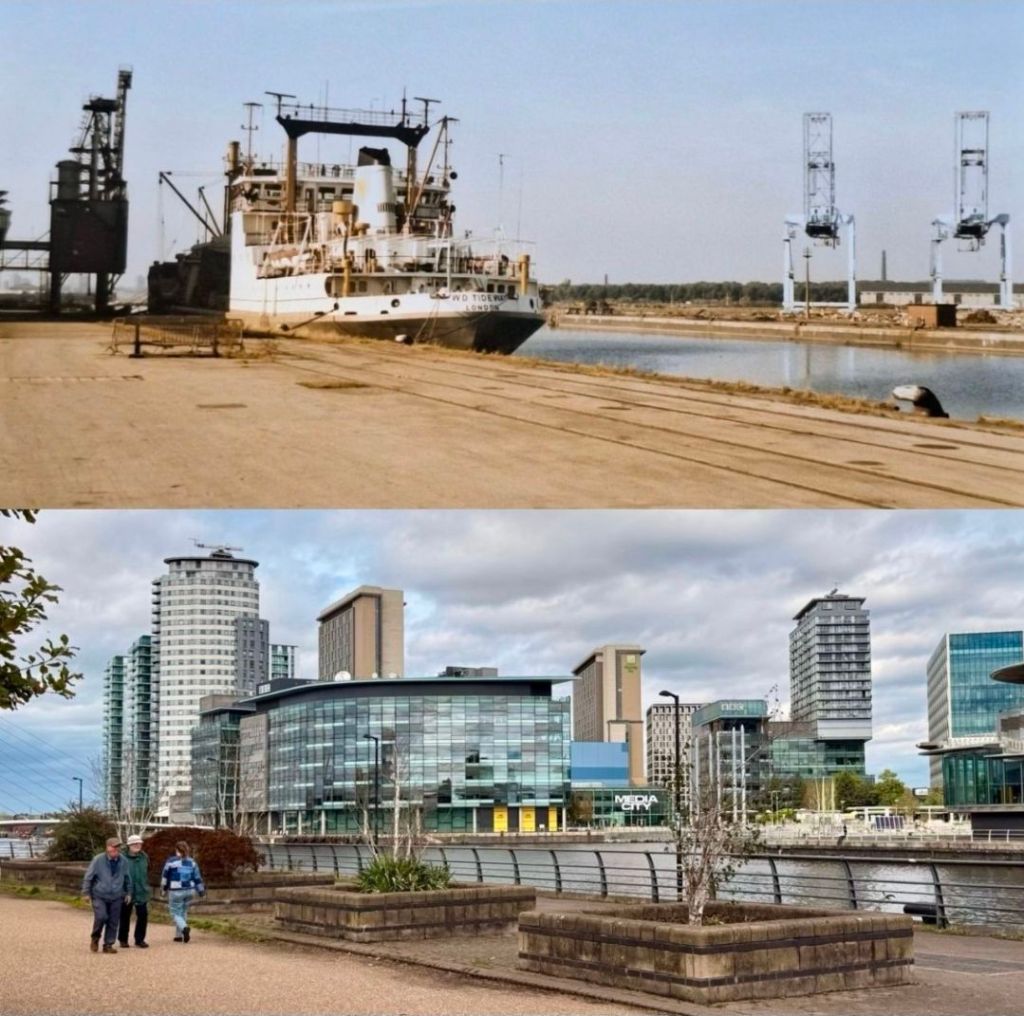
Here is the detailed timeline of Salford Quays, broken down by era, year, and key milestones.
⚓ The Industrial & Docks Era (1894–1982)
Before the late 19th century, the area was largely empty space, occupied only by a medieval hall and a racecourse. The construction of the Manchester Ship Canal fundamentally altered the landscape, making the inland region accessible to ocean-going ships.
- 1894: Queen Victoria officially opens the Manchester Ship Canal and the Manchester Docks. Four of the largest docks (Docks 6, 7, 8, and 9) are built on the Salford side of the canal.
- 1905: King Edward VII opens Dock No. 9, which becomes the largest and most crucial dock in the Salford cluster.
- 1947–1948: Owing to heavy damage suffered by rival ports like Hull during the World War II Blitz, Salford and Manchester Docks temporarily peak to become Britain’s third busiest port.
- 1952–1974: The golden era of operations. Over 16 million tonnes of cargo and 5,000 ships pass through the canal annually.
- 1970s: The rapid rise of standardized maritime containerization triggers a sharp decline. Newly built global freight vessels grow too large to navigate the tight locks of the Ship Canal.
- 1982: Traffic dries up completely. The historic docks officially close down, resulting in 3,000 immediate job losses and leaving behind 120 acres of heavily contaminated, derelict land.
🏗️ The Reclamation & Infrastructure Era (1983–1999)
With the area decaying into an unsafe, heavily polluted “no-go zone,” local government took a bold, unprecedented approach to urban reclamation.
- 1983: Salford City Council buys the derelict docks from the Manchester Ship Canal Company. See photo above.
- 1984: The council secures a Derelict Land Grant to finance total land reclamation. The territory is officially rebranded as Salford Quays.
- 1985: The Salford Quays Development Plan is formally adopted, laying out a master plan for commercial, residential, and leisure zoning. Dams are constructed to isolate the stagnant dock basins from the heavily polluted main canal.
- 1986: Physical infrastructure redevelopment officially kicks off.
- 1987: To fix severe water pollution, an innovative compressed air mixing aeration system is installed. Oxygen levels bounce back, allowing scientists to successfully introduce 12,000 coarse fish into the re-engineered ecosystem.
- 1988: The council publishes a development review expanding the vision to highlight massive tourism, leisure, and cultural landmarks. The early concept for a performing arts center (later known as The Lowry) is drafted.
- 1990: By this year, the initial infrastructure push transforms the landscape. Roads, promenades, bridges, and the first wave of offices, hotels, and houses are constructed across Piers 5, 6, and 7.
- 1999: Major pedestrian and structural bridge works conclude. Crucially, the Metrolink tram system extension opens, instantly linking Salford Quays directly to Manchester City Centre.
🎭 The Cultural Landmark Era (2000–2005)
With the environmental clean-up and transit links secured, the focus shifted to turning the Quays into a premier leisure destination.
- 2000: The Lowry arts centre officially opens to the public, housing a major theatre and art gallery dedicated to local artist L.S. Lowry.
- 2001: The retail landscape arrives with the opening of the Lowry Outlet Mall (now known as Quayside MediaCityUK). The Salford Community Water Sports Centre opens to take advantage of the clean waters.
- 2002: The striking architectural landmark Imperial War Museum North (IWM North) opens directly across the water. The dock lock gates reopen, linking the Quays back into the national canal network.
- 2004: The BBC begins looking at Salford Quays as a prime option for decentralized office relocation outside of London.
📺 The MediaCityUK & Residential Boom Era (2006–Present)
The modern era established Salford Quays as a powerhouse for the UK’s creative, digital, and high-rise residential sectors.
- 2006: Salford Quays is officially selected over competing sites to host the massive MediaCityUK development project.
- 2011: Phase One of MediaCityUK completes. Broadcasters like the BBC and ITV relocate massive operations, studios, and staff here alongside the University of Salford’s media campus.
- 2012–2020: The region experiences a massive economic boom. The wider borough sees average property values double over eight years as young professionals flood the high-rise apartments flanking the waterfront.
- 2023: Vertical expansion continues as Eda (Erie Dock Apartments), a prominent 29-storey residential skyscraper, is completed.
- 2026 (Present): Salford Quays is currently undergoing a massive ongoing £1 billion expansion approved by the local council to double its development footprint, headlined by high-density projects like the four-tower X1 Michigan Towers reaching up to 46 storeys.


