

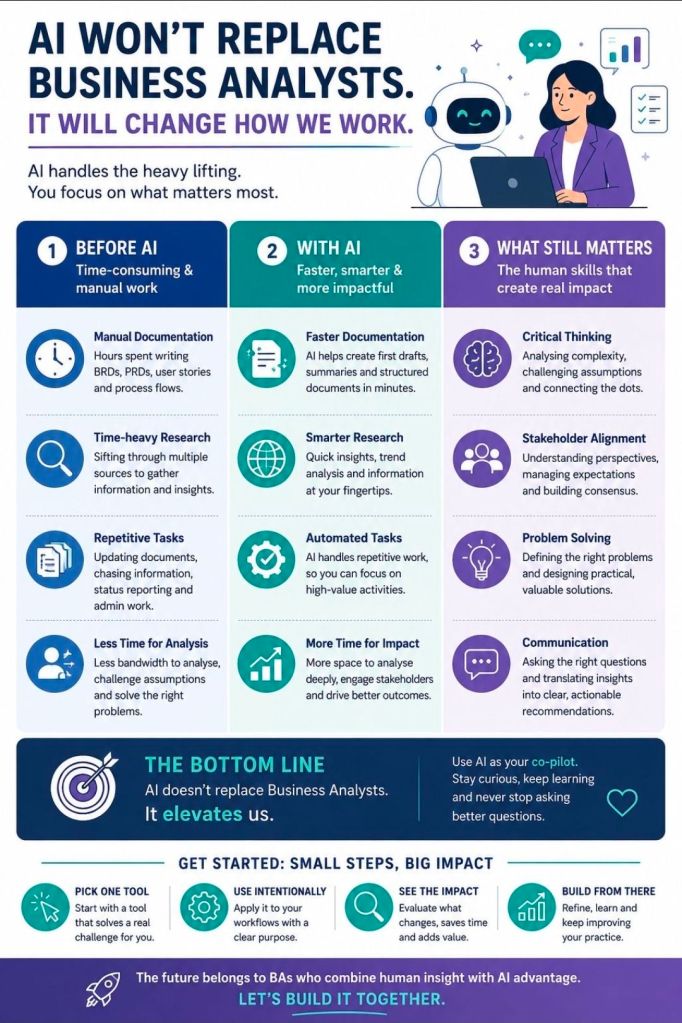
Artificial Intelligence (AI) is fundamentally shifting the role of the Business Analyst (BA) from a focus on routine data processing and documentation to more strategic, human-centric activities. While AI excels at identifying patterns and automating labor-intensive tasks, it currently lacks the contextual awareness and emotional intelligence required to manage complex stakeholder relationships.
Core AI Applications for Business Analysts
AI functions as a high-speed “copilot” that streamlines the traditional BA lifecycle.
- Requirement Generation: AI can process meeting transcripts to draft an initial list of requirements, user stories, or a Business Requirements Document (BRD).
- Data Analysis & Forecasting: Machine learning algorithms can identify subtle trends in large datasets and move analysis from descriptive (what happened) to predictive (what might happen).
- Visual Modeling: Tools can now generate process flows, data models, and architecture diagrams from simple text descriptions, drastically reducing time spent on manual formatting.
- Information Elicitation: Analysts can use AI to quickly extract key details from vast document repositories or prepare for stakeholder interviews by anticipating potential questions.
Skills That Remain Uniquely Human
As AI handles the “grunt work,” the most valuable BA skills are those that cannot be easily automated.
- Strategic Thinking: Connecting big-picture organizational goals to specific technical solutions and defining the “why” behind an initiative.
- Stakeholder Management: Navigating office politics, facilitating discussions to resolve disagreements, and building trust across teams.
- Creative Problem Solving: Tackling ambiguous business challenges where there is no clear historical data for an AI to learn from.
- Critical Evaluation: Fact-checking AI outputs to ensure they are accurate and free from “hallucinations” before they influence business decisions.
The Shift from “AI4BA” to “BA4AI”
A new perspective emerging in the field is that BAs shouldn’t just use AI, but should lead the organization’s AI adoption.
- Guiding Implementation: BAs act as strategic enablers, ensuring that AI projects solve meaningful problems rather than just chasing technological trends.
- Managing Risk: Analysts play a critical role in addressing ethical concerns, bias detection, and security risks associated with AI-driven systems.
- Bridging the Gap: They serve as the essential link between technical AI teams and non-technical business leaders to ensure projects deliver tangible value.
Future Career Outlook
The consensus among industry experts is that AI will transform—rather than eliminate—the BA profession. The market for business analytics is projected to grow significantly through 2031. Analysts who successfully integrate AI into their workflow to enhance productivity are expected to replace those who do not.

