Download Templates for Project Management | FREE Upgrades & Additions
Author: Mark Whitfield
Welcome to my site!
After graduating in Computing in 1990, I accepted a position as a programmer at a Runcorn based software house specialising in electronic banking software, namely sp/ARCHITECT-BANK on Tandem Computers (now HPE NonStop). This was before the internet became more prevalent and so the notion of enabling desktop access to company accounts for inter-account transfers and book keeping was still quite a cutting edge idea (and smartphones only ever hinted at in Space 1999). The company was called The Software Partnership (which was taken over by Deluxe Data in 1994).
I spent 5 years in Runcorn developing code for SP/ARCHITECT for various banks like TSB, Bank of Scotland, Rabobank and Girofon (Denmark) to name but a few. I then moved onto a software house in Salford Quays for further bank facing projects. After a further 23 years in the IT industry and now a Senior IT Project Manager (both Agile and Waterfall delivery), I thought I would echo out my Career Profile in this corner of the internet for quick and easy access.
Artificial intelligence (AI) is transforming project management through two distinct but related paths: the use of AI-powered tools to manage general projects and the specialized methodologies required to manage AI development itself.
1. Methodologies for Managing AI Projects
Traditional software development methods (like Waterfall) often fail for AI because these projects are experimental and non-linear. Specialized frameworks have emerged to handle the “data-first” nature of AI:
CPMAI (Cognitive Project Management for AI): A leading methodology that combines Agile principles with data-centric phases: Business Understanding, Data Understanding, Data Preparation, Model Development, Model Evaluation, and Model Operationalization.
Agile-AI Hybrid: Adapts standard Agile by using “short-boxed” iterations for model training and allowing for a “flexible scope” because model performance is unpredictable until tested.
Data Driven Scrum: A variation of Scrum that prioritizes work based on data availability and experimental results rather than just feature backlogs.
MLOps (Machine Learning Operations): An operational framework focused on the continuous integration, deployment, and monitoring of models to prevent “model drift” after a project officially “ends”.
2. AI-Augmented Project Management (The “AI Copilot”)
For non-AI projects, AI acts as an intelligent assistant to automate administrative tasks and provide predictive insights.
3. Implementation Strategy
Experts recommend a phased approach to integrating AI into management workflows:
Assess Inefficiencies: Identify repetitive tasks (e.g., status reporting) that can be automated first.
Data Governance: Ensure project data is clean and centralized; AI is only as good as the data it consumes (“Garbage In, Garbage Out”).
Human-in-the-Loop: Use AI for data-heavy lifting, but retain human judgment for high-stakes leadership, ethics, and stakeholder empathy.
AI Projects and Methodologies for Managing AI Projects
The history of artificial intelligence is defined by cycles of extreme optimism followed by “winters” of reduced funding and interest. It has evolved from a theoretical branch of mathematics into a pervasive modern technology.
The Foundations (Pre-1950)
Before AI was a formal field, it existed in science fiction and early mechanical concepts.
1921: The term “robot” is coined by Karel Čapek in the play Rossum’s Universal Robots.
1943: Warren McCulloch and Walter Pitts publish the first mathematical model of a neural network.
1949: Edmund Berkeley’s book Giant Brains proposes that machines can think.
The Birth of AI (1950–1956)
This era shifted AI from mythology to a serious academic discipline.
1950: Alan Turing publishes “Computing Machinery and Intelligence,” introducing the Turing Test to measure machine intelligence.
1952: Arthur Samuel creates the first self-learning checkers program.
1955-1956: John McCarthy coins the term “Artificial Intelligence” during the proposal for the Dartmouth Workshop, which officially launched the field.
The Golden Years & First AI Winter (1957–1979)
Initial successes led to over-promising and a subsequent crash.
1958: Frank Rosenblatt develops the Perceptron, the foundation for modern neural networks.
1973-1974: The Lighthill Report in the UK and subsequent funding cuts by DARPA lead to the First AI Winter due to limited computing power and unmet expectations.
The Expert Systems Boom & Second Winter (1980–1993)
AI found commercial success through specialized knowledge bases before another decline.
1980: XCON (expert configurer) becomes the first commercially successful expert system, saving Digital Equipment Corporation millions.
1981: Japan launches the Fifth Generation Computer project with $850 million to create human-level reasoning.
1987-1993: The Second AI Winter occurs as specialized AI hardware (Lisp machines) becomes obsolete compared to cheaper personal computers from Apple and IBM.
The Age of Agents & Narrow AI (1993–2011)
AI began achieving superhuman performance in specific, “narrow” tasks.
1997: IBM’s Deep Blue defeats world chess champion Garry Kasparov.
2002: iRobot releases the Roomba, bringing autonomous AI into the home.
2011: IBM’s Watson wins Jeopardy! against human champions, and Apple releases Siri.
The Deep Learning Revolution (2012–2021)
A massive surge in data and GPU power transformed the field.
2012: AlexNet wins the ImageNet competition, proving the power of deep convolutional neural networks.
2016: Google DeepMind’s AlphaGo defeats world Go champion Lee Sedol.
2017: Researchers at Google propose the Transformer architecture, which becomes the backbone of modern large language models.
The Generative AI Boom (2022–Present)
AI has entered the mainstream, moving toward Agentic AI that can plan and act autonomously.
2022: OpenAI releases ChatGPT, sparking global interest in generative AI.
2023-2024: Focus shifts toward Multimodal AI (images, video, and text) and Agentic AI capable of completing complex workflows across multiple tools.
Roger Federer is a Swiss former professional tennis player who is widely regarded as one of the greatest of all time, having won 20 Grand Slam singles titles and held the world No. 1 ranking for 310 weeks. Known for his effortless playing style and versatile shot-making, he revolutionized the sport during a career that spanned over two decades from 1998 to 2022.
Federer faced intense competition from the emergence of the “Big Four” (Nadal, Djokovic, and Murray).
2008: Battled mononucleosis; won fifth consecutive US Open; won Olympic Gold in doubles with Stan Wawrinka.
2009: Won first French Open to complete the Career Grand Slam; passed Sampras’ record with a 15th major at Wimbledon.
2010: Won fourth Australian Open.
2012: Won 7th Wimbledon title and Olympic Silver in singles; reclaimed world No. 1 to break the record for total weeks at the top.
4. Injury Struggles & Renaissance (2013–2019)
After several years plagued by back and knee injuries, Federer staged a remarkable late-career comeback.
2014: Led Switzerland to its first Davis Cup title.
2016: Underwent first knee surgery; missed the second half of the season for recovery.
2017: Returned after a 6-month hiatus to win the Australian Open (defeating Nadal) and a record 8th Wimbledon title.
2018: Won 20th Grand Slam at the Australian Open; became the oldest No. 1 in history at age 36.
2019: Won 100th career title in Dubai; reached 12th Wimbledon final.
5. Final Years & Retirement (2020–2022)
Persistent knee issues eventually forced the conclusion of his competitive career.
2020–21: Underwent multiple knee surgeries; reached Wimbledon quarter-finals in 2021 as the oldest man in the Open Era to do so.
2022: Officially retired on 23 September at the Laver Cup in London, playing his final match in doubles alongside long-time rival and friend Rafael Nadal.
Roger Federer Overview and Detailed Timeline History by Era
Mark Whitfield is an experienced IT Project Manager and software developer who has spent over 22 years specialising in HP NonStop (formerly Tandem) systems. He is currently an Engagement Project Manager at Capgemini.
Career & Expertise
Whitfield’s career in HP NonStop began in 1990 and includes significant technical and leadership roles across the financial and technology sectors:
Software Development: Early in his career, he worked as a programmer for The Software Partnership (later Deluxe Data/FIS), focusing on electronic banking software like sp/ARCHITECT on Tandem mainframes.
Insider Technologies (1995–2013): He spent 18 years at Insider Technologies as a Senior Development Engineer and Project Manager. His work involved:
Developing monitoring and diagnostic software such as Reflex 80:20, Reflex ONE24, and RTLX (Real-Time Log Extraction) for payment systems.
Managing the first HP OpenView Operations Smart Plug-In certification for the NonStop platform.
Designing XPERT24, a performance tracking product for ACI’s XPNET layer.
Capgemini (2016–Present): As an Engagement Project Manager, he has led digital projects for major clients in the automotive, government, and aerospace sectors, including a cloud migration for UK Government applications.
Technical Contributions
Publications: He has authored articles for globally published journals like The Connection (2013), discussing topics such as querying terabytes of legacy transaction log data from NonStop mainframes.
Project History: He has managed high-value projects, including a £5 million initiative to migrate legacy HP NonStop software to AIX-based technologies for a large UK retail bank.
Training: He is trained in various NonStop-specific technologies, including TAL (Transaction Application Language), COBOL85, PATHWAY, and NonStop SQL.
Whitfield also maintains a professional website, mark-whitfield.com, where he provides project management templates and resources related to HP NonStop and Tandem systems.
Mark Whitfield provides a comprehensive bundle of over 200 editable project management templates designed for Agile, Waterfall, and PRINCE2 methodologies. These templates are based on over 30 years of project delivery experience and are available for purchase via his official website or Etsy shop.
Key Template Categories
The bundle includes a wide variety of tools across different formats (Excel, PowerPoint, Word, and MS Project):
Planning & Scheduling:
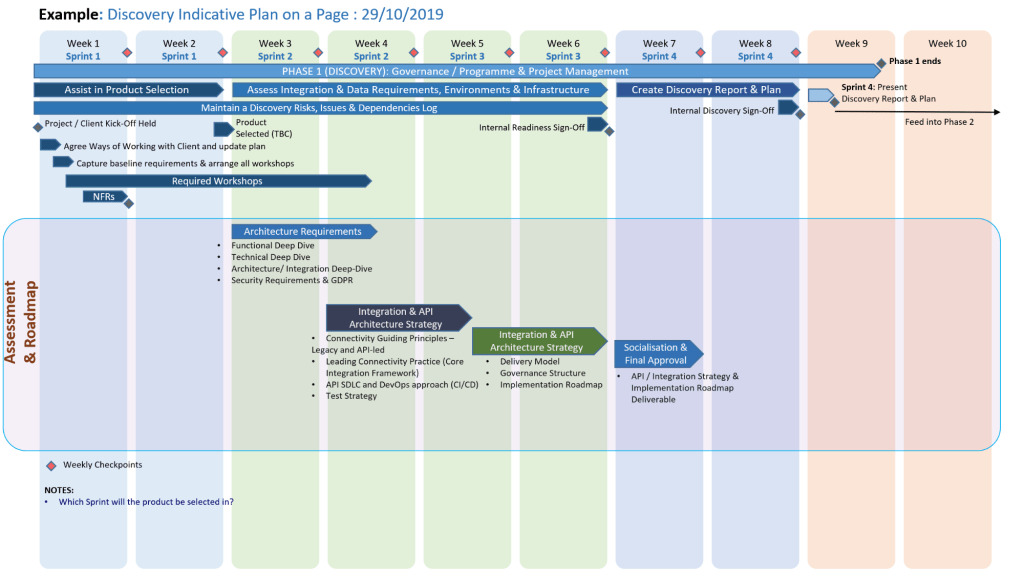
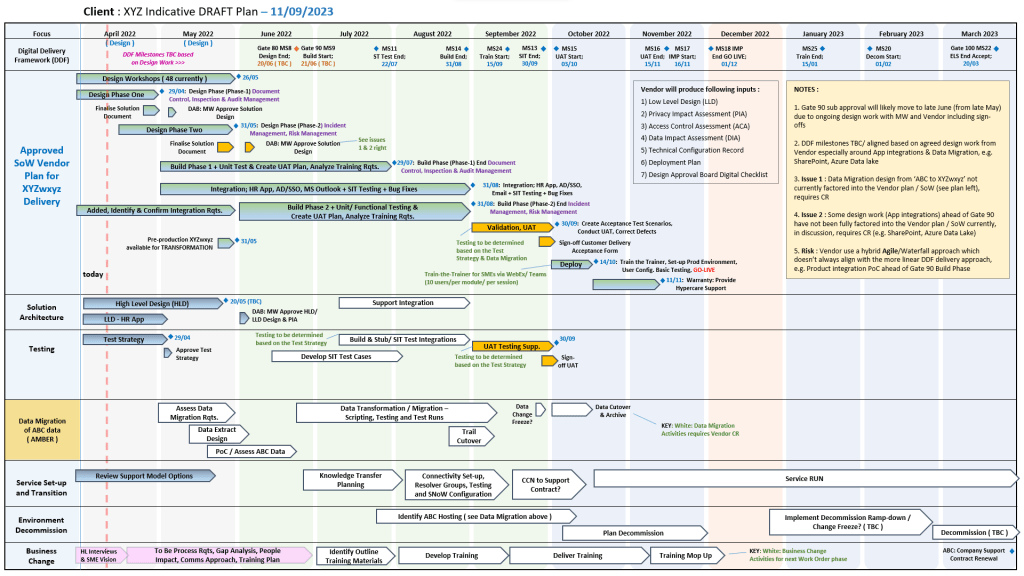
Plan on a Page (POaP): Over 30 PowerPoint slide examples for executive-level summaries.
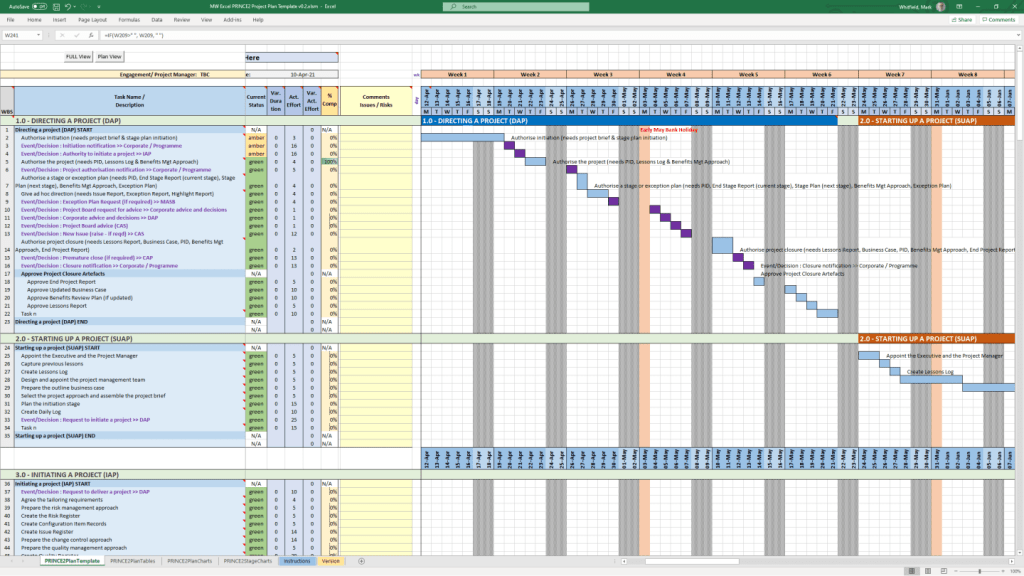
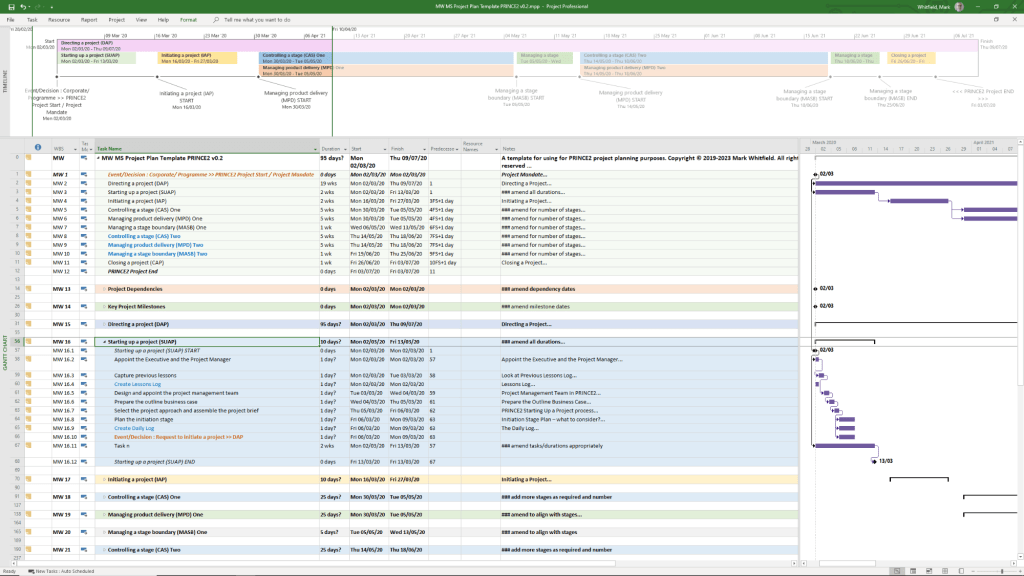
Detailed Project Plans: MS Project (MPP) and Excel templates for SDLC, PRINCE2 7th Edition, and Agile Scrum projects.
Gantt Charts: Built-in tracking views for both MS Project and Excel.
Tracking & Control:
RAID Logs: Comprehensive logs for tracking Risks, Actions, Issues, and Dependencies, plus additional tabs for Change Requests and Lessons Learned.
RACI Matrix: Templates to define project roles and responsibilities (Responsible, Accountable, Consulted, Informed).
Finance Trackers: Tools for internal and external forecast vs. actual costs, including margin and variance tracking.
Agile Specific Tools:
Burn Down & Burn Up Charts: Excel-based alternatives when tools like Jira are unavailable.
Agile Story Dependency Tracking: Specifically for managing dependencies between agile stories and external suppliers.
Reporting & Governance:
Status Reports: Weekly and monthly templates in Word and PowerPoint formats.
Stakeholder Analysis: Power/interest mapping and engagement plan templates.
Benefits Realisation: Plans to track project outcomes against initial business goals.
Purchase Benefits
Lifetime Upgrades: Once purchased, all future additions and updates to the template package are provided for free.
Compatibility: Templates are designed for Microsoft Office 365 but also include Excel versions compatible with earlier software.
Support: The package typically includes walkthrough Word documents to guide users on how to use each major template.
Mark Whitfield HP NonStop Tandem experience & Project Management Templates