

A Project Management Office (PMO) is a centralized department or group that defines, maintains, and ensures project management standards across an organization. It serves as the “command center” that aligns project execution with broader business strategy to improve success rates and ROI.
Core PMO Models
The level of control a PMO exerts depends on its specific operational model:
- Supportive PMO: Provides a consultative role by supplying templates, best practices, and training. It has low control, acting primarily as a project repository.
- Controlling PMO: Enforces governance and requires compliance through specific frameworks and tools. It maintains a moderate degree of control.
- Directive PMO: Directly manages projects by assigning project managers who report to the PMO. This model offers the highest degree of control and accountability.
Key Responsibilities
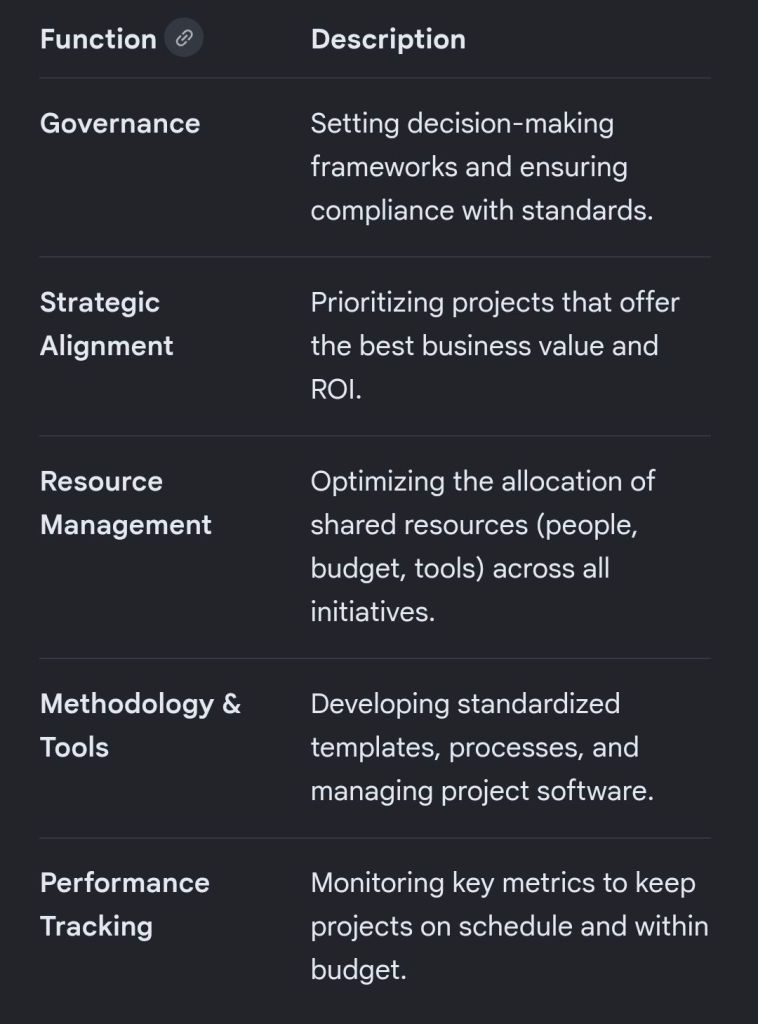
A PMO’s daily functions bridge the gap between high-level strategy and ground-level execution:
Common PMO Roles:
Staffing varies by organization size, but typical roles include:
- PMO Director/Manager: Oversees the entire office, ensuring processes are followed and goals are met.
- PMO Analyst: Collects and analyzes project data to support decision-making and reporting.
- Project/Portfolio Managers: Lead individual projects or entire portfolios to completion.
- PMO Specialist: Focuses on implementing methodologies and providing expert advice on project management.
Organizational Levels
PMOs can operate at different tiers within a company:
- Project PMO: Focused on a single, large-scale project.
- Program/Department PMO: Oversees a group of related projects within a specific department (e.g., IT or Marketing).
- Enterprise PMO (EPMO): Operates at the executive level, ensuring all projects across the entire organization align with strategic corporate goals.
Project Management Office (PMO) Overview


