CPM Critical Path Method project management and detailed historical timeline by era and year

The Critical Path Method (CPM) is a foundational project management technique developed in the late 1950s to identify the longest sequence of dependent tasks (the “critical path”) that determines the minimum time needed to complete a project. By focusing on these critical tasks, managers can identify which activities have flexibility (float) and which will delay the entire project if they slip. 

Detailed Historical Timeline of CPM

Pre-Development Era (1940-1955): The Need for Speed 

  • 1940–1943: DuPont develops precursor techniques to manage scheduling challenges during the Manhattan Project.
  • Early 1950s: The U.S. Navy recognizes the need for better planning systems for complex, high-stakes defense projects. 

Development Era (1956-1959): The Birth of CPM 

  • 1956: Morgan R. Walker (DuPont) and James E. Kelley Jr. (Remington Rand) begin collaborating to create a new method for managing industrial plant maintenance shutdowns.
  • 1957: Walker and Kelley formalize the Critical Path Method (CPM). The technique is first applied to DuPont’s chemical plant projects, saving $1 million in its first year.
  • 1958: Simultaneously, the U.S. Navy and Booz Allen Hamilton develop the Program Evaluation and Review Technique (PERT) for the Polaris missile program. The term “critical path” is coined by the PERT team.
  • 1959: First paper on the critical path, “Critical-Path Planning and Scheduling,” is published by Kelley and Walker. First computer-based CPM is implemented on UNIVAC computers. 

Expansion Era (1960-1979): Industrial Adoption

  • 1961: Dr. John Fondahl develops the Precedence Diagramming Method (PDM), a manual “non-computer” alternative to early computer-heavy CPM.
  • 1962: The U.S. Department of Defense (DoD) mandates the use of Work Breakdown Structures (WBS) along with network scheduling (PERT/CPM) for projects.
  • 1966: CPM is used for the first time in the construction of the World Trade Center Twin Towers in New York City.
  • 1970s: CPM moves from chemical and defense sectors to widespread use in construction, engineering, and infrastructure projects. 

Computerization Era (1980-1999): The PC Revolution

  • 1980s: Advent of personal computers (PCs) allows project management software (like Primavera) to make CPM accessible, removing the need for expensive mainframes.
  • 1987: The Project Management Institute (PMI) publishes the first Project Management Body of Knowledge (PMBOK Guide), standardizing CPM as a best practice.
  • 1997: Eliyahu M. Goldratt introduces Critical Chain Project Management (CCPM), a new method that builds on CPM by focusing on resource limitations rather than just activity sequence. 

Digital/Agile Era (2000-Present): Modern Integration 

  • 2001: The Agile Manifesto is written, introducing iterative, non-critical-path methods for software development.
  • 2010s: Hybrid project management becomes popular, combining CPM (for predictable, sequential work) with Agile methods (for unpredictable work).
  • Today: CPM algorithms are embedded in modern scheduling software (Microsoft Project, Oracle Primavera, ClickUp), enabling real-time recalculation of the critical path. 

Key Components of CPM

  • Network Diagram: A visual representation of activities (nodes) connected by dependencies.
  • Forward Pass: Calculates the earliest start (ES) and finish (EF) times for tasks.
  • Backward Pass: Calculates the latest start (LS) and finish (LF) times for tasks.
  • Float Calculation: Determines how long a task can be delayed without affecting the project completion date (Float = LS – ES).
  • Critical Path: The path with zero float; any delay in these tasks delays the project. 

CPM Critical Path Method project management and detailed historical timeline by era and year
ISO 21500 high-level guidance on project, program, and portfolio management

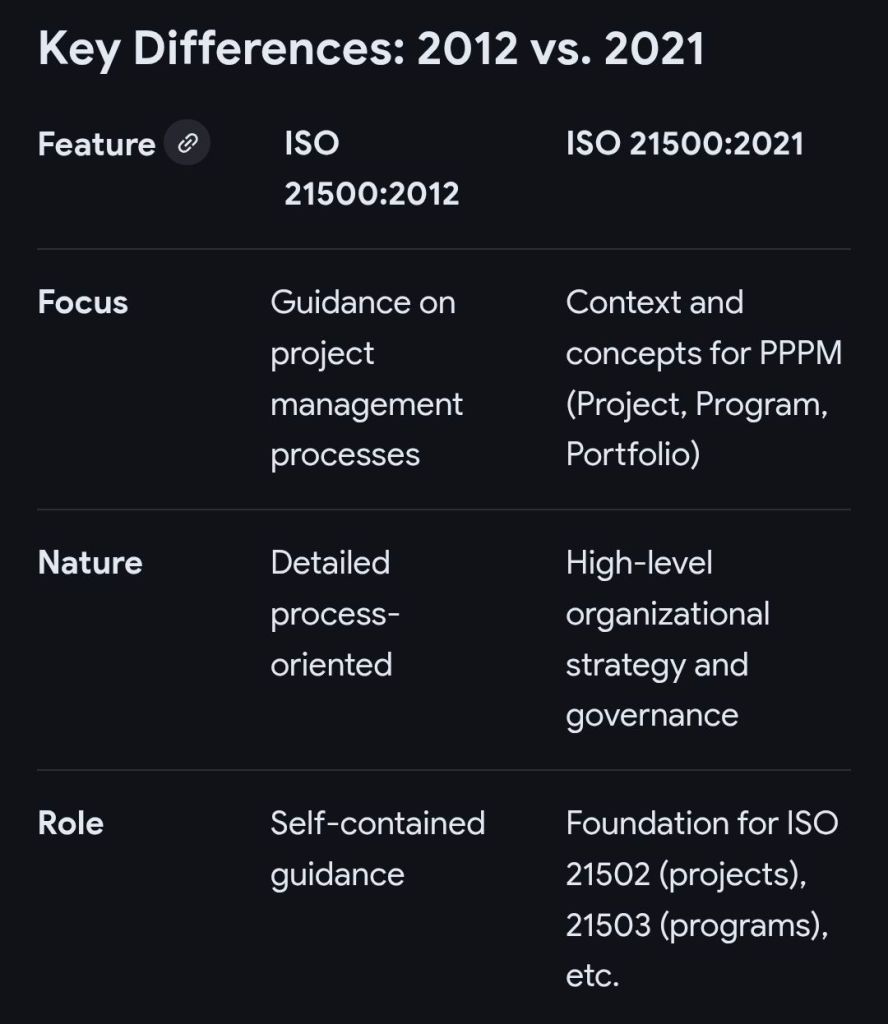
ISO 21500 is a set of international standards providing high-level guidance on project, program, and portfolio management. Initially published in 2012 as a guidance document for project management, it was updated in 2021 to serve as the foundational, high-level “Context and Concepts” document for a broader suite of ISO project management standards (ISO 21500–21505). 

ISO 21500 Development Timeline

  • 2007: The ISO Technical Committee ISO/TC 258 (Project, programme and portfolio management) began working on a global project management standard.
  • September 2012: ISO 21500:2012 (Guidance on Project Management) was officially published, providing a generic framework for project management and a common language for professionals.
  • 2017: Work intensified on updating the standard to reflect new best practices and to transition into a family of standards (21500-21505).
  • 2020: ISO 21502:2020 was published, taking over the detailed guidance on project management formerly covered by ISO 21500:2012.
  • March 2021: ISO 21500:2021 (Project, programme and portfolio management – Context and concepts) was released, replacing the 2012 edition, with a focus on defining the overarching environment for project management rather than specific processes. 

Detailed Historical Timeline of Project Management

The following timeline details the evolution of project management leading up to the ISO standards. 

1. Ancient Era – Pre-1900: Foundation & Construction

  • Ancient Times: The pyramids of Giza, the Great Wall of China, and Roman infrastructure demonstrated early, sophisticated, large-scale project management.
  • 1896: Carol Adami developed the harmonogram, a precursor to visualization tools. 

2. Early Modern Era (1900–1950): Scheduling Techniques 

  • 1910-1915: Henry Gantt developed the Gantt Chart, revolutionizing scheduling by tracking project progress visually.
  • 1940s: Large-scale projects, such as the Manhattan Project, pioneered modern, integrated project teams. 

3. The Golden Age (1950–1980): Formalization

  • 1957: DuPont introduced the Critical Path Method (CPM) for chemical plant construction.
  • 1958: The U.S. Navy developed PERT (Program Evaluation and Review Technique) for the Polaris missile project.
  • 1962: U.S. Department of Defense mandated Work Breakdown Structures (WBS).
  • 1965: Founding of the International Project Management Association (IPMA).
  • 1969: Founding of the Project Management Institute (PMI). 

4. The Silver Age (1980–2000): Methodologies & Technology

  • 1984: Eliyahu Goldratt published “The Goal,” introducing the Theory of Constraints (TOC).
  • 1986: Takeuchi and Nonaka defined Scrum as a flexible, holistic product development strategy.
  • 1987: PMI published the first Project Management Body of Knowledge (PMBOK) guide.
  • 1989: The UK government developed PRINCE (Projects in Controlled Environments), later evolving into PRINCE2.
  • 1995: Scrum was formalized for software development by Jeff Sutherland and Ken Schwaber.
  • 1996: PMI published the first official edition of the PMBOK Guide. 

5. Modern Era (2000–Present): Agile & Global Standardization 

  • 2001: Publication of the Agile Manifesto, highlighting flexible and user-focused development.
  • 2007: ISO began developing international project management standards.
  • 2012: ISO 21500:2012 published, providing a global, standard-agnostic guide for project management.
  • 2017: The Association for Project Management (APM) received a Royal Charter.
  • 2020-2021: Shift towards Agile and hybrid methodologies; PMI released PMBOK 7th Edition, focusing on principles over processes.
  • 2021: ISO 21500:2021 (updated) and ISO 21502:2020 (detailed guidance) were established as the new global standard for project management.

ISO 21500 high-level guidance on project, program, and portfolio management

PERT Program Evaluation & Review Technique summary & detailed historical timeline by era & year

The Program Evaluation and Review Technique (PERT) is a project management tool developed in the late 1950s to analyze and represent the tasks involved in completing a complex project. It is designed to handle uncertainty in project scheduling by using three time estimates (optimistic, pessimistic, and most likely) to calculate the expected duration of tasks. 

Summary of PERT Project Management

  • Origin: Developed in 1958 by the U.S. Navy Special Projects Office to manage the Polaris missile submarine program, which involved thousands of contractors.
  • Purpose: To schedule, organize, and coordinate tasks within complex, non-repetitive projects, allowing for the identification of the critical path.
  • Key Feature (Three-Time Estimate): Unlike traditional methods, PERT uses a probabilistic approach.
  • Visual Structure: A PERT chart acts as a network diagram, using nodes (circles/rectangles) for events and arrows for tasks and dependencies.
  • Impact: Credited with shortening the Polaris project timeline by two years.

Detailed Historical Timeline of PERT (1950s–Present)

The Era of Development (1950s)

  • 1957: The groundwork for network scheduling began in the US, with DuPont developing the Critical Path Method (CPM) and preliminary research into PERT concepts beginning.
  • 1958: Birth of PERT. The U.S. Navy Special Projects Office officially develops PERT for the Polaris missile project to manage high uncertainty in R&D.
  • 1958: The first two publications, Program Evaluation Research Task, Summary Report, Phase 1 and 2, are written (primarily by Charles F. Clark) to document the technique.
  • 1959: Willard Fazar of the Navy officially introduces PERT to the public in The American Statistician, detailing the use of three time estimates. 

The Expansion and Mainframe Era (1960s–1970s) 

  • 1960s: PERT is widely adopted by NASA and the U.S. Department of Defense for large, schedule-driven projects.
  • 1962: The US Department of Defense mandates the use of Work Breakdown Structures (WBS) for projects, reinforcing PERT application.
  • 1965: PERT is applied to the planning and organization of the 1968 Winter Olympics in Grenoble.
  • 1970s: PERT/CPM software packages begin to be used on mainframe and minicomputers. 

The PC and Software Era (1980s–1990s)

  • 1980s: With the advent of personal computers, PERT software becomes accessible, leading to adoption in software development and manufacturing.
  • 1984: The Theory of Constraints (TOC) is introduced, which later influences critical chain methodologies, adding to network scheduling techniques.
  • 1987: The Project Management Institute (PMI) publishes the first white paper on the Project Management Body of Knowledge (PMBOK), including network techniques.
  • 1997: Critical Chain Project Management (CCPM) is introduced as a new approach to managing resources and task uncertainty, building on PERT/CPM principles. 

The Digital and Agile Era (2000s–Present)

  • 2000s: PERT charts become a standard feature in project management software (MS Project, Primavera), automating the calculation of critical paths.
  • 2012: ISO 21500:2012 provides guidance on project management, incorporating network analysis techniques.
  • 2017/2021: PMBOK releases 6th and 7th editions, integrating PERT and network scheduling with agile and adaptive environments.
  • Present: While overshadowed by Agile (Scrum/Kanban) in software, PERT remains crucial for complex construction, R&D, and defense projects, often used in hybrid approaches. 

Key Components of a PERT Chart

  1. Event (Node): A milestone representing the start or completion of a task.
  2. Activity (Arrow): The actual task required to move from one event to another.
  3. Critical Path: The longest sequence of dependent tasks, determining the minimum project duration.
  4. Float (Slack): The amount of time a task can be delayed without delaying the overall project. 

Adaptive Project Framework (APF) Adaptive Project Management (APM)

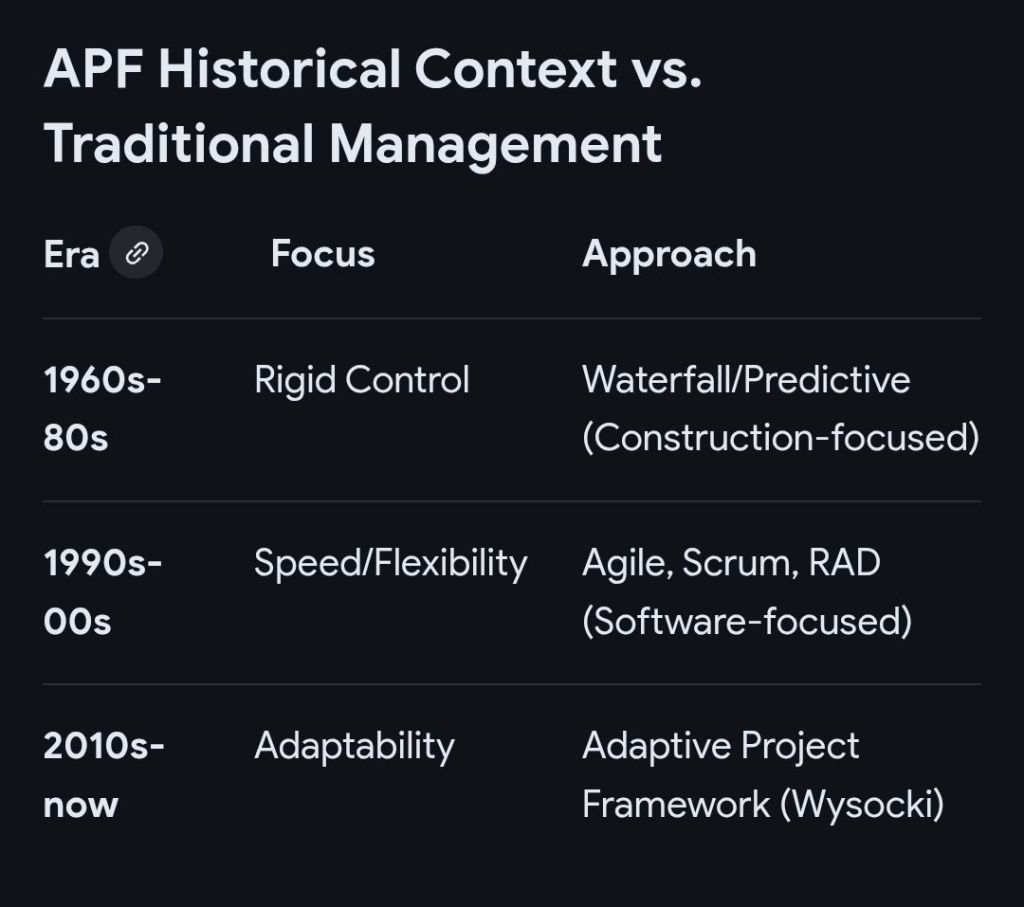
The Adaptive Project Framework (APF), often called Adaptive Project Management (APM), is a flexible, client-driven methodology designed to handle high-complexity, high-uncertainty projects where goals are clear but the methods to achieve them are not. Unlike traditional “Waterfall” approaches that follow rigid, linear plans, APF embraces change, utilizing iterative cycles to learn from previous results and improve future project practices. 

Summary of Adaptive Project Framework (APF)

  • Core Philosophy: “Think like a chef, not a cook.” APF adapts to the situation rather than strictly following a pre-written recipe.
  • Key Principles:
    • Client-driven: The client is a co-manager, determining next steps and adjusting scope.
    • Thrive on change: Change is expected and embraced, not resisted.
    • Iterative Cycles: Work is done in short cycles (“iterations”), with deliverable reviews at the end of each.
    • Learn by doing: The project strategy evolves based on learning from the outcomes of previous cycles.
    • Maximize Business Value: Focuses only on tasks that add value, reducing non-value-added work.
  • Core Characteristics:
    • Adaptive Scope: Scope is not fixed; it is continuously adjusted.
    • Just-in-Time Planning: Plans are made in detail only when needed, not months in advance.
    • Continuous Feedback: Regular checkpoint reviews with the customer.
  • The 5 Step APF Process:
    1. Project Scope: Defining the “Conditions of Satisfaction” (CoS).
    2. Cycle Schedule: Planning the iterative work.
    3. Cycle Build: Carrying out the work.
    4. Client Checkpoint: Reviewing deliverables and revising the plan.
    5. Final Report: Evaluating success and gathering lessons.

Historical Timeline of Adaptive Project Management

Adaptive project management evolved to address the limitations of traditional, rigid project management when faced with the rapid change and high uncertainty of the 21st-century IT landscape. 

Pre-Adaptive Era (Pre-1950s)

  • 1917: Henry Gantt develops the Gantt chart, pioneering rigid scheduling.
  • Pre-1950s: Project management is informal, experience-driven, and relies heavily on one-time planning. 

Early Evolution of Iterative Methods (1950s–1980s)

  • 1957: Critical Path Method (CPM) invented by Dupont.
  • 1958: Program Evaluation Review Technique (PERT) developed for complex US Navy projects.
  • 1975: First inklings of iterative techniques appear (e.g., iterative and evolutionary development).
  • 1986: Scrum is named and described as a new style of managing projects. 

Rise of Agile and Pre-APF Adaptive Models (1990s)

  • 1991: Rapid Application Development (RAD) is described, linking timeboxing with iterations.
  • 1994: The CHAOS Report is first published, highlighting the high failure rate of traditional projects, driving the need for better methods.
  • 1995: Scrum is introduced formally by Jeff Sutherland and Ken Schwaber.
  • 1997: Extreme Programming (XP) and Critical Chain Project Management (CCPM) emerge. 

Formalization of Agile and Adaptive Concepts (2000s) 

  • 2001: The Agile Manifesto is signed, formalizing iterative, client-focused development.
  • 2002–2004: A surge of adaptive techniques, including Radical Project Management, Extreme Project Management, and Agile Project Management. 

The Development of APF (2010s-Present)

  • 2010: Robert K. Wysocki publishes Adaptive Project Framework: Managing Complexity in the Face of Uncertainty, formally defining the APF methodology.
  • 2010s-2020s: Shift toward “adaptive project management” in HR and business transformation to thrive in high-uncertainty environments.
  • 2022-2025: Increased emphasis on automated data-driven decision-making within APF to maximize efficiency.

Hybrid HPM project management summary and detailed historical timeline by era and year
Hybrid Project Management (HPM) is a tailored approach that combines structured, predictive methods—most commonly Waterfall—with flexible, iterative methods like Agile to maximize efficiency, speed, and control. As organizations face increasingly complex, rapid-change environments, HPM allows for detailed upfront planning of scope and budget, while utilizing sprints for development and stakeholder feedback. 

Summary of Hybrid Project Management

  • Definition: A blended approach merging Waterfall’s discipline with Agile’s adaptability.
  • Why It Emerged: To bridge the gap between rigid traditional methods and the high-speed needs of modern, often digital, projects.
  • Core Characteristics:
    • Predictive Planning: Upfront requirement gathering and high-level scheduling (Waterfall).
    • Adaptive Execution: Iterative development, Scrum ceremonies, or Kanban workflows (Agile).
    • Fit-for-Purpose: Tailoring the project lifecycle to specific organizational, technical, or regulatory needs rather than using a one-size-fits-all framework.
  • When to Use: Projects requiring high predictability for deliverables/compliance (e.g., infrastructure) but requiring flexibility in implementation (e.g., software).
  • Benefits: Increased speed, improved resource management, and higher adaptability to change. 

Detailed Historical Timeline: Evolution Toward Hybrid

The history of project management shows a progression from early manual techniques to structured “Golden Age” methodologies, eventually diversifying into Agile before merging into modern Hybrid approaches. 

I. Pre-Modern Era (Before 1950) – The Birth of Structure

  • ~2570 BC: Completion of the Great Pyramid of Giza, demonstrating early massive-scale planning.
  • 1910s: Henry Gantt develops the Gantt chart, introducing visual scheduling for tasks, dependencies, and timelines.
  • 1931: Hoover Dam project uses early scheduling techniques. 

II. The “Golden Age” (1950s-1960s) – Introduction of Predictive Methods 

  • 1956: The American Association of Cost Engineers (now AACE International) is formed.
  • 1957: DuPont Corp develops the Critical Path Method (CPM) to manage complex, repetitive projects.
  • 1958: Program Evaluation and Review Technique (PERT) is developed by the US Navy for the Polaris missile project, focusing on handling uncertainty in task durations.
  • 1960s: Formalization of the Waterfall method.
  • 1962: US Department of Defense mandates the Work Breakdown Structure (WBS).
  • 1969: Project Management Institute (PMI) is founded, establishing a standard profession. 

III. The “Silver Age” (1970s-1980s) – Diversification & Lean 

  • 1970: Winston Royce publishes the first formal description of the Waterfall process.
  • 1975: PROMPTII method created (the ancestor to PRINCE).
  • 1978: Toyota Production System, including early Kanban and Lean principles, gains attention.
  • 1984: Theory of Constraints (TOC) introduced by Eliyahu Goldratt.
  • 1986: Takeuchi and Nonaka define Scrum as a new product development game.
  • 1987: PMI publishes the first Guide to the Project Management Body of Knowledge (PMBOK Guide). 

IV. The Digital Age & Agile Revolution (1990s-2000s) – Flexibility 

  • 1991: Crystal Clear Agile methodology developed.
  • 1995: Jeff Sutherland and Ken Schwaber formalize Scrum.
  • 1996: PRINCE2 published by the UK Government.
  • 1997: Critical Chain Project Management (CCPM) invented.
  • 2001: Agile Manifesto published, accelerating the shift toward iterative software development.
  • 2000s: Proliferation of project management software (Microsoft Project, Jira, Asana). 

V. The Hybrid Era (2010s-Present) – Tailored Integration 

  • 2010s: Hybrid Methodologies gain popularity, bridging the gap between Waterfall’s rigid structure for milestones and Agile’s flexibility for development.
  • 2015-2018: Increased adoption of “ScrumBan” (Scrum + Kanban) and early “Agile-Waterfall” hybrid models.
  • 2020s: COVID-19 pandemic acts as a catalyst, forcing remote work and accelerating hybrid adoption for greater resilience.
  • 2021-2024: Shift towards “fit-for-purpose” approaches, where projects combine predictive and adaptive lifecycles based on risk and complexity.
  • 2024: PMI data shows traditional predictive methods decreasing, while hybrid methodologies rise significantly (over 57% increase) as the dominant project management trend.
  • 2025+: Integration of Artificial Intelligence (AI) and automated tools into hybrid frameworks to further refine efficiency. 

Hybrid HPM project management summary and detailed historical timeline by era and year
Extreme Programming XP project management summary and detailed historical timeline by era and year
Extreme Programming (XP) is a prominent, disciplined Agile software development framework designed to improve software quality and responsiveness to changing customer requirements. Developed by Kent Beck in the mid-1990s, it focuses on taking beneficial engineering practices—such as pair programming, testing, and continuous integration—to “extreme” levels. 

Project Management Summary: Core XP Components

XP differs from other Agile methods by focusing intensely on technical engineering practices alongside project management techniques. 

  • Core Values: Communication, Simplicity, Feedback, Courage, and Respect.
  • Key Practices: Pair Programming, Test-Driven Development (TDD), Collective Ownership, Continuous Integration, Refactoring, and Small Releases.
  • Project Management Focus:
    • The Planning Game: Combines business priorities with technical estimates to determine what to build next.
    • Small Releases: Frequent, working software releases (often 1–2 weeks) to gather rapid customer feedback.
    • On-site Customer: A customer representative works with the team to provide instant feedback and clarify requirements.
    • Sustainable Pace: Limiting work weeks to 40 hours to avoid burnout and maintain quality. 

Detailed Historical Timeline of XP

Era 1: Origins and The Chrysler C3 Project (1993–1996) 

  • 1993: Chrysler launches the Comprehensive Compensation System (C3) project to upgrade payroll software, which struggles for years.
  • March 1996: Kent Beck is brought in to lead the C3 project. To salvage the project, Beck starts encouraging team members to adopt a set of technical practices he developed based on his experiences.
  • 1996: Ward Cunningham heavily influences the development of early XP concepts, particularly the “metaphor”.
  • 1996: The project begins adopting daily meetings, pair programming, and TDD.

Era 2: Formalization and “Embracing Change” (1997–2000) 

  • 1997: Ron Jeffries is brought in to coach the C3 team, helping solidify the practices.
  • 1998: The term “Extreme Programming” becomes widely discussed within the Smalltalk and Object-Oriented programming communities.
  • October 1999: Kent Beck publishes Extreme Programming Explained: Embrace Change, formally defining the framework.
  • February 2000: Daimler-Benz acquires Chrysler and cancels the C3 project after 7 years of work. Despite cancellation, the methodology proved that it could produce working, high-quality software, just not fast enough to overcome the legacy backlog. 

Era 3: Rise of Agile and Expansion (2001–2005)

  • February 2001: Kent Beck and Ron Jeffries are among the 17 developers who draft the Manifesto for Agile Software Development at Snowbird, Utah. XP is recognized as one of the foundational “Agile” methods.
  • 2001: The first Agile Alliance conference is held. XP is considered the dominant agile methodology during this period.
  • 2002–2003: XP gains global popularity; numerous books are published expanding on the core 12 practices.
  • 2004: The second edition of Extreme Programming Explained is released, shifting focus from 12 rigid practices to more adaptive principles. 

Era 4: Integration with DevOps and Continuous Delivery (2006–Present)

  • 2006-2010: As Scrum gains popularity for general project management, XP practices like TDD and Pair Programming become the “standard” technical practices for high-performing teams, often blended with Scrum (ScrumXP).
  • 2010s: The rise of DevOps and continuous delivery, which inherently requires XP practices like CI/CD (Continuous Integration/Continuous Delivery).
  • 2020-2026: While fewer companies identify strictly as doing “XP,” its technical practices are considered essential to modern software development and are integrated into almost all Agile methodologies to ensure quality and speed.

Extreme Programming XP project management summary and detailed historical timeline by era and year
Agile project management summary and detailed historical timeline by era and year
Agile project management is an iterative, incremental approach to project management that focuses on flexibility, continuous improvement, and rapid delivery of value. Unlike the linear “Waterfall” approach, Agile breaks projects into small, time-boxed cycles (sprints or iterations) to allow for frequent feedback and adaptation to changing requirements. 

Summary of Agile Project Management

  • Core Values: Individuals/interactions over tools, working software over documentation, customer collaboration over negotiation, and responding to change over following a plan.
  • Key Techniques: Sprints, daily stand-up meetings, visual control (Kanban boards), and user stories.
  • Primary Benefits: Increased adaptability, higher quality through continuous testing, faster ROI, and better team collaboration.
  • Common Frameworks: Scrum, Kanban, Extreme Programming (XP), Crystal, and Dynamic Systems Development Method (DSDM). 

Detailed Historical Timeline of Agile (1950s–Present) 

1. The Pre-Agile Era: Iterative Roots (1950s–1980s) 

Before “Agile” was a term, software pioneers experimented with iterative approaches to break away from linear, heavy-documentation processes. 

  • 1957: Gerald M. Weinberg begins experimenting with incremental development at IBM.
  • 1968: “Conway’s Law” is coined, highlighting the impact of organizational communication on system design.
  • 1970s: Barry Boehm proposes “Wideband Delphi,” a forerunner to modern estimation techniques like Planning Poker.
  • 1985: Tom Gilb introduces the “Evolutionary Delivery Model” (Evo), focusing on small, incremental releases.
  • 1986: Takeuchi and Nonaka publish “The New New Product Development Game” in Harvard Business Review, describing a rugby-like approach that inspires Scrum.
  • 1988: Scott Schultz describes timeboxing in “Rapid Iterative Production Prototyping”. 

2. The Birth of “Lightweight” Methods (1990s)

Practitioners, frustrated with the “Waterfall” approach, created new, faster methodologies, often called “lightweight” methods. 

  • 1991: James Martin releases Rapid Application Development (RAD), popularizing prototyping and iterative feedback.
  • 1993: Jeff Sutherland, John Scumniotales, and Jeff McKenna develop the first Scrum framework at Easel Corporation.
  • 1994: The Dynamic Systems Development Method (DSDM) is created to provide structure to RAD.
  • 1995: Ken Schwaber and Jeff Sutherland co-present the Scrum methodology at the OOPSLA Conference.
  • 1996: Kent Beck develops Extreme Programming (XP) at Chrysler; Jon Kern, Ivan Joseph, and Peter Coad create Feature-Driven Development (FDD).
  • 1997: Ken Schwaber describes the “Daily Scrum”.
  • 1998: The Chrysler Goes to Extremes case study popularizes XP practices like pair programming and three-week iterations. 

3. The Agile Manifesto and Formalization (2000s)

  • 2000: A group of 17 thought leaders meets in Oregon to discuss lightweight development, setting the stage for the Manifesto.
  • 2001 (Feb): The 17 developers meet at Snowbird, Utah, to formulate the “Manifesto for Agile Software Development”.
  • 2001 (Late): The Agile Alliance is formed to support the community.
  • 2004: Ken Schwaber and Mike Beedle publish Agile Software Development with Scrum; Jim Highsmith publishes Agile Project Management.
  • 2009: Kanban gains significant traction in the IT sector, focusing on continuous flow. 

4. Mainstream Adoption and Scaling (2010s)

  • 2010s: Real-life success metrics and case studies accompany Agile, driving adoption above 50%.
  • 2011: The Agile Alliance holds “Agile2011” to reflect on ten years of the Manifesto.
  • 2012-2015: Large-scale adoption accelerates, prompting the creation of frameworks like SAFe (Scaled Agile Framework) and LeSS (Large-Scale Scrum).
  • 2017: AXELOS releases PRINCE2 Agile; Agile Testing gains a formal, collaborative definition. 

5. Enterprise Agility and Beyond (2020s)

  • 2020: COVID-19 pandemic drastically accelerates the adoption of remote/distributed Agile and digital tools like Jira.
  • 2021+: Continued focus on “Business Agility,” moving Agile principles from IT departments into HR, marketing, and leadership teams. 

Evolution of Core Methodologies

  • Scrum: Emerged 1993/1995 (Sutherland/Schwaber).
  • XP (Extreme Programming): Emerged 1996 (Beck).
  • Crystal: Emerged 1991 (Cockburn).
  • FDD (Feature Driven Development): Emerged 1997.
  • Kanban: Adopted from manufacturing (Toyota 1940s) and applied to IT in late 2000s. 

Agile project management summary and detailed historical timeline by era and year

Waterfall project management is a linear, sequential methodology

Waterfall project management is a linear, sequential methodology where progress flows steadily downward through defined phases, much like a physical waterfall. In this model, each stage—such as requirements, design, implementation, and testing—must be fully completed and approved before the next one begins. 

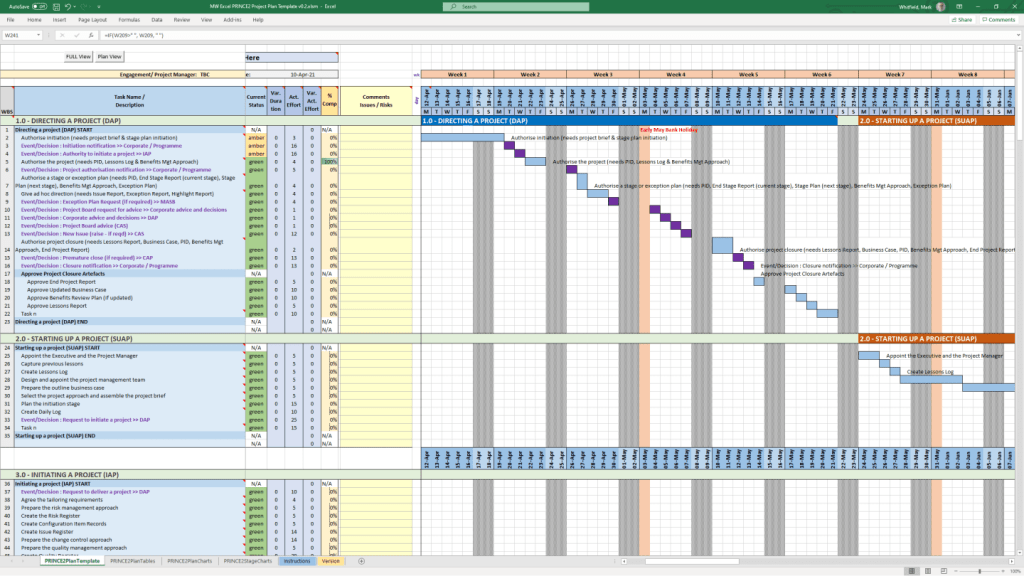
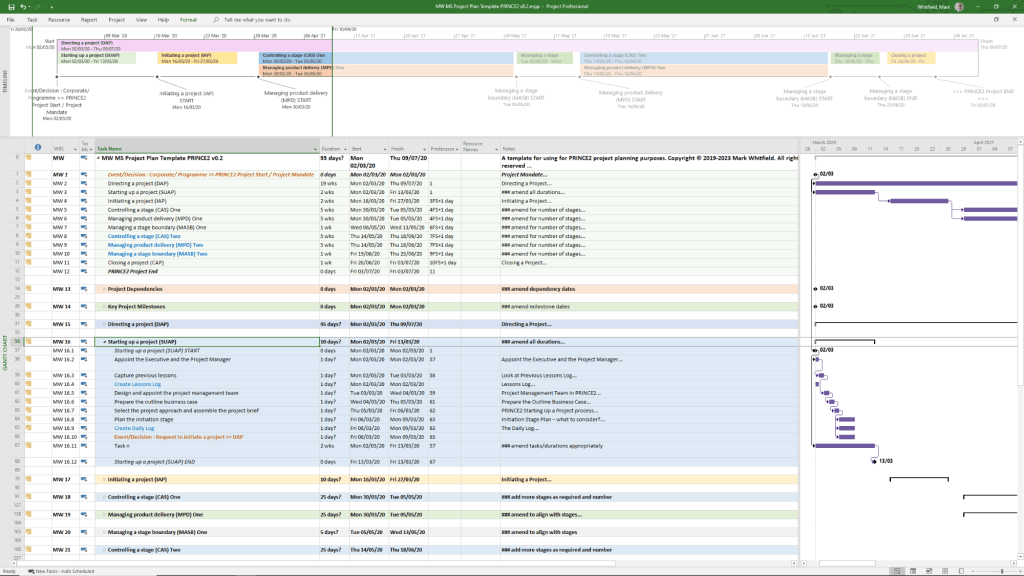
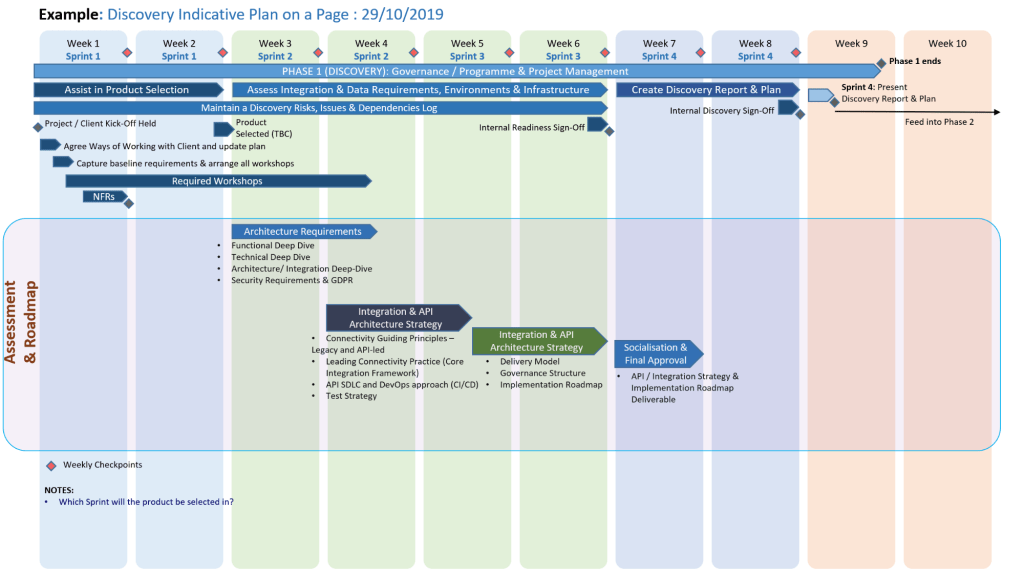
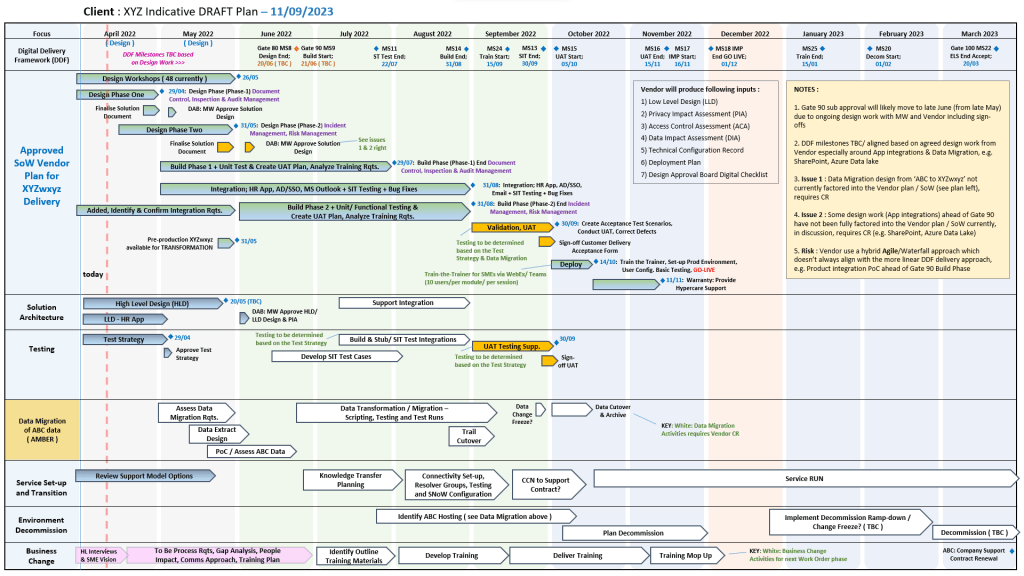
Waterfall Project Plans, .xls and .mpp file formats respectively

Core Characteristics

  • Sequential Design: No overlapping phases; each “cascades” into the next.
  • Documentation-Driven: Extensive upfront planning and detailed records are required at every step.
  • Fixed Scope: Requirements are gathered at the start, making the project’s timeline and budget highly predictable but difficult to change.
  • Specialised Use: Best suited for regulated industries like aerospace, construction, and healthcare, where changes are costly or safety is paramount. 

Historical Timeline by Era and Year

The following timeline tracks Waterfall from its origins in post-WWII engineering to its current role in hybrid project management.

Examples, Waterfall Plan On a Page POaP in MS PowerPoint format

The Pre-Formal Era (1950s – 1969)

Software development adopted structured, sequential approaches from engineering, largely driven by complex, high-risk projects. 

  • 1956: Herbert D. Benington documented a sequential process for the SAGE project, establishing the technical roots.
  • Late 1960s: NASA applied linear, rigid methodologies to Apollo missions, setting a precedent for high-stakes, documentation-heavy development.
  • 1968: The NATO Software Engineering Conference highlighted the “software crisis,” prompting a push for formal, disciplined development models. 

The Formalisation Era (1970 – 1979)

The model was officially, yet ironically, described and named. 

  • 1970: Dr. Winston W. Royce published his foundational paper on managing large software systems, often cited as the origin of the “Waterfall” model, though he originally presented it as a cautionary, flawed approach.
  • 1976: T.E. Bell and T.A. Thayer likely first used the term “Waterfall” in literature. 

The Institutional Era (1980 – 1999)

Waterfall became the mandatory standard for large-scale, complex projects. 

  • 1985: The U.S. DoD mandated DOD-STD-2167, cementing Waterfall as the standard for military software.
  • 1989: The UK Government introduced PRINCE2, deeply influenced by Waterfall principles.
  • 1994: The U.S. DoD formally abandoned strict Waterfall mandates for more flexible methods. 

The Modern & Hybrid Era (2000 – Present)

Waterfall transitioned from the default standard to a specialised methodology. 

  • 2001: The Agile Manifesto marked a shift toward iterative development, reducing Waterfall’s dominance.
  • Present Day: It remains vital in regulated sectors (e.g., aerospace) and is often combined with Agile in hybrid approaches.

Waterfall project management is a linear, sequential methodology

Click on the link in the website banner above to purchase example, editable template project plans shown and many others.