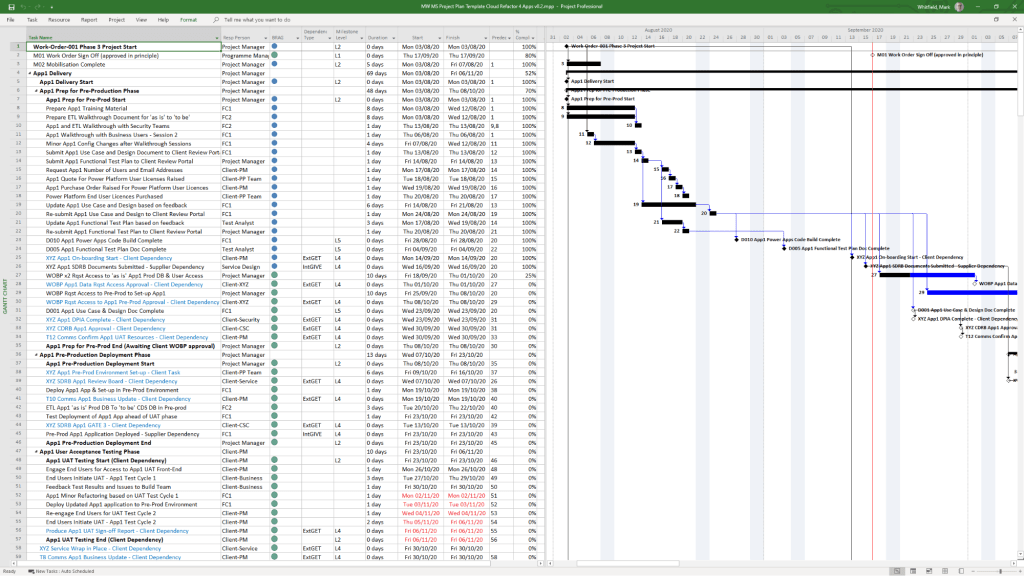
Microsoft Project has evolved from a DOS-based tool in the 1980s into a cloud-integrated platform. Its “Timeline” feature specifically has transitioned from a simple static view to a multi-layered, interactive reporting tool.
Template included in package – see website banner
Timeline Feature Development History
Early Era (1984–2007): For decades, the “timeline” was synonymous with the Gantt Chart. Users had to rely on complex print-outs or third-party tools to create high-level summaries for executives.
The dedicated Timeline View (2010): Microsoft introduced a native Timeline view in Project 2010, allowing users to cherry-pick specific tasks and milestones to display on a single horizontal bar.
Multi-Timeline Support (2016): Project 2016 expanded this by allowing multiple timeline bars in a single view. This enabled managers to represent different project phases or workstreams with independent start and end dates.
Cloud & Web Integration (2019–Present): With the launch of Project for the web, timelines became more interactive, supporting drag-and-drop adjustments and real-time co-authoring.
Task History Tracking (2023): Microsoft added a Task History pane to the web version, allowing users to see a chronological log of changes to specific timeline items.
Key Components of a Modern MS Project Timeline
Templates included in download bundle – see website banner
Gantt-Style Visualization: Displays tasks as horizontal bars against a calendar timescale.
Milestones & Callouts: Important dates appear as diamonds or labels that can be dragged above or below the main bar to avoid clutter.
Dependencies: Visual links between tasks that illustrate the sequence of work and the Critical Path.
Copy for Presentation: A dedicated formatting tool that allows users to export the timeline directly to Microsoft PowerPoint or email at various sizes (Small, Medium, Full Size).
Future Outlook
Template included in download bundle – see website banner
Microsoft has announced that Project Online will be officially retired on 30 September 2026, with development focus shifting entirely to the new Microsoft Planner and Project for the web ecosystem.
Microsoft Project Timeline, Development History Overview
Manchester’s technical history is defined by its evolution from the world’s first industrial city to a global hub for computing and material science.
18th Century: The Birth of Industry
1733:John Kay invented the Fly Shuttle, a key advancement in weaving.
1761: The Bridgewater Canal opened as Britain’s first man-made waterway independent of rivers, drastically reducing coal costs.
1764–1779:James Hargreaves invented the Spinning Jenny (1764), and Samuel Crompton created the Spinning Mule (1779), allowing for mass textile production.
1783:Richard Arkwright established Manchester’s first steam-powered mill.
1790:Piccadilly Mill became the first in the city to be powered directly by a steam engine.
19th Century: Engineering & Precision
1803:John Dalton published his Atomic Theory at the Manchester Literary & Philosophical Society.
Bill Bryson’s A Short History of Nearly Everything
Bill Bryson’s A Short History of Nearly Everything is a journey from the Big Bang to the rise of humanity, focusing not just on what happened, but how we figured it all out.
Here is a condensed timeline of the major milestones covered in the book, divided by the “Big Ideas” that shaped our understanding of the universe.
1. The Deep Past (The Universe and Earth)
This era covers the transition from “nothing” to a habitable rock.
13.8 Billion Years Ago: The Big Bang. In a fraction of a second, the universe expands from a singularity to a vast expanse.
4.5 Billion Years Ago: The Earth forms from a spinning cloud of gas and dust. Shortly after, a Mars-sized object strikes Earth, creating the Moon.
3.8 Billion Years Ago: The first signs of microbial life appear in the oceans.
700 Million Years Ago: “Snowball Earth”—a period where the planet may have been entirely encased in ice.
2. The Great Discoveries (17th – 19th Century)
3. The Atomic and Relativistic Age (20th Century)
In this era, science moved from the “visible” world to the subatomic and the cosmic.
1905: Albert Einstein publishes his papers on Special Relativity, proving that E = mc squared.
1911: Ernest Rutherford discovers the nucleus of the atom, realising that atoms are mostly empty space.
1930s: The discovery of Neutrons and the start of the “Particle Zoo.”
1953: Watson, Crick, and Franklin decipher the structure of DNA, the blueprint of life.
1960s: The theory of Plate Tectonics is finally accepted, explaining how continents move.
4. The Rise of Us (The Biological Timeline)
Bryson highlights how incredibly lucky we are to exist at all, given the history of extinctions.
540 Million Years Ago: The Cambrian Explosion. A massive burst of complex life forms.
250 Million Years Ago: The Permian Extinction. The “Great Dying” where 95% of all species vanished.
65 Million Years Ago: The KT Event. An asteroid hits the Yucatan Peninsula, ending the reign of the dinosaurs.
100,000 Years Ago:Homo sapiens begin to emerge as the dominant homid species.
Present Day: Humans have become a “geological force,” capable of altering the planet’s climate and future.
Key Themes to Remember
Human Fallibility: Much of the “history” is about scientists being wrong, arguing, or losing their notes.
The Size of the Void: We live on a tiny, fragile speck in a universe that is mostly “nothing.”
The Miracle of Existence: If any one of a billion variables had been slightly different, life as we know it wouldn’t exist.
“We are an impossibly lucky accident.” — Summary of Bryson’s core philosophy.
A Short History of Nearly Everything by Bill Bryson
Bolton’s evolution from a small moorland settlement to a world-leading industrial powerhouse and modern metropolitan borough is marked by these key milestones:
Bolton’s technical and industrial evolution shifted it from a medieval market town to a global leader in cotton spinning and engineering, before transitioning into a modern educational and service hub.
Bolton’s transformation was driven by local inventors whose technical breakthroughs redefined the textile industry.
1779:Samuel Crompton invented the Spinning Mule at Hall i’ th’ Wood, combining earlier technologies to produce high-quality yarn.
1780: The town’s first spinning mill opened, marking the start of large-scale mechanised production.
1820:Thomas Bonsor Crompton patented a method for continuously drying paper, a major technical breakthrough for the local paper industry.
1828: One of the world’s first railways, the Bolton and Leigh Railway, opened using George Stephenson’s locomotive “The Witch”.
1873: The Bolton Town Hall opened, a massive Victorian architectural project reflecting the town’s industrial wealth.
Modern Infrastructure & Power (1880 – 1950)
Technical focus shifted toward municipal services, electricity, and the zenith of the cotton industry.
1880: Horse-drawn municipal transport began, followed by a telephone connection between Bolton and Manchester.
1894: The first electric power station opened at Spa Road on October 31st.
1899: The town launched its first electric tram service.
1914: The Back o’ th’ Bank electricity generating station began supplying the town.
1929: Bolton reached its industrial peak with 216 cotton mills in operation.
Education & Re-development (1960s – Present)
As the cotton industry declined, Bolton pivoted toward technical education and retail-led regeneration.
1963: The Bolton Technical College split into Bolton Technical College and the Bolton Institute of Technology (the precursor to the University of Bolton).
Leigh, a historic market town in South Lancashire, evolved from a collection of medieval agricultural townships into a powerhouse of the Industrial Revolution. Below is a timeline of its development.
Early History & Foundations
Ancient Origins: Neolithic stone axes and Bronze Age spearheads suggest activity as early as 1500–1000 BC.
Medieval Growth: The name “Leigh” (Saxon for “meadow” or “pasture”) was recorded as Leech in 1264. The town was the centre of an ecclesiastical parish including the townships of Bedford, Pennington, and Westleigh.
1642: During the English Civil War, local “Chowbenters” (men from nearby Atherton) defeated Royalist troops in a battle at Leigh on 2nd December.
1651: The Earl of Derby spent his final night at the King’s Arms in Leigh before his execution in Bolton.
Industrial Revolution & Expansion
1795: The Bridgewater Canal was extended to Leigh, linking the town to Manchester’s industrial network.
1820: The Leigh Branch Canal opened, connecting the town to the Leeds and Liverpool Canal.
1828: The Bolton and Leigh Railway opened—the first public railway in Lancashire.
1839: The “Leigh Feight” occurred on 14th August, a major Chartist protest and riot involving over 2,000 people.
1850s: The Leigh Union Workhouse was established at Atherleigh.
Late 19th Century: Large multi-storey cotton mills like Leigh Spinners (Grade II*) and Mather Lane Mill (Grade II) transformed the skyline.
Civic Development
1875: The townships of Bedford, Pennington, and Westleigh merged to form the Leigh Local Board.
1894: Leigh became an Urban District.
1899: Leigh was granted a Royal Charter, becoming a Municipal Borough.
1907: The current Leigh Town Hall was completed on Market Street.
1920:Pennington Hall and its grounds were gifted to the people of Leigh, eventually becoming Pennington Park.
Modern Era
1974: Under the Local Government Act 1972, the Municipal Borough was abolished and Leigh became part of the Metropolitan Borough of Wigan in Greater Manchester.
1992: The last coal mines in the area, Bickershaw and Parsonage Collieries, closed on 13th March.
2016: The Leigh-Salford-Manchester Guided Busway opened to provide rapid transit to Manchester city centre.
2023: The Leigh Leopards rugby league team won the Challenge Cup for the first time in 52 years.
Leigh’s history is a classic Lancashire tale of transition from a rural collection of townships to an industrial powerhouse. Here is a timeline of its most significant milestones:
Early Origins & Medieval Period
Stone Age & Roman Era: Archaeological finds in the area include a Stone Age axe in Pennington and a Roman coin in Bedford.
12th Century: The name “Leigh” (from the Old English leah, meaning a woodland clearing) appears in records. The ancient parish originally consisted of six townships: Astley, Atherton, Bedford, Pennington, Tyldesley cum Shakerley, and Westleigh.
1189–1199: Higher Hall, the manor house of Westleigh, dates back to the reign of Richard I.
Conflict & Industrial Revolution
1642: During the English Civil War, local Parliamentarians (the “Chowbenters”) defeated Royalist troops in the Battle of Leigh.
1760s: Local legend attributes the invention of the spinning jenny and the water frame to Thomas Highs of Leigh, marking the start of its textile dominance.
1795–1820: The Bridgewater Canal was extended to Leigh (1795), followed by the Leigh branch of the Leeds and Liverpool Canal (1820), making the town a critical hub for coal and textiles.
1828: The Bolton and Leigh Railway opened for freight, becoming the first public railway in Lancashire.
1839: The “Leigth Feight” occurred on 14 August, when a mob of 2,000 Chartist strikers clashed with troops over high unemployment and living costs.
Civic Development & Modern Era
1875: The townships of Bedford, Pennington, and Westleigh merged to form the Leigh Local Board, officially adopting “Leigh” as the town’s name.
1899:Leigh was granted a Royal Charter to become a Municipal Borough.
1907: The current Leigh Town Hall, designed by J.C. Prestwich, was completed.
1911: The textile industry peaked, with over 6,000 people employed in the town’s mills.
1974: Under local government reorganisation, Leigh ceased to be an independent borough and became part of the Metropolitan Borough of Wigan in Greater Manchester.
2008: The Leigh Sports Village opened, providing a modern home for the Leigh Leopards rugby league team.
2016: The Leigh-Salford-Manchester guided busway opened, re-establishing a rapid transport link to Manchester.
Leigh College, Marshall Street, Leigh, Lancs
Building below demolished 2007 and now rebuilt at the Leigh Sports Village – 1, 2, 3, 4 article by Julie McKiernan courtesy of PastForward, produced by Wigan Archives & Museums, Issue No. 97, August – November 2024, Marking 50 years of the borough, Wigan and Leigh’s local history magazine – Address: Past Forward, Archives, Wigan & Leigh, Leigh Town Hall, Mark Street, Leigh, WN7 1DY