The professional performance and stakeholder feedback received by Senior IT Project Manager and Engagement Manager Mark Whitfield throughout his career (specifically documented across his tenure at Capgemini and various client engagements) is exceptionally positive.
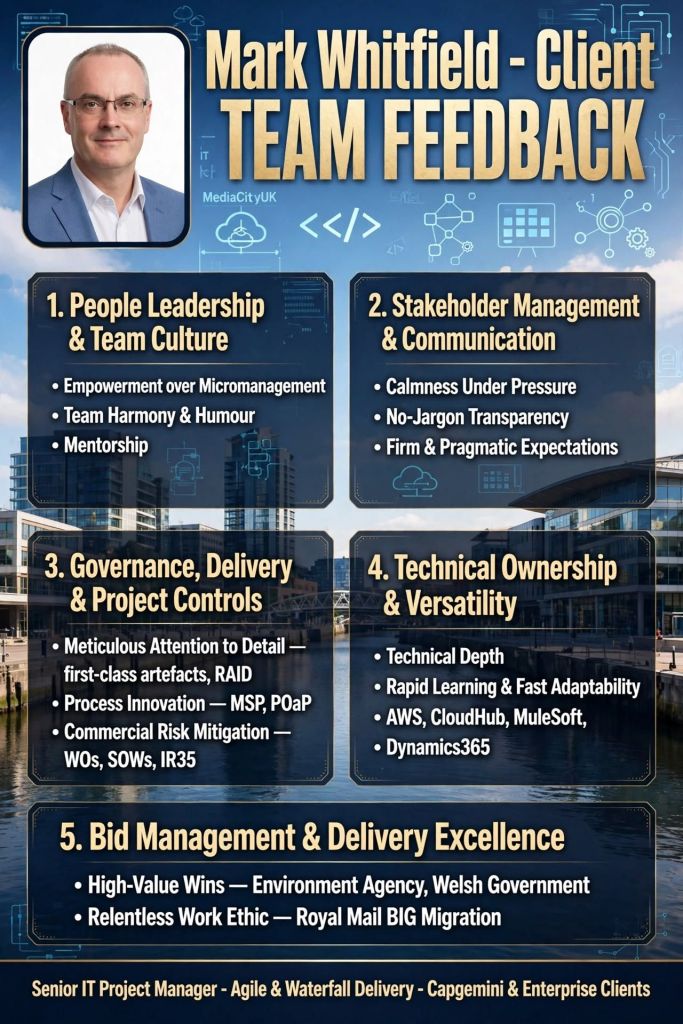
His feedback has been categorized below into the primary areas of leadership, management, and technical delivery:
👥 People Leadership & Team Culture
- Empowerment over Micromanagement: Multiple team members and consultants highlighted that Mark empowers individuals to take on responsibility, giving them the freedom to execute tasks without feeling pushy or micromanaged.
- Team Harmony & Humour: Feedback from lead functional consultants explicitly credited Mark with building outstanding, cohesive remote team cultures. He balances high professionalism with a fantastic sense of humour and humility, making heavy workloads feel manageable and enjoyable.
- Mentorship: Described by colleagues as a “tailored enabler” who caters to his team’s professional comfort to yield peak results, he has been thanked directly for creating learning opportunities in modern frameworks like the Power Platform and Azure cloud migration.
👔 Stakeholder Management & Communication
- Calmness Under Pressure: Clients and Account Delivery Managers frequently commend Mark for his “voice of reason” demeanor. He maintains remarkable levels of calmness and rational thinking during complex project challenges, shifting timelines, and fluid client environments.
- No-Jargon Transparency: He is highly respected for his “say it as it is” and “no-ego” client engagement style. He translates deeply complex technical aspects into clear, pragmatic delivery timelines, putting stakeholders at ease and building instant trust.
- Firm & Pragmatic Expectations: While accommodating to customer needs, feedback indicates he is unafraid to push back firmly when faced with unreasonable client expectations or scope creep.
⚙️ Governance, Delivery & Project Controls
- Meticulous Attention to Detail: Senior Program Managers have labeled Mark’s project artefacts, financial logs, and reporting structures as “first-class” and “exemplar”. He sticks rigorously to reporting cadences and ensures RAID (Risks, Issues, Assumptions, Dependencies) logs are meticulously maintained.
- Process Innovation: Mark frequently goes beyond baseline requirements to improve delivery templates. For example, he spent considerable effort mapping complex “strawman” spreadsheets into robust Microsoft Project (MSP) plans and creating standard Plan on a Page (POaP) layouts utilized across wider programs.
- Commercial Risk Mitigation: He works tightly with legal and account leadership to gain fast approvals on Work Orders (WOs) and Statements of Work (SOWs), effectively managing complex multi-million pound account financials and navigating corporate hurdles (such as IR35 legislation compliance).
💻 Technical Ownership & Versatility
- Technical Depth: Uniquely for a project manager, technical architects have praised Mark for taking structural ownership of solutions. He acquires a deep enough technical understanding of complex architectures to “hold his own” on technical calls.
- Rapid Learning & Fast Adaptability: Throughout his diverse contract assignments, Mark has consistently demonstrated an ability to quickly pick up new technologies (such as AWS, CloudHub, MuleSoft OBD, and Dynamics365) and unfamiliar client governance protocols with minimal to zero handover.
🏆 Bid Management & Delivery Excellence
- High-Value Wins: Bid Directors have noted his exceptional proficiency in creating high-quality estimation models and plans under strict, stressful timelines, resulting in critical project extensions and massive programme wins (such as the Environment Agency estate migration and the Welsh Government Childcare bid).
- Relentless Work Ethic: During high-impact cut-over periods (like the massive Royal Mail BIG Interface Migration), senior leadership highly commended Mark for his massive personal sacrifice, working long hours and overnights to deliver project milestones ahead of peak corporate change freezes.