

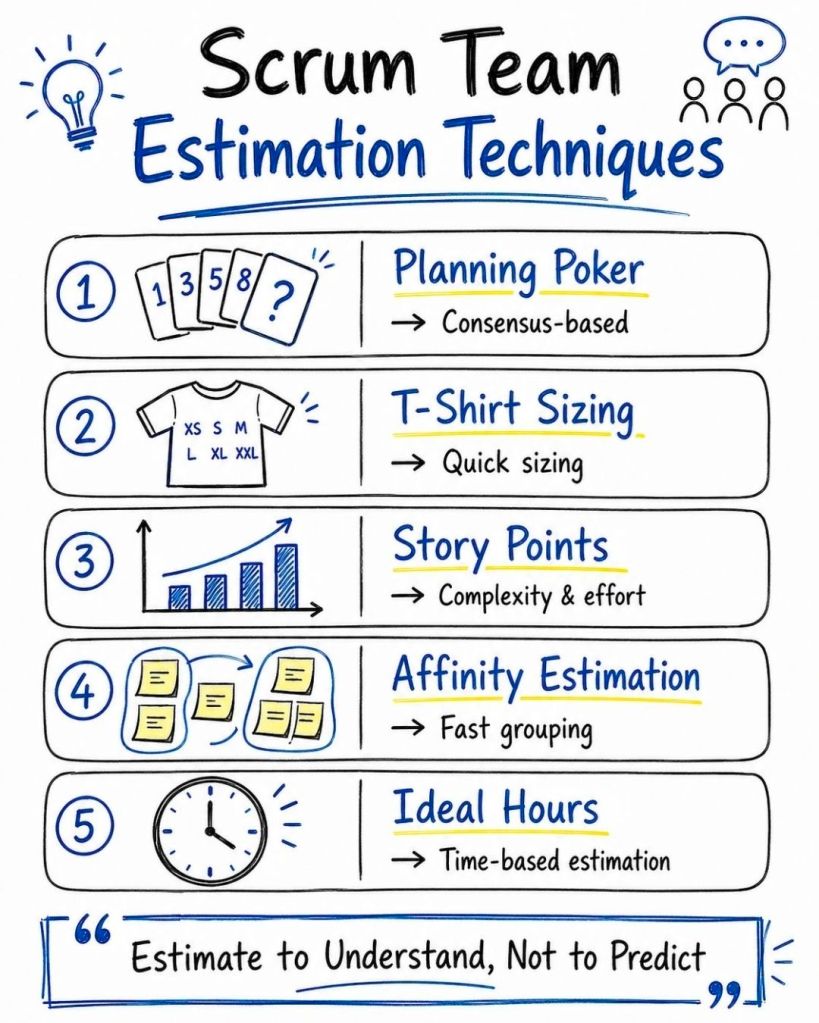
Agile estimation techniques use relative sizing rather than exact time tracking to gauge the effort, complexity, and risk of completing tasks. These collaborative methods help Scrum teams maintain predictable delivery and realistic workloads without relying on rigid, top-down predictions.
Common Agile estimation techniques include:
1. Planning Poker
- How it works: Team members use a deck of cards with values from the modified Fibonacci sequence (0, 1, 2, 3, 5, 8, 13, 21, etc.). The Product Owner presents a user story, the team discusses it, and each member privately selects a card representing their effort estimate.
- When to use it: Ideal for detailed sprint planning and backlog refinement, especially when you need to encourage team collaboration and reach a consensus.
2. T-Shirt Sizing
- How it works: Tasks are assigned sizes (XS, S, M, L, XL) based on high-level complexity rather than precise points.
- When to use it: Excellent for rapid, broad-brush estimation during initial release planning or when mapping out large Epics that aren’t yet refined into granular user stories.
3. Affinity Estimation
- How it works: The team collaboratively groups user stories on a wall or digital board into columns representing different sizes. Every team member can move a story if they disagree with its current size, creating a consensus through comparative grouping.
- When to use it: Best suited for large product backlogs where many items need to be sized quickly in a single session.
4. Dot Voting
- How it works: Team members receive a limited number of physical or digital “dots” to place on user stories they believe carry the highest complexity or effort, prioritizing stories based on the concentration of votes.
- When to use it: Helpful for quick prioritization and establishing a baseline for relative difficulty among a large list of tasks.
5. The Bucket System
- How it works: Similar to Affinity Estimation, various “buckets” (numbered with Fibonacci sequences) are laid out. Stories are placed in the buckets, which helps the team rapidly categorize relative effort.
- When to use it: Great for medium-to-large backlogs requiring faster execution than traditional Planning Poker without sacrificing sizing accuracy.
To dive deeper into implementing these practices for your team, check out Atlassian’s Guide to Agile Estimation or explore Monday.com’s Agile Estimation Strategies.


