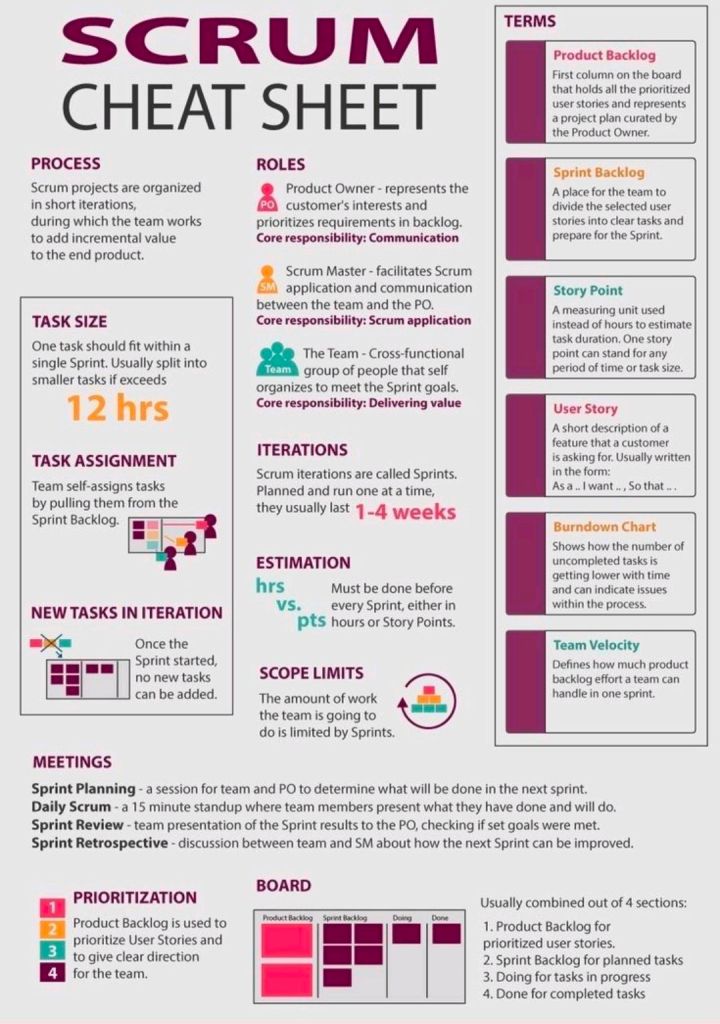
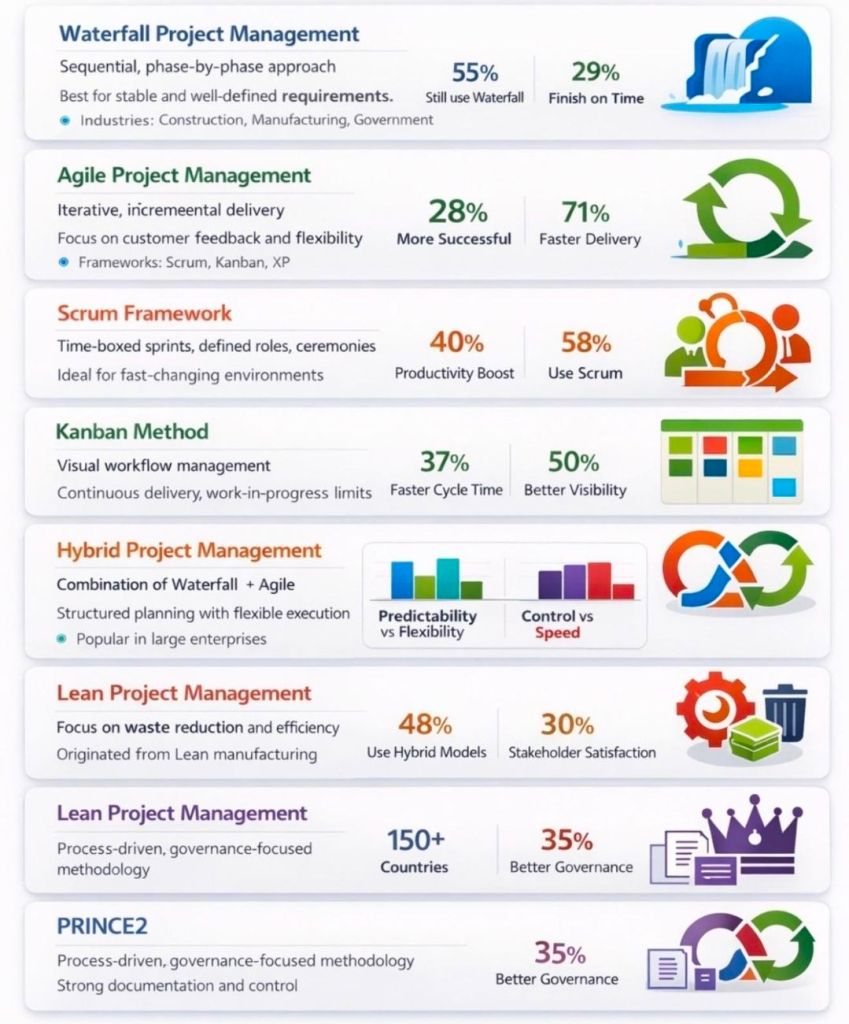
Agile Scrum on a page, summary of core focus areas

Agile Scrum on a page, summary of core focus areas

Scrumban project management summary and detailed historical timeline by era and year

Scrumban is a hybrid Agile project management framework that blends the structured planning and roles of Scrum with the continuous flow and visualization of Kanban. Originally designed as a transition method for teams moving from Scrum to Kanban, it has evolved into a popular, distinct approach for teams needing to manage unpredictable work (e.g., support, maintenance) while maintaining prioritized planning. It focuses on pull-based workflows, limiting Work-in-Progress (WIP), and continuous improvement. 

Scrumban Summary

  • Best Used For: Teams needing more flexibility than Scrum (no rigid sprints) but more structure than Kanban (needs planning cycles).
  • Key Features: Visual board (Kanban), Work-in-Progress (WIP) limits, on-demand or iterative planning, and a pull-based workflow.
  • Differences from Parent Frameworks:
    • vs. Scrum: No set sprint length or rigid roles; work is pulled continuously rather than planned in batches.
    • vs. Kanban: Uses planning meetings and team retrospectives, whereas classic Kanban is purely continuous. 

Detailed Historical Timeline of Scrumban

1. The Pre-Scrumban Era (Pre-2008)

  • 1950s (Kanban Origin): Toyota develops Kanban to optimize manufacturing production processes, focusing on Just-in-Time (JIT) production.
  • 1986 (Scrum Concept): Takeuchi and Nonaka introduce the “rugby” approach to product development in the Harvard Business Review, fostering flexible, team-based development.
  • 1995 (Scrum Introduced): Ken Schwaber and Jeff Sutherland formalize the Scrum framework for software development.
  • 2001 (Agile Manifesto): Release of the Agile Manifesto, establishing core agile principles.
  • 2004 (Kanban in Software): David J. Anderson suggests applying Kanban practices to software development to improve workflow.
  • 2000-2007 (Evolution): Microsoft teams begin experimenting with “feature crews” that mix structured planning with continuous delivery, planting the seeds for hybrid approaches. 

2. Conception and Definition (2008–2010)

  • 2008: Corey Ladas coins the term “Scrumban” and introduces the concept in his work, proposing it as a mechanism for teams to transition from Scrum to Kanban, or as a sustainable hybrid for maintaining focus while reducing iteration overhead.
  • 2008: Ajay Reddy discusses the “Scrumban (R)evolution,” emphasizing that Scrumban is a distinct, powerful approach, not merely a blend.
  • 2009: Ladas publishes “Scrumban: Essays on Kanban Systems for Lean Software Development,” providing the definitive framework for the approach. 

3. Formalization and Adoption (2011–2019)

  • Early 2010s: The methodology gains popularity in specialized software areas, such as maintenance and support teams, where unpredictable bugs demand faster flexibility than two-week sprints.
  • 2016: Ajay Reddy releases “The Scrumban [R]Evolution: Getting the Most Out of Agile, Scrum, and Lean Kanban,” providing practical guidelines for applying the methodology.
  • 2018-2019: Adoption expands beyond software development into agile marketing and HR, looking for reduced bureaucracy. 

4. Mature Hybrid & Continued Growth (2020s–Present)

  • 2020s: Scrumban is recognized as a standard agile framework within major project management tools (e.g., Jira, Miro, Monday).
  • 2025-2026: Further refinement as teams integrate AI-driven task management with visual Kanban workflows to increase throughput and automate WIP tracking. 

Core Principles of Modern Scrumban (2026 Perspective)

  1. Pull System: Work is pulled by team members when capacity allows, rather than pushed into the team.
  2. Visual Board: All tasks are visualized to show bottlenecks.
  3. WIP Limits: Restricting the number of active tasks at any stage to improve efficiency.
  4. No Required Roles: Teams can keep Scrum roles (Product Owner, Scrum Master) or remove them, depending on their needs.
  5. Adaptive Planning: Planning occurs on-demand or at short intervals, not just in strict timeboxed sprints.

Scrumban project management summary and detailed historical timeline by era and year

PERT Program Evaluation & Review Technique summary & detailed historical timeline by era & year

The Program Evaluation and Review Technique (PERT) is a project management tool developed in the late 1950s to analyze and represent the tasks involved in completing a complex project. It is designed to handle uncertainty in project scheduling by using three time estimates (optimistic, pessimistic, and most likely) to calculate the expected duration of tasks. 

Summary of PERT Project Management

  • Origin: Developed in 1958 by the U.S. Navy Special Projects Office to manage the Polaris missile submarine program, which involved thousands of contractors.
  • Purpose: To schedule, organize, and coordinate tasks within complex, non-repetitive projects, allowing for the identification of the critical path.
  • Key Feature (Three-Time Estimate): Unlike traditional methods, PERT uses a probabilistic approach.
  • Visual Structure: A PERT chart acts as a network diagram, using nodes (circles/rectangles) for events and arrows for tasks and dependencies.
  • Impact: Credited with shortening the Polaris project timeline by two years.

Detailed Historical Timeline of PERT (1950s–Present)

The Era of Development (1950s)

  • 1957: The groundwork for network scheduling began in the US, with DuPont developing the Critical Path Method (CPM) and preliminary research into PERT concepts beginning.
  • 1958: Birth of PERT. The U.S. Navy Special Projects Office officially develops PERT for the Polaris missile project to manage high uncertainty in R&D.
  • 1958: The first two publications, Program Evaluation Research Task, Summary Report, Phase 1 and 2, are written (primarily by Charles F. Clark) to document the technique.
  • 1959: Willard Fazar of the Navy officially introduces PERT to the public in The American Statistician, detailing the use of three time estimates. 

The Expansion and Mainframe Era (1960s–1970s) 

  • 1960s: PERT is widely adopted by NASA and the U.S. Department of Defense for large, schedule-driven projects.
  • 1962: The US Department of Defense mandates the use of Work Breakdown Structures (WBS) for projects, reinforcing PERT application.
  • 1965: PERT is applied to the planning and organization of the 1968 Winter Olympics in Grenoble.
  • 1970s: PERT/CPM software packages begin to be used on mainframe and minicomputers. 

The PC and Software Era (1980s–1990s)

  • 1980s: With the advent of personal computers, PERT software becomes accessible, leading to adoption in software development and manufacturing.
  • 1984: The Theory of Constraints (TOC) is introduced, which later influences critical chain methodologies, adding to network scheduling techniques.
  • 1987: The Project Management Institute (PMI) publishes the first white paper on the Project Management Body of Knowledge (PMBOK), including network techniques.
  • 1997: Critical Chain Project Management (CCPM) is introduced as a new approach to managing resources and task uncertainty, building on PERT/CPM principles. 

The Digital and Agile Era (2000s–Present)

  • 2000s: PERT charts become a standard feature in project management software (MS Project, Primavera), automating the calculation of critical paths.
  • 2012: ISO 21500:2012 provides guidance on project management, incorporating network analysis techniques.
  • 2017/2021: PMBOK releases 6th and 7th editions, integrating PERT and network scheduling with agile and adaptive environments.
  • Present: While overshadowed by Agile (Scrum/Kanban) in software, PERT remains crucial for complex construction, R&D, and defense projects, often used in hybrid approaches. 

Key Components of a PERT Chart

  1. Event (Node): A milestone representing the start or completion of a task.
  2. Activity (Arrow): The actual task required to move from one event to another.
  3. Critical Path: The longest sequence of dependent tasks, determining the minimum project duration.
  4. Float (Slack): The amount of time a task can be delayed without delaying the overall project. 

Six Sigma project management summary and detailed historical timeline by era and year

Six Sigma is a disciplined, data-driven methodology and project management strategy designed to improve process performance, eliminate defects, and minimize variation. Pioneered at Motorola in the 1980s, it aims for a near-perfection standard of no more than 3.4 defects per million opportunities (DPMO). It is often used in combination with Lean principles (Lean Six Sigma) to simultaneously eliminate waste and reduce variation. 

Six Sigma Project Management Summary

Six Sigma project management relies on a structured, five-phase framework known as DMAIC (pronounced “duh-may-ick”) for improving existing processes: 

  • Define: Identify the project goals and customer deliverables (Critical to Quality – CTQ).
  • Measure: Quantify the current process performance and gather baseline data.
  • Analyze: Determine the root causes of defects and variation.
  • Improve: Implement and verify solutions that eliminate the root causes.
  • Control: Standardize the new process and implement monitoring to ensure long-term sustainability. 

Key Project Roles (The Belt System):

  • White/Yellow Belt: Basic awareness and team members.
  • Green Belt: Leads projects, assists Black Belts.
  • Black Belt: Leads complex projects, acts as change agent.
  • Master Black Belt: Coaches Black/Green Belts, oversees strategy.

Detailed Historical Timeline by Era and Year

Pre-1980s: Foundational Quality Efforts 

  • 1799: Eli Whitney introduces the concept of interchangeable parts (standardization) to produce muskets, reducing variation.
  • 1920s: Walter Shewhart at Bell Laboratories shows that 3-sigma process control is necessary to reduce variation.
  • 1950s: Toyota Production System (TPS) develops to create efficiency and quality. 

1980s: Origin and Development (The Motorola Era) 

  • 1981: Motorola leadership (Bob Galvin) initiates a push for increased quality, arguing that traditional 3-sigma defects (thousands) were insufficient, prompting a push for DPMO.
  • 1985: Engineer Bill Smith pens a paper proposing the term and methodology of Six Sigma.
  • 1986: Bill Smith officially introduces Six Sigma at Motorola, with Mikel Harry and Bob Galvin as co-contributors.
  • 1987: Motorola formally founds the Six Sigma improvement program, targeting a 10-fold reduction in defects.
  • 1988: Motorola receives the first Malcolm Baldrige National Quality Award.
  • 1989: Motorola establishes the Six Sigma Research Institute. 

1990s: Expansion and Standardization (The GE/Allied Signal Era) 

  • 1990: Motorola introduces the concept of Black Belts to formally lead improvement projects.
  • 1993: Motorola registers Six Sigma as a trademark.
  • 1994: AlliedSignal adopts Six Sigma, with CEO Larry Bossidy leading the effort.
  • 1995: Jack Welch adopts Six Sigma at General Electric (GE), optimizing the DMAIC approach and boosting its popularity.
  • Late 1990s: Over 2/3 of Fortune 500 companies start Six Sigma initiatives. 

2000s: Integration with Lean (The Lean Six Sigma Era) 

  • 2000s: Global adoption of Six Sigma by companies like Sony, Jaguar, Samsung, and Adidas.
  • 2002: Michael George publishes “Lean Six Sigma,” combining the speed of Lean (waste reduction) with the quality of Six Sigma (variation reduction).
  • Mid-2000s: Six Sigma expands beyond manufacturing into services, healthcare, and finance. 

2010s – Present: Digitalization and Advanced Analytics

  • 2010s: Integration of data-driven Six Sigma with technology, including real-time monitoring and advanced data analytics.
  • Present: Incorporation of Big Data, Machine Learning, and AI to enhance analytical capabilities and predictive maintenance within the DMAIC framework. 

Key Contributors to Six Sigma

  • Bill Smith: “Father of Six Sigma,” developed the concept at Motorola.
  • Bob Galvin: CEO of Motorola, supported and pushed the adoption of the methodology.
  • Mikel Harry: Co-developed the methodology and helped establish the Six Sigma Institute.
  • Jack Welch: Former CEO of GE, championed the strategy, proving its power outside of manufacturing.
  • Larry Bossidy: CEO of Allied Signal, instrumental in early adoption.

Six Sigma project management summary and detailed historical timeline by era and year

Scrum Agile Framework summary and detailed historical timeline by era and year

Scrum is an Agile framework for managing complex, innovative product development through small, cross-functional teams working iteratively in short time-boxes called Sprints. Inspired by a 1986 “rugby” approach to product development, it was formalized in the early 1990s by Jeff Sutherland and Ken Schwaber to improve team productivity and deliver value quickly.

Scrum is based on empiricism—transparency, inspection, and adaptation—and is defined by specific roles (Product Owner, Scrum Master, Developers), events (Sprint Planning, Daily Scrum, Sprint Review, Retrospective), and artifacts (Product Backlog, Sprint Backlog, Increment). 

Detailed Historical Timeline

The Conceptual Era (Pre-1990s)

  • 1986: Takeuchi and Nonaka publish “The New New Product Development Game” in Harvard Business Review. They introduce the “rugby” approach—a team working together, passing the ball back and forth, to increase speed and flexibility. 

Scrum Takes Shape (1990–1999) 

  • 1993: First Scrum implementation: Jeff Sutherland, John Scumniotales, and Jeff McKenna at Easel Corporation apply these concepts to software development.
  • 1995: Ken Schwaber and Jeff Sutherland present a paper, “The SCRUM Development Process,” at the Object-Oriented Programming, Systems, Languages & Applications (OOPSLA) conference in Austin, Texas, formally introducing the framework.
  • 1996: Ken Schwaber and Mike Beedle refine the process, focusing on software development.
  • 1999: Mike Beedle, Martine Devos, Yonat Sharon, Ken Schwaber, and Jeff Sutherland publish “SCRUM: An extension pattern language for hyperproductive software development”. 

Agile and Formalization (2000–2009) 

  • 2001: Ken Schwaber, Jeff Sutherland, and 15 others create the “Agile Manifesto” in Snowbird, Utah. Schwaber and Beedle publish the first book on Scrum: Agile Software Development with Scrum.
  • 2002: Ken Schwaber, Mike Cohn, and Esther Derby found the Scrum Alliance to provide certifications.
  • 2004: Ken Schwaber publishes Agile Project Management with Scrum.
  • 2006: Jeff Sutherland founds Scrum Inc..
  • 2009: Ken Schwaber leaves the Scrum Alliance and founds Scrum.org to provide Professional Scrum accreditation. 

The Scrum Guide Era (2010–Present) 

  • 2010: First “Scrum Guide” is published by Ken Schwaber and Jeff Sutherland to define the framework, often revised in subsequent years (2011, 2013, 2016, 2017).
  • 2017: PRINCE2 Agile is published, adding governance layers for organizations using Scrum.
  • 2020: The latest Scrum Guide (November 2020) is released, focusing on a more minimal, less prescriptive definition, introducing the “Product Goal” and changing “Development Team” to “Developers”. 

Key Components of Scrum

  • Roles: Scrum Master (servant leader), Product Owner (backlog owner), Developers (build the product).
  • Events: Sprint (1–4 weeks), Sprint Planning, Daily Scrum, Sprint Review, Sprint Retrospective.
  • Artifacts: Product Backlog, Sprint Backlog, Increment. 

Scrum Agile Framework summary and detailed historical timeline by era and year

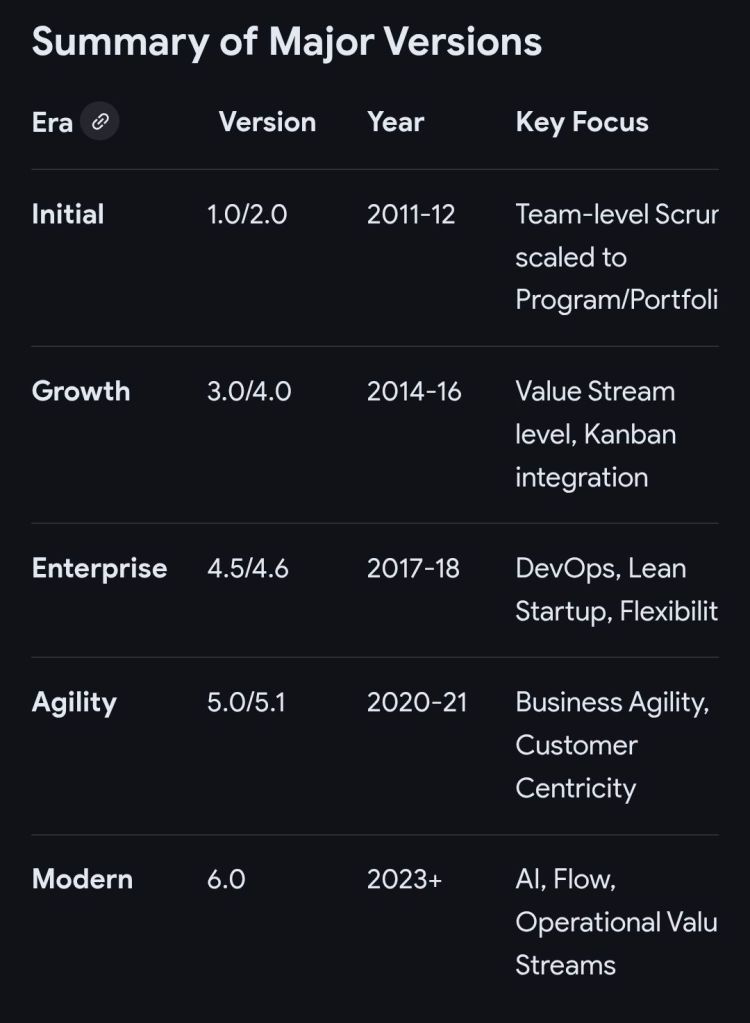
SAFe Scaled Agile Framework summary and detailed historical timeline by era and year

The Scaled Agile Framework (SAFe) is a set of organization and workflow patterns intended to guide enterprises in scaling lean and agile practices across large-scale software and systems development. Created by Dean Leffingwell in 2011, it combines Agile development, Lean product development, and systems thinking to enable alignment, collaboration, and delivery across hundreds or thousands of practitioners. 

SAFe Project Management Summary

SAFe structures project management across multiple levels to bring agility to the enterprise: 

  • Team Level: Scrum or Kanban teams operate in 2-week iterations (sprints) to deliver working software.
  • Program Level (Agile Release Train – ART): A “team of teams” (typically 50-125+ people) aligns to a common mission, planning, and releasing together on a fixed cadence, usually via Program Increments (PIs) lasting 8–12 weeks.
  • Portfolio Level: Aligns strategy to execution, managing investment themes (Epics) through Lean Portfolio Management.
  • Core Values & Principles: SAFe is grounded in 10 principles (e.g., “Take an economic view,” “Apply systems thinking”) and four core values: Alignment, Built-in Quality, Transparency, and Program Execution. 

Historical Timeline by Era and Version

The evolution of SAFe tracks the growing need for business agility and faster delivery in complex organizations. 

1. Foundation & Initial Concept (2007–2010)

  • 2007–2008: Dean Leffingwell publishes Scaling Software Agility, laying the foundation for enterprise agile patterns.
  • 2010: Agile Software Requirements is published, bridging Agile with enterprise needs. 

2. The Early Years: SAFe 1.0 – 2.0 (2011–2013) 

  • 2011: SAFe 1.0 released, initially termed “Agile Enterprise Big Picture,” focusing on applying Scrum/XP at scale.
  • 2012: SAFe 2.0 (October) released to restructure portfolio and program levels.
  • 2013: Initial refinements to the “Big Picture” to better integrate lean principles. 

3. Expansion: SAFe 3.0 – 4.0 (2014–2016) 

  • 2014: SAFe 3.0 introduced, introducing more emphasis on DevOps and faster, value-driven delivery.
  • 2016: SAFe 4.0 launched, introducing a dedicated “Value Stream” level for larger, complex systems and enhancing Kanban adoption. 

4. The Enterprise & DevOps Era: SAFe 4.5 – 4.6 (2017–2018) 

  • 2017: SAFe 4.5 released, emphasizing Lean Startup techniques, Lean UX, and faster, more flexible “Essential SAFe” configuration.
  • 2018: SAFe 4.6 updated to further incorporate the “Five Core Competencies of the Lean Enterprise”. 

5. Business Agility Era: SAFe 5.0 – 5.1 (2020–2021)

  • 2020: SAFe 5.0 (January) released, focusing on “Business Agility,” expanding agile principles beyond IT to the entire business (Human Resources, Finance, etc.).
  • 2021: SAFe 5.1 introduced, with enhanced focus on distributed teams, DevOps, and Accelerate metrics. 

6. AI & Continuous Learning Era: SAFe 6.0 (2023–Present) 

  • 2023: SAFe 6.0 (March) released, providing updated guidance on AI, Big Data, and Cloud technologies, while enhancing flow-based planning and accelerating value delivery.
  • 2024/2025: Focus on “AI-Empowered” SAFe, integrating artificial intelligence into the framework’s roles and ceremonies. 

SAFe Scaled Agile Framework summary and detailed historical timeline by era and year

PMP Project Management Professional summary and detailed historical timeline by era and year

Project Management Professional (PMP) history, as guided by the Project Management Institute (PMI), tracks the evolution from ancient craft systems to a modern, standardized profession combining predictive, agile, and hybrid approaches. Modern project management as a formal discipline emerged in the 1950s, with PMP certification officially launching in 1984. 

Summary of Project Management Eras

  • Pre-1950s (Craft Era): Large-scale construction (Pyramids, Great Wall) relied on master builders, intuitive planning, and heavy labor.
  • 1950s-1960s (Birth of Modern PM): Scheduling tools (CPM, PERT) and the Work Breakdown Structure (WBS) were developed for defense and construction.
  • 1969-1980s (Standardization Era): PMI was founded, and the PMP certification was introduced to create a shared professional language.
  • 1990s-2000s (Digital & Agile Era): Project software matured, the PMBOK Guide was published, and Agile techniques began reshaping software development.
  • 2010s-Present (Hybrid & AI Era): Focus on flexibility, stakeholder management, hybrid approaches, and AI integration. 

Detailed Historical Timeline

Ancient to Early 20th Century: Foundations

  • 2570 BC: Completion of the Great Pyramid of Giza, showing advanced resource planning.
  • 208 BC: Construction of the Great Wall of China, demonstrating large-scale logistical management.
  • 1917: Henry Gantt develops the Gantt Chart, a cornerstone of project scheduling. 

1950s-1960s: Birth of Modern Project Management 

  • 1957-1958: Development of key scheduling tools, Critical Path Method (CPM) and Program Evaluation Review Technique (PERT).
  • 1962: WBS approach mandated by the U.S. Department of Defense.
  • 1969: Project Management Institute (PMI) founded in Pennsylvania to standardize the profession. 

1970s-1980s: Professionalization and Certification 

  • 1975: Publication of The Mythical Man-Month by Fred Brooks, identifying software project risks.
  • 1984: First PMP certification exam administered by PMI.
  • 1986: Takeuchi and Nonaka introduce “Scrum” as a project management style.
  • 1987: First PMBOK Guide published as a white paper. 

1990s: PMBOK and Formalization 

2000s-2010s: Agile and Global Expansion 

  • 2001: Agile Manifesto written, emphasizing flexibility.
  • 2003: PMP exam revised to incorporate Agile techniques.
  • 2017: PMBOK 6th Edition released, integrating Agile and adaptive environments. 

2020s-Present: Modernization and AI

  • 2021: PMBOK 7th Edition released, shifting from process-based to principle-based standards.
  • 2024: PMI launches initiatives to incorporate Generative AI (PMIxAI) into project management. 

Key Evolution Trends

  1. From Craft to Science: Moving from intuitive, “master builder” approaches to structured, data-driven methodologies (PERT/CPM).
  2. From Fixed to Adaptive: Transitioning from rigid “waterfall” plans to iterative Agile and Hybrid approaches.
  3. Standardization: The PMP credential has shifted from solely construction/engineering focus to a global, cross-industry benchmark.
  4. Technology Integration: The rise of Artificial Intelligence (AI) and automated tools for risk management and scheduling.

PMP Project Management Professional summary and detailed historical timeline by era and year

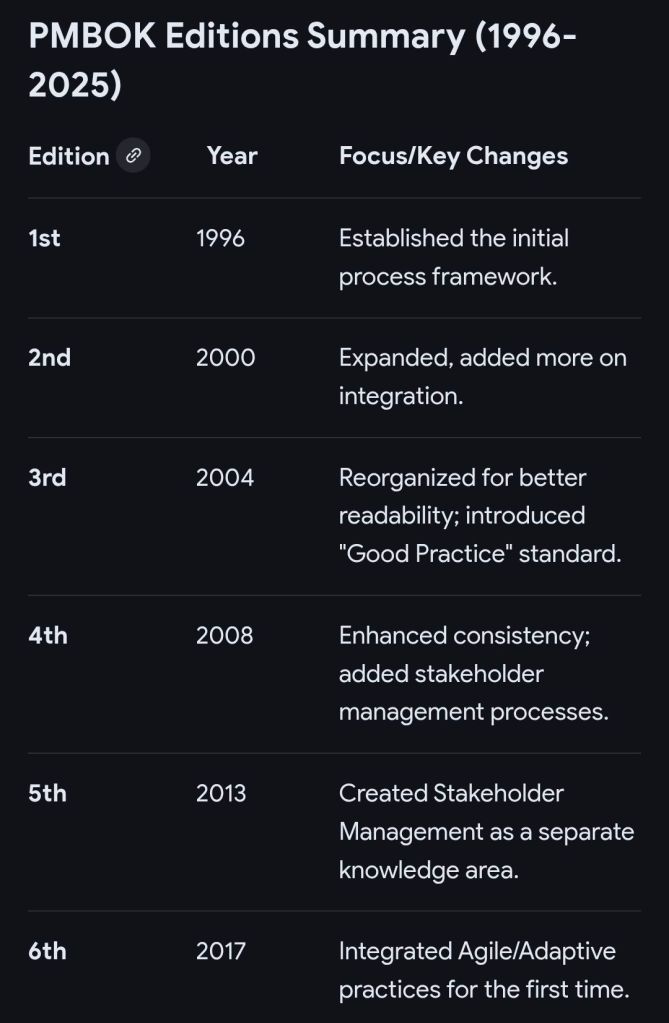
PMBOK Project Management Body of Knowledge summary and detailed historical timeline by era and year

The PMBOK (Project Management Body of Knowledge) Guide, published by the Project Management Institute (PMI), is the globally recognized standard for project management best practices. Its evolution reflects the shift from rigid, industrial-era scheduling to flexible, value-driven, and hybrid methodologies. 

Summary of PMBOK Evolution

  • 1980s (Origins): PMI sought to standardize knowledge, starting with a white paper in 1983 and the first “Body of Knowledge” document in 1987.
  • 1996 (1st Edition): The first official PMBOK Guide was published, introducing a foundational process framework.
  • 2000s (Expansion): The 2nd (2000) and 3rd (2004) editions expanded on integration and finalized the standard for project management.
  • 2010s (Integration): The 4th (2008) and 5th (2012) editions added stakeholder management and aligned with enterprise needs. The 6th Edition (2017) formally bridged predictive (waterfall) and agile practices.
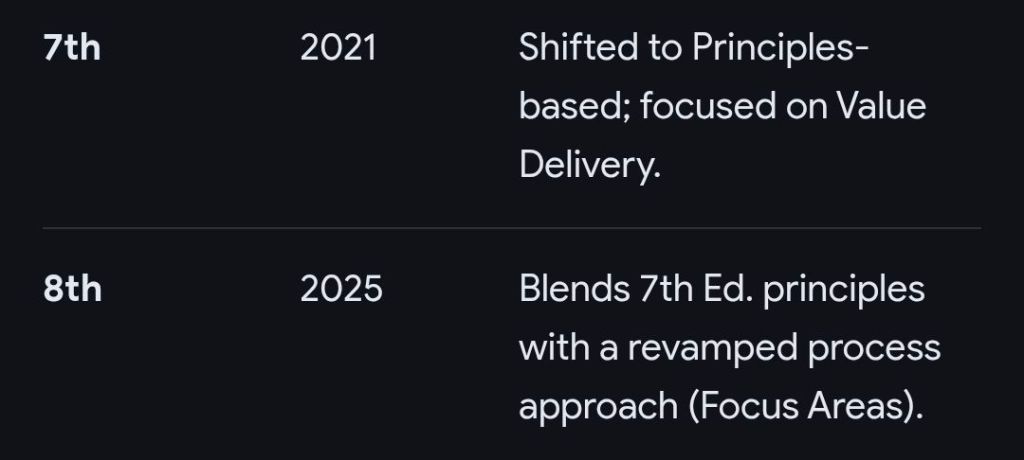
  • 2020s (Transformation): The 7th Edition (2021) marked a massive shift from process-based to principle-based, focusing on project outcomes rather than just outputs. The 8th Edition (2025) reintroduces practical, tailored process guidance alongside principles. 

Detailed Historical Timeline by Era and Year

Ancient Era to Pre-Modern (Before 1950s)

  • 2570 BC: Completion of the Great Pyramid of Giza, requiring complex organization, planning, and control.
  • 208 BC: Construction of the Great Wall of China, demonstrating massive, orchestrated labour management.
  • 1917: Henry Gantt developed the Gantt chart, a foundational scheduling tool still used today.

The Foundation Era (1950s – 1960s) 

  • 1956: American Association of Cost Engineers (now AACE International) formed.
  • 1957: Critical Path Method (CPM) invented by Dupont.
  • 1958: Program Evaluation and Review Technique (PERT) developed by the U.S. Navy for the Polaris missile program.
  • 1962: U.S. Dept of Defense mandated the Work Breakdown Structure (WBS) approach.
  • 1969: Project Management Institute (PMI) founded to promote the profession and set standards. 

The Formalization Era (1970s – 1980s) 

  • 1975: PROMPTII method created (later becoming PRINCE).
  • 1984: Dr. Eliyahu M. Goldratt introduced the Theory of Constraints (TOC) in his book “The Goal”.
  • 1986: Scrum named as a project management style.
  • 1987: First PMBOK Guide published by PMI as a white paper, attempting to standardize practices. 

The Standardization Era (1990s – 2000s)

  • 1991: Navy A-12 Avenger II Program cancelled due to poor performance detected by EVM.
  • 1996: 1st Edition of the PMBOK Guide released, establishing it as the foundational standard.
  • 1997: Critical Chain Project Management (CCPM) invented.
  • 1998: PMBOK recognized as a standard by ANSI (American National Standards Institute) and IEEE.
  • 2000: 2nd Edition of the PMBOK Guide released, adding more practical, in-depth material.
  • 2001: Agile Manifesto written, focusing on adaptability in software development.
  • 2004: 3rd Edition of the PMBOK Guide released, changing focus from “generally accepted” to “good practice”. 

The Modern Age & Agility Era (2010s – Present)

  • 2008: 4th Edition of the PMBOK Guide released, improving consistency and introducing new processes.
  • 2012: 5th Edition of the PMBOK Guide released, introducing the 10th Knowledge Area: Project Stakeholder Management.
  • 2017: 6th Edition of the PMBOK Guide released, incorporating Agile, Iterative, and Adaptive methodologies into every knowledge area.
  • 2021: 7th Edition of the PMBOK Guide released, a major shift towards a principle-based, value-delivery approach.
  • 2025: 8th Edition of the PMBOK Guide released, reintroducing tailored, practical processes along with principles.

PMBOK Project Management Body of Knowledge summary and detailed historical timeline by era and year

LeSS Large-Scale Scrum project management summary and detailed historical timeline by era and year

Large-Scale Scrum (LeSS) is a product management framework designed to scale the principles and purpose of Scrum across multiple teams working on a single product. Unlike other scaling frameworks that add complex layers of management, LeSS focuses on “descaling” organisational complexity by maintaining a single Product Owner and one unified Product Backlog for up to eight teams (Basic LeSS) or thousands of people (LeSS Huge). 

Historical Timeline of LeSS

The development of LeSS followed the maturation of Scrum and the need for a simplified way to apply it to large-scale, multi-site environments.

Era 1: Pre-Framework Foundation (1986–2004)

  • 1986: The term “Scrum” is first used in a management context by Hirotaka Takeuchi and Ikujiro Nonaka in their Harvard Business Review article, “The New New Product Development Game”.
  • 1993–1995: Jeff Sutherland and Ken Schwaber formalise Scrum as a practical software development framework.
  • 2001: The Agile Manifesto is authored, setting the cultural stage for lightweight scaling methods.
  • 2002: The Scrum Alliance is founded to promote and standardise Scrum training.

Era 2: Conception and Early Implementation (2005–2007)

  • 2005Craig Larman and Bas Vodde begin collaborating at Nokia Siemens Networks. They start combining their experiences to address the challenges of multi-site, large-scale agile development, laying the groundwork for what would become the LeSS framework.
  • 2005–2007: The principles are tested and refined in large-scale environments at companies like Nokia, Xerox, and Siemens. 

Era 3: Formalisation and Publication (2008–2015)

  • 2008: The first major book detailing these practices, Scaling Lean & Agile Development: Thinking and Organizational Tools for Large-Scale Scrum, is published by Larman and Vodde.
  • 2010Practices for Scaling Lean & Agile Development is released, providing concrete experiments and guides for practitioners.
  • 2014: The official LeSS.works website is launched to provide a centralized hub for LeSS rules, principles, and guides.
  • 2015: LeSS is increasingly recognized as a major scaling framework alongside others like SAFe and Nexus. 

Era 4: Consolidation and Modern Scaling (2016–Present)

  • 2016: The third book, Large-Scale Scrum: More with LeSS, is published, distilling the framework into its most essential rules and guides.
  • 2017–Present: LeSS adoption expands globally into diverse sectors including finance (JP Morgan), telecom, and large-scale hardware-software systems.
  • 2020s: Continuous evolution of “LeSS Huge” cases, showing the framework’s ability to support up to 2,500 people working on a single integrated product. 

Core Principles Summary

LeSS is guided by 10 core principles that differentiate it from other frameworks: 

  • Large-Scale Scrum is Scrum: It is not a “new” version but Scrum applied to many teams.
  • Empirical Process Control: Reliance on transparency, inspection, and adaptation.
  • More with LeSS: Scaling by removing roles and artifacts rather than adding them.
  • Whole-Product Focus: One Product Backlog and one Product Owner regardless of team count.
  • Systems Thinking: Optimising the whole system rather than individual team performance.

LeSS Large-Scale Scrum project management summary and detailed historical timeline by era and year

Lean project management summary and detailed historical timeline by era and year

Lean Project Management is a strategic methodology aimed at maximizing customer value while minimizing waste, derived primarily from the Toyota Production System (TPS). It focuses on efficient workflows, continuous improvement (Kaizen), and delivering high-quality results in smaller, faster increments. 

Summary of Core Principles

  1. Define Value: Identify what the customer is willing to pay for.
  2. Map the Value Stream: Analyze all steps required to produce the product/service and eliminate non-value-added steps (waste).
  3. Create Flow: Ensure tasks move smoothly without bottlenecks or interruptions.
  4. Establish Pull: Produce only what is needed, when it is needed, based on customer demand.
  5. Seek Perfection (Kaizen): Continuously improve processes to reduce waste further. 

Detailed Historical Timeline: The Evolution of Lean

The origins of Lean span from early American mass production to post-war Japanese necessity, maturing into a global management philosophy. 

Era 1: Pre-Lean & Industrial Foundations (1890s–1920s)

  • Early 1900s: Frank and Lillian Gilbreth develop motion studies to reduce wasted movement, laying the groundwork for waste elimination.
  • 1913: Henry Ford pioneers “Flow Production” at his Highland Park factory, combining standardized interchangeable parts with the moving assembly line to create continuous flow. 

Era 2: The Birth of Toyota Production System (1920s–1945) 

  • 1924: Sakichi Toyoda invents an automatic loom (Jidoka) that stops when a thread breaks, introducing the concept of autonomation (automation with a human touch).
  • 1937: Kiichiro Toyoda creates the automotive division of Toyota Loom Works, adopting Ford’s flow techniques while focusing on adapting to a small-demand market.
  • 1939-1945: Wartime shortages force Japanese industry to focus on resourceful, fast production. 

Era 3: Development of TPS (1945–1970s)

  • 1948–1975: Toyota engineers Taiichi Ohno and Eiji Toyoda develop the Toyota Production System (TPS).
  • 1950: Eiji Toyoda visits US factories but realizes they must adapt to a low-volume, high-variety environment, leading to the “supermarket” system.
  • 1954: Just-in-Time (JIT) production is implemented, shifting production scheduling from forecasts to real demand.
  • 1962: The TPS system is deployed across all Toyota plants. 

Era 4: International Adoption & “Lean” Coined (1970s–1990s)

  • 1973: Oil shock highlights Toyota’s efficiency compared to competitors, causing worldwide interest.
  • 1978: Taiichi Ohno publishes “Toyota Production System – Aiming at an Off-Scale Management”.
  • 1988: John Krafcik coins the term “Lean Production” in his MIT thesis “Triumph of the Lean Production System”.
  • 1990: James P. Womack, Daniel Roos, and Daniel T. Jones publish “The Machine That Changed the World,” popularizing TPS worldwide. 

Era 5: Modern Lean Management (1990s–Present) 

  • 1992: Professor Lauri Koskela formally introduces Lean construction, arguing for the transformation of production systems.
  • 1996: Womack and Jones publish “Lean Thinking,” further distilling the five principles.
  • 2001-2011: “The Toyota Way” is published by Jeffrey Liker, detailing the culture and continuous improvement aspects of the philosophy.
  • 2020s: Lean is widely applied beyond manufacturing to services, healthcare, and software development (Agile/Lean mix).

Lean project management summary and detailed historical timeline by era and year

Extreme Programming XP project management summary and detailed historical timeline by era and year

Extreme Programming (XP) is a prominent, disciplined Agile software development framework designed to improve software quality and responsiveness to changing customer requirements. Developed by Kent Beck in the mid-1990s, it focuses on taking beneficial engineering practices—such as pair programming, testing, and continuous integration—to “extreme” levels. 

Project Management Summary: Core XP Components

XP differs from other Agile methods by focusing intensely on technical engineering practices alongside project management techniques. 

  • Core Values: Communication, Simplicity, Feedback, Courage, and Respect.
  • Key Practices: Pair Programming, Test-Driven Development (TDD), Collective Ownership, Continuous Integration, Refactoring, and Small Releases.
  • Project Management Focus:
    • The Planning Game: Combines business priorities with technical estimates to determine what to build next.
    • Small Releases: Frequent, working software releases (often 1–2 weeks) to gather rapid customer feedback.
    • On-site Customer: A customer representative works with the team to provide instant feedback and clarify requirements.
    • Sustainable Pace: Limiting work weeks to 40 hours to avoid burnout and maintain quality. 

Detailed Historical Timeline of XP

Era 1: Origins and The Chrysler C3 Project (1993–1996) 

  • 1993: Chrysler launches the Comprehensive Compensation System (C3) project to upgrade payroll software, which struggles for years.
  • March 1996: Kent Beck is brought in to lead the C3 project. To salvage the project, Beck starts encouraging team members to adopt a set of technical practices he developed based on his experiences.
  • 1996: Ward Cunningham heavily influences the development of early XP concepts, particularly the “metaphor”.
  • 1996: The project begins adopting daily meetings, pair programming, and TDD.

Era 2: Formalization and “Embracing Change” (1997–2000) 

  • 1997: Ron Jeffries is brought in to coach the C3 team, helping solidify the practices.
  • 1998: The term “Extreme Programming” becomes widely discussed within the Smalltalk and Object-Oriented programming communities.
  • October 1999: Kent Beck publishes Extreme Programming Explained: Embrace Change, formally defining the framework.
  • February 2000: Daimler-Benz acquires Chrysler and cancels the C3 project after 7 years of work. Despite cancellation, the methodology proved that it could produce working, high-quality software, just not fast enough to overcome the legacy backlog. 

Era 3: Rise of Agile and Expansion (2001–2005)

  • February 2001: Kent Beck and Ron Jeffries are among the 17 developers who draft the Manifesto for Agile Software Development at Snowbird, Utah. XP is recognized as one of the foundational “Agile” methods.
  • 2001: The first Agile Alliance conference is held. XP is considered the dominant agile methodology during this period.
  • 2002–2003: XP gains global popularity; numerous books are published expanding on the core 12 practices.
  • 2004: The second edition of Extreme Programming Explained is released, shifting focus from 12 rigid practices to more adaptive principles. 

Era 4: Integration with DevOps and Continuous Delivery (2006–Present)

  • 2006-2010: As Scrum gains popularity for general project management, XP practices like TDD and Pair Programming become the “standard” technical practices for high-performing teams, often blended with Scrum (ScrumXP).
  • 2010s: The rise of DevOps and continuous delivery, which inherently requires XP practices like CI/CD (Continuous Integration/Continuous Delivery).
  • 2020-2026: While fewer companies identify strictly as doing “XP,” its technical practices are considered essential to modern software development and are integrated into almost all Agile methodologies to ensure quality and speed.

Extreme Programming XP project management summary and detailed historical timeline by era and year

Agile project management summary and detailed historical timeline by era and year

Agile project management is an iterative, incremental approach to project management that focuses on flexibility, continuous improvement, and rapid delivery of value. Unlike the linear “Waterfall” approach, Agile breaks projects into small, time-boxed cycles (sprints or iterations) to allow for frequent feedback and adaptation to changing requirements. 

Summary of Agile Project Management

  • Core Values: Individuals/interactions over tools, working software over documentation, customer collaboration over negotiation, and responding to change over following a plan.
  • Key Techniques: Sprints, daily stand-up meetings, visual control (Kanban boards), and user stories.
  • Primary Benefits: Increased adaptability, higher quality through continuous testing, faster ROI, and better team collaboration.
  • Common Frameworks: Scrum, Kanban, Extreme Programming (XP), Crystal, and Dynamic Systems Development Method (DSDM). 

Detailed Historical Timeline of Agile (1950s–Present) 

1. The Pre-Agile Era: Iterative Roots (1950s–1980s) 

Before “Agile” was a term, software pioneers experimented with iterative approaches to break away from linear, heavy-documentation processes. 

  • 1957: Gerald M. Weinberg begins experimenting with incremental development at IBM.
  • 1968: “Conway’s Law” is coined, highlighting the impact of organizational communication on system design.
  • 1970s: Barry Boehm proposes “Wideband Delphi,” a forerunner to modern estimation techniques like Planning Poker.
  • 1985: Tom Gilb introduces the “Evolutionary Delivery Model” (Evo), focusing on small, incremental releases.
  • 1986: Takeuchi and Nonaka publish “The New New Product Development Game” in Harvard Business Review, describing a rugby-like approach that inspires Scrum.
  • 1988: Scott Schultz describes timeboxing in “Rapid Iterative Production Prototyping”. 

2. The Birth of “Lightweight” Methods (1990s)

Practitioners, frustrated with the “Waterfall” approach, created new, faster methodologies, often called “lightweight” methods. 

  • 1991: James Martin releases Rapid Application Development (RAD), popularizing prototyping and iterative feedback.
  • 1993: Jeff Sutherland, John Scumniotales, and Jeff McKenna develop the first Scrum framework at Easel Corporation.
  • 1994: The Dynamic Systems Development Method (DSDM) is created to provide structure to RAD.
  • 1995: Ken Schwaber and Jeff Sutherland co-present the Scrum methodology at the OOPSLA Conference.
  • 1996: Kent Beck develops Extreme Programming (XP) at Chrysler; Jon Kern, Ivan Joseph, and Peter Coad create Feature-Driven Development (FDD).
  • 1997: Ken Schwaber describes the “Daily Scrum”.
  • 1998: The Chrysler Goes to Extremes case study popularizes XP practices like pair programming and three-week iterations. 

3. The Agile Manifesto and Formalization (2000s)

  • 2000: A group of 17 thought leaders meets in Oregon to discuss lightweight development, setting the stage for the Manifesto.
  • 2001 (Feb): The 17 developers meet at Snowbird, Utah, to formulate the “Manifesto for Agile Software Development”.
  • 2001 (Late): The Agile Alliance is formed to support the community.
  • 2004: Ken Schwaber and Mike Beedle publish Agile Software Development with Scrum; Jim Highsmith publishes Agile Project Management.
  • 2009: Kanban gains significant traction in the IT sector, focusing on continuous flow. 

4. Mainstream Adoption and Scaling (2010s)

  • 2010s: Real-life success metrics and case studies accompany Agile, driving adoption above 50%.
  • 2011: The Agile Alliance holds “Agile2011” to reflect on ten years of the Manifesto.
  • 2012-2015: Large-scale adoption accelerates, prompting the creation of frameworks like SAFe (Scaled Agile Framework) and LeSS (Large-Scale Scrum).
  • 2017: AXELOS releases PRINCE2 Agile; Agile Testing gains a formal, collaborative definition. 

5. Enterprise Agility and Beyond (2020s)

  • 2020: COVID-19 pandemic drastically accelerates the adoption of remote/distributed Agile and digital tools like Jira.
  • 2021+: Continued focus on “Business Agility,” moving Agile principles from IT departments into HR, marketing, and leadership teams. 

Evolution of Core Methodologies

  • Scrum: Emerged 1993/1995 (Sutherland/Schwaber).
  • XP (Extreme Programming): Emerged 1996 (Beck).
  • Crystal: Emerged 1991 (Cockburn).
  • FDD (Feature Driven Development): Emerged 1997.
  • Kanban: Adopted from manufacturing (Toyota 1940s) and applied to IT in late 2000s. 

Agile project management summary and detailed historical timeline by era and year

Kanban project management summary and detailed historical timeline by era and year

Kanban is a visual project management framework used to implement lean and agile methodologies, focusing on reducing waste, managing work-in-progress (WIP), and ensuring continuous, high-quality flow. Originating from Japanese manufacturing in the 1940s, it has evolved into a dominant, flexible system for knowledge work, software development, and everyday task management, characterized by “pulling” work only when capacity allows. 

Summary of Kanban Project Management

  • Definition: “Kanban” is Japanese for “signboard” or “visual card”. It is a system for managing work as it moves through a process.
  • Core Principles: Visualize workflow, limit work-in-progress (WIP), manage flow, make process policies explicit, and improve collaboratively.
  • Key Components: Kanban Board (visual representation), Kanban Cards (work items), and Columns (workflow stages like To Do, Doing, Done).
  • Key Benefits: Increased visibility of bottlenecks, improved team focus, flexibility in priorities, and reduced waste (overproduction/excess inventory).
  • “Pull” System: Work is only started when a downstream team member “pulls” a new card, preventing overburdening.

Detailed Historical Timeline

Era 1: Roots & Conceptualization (1600s – 1930s)

  • 1600s (Edo Period): The term “Kanban” originates, referring to signboards used by Japanese shops to attract customers and distinguish their services, representing the need to communicate content clearly.
  • 1920s: Sakichi Toyoda, founder of Toyoda Automatic Loom Works, invents automatic looms that stop if a thread breaks, establishing the “jidoka” (automation with a human touch) principle.
  • 1930s: Toyota releases its first automobiles, with manufacturing heavily influenced by American assembly line methods. 

Era 2: Toyota Production System (1940s – 1990s) 

  • Late 1940s: Taiichi Ohno, an industrial engineer at Toyota, develops the “Just-in-Time” (JIT) production system to minimize waste and inventory costs while increasing manufacturing efficiency.
  • 1953: Toyota applies supermarket-style “pull” logic to its main plant machine shop, using cards to signal demand and replenish materials.
  • 1956: Ohno visits American supermarkets and studies how shelf-stocking relies on customer demand to trigger replenishment.
  • 1963: The Kanban system is officially implemented and adopted across all Toyota factories.
  • 1973–1978: Ohno publishes the principles of the Toyota Production System, popularizing Lean Manufacturing. 

Era 3: Transition to Knowledge Work (2000s) 

  • 2001: The Agile Manifesto is published, highlighting the need for faster software development, which Kanban later helps achieve.
  • 2003: Mary and Tom Poppendieck publish “Lean Software Development: An Agile Toolkit,” mapping manufacturing principles to IT.
  • 2004: David J. Anderson applies “pull system” principles to Microsoft’s XIT Sustaining Engineering group, creating the “Kanban Method”.
  • 2005: David Anderson implements the first Kanban system for change request management at Corbis.
  • 2007: Anderson introduces Kanban to the Agile community at the Agile 2007 conference. Karl Scotland introduces Kanban to Yahoo!.
  • 2008: The “kanbandev” Yahoo! group is formed, fostering community development of virtual kanban systems. 

Era 4: Modernization and Global Adoption (2009 – Present)

  • 2009: Corey Ladas publishes “Scrumban,” exploring the mix of Scrum and Kanban. The first Lean Kanban conference is held in Miami.
  • 2009 (Summer): Jim Benson begins developing Personal Kanban, applying the methodology to personal organization.
  • 2010: Anderson publishes “Kanban: Successful Evolutionary Change for Your Technology Business”, cementing the framework in tech management.
  • 2011: Jim Benson and Tonianne DeMaria Barry publish “Personal Kanban”.
  • 2016: “Essential Kanban Condensed” is published by David Anderson and Andy Carmichael, distilling the method into five core practices.
  • 2020s: Digital Kanban tools become industry standard for remote work, and adoption spreads to non-tech industries like marketing, human resources, and law.

Kanban project management summary and detailed historical timeline by era and year
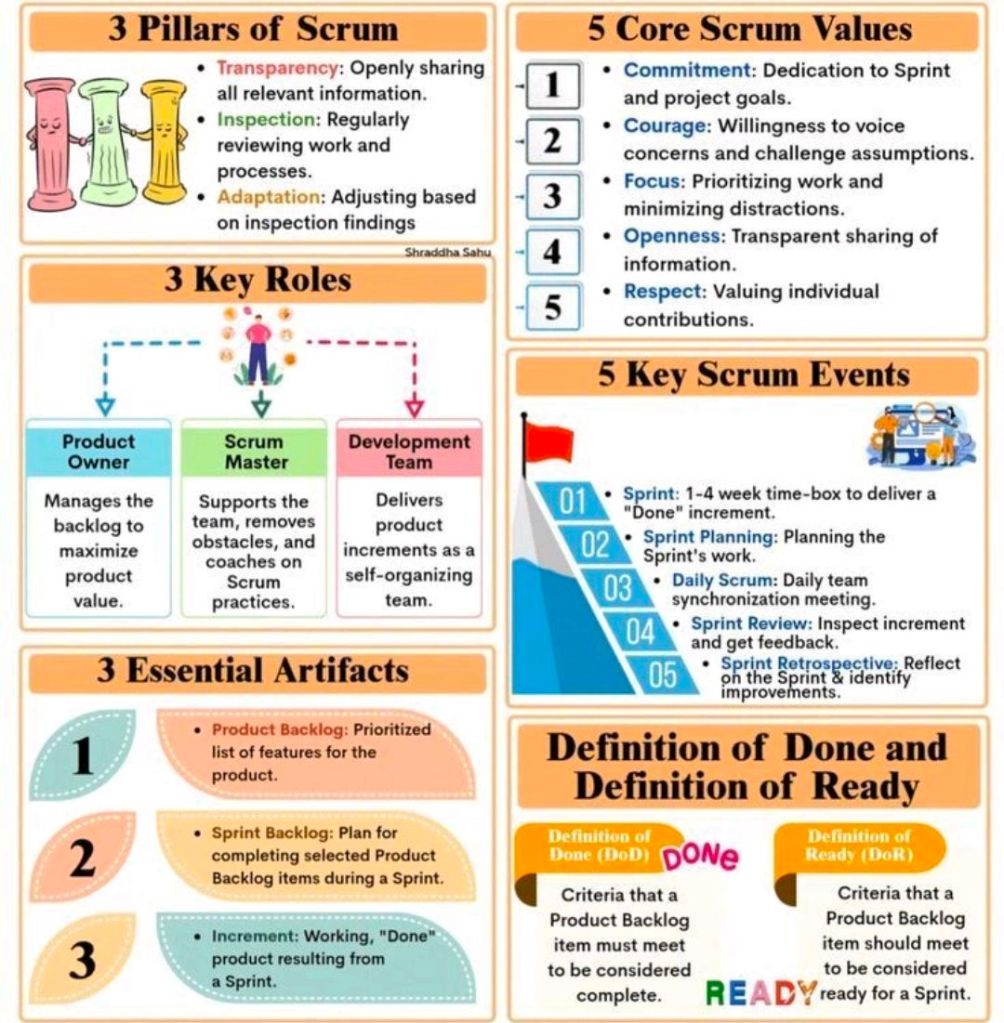
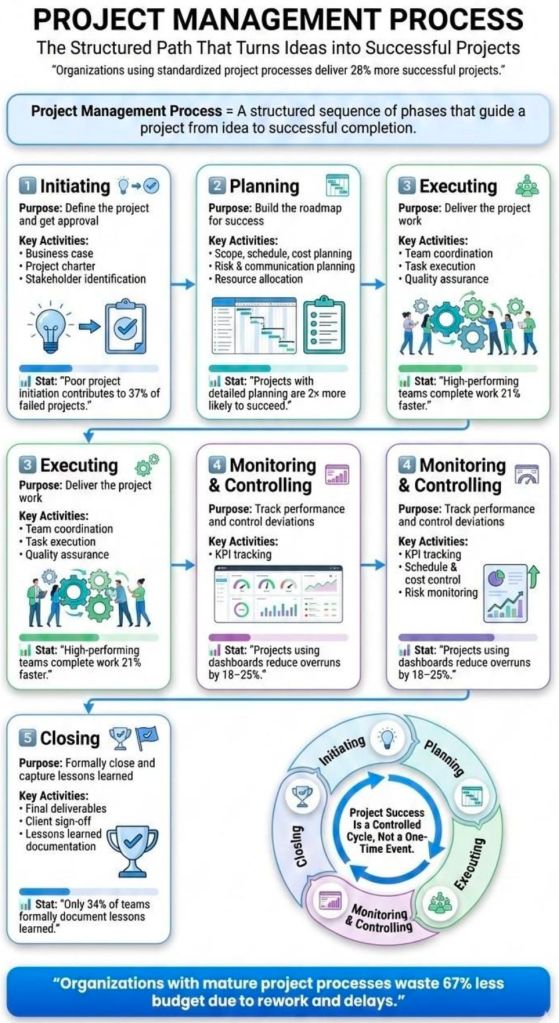
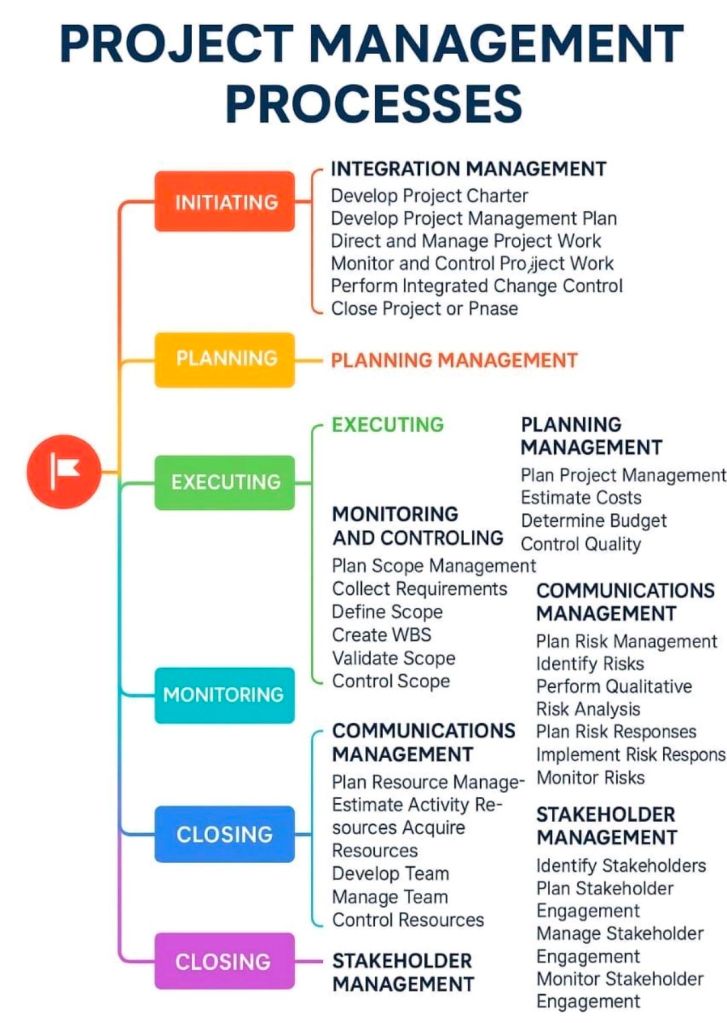
Project Management Process Summary

Project Management Process Summary

Project Management Processes Summary

Project Management Processes Summary

Agile Scrum Terms Summary Overview

Agile Scrum Terms Summary Overview

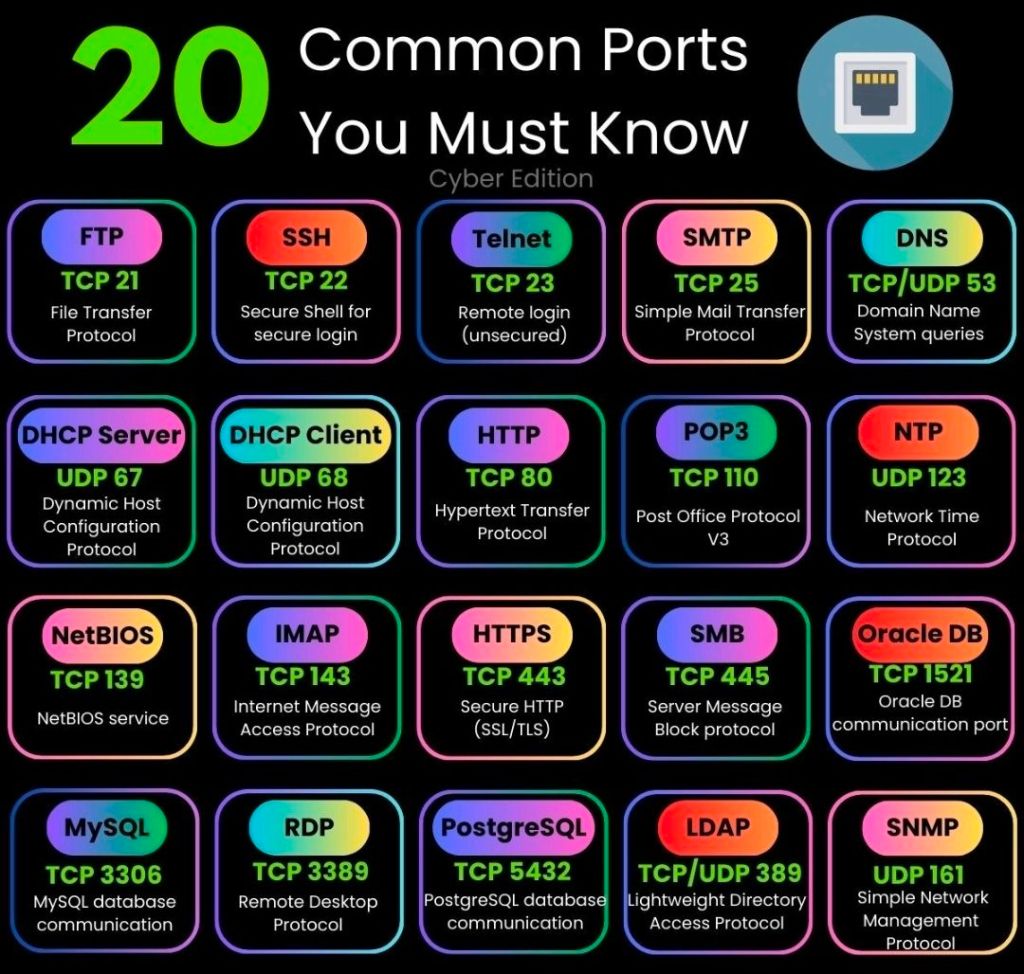
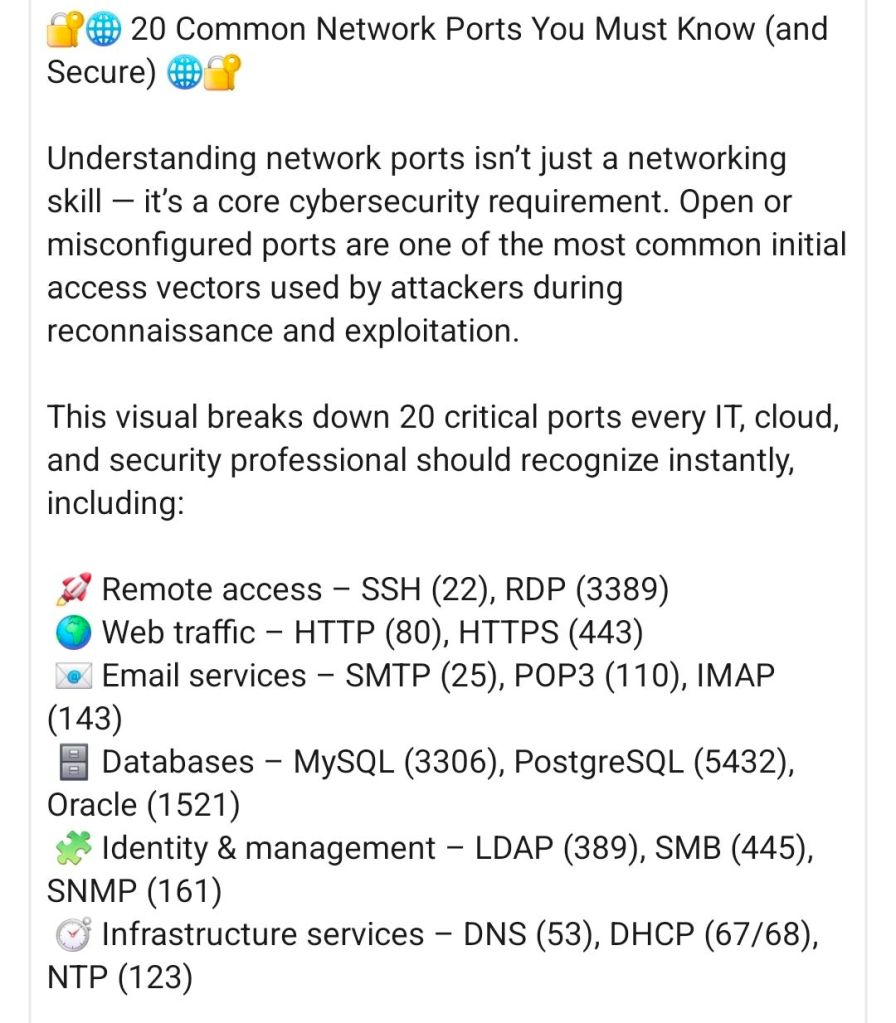
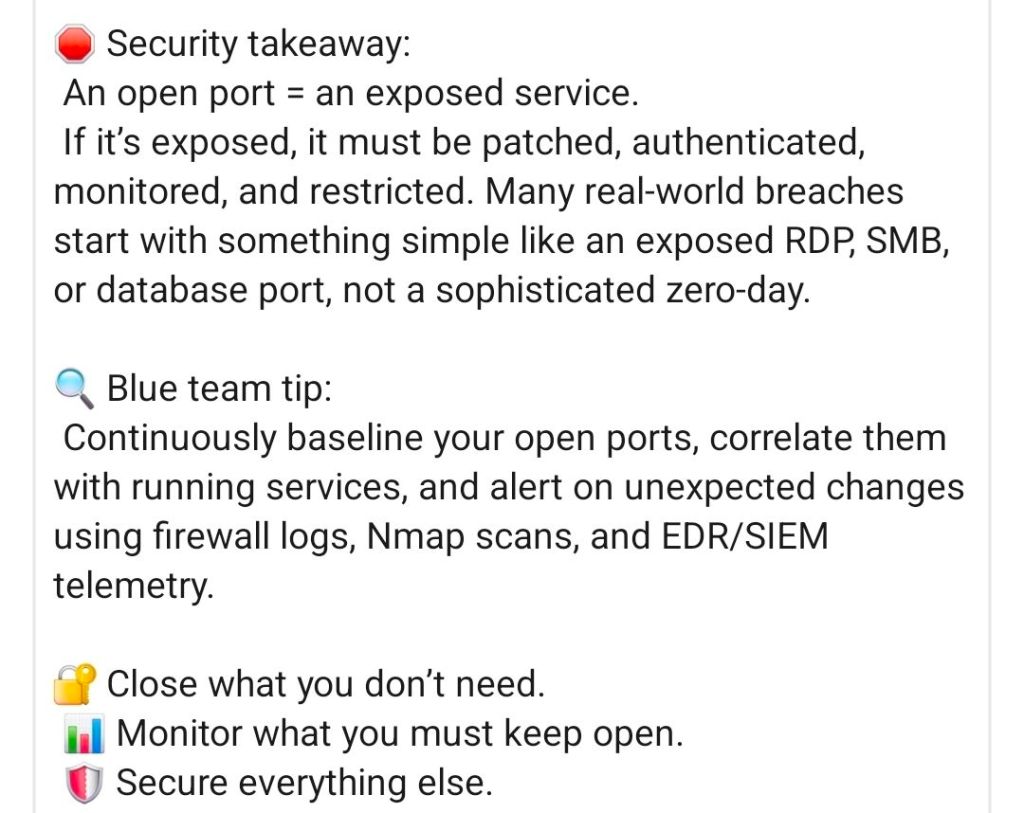
Common IT Protocol Ports Summary Overview

Common IT Protocol Ports Summary Overview

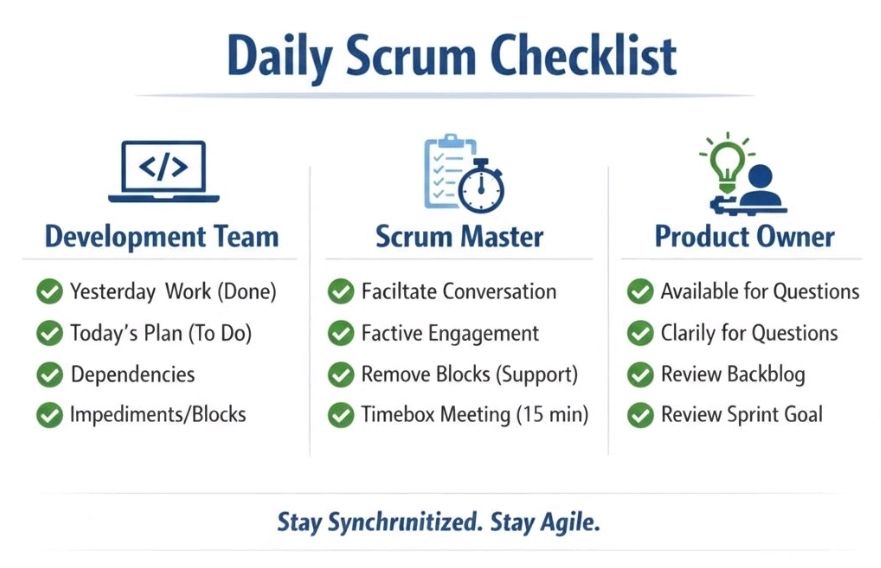
Daily Agile Scrum Checklist Summary

Daily Agile Scrum Checklist Summary

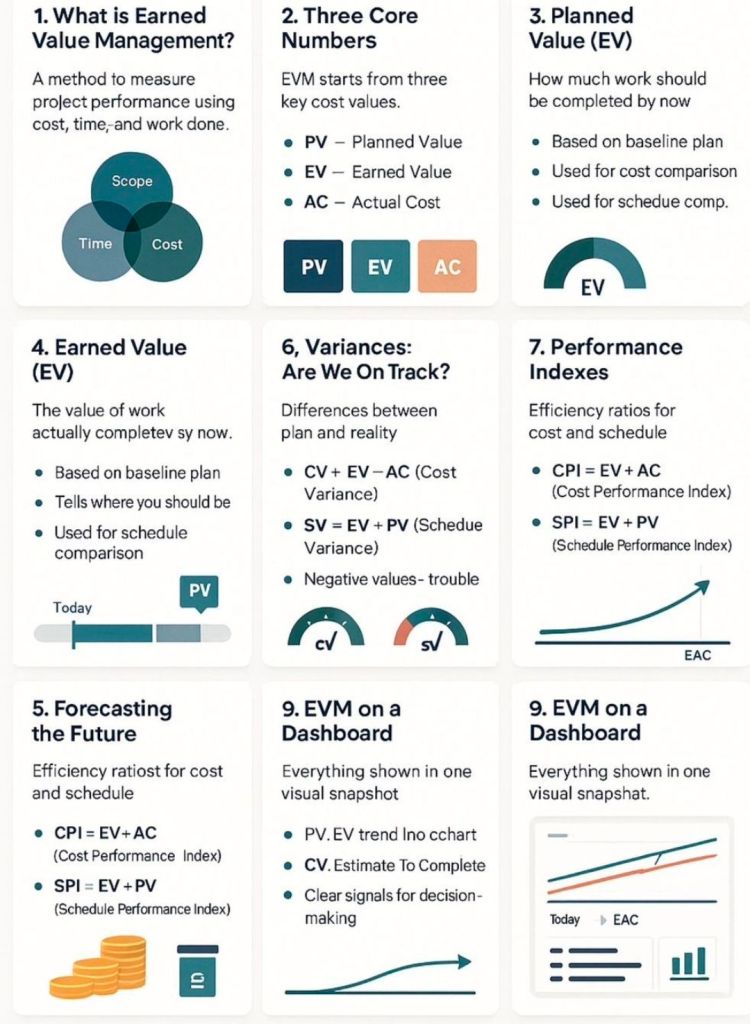
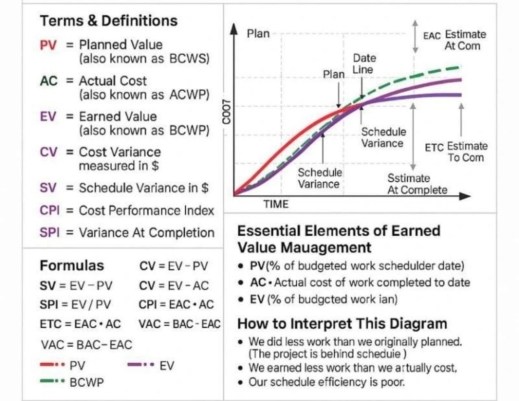
Earned Value Management EVM Overview Summary

Earned Value Management EVM Overview Summary

Types of Project Management Overview Summary

Types of Project Management Overview Summary