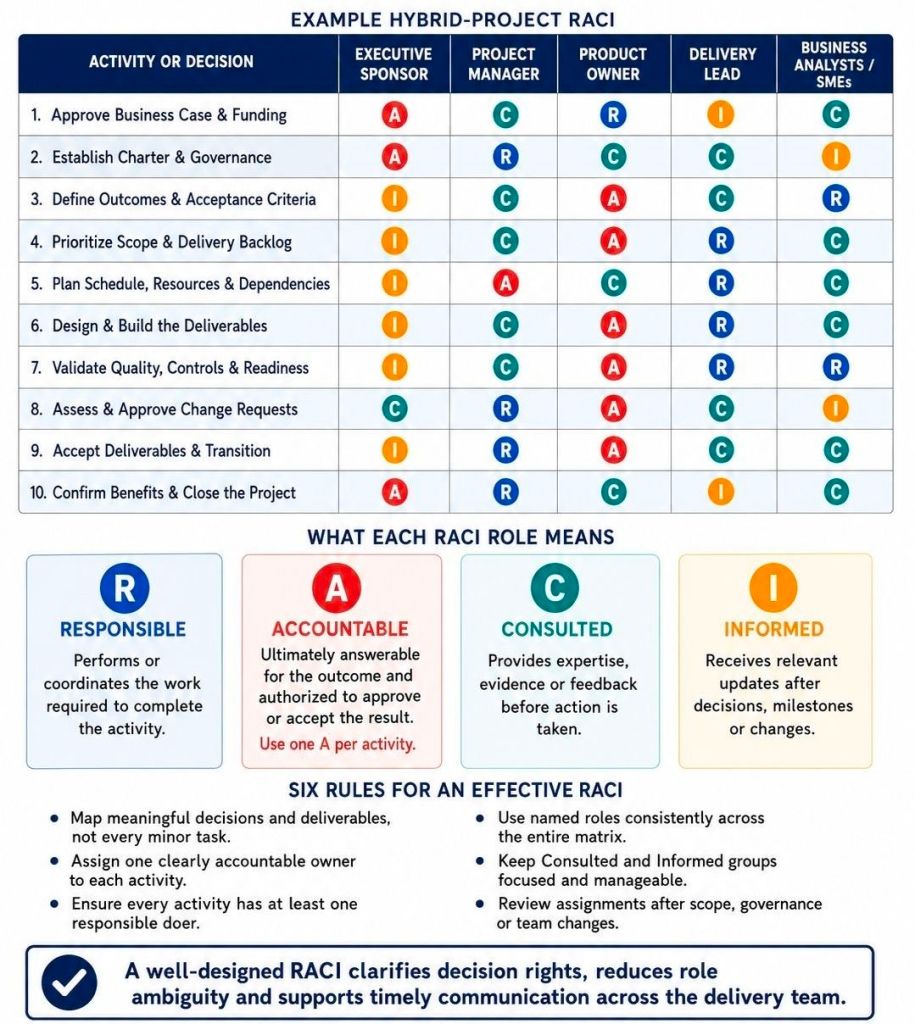
A RACI matrix for a hybrid project bridges the gap between structured predictive governance (Waterfall) and flexible iterative delivery (Agile). Because hybrid projects mix distinct management styles, a RACI matrix is essential to clarify who owns high-level deliverables versus who manages sprint-level execution.
The Hybrid RACI Challenge
In pure Agile/Scrum, a RACI is often redundant because roles like Product Owner and Scrum Master have built-in accountability. However, in a hybrid environment, conflicts arise at the intersection points—such as when a traditional Project Manager interacts with a self-organizing Scrum Team, or when a cross-functional sprint output requires steering committee or regulatory sign-off.
The golden rule remains: Every task must have exactly one Accountable (A) owner to prevent costly decision delays.
- R = Responsible (Does the work)
- A = Accountable (Final decision maker/approver; only one per row)
- C = Consulted (Two-way communication before the task)
- I = Informed (One-way notification after completion)
Best Practices for Hybrid RACIs
- Focus on Deliverables, Not Micro-tasks: Map out macro phases, key milestones, and critical cross-framework decision points rather than granular daily duties.
- Delineate the PM and PO Roles: The Project Manager is typically Accountable for overall project timelines, budgets, and predictive governance. The Product Owner holds Accountability for product requirements, value delivery, and sprint goals.
- Avoid Dual-Accountability Pitfalls: Never assign “A” to both the PM and the PO for the same item. If a task feels like it belongs to both, split it into separate lines (e.g., split “Product Deployment” into “Feature Validation” and “Release Governance”).
- Keep the Sprints Agile: Do not write a RACI for inside a sprint. Trust the Scrum Guide for development cycles, and use the RACI strictly to manage how those cycles plug back into the larger corporate structure.