Essential Requirements Practices for a Business Analyst

Essential Requirements Practices for a Business Analyst

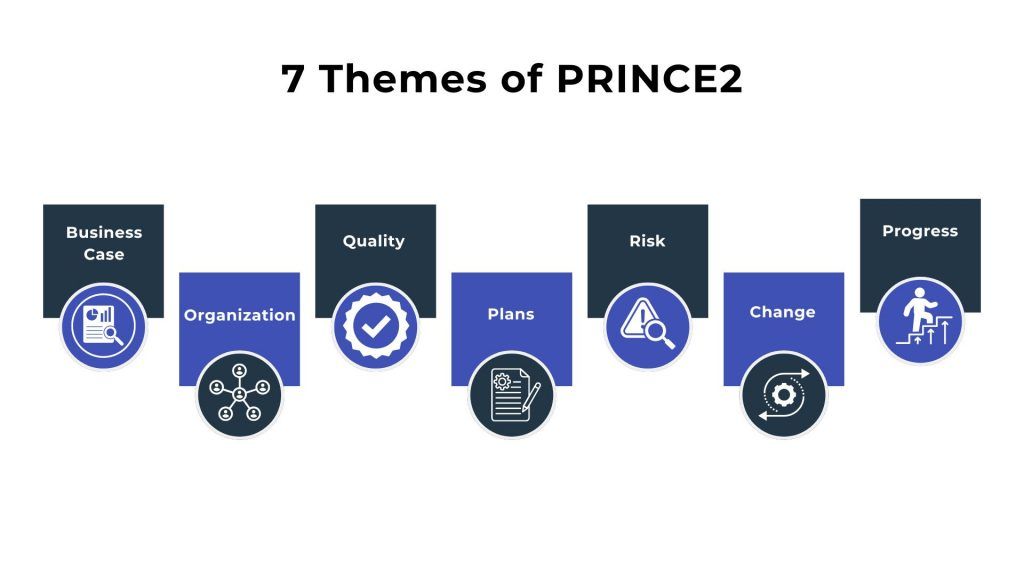
PRINCE2 7 Themes / Practices of PRINCE2

In the PRINCE2 project management methodology, Themes (renamed to Practices in the 7th edition released in 2023) are the seven functional areas of project management that must be addressed continuously throughout the project lifecycle. They provide a structured framework for managing key aspects like cost, risk, and quality to ensure the project remains on track. 

7 Themes / Practices of PRINCE2

Overview of the Seven Themes (Practices)

  • Business Case: Focuses on the “Why” of the project. It establishes the justification for the investment and ensures the project remains desirable, viable, and achievable.
  • Organisation: Addresses the “Who” by defining the project’s structure of accountability and responsibilities. It identifies key stakeholders and establishes the project management team.
  • Quality: Focuses on the “What” by defining the user’s requirements and quality standards. It ensures that deliverables are fit for purpose and meet stakeholder expectations.
  • Plans: Describes the “How,” “How Much,” and “When”. This theme provides techniques for creating project, stage, and team plans to facilitate communication and control.
  • Risk: Manages the “What If” by identifying, assessing, and controlling uncertainties that could impact the project’s objectives, whether they are threats or opportunities.
  • Change (Issues): Deals with the impact of changes and unexpected events. It provides a formal process for capturing, assessing, and controlling requests for change to project baselines.
  • Progress: Evaluates “Where are we now?” versus “Where are we going?”. It establishes mechanisms to monitor actual achievements against planned outcomes and manage deviations through tolerances. 

Key Concepts and Terminology

  • Continuous Application: Unlike processes, which follow a sequence, themes are applied simultaneously throughout the project.
  • Tolerances: Each theme uses tolerances (allowable deviations for time, cost, quality, etc.) to support the principle of Manage by Exception.
  • PRINCE2 7 Updates: The latest edition introduces Sustainability as a 7th performance target and emphasizes People as a core element alongside Principles, Practices, and Processes.

PRINCE2 Process Model Overview

PRINCE2 Process Model

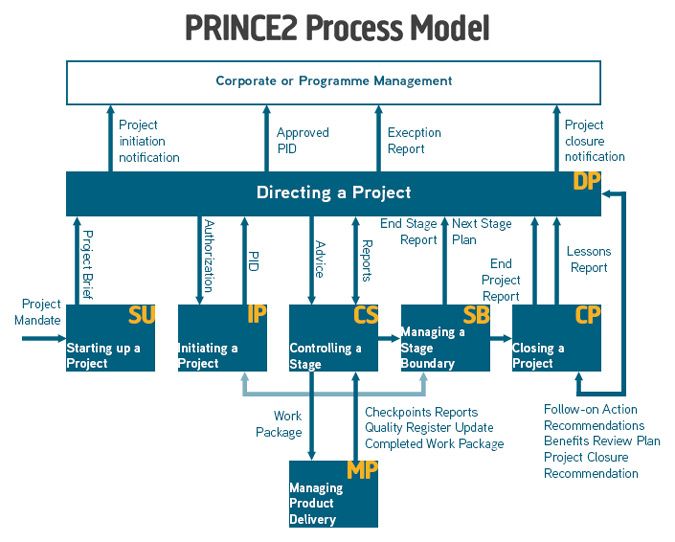
The PRINCE2 process model provides a structured, process-driven roadmap for managing a project from its initial conception to formal closure. It consists of seven core processes that define specific activities, responsibilities, and decision points across the project lifecycle. 

The 7 PRINCE2 Processes

The processes are designed to ensure control and align with the project’s management levels: 

  • Starting Up a Project (SU): A pre-project process that filters out unviable ideas. It focuses on confirming if there is a “viable and worthwhile” business case and appoints the Project Manager and Executive.
  • Directing a Project (DP): Spans the entire project from start to finish. It is the responsibility of the Project Board, which provides strategic oversight, makes key decisions (e.g., authorising stages), and manages by exception.
  • Initiating a Project (IP): Occurs during the first management stage. It involves detailed planning to establish solid foundations, resulting in the Project Initiation Documentation (PID), which includes the project plan, risk management approach, and full business case.
  • Controlling a Stage (CS): Focuses on the Project Manager’s day-to-day management of a stage. This includes assigning work to teams, monitoring progress, and dealing with issues or risks within agreed tolerances.
  • Managing Product Delivery (MP): Governs the link between the Project Manager and Team Managers. It is where the “specialist products” (actual deliverables) are created, quality-checked, and delivered.
  • Managing a Stage Boundary (SB): Occurs at the end of each management stage (except the final one). The Project Manager reviews the current stage, updates the project plan and business case, and plans the next stage for Board approval.
  • Closing a Project (CP): Ensures an orderly end to the project. It confirms that objectives have been met, products have been accepted by the user, and lessons are captured before the project is formally disbanded. 

Hierarchy of Management Levels

The process model operates across four distinct levels of authority: 

  1. Corporate or Programme Management: Sets the initial project mandate.
  2. Directing (Project Board): Responsible for overall governance and major decisions (Directing a Project).
  3. Managing (Project Manager): Handles daily management and stage control (Controlling a Stage, Initiating a Project).
  4. Delivering (Team Members/Managers): Focuses on creating the physical products (Managing Product Delivery). 

Key Characteristics

  • Management Stages: Projects are broken into at least two stages (Initiation and at least one Delivery stage) to provide “stop/go” decision points.
  • Triggers: Each process is activated by a specific trigger, such as a “Project Mandate” from corporate management to start the SU process.
  • Management Products: These are documents like the Business Case, Project Brief, and Highlight Reports used to facilitate control and communication.

PRINCE2 (PRojects IN Controlled Environments) framework is built on seven core principles

PRINCE2 framework is built on seven core principles

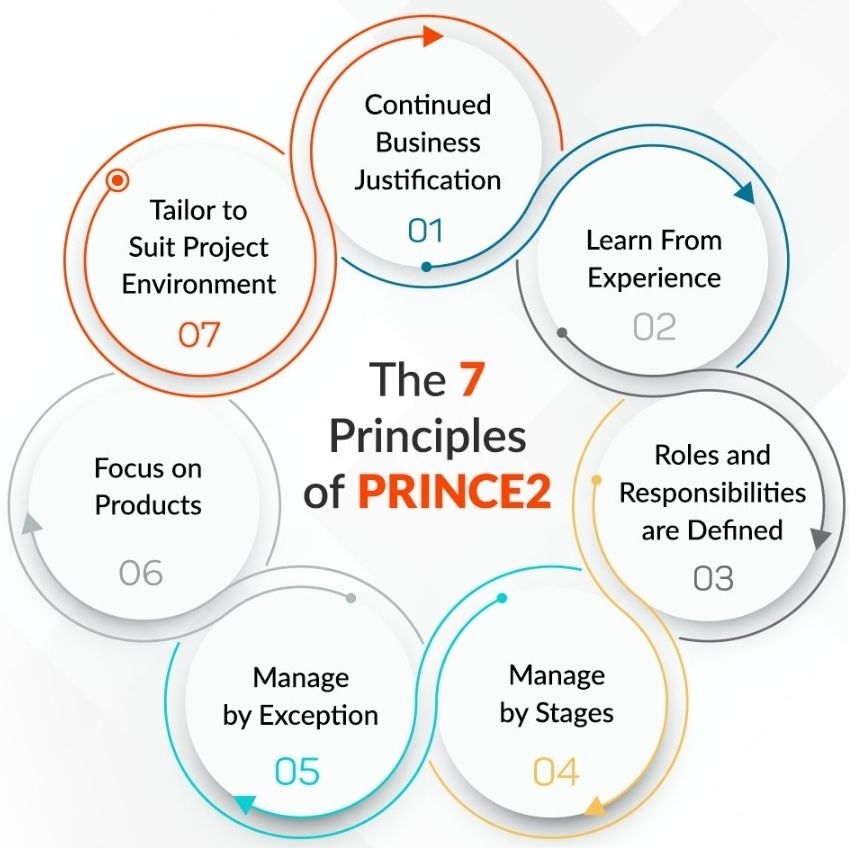
The PRINCE2 (PRojects IN Controlled Environments) framework is built on seven core principles that serve as guiding obligations for any project using this methodology. For a project to be considered a “PRINCE2 project,” all seven must be applied. 

  • Continued Business Justification: A project must have a valid reason to start and must remain justified throughout its lifecycle. This is documented in a Business Case, which is regularly reviewed to ensure the project remains viable, desirable, and achievable.
  • Learn from Experience: Project teams are required to seek out lessons from previous projects and record new lessons as the current project progresses. A Lessons Log is typically used to capture these insights.
  • Defined Roles and Responsibilities: Every person involved must understand what is expected of them and who is responsible for specific tasks. PRINCE2 defines a clear management hierarchy: Project Board (Direction), Project Manager (Management), and Team Manager (Delivery).
  • Manage by Stages: Projects are broken down into manageable chunks called management stages. Each stage acts as a “stop/continue” decision point for the Project Board to assess progress before committing more resources.
  • Manage by Exception: Senior management (Project Board) only intervenes when the project deviates beyond agreed tolerances for time, cost, quality, scope, risk, or benefits. This empowers the Project Manager while ensuring efficient use of executive time.
  • Focus on Products: The methodology prioritizes the definition and delivery of high-quality products (outputs) rather than just completing activities. Product descriptions specify the quality criteria and requirements for each deliverable.
  • Tailor to Suit the Project: PRINCE2 is not a rigid “one-size-fits-all” approach; it must be adapted to the project’s specific scale, complexity, and environment. Tailoring ensures that the controls are appropriate for the level of risk involved. 

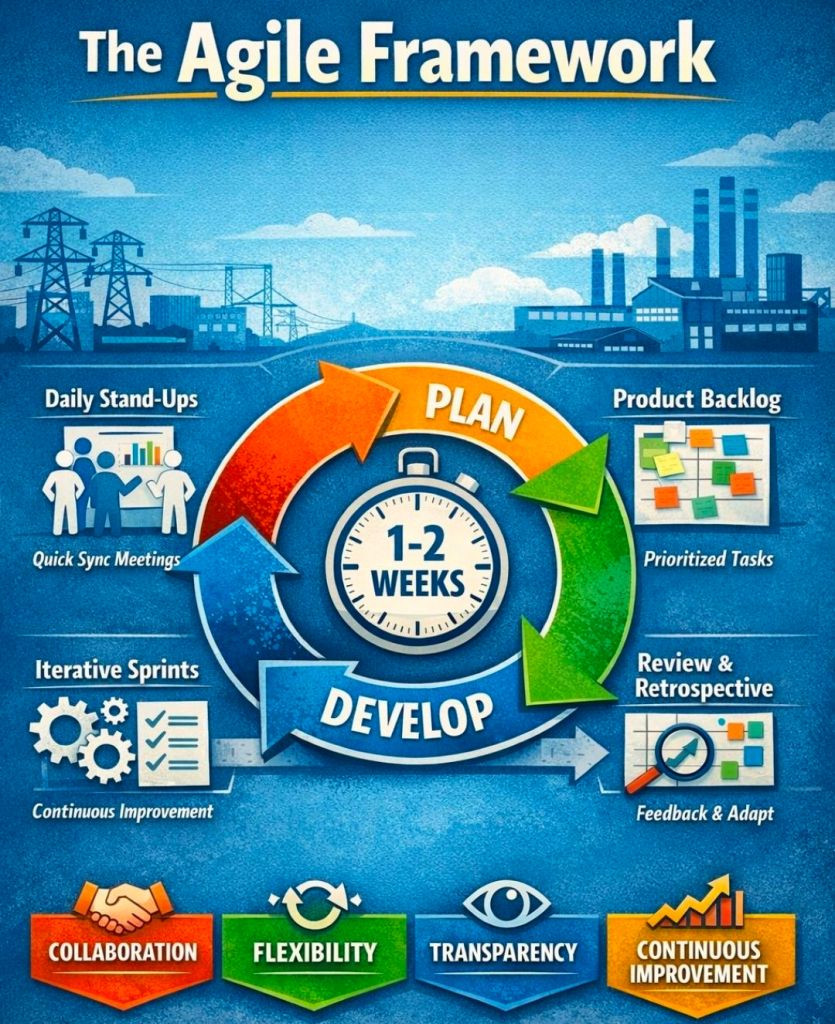
Agile Framework Executive Summary Overview Snapshot

Agile Framework Executive Summary Overview Snapshot

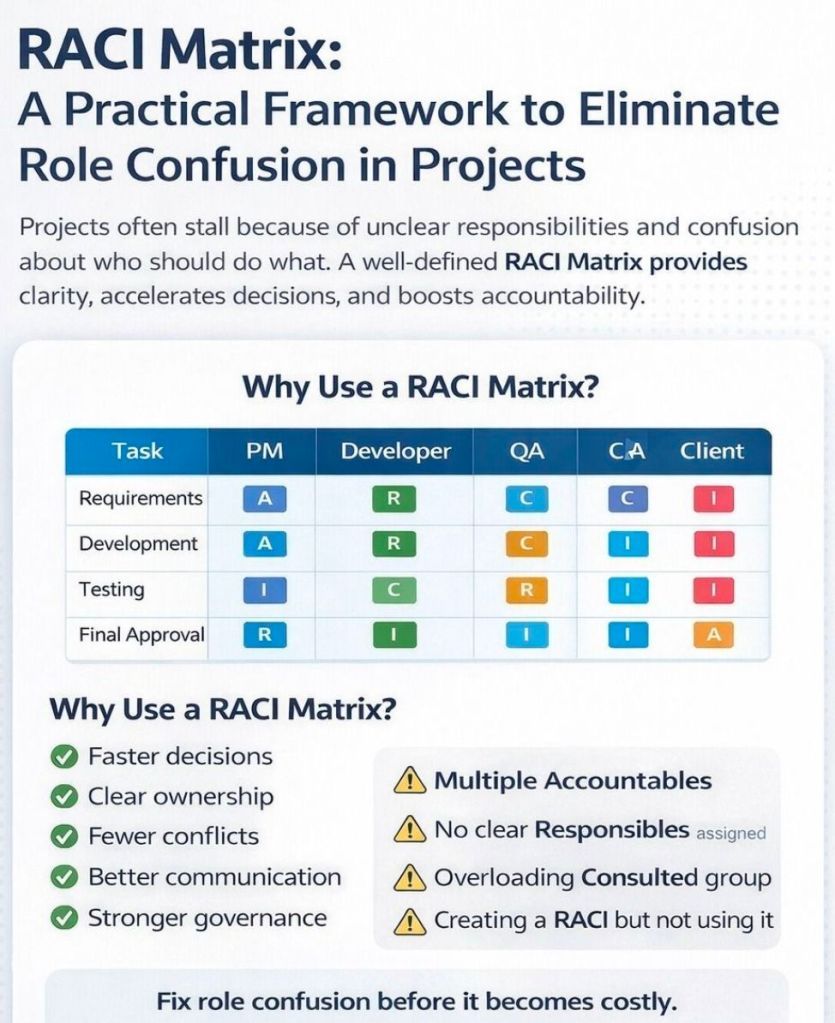
RACI Matrix to Eliminate Role Confusion in Projects

RACI Matrix to Eliminate Role Confusion in Projects

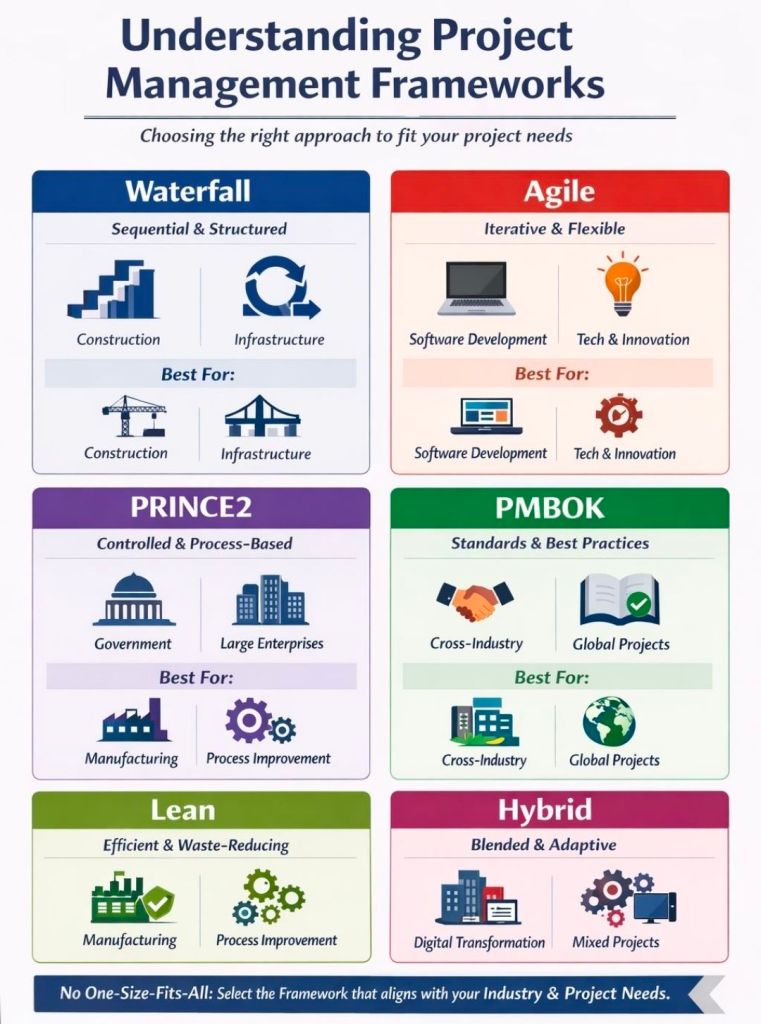
Understanding Project Management Frameworks

Understanding Project Management Frameworks

Theory of Constraints (TOC) Overview and Timeline History

The Theory of Constraints (TOC) is a management philosophy introduced by Dr. Eliyahu M. Goldratt in his 1984 bestselling business novel, The Goal. 

At its core, TOC operates on a simple premise: A chain is only as strong as its weakest link. In any complex system—be it a manufacturing plant, a hospital, or a software team—there is always one specific constraint (bottleneck) that limits the system from achieving more of its goal. If you improve anything other than that constraint, you are wasting your time. 

The Five Focusing Steps

TOC uses a rigorous five-step process for continuous improvement: 

  1. Identify the constraint.
  2. Exploit the constraint (ensure it doesn’t waste time).
  3. Subordinate everything else (align the whole system to support the constraint).
  4. Elevate the constraint (invest in more capacity if steps 2 and 3 weren’t enough).
  5. Repeat (prevent inertia; find the next bottleneck). 

Annotated Timeline of TOC Evolution

  • 1979 – Optimized Production Technology (OPT): Goldratt introduces OPT, a scheduling software that challenged traditional cost accounting by focusing on throughput.
  • 1984 – The Goal Published: Goldratt pivots from software to education. He uses a fictional story to introduce the Drum-Buffer-Rope (DBR) method and the concept of “Throughput Accounting.”
  • 1990 – The Haystack Syndrome: This marks the shift toward formalising TOC metrics: Throughput (money coming in), Inventory (money stuck inside), and Operating Expense (money going out).
  • 1994 – It’s Not Luck: Goldratt introduces the Thinking Processes (TP)—a set of logical tools (like the Current Reality Tree) used to solve complex problems and overcome resistance to change.
  • 1997 – Critical Chain: TOC is applied to Project Management. This introduced “buffers” at the end of project paths rather than individual tasks, drastically reducing project durations.
  • 2003 – Strategy & Tactic (S&T) Trees: A framework developed to synchronise large-scale organisational change, ensuring every action aligns with the ultimate goal.
  • 2000s–Present – Throughput Economics: Integration of TOC with Lean and Six Sigma (often called TLS) becomes the gold standard for high-performance manufacturing. 

Theory of Constraints (TOC) Overview and Timeline History