Download Templates for PROject Management | FREE Upgrades & Additions
Author: Mark Whitfield
Welcome to my site!
After graduating in Computing in 1990, I accepted a position as a programmer at a Runcorn based software house specialising in electronic banking software, namely sp/ARCHITECT-BANK on Tandem Computers (now HPE NonStop). This was before the internet became more prevalent and so the notion of enabling desktop access to company accounts for inter-account transfers and book keeping was still quite a cutting edge idea (and smartphones only ever hinted at in Space 1999). The company was called The Software Partnership (which was taken over by Deluxe Data in 1994).
I spent 5 years in Runcorn developing code for SP/ARCHITECT for various banks like TSB, Bank of Scotland, Rabobank and Girofon (Denmark) to name but a few. I then moved onto a software house in Salford Quays for further bank facing projects. After a further 23 years in the IT industry and now a Senior IT Project Manager (both Agile and Waterfall delivery), I thought I would echo out my Career Profile in this corner of the internet for quick and easy access.
Dinosaurs lived during the Mesozoic Era, commonly known as the “Age of Reptiles,” which lasted from approximately 252 to 66 million years ago (mya). This era is divided into three distinct geological periods: the Triassic, Jurassic, and Cretaceous.
1. Triassic Period (252 – 201 mya)
The Triassic began after the “Great Dying” extinction event, which wiped out 90% of life on Earth.
Early Triassic: The world was a single supercontinent called Pangaea, largely covered by deserts.
The Dawn of Dinosaurs (~243–233 mya): The first dinosaurs emerged as small, bipedal creatures.
Key Dinosaurs:
Nyasasaurus: One of the earliest possible dinosaurs.
The K-Pg Extinction (66 mya): A massive asteroid impact in the Yucatan Peninsula triggered a global catastrophe that wiped out all non-avian dinosaurs.
The ZX Spectrum timeline spans from its revolutionary launch in 1982 to its final official production in 1992, followed by a vibrant modern era of community-driven hardware.
The Sinclair Era (1982–1986)
23 April 1982: Sinclair Research launches the ZX Spectrum at the Earls Court Computer Show. It features 16 KB (£125) or 48 KB (£175) of RAM, a Z80A CPU, and the iconic rubber “chiclet” keyboard.
1983: Timex Sinclair 2068 is released in the US as a modified version of the Spectrum.
October 1984: The ZX Spectrum+ is released for £179. It features a new injection-moulded keyboard similar to the Sinclair QL and a dedicated reset button, but remains electronically identical to the 48K model.
September 1985: The ZX Spectrum 128 (“The Toast Rack”) is unveiled at the SIMO trade show in Spain. It introduces 128 KB of RAM, an AY-3-8912 sound chip, and MIDI compatibility.
January 1986: The ZX Spectrum 128 officially goes on sale in the UK for £179.95.
The Amstrad Era (1986–1992)
7 April 1986: Amstrad plc acquires the “Sinclair” brand and all Spectrum assets from Sinclair Research for £5 million.
1986: The ZX Spectrum +2 is released. It features a grey case with a spring-loaded keyboard and a built-in “Datacorder” cassette player.
1987: The ZX Spectrum +3 launches with a built-in 3-inch floppy disk drive, replacing the tape deck. It is the only official Spectrum capable of running the CP/M operating system.
1988–1989: Amstrad releases the +2A, +2B, and +3B models, which use unified circuit boards and transition to black cases.
1992: Official production of all ZX Spectrum models is discontinued.
The Modern Revival (2017–Present)
2017: The ZX Spectrum Next Kickstarter campaign successfully funds a new, officially licensed hardware evolution.
February 2020: The first batch of ZX Spectrum Next machines is delivered to backers.
November 2023: The ZX Touch, a handheld emulation console, is released.
22 November 2024: Retro Games releases “The Spectrum”, a modern HDMI-compatible recreation with 48 built-in games.
A project planning timeline is typically structured around the five phases of the project management lifecycle: Initiation, Planning, Execution, Monitoring/Control, and Closure. This framework breaks a complex project into manageable stages to ensure systematic progress and stakeholder alignment.
1. Project Initiation
The foundation phase where the project’s value and feasibility are established.
Primary Objective: Secure formal approval to begin.
Key Activities: Identify stakeholders, perform feasibility studies, and create a Project Charter.
The timeline of the world’s tallest buildings has evolved from ancient stone monuments to modern steel and concrete megastructures. Historically, the title has shifted from religious and funerary structures in Egypt and Europe to the corporate skyscrapers of North America, and most recently, to the massive mixed-use towers of Asia and the Middle East.
Ancient & Medieval Era (Spiritual & Funerary)
For millennia, the tallest structures were largely pyramids and cathedrals, often holding records for centuries.
c. 2570 BC – 1311 AD: Great Pyramid of Giza (Egypt) – 146.6m. Held the record for over 3,800 years.
1311 – 1548: Lincoln Cathedral (England) – 160m. The first structure to surpass the Great Pyramid.
1548 – 1884: European Cathedrals (Various) – Following the collapse of Lincoln’s spire, several cathedrals held the title, including St. Mary’s Church (151m) and Cologne Cathedral (157m).
The Rise of Modern Structures (1884–1930)
The Industrial Revolution introduced steel frames and safety elevators, moving the “race to the sky” to the United States.
1884 – 1889: Washington Monument (USA) – 169m. The world’s tallest all-stone structure.
1889 – 1930: Eiffel Tower (France) – 312m. Nearly doubled the previous record; it was the first structure to exceed 300 metres.
1894 – 1908: Philadelphia City Hall (USA) – 167m. Often cited as the first modern building to hold the title.
The “Golden Age” of NYC Skyscrapers (1930–1974)
A fierce competition in New York City led to rapid record-breaking.
1930: Chrysler Building – 319m. The first building to surpass 1,000 feet.
1931 – 1970: Empire State Building – 381m. Held the record for 40 years and was the first building with over 100 stories.
1970 – 1973: World Trade Center (North Tower) – 417m. Briefly the world’s tallest before being surpassed by Chicago.
The Contemporary Era (1974–Present)
The record moved from the US to Asia and the Middle East as construction technology advanced.
Tennis history is defined by three primary eras, characterized by significant shifts in professionalism and court surfaces.
The Amateur Era (1877–1967)
During this period, only amateur players were permitted to compete in the Grand Slam tournaments. Professional players were banned from these events and played on their own separate tour.
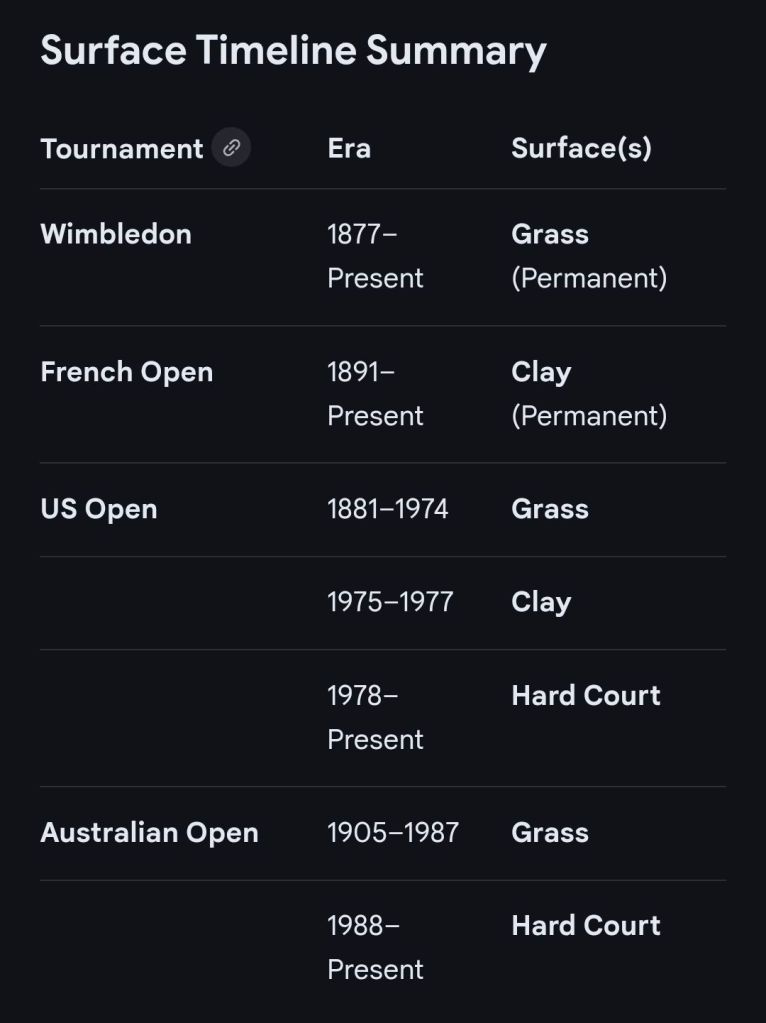
1877:Wimbledon is founded in London. It has been played on Grass since its inception.
1881: The U.S. National Championship (now the US Open) begins on Grass in Newport, Rhode Island.
1891: The French Championships are established. It was initially played on Sand/Clay and restricted to French club members until 1925.
1905: The Australasian Championships (now the Australian Open) starts on Grass.
1913: The International Lawn Tennis Federation (ILTF) is formed to standardise rules globally.
1925: The French Championships opens to international players, officially becoming a major played on Clay.
The Early Open Era (1968–1987)
The “Open Era” began when Grand Slam tournaments agreed to allow professional players to compete alongside amateurs, unifying the sport.
1968: The French Open becomes the first Grand Slam of the Open Era.
1970: The Tiebreaker is introduced to tennis rules to shorten match lengths.
1972/1973: The ATP (men) and WTA (women) are formed, introducing the first computerised world rankings.
1975: The US Open switches its surface from grass to Clay (Har-Tru).
1978: The US Open moves to Flushing Meadows and switches to its current surface: Hard Court (DecoTurf).
1987: The Australian Open moves its calendar slot from December to January, becoming the first Slam of the year.
The Modern Open Era (1988–Present)
This era is marked by the dominance of “The Big Three” and the standardisation of surfaces across the tour.
1988: The Australian Open moves to Flinders Park (now Melbourne Park) and switches from grass to Hard Court (Rebound Ace).
2006:Hawk-Eye technology is first introduced at the US Open to allow players to challenge line calls.
2007: Wimbledon and the French Open join the other Slams in offering Equal Prize Money for men and women.
2009: Wimbledon installs a Retractable Roof on Centre Court, ensuring play during rain.
2020s: Standardisation of a 10-point tiebreak in the final set across all four Grand Slams to ensure consistency.
My trip to Wimbledon 2007 where Roger won his 5 in a row
Tennis Development Timeline History by Era
The history of professional tennis is broadly divided into the Amateur Era (pre-1968) and the Open Era (1968–present), which allowed professionals to compete in Grand Slam tournaments for the first time.
Key Eras and Milestones
1877–1905: The Birth of the Majors
1877: The first Wimbledon Championships are held, won by Spencer Gore.
1881: The US Open is established.
1891: The French Open begins (initially for French club members; open to all in 1925).
1905: The Australian Open is founded.
1913–1967: The Amateur Era and Pro Tours
1913: The International Tennis Federation (ITF) is formed.
1938:Don Budge becomes the first player to achieve a calendar-year Grand Slam.
1953:Maureen Connolly becomes the first woman to achieve a calendar-year Grand Slam.
1962:Rod Laver wins his first calendar-year Grand Slam as an amateur.
1968–2000: The Start of the Open Era
1968: The Open Era begins; professionals are finally allowed to play in Grand Slams.
1969:Rod Laver achieves a second calendar-year Grand Slam, the only person to do so in the Open Era.