HND Higher National Diploma Overview and Historical Timeline by Year

Higher National Diploma (HND) is a Level 5 vocational qualification in the UK, equivalent to the first two years of a university bachelor’s degree. Designed to provide industry-specific practical skills, it typically takes two years of full-time study or three to four years part-time. 

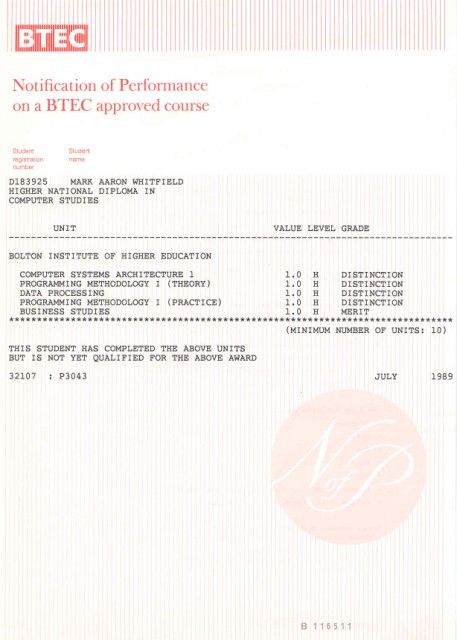
Higher National Diploma HND in Computer Studies (3)

Historical Timeline of the HND

The HND has evolved from a niche engineering credential into a globally recognised vocational standard. 

The Early Era: Origins and Industrial Focus (1920s–1950s)

  • 1920: The Higher National Diploma was first introduced in England and Wales alongside the Ordinary National Diploma (OND) and Higher National Certificate (HNC).
  • 1921–1923: Initial subject frameworks were established, starting with Mechanical Engineering (1921) and Electrical Engineering (1923).
  • 1930s: The qualification expanded into Building (1929) and Commerce (1939) to support a growing industrial economy.
  • Post-WWII: The 1944 Butler Act reorganised secondary education, but HNDs remained the primary route for advanced technical training in colleges. 

The Expansion Era: Growth and New Governance (1960s–1970s)

  • 1960s: HNDs gained prominence in polytechnics, addressing critical skills gaps through a practical approach to higher education.
  • 1968–1969: Awards for HNDs saw a massive 665% increase compared to a decade prior, beginning to rival university “ordinary degrees” in popularity.
  • 1972–1974: Under Margaret Thatcher (then Education Secretary), the Haselgrave Report recommendations led to moving qualifications from the City and Guilds to two new bodies: the Business Education Council (BEC) and the Technician Education Council (TEC)

The BTEC and Modernisation Era (1980s–2000s)

  • 1983: BEC and TEC merged to form the Business and Technician Education Council (BTEC), which became the primary awarding body for HNDs.
  • 1990s: BTEC merged with the University of London Examinations Board to form Edexcel (now part of Pearson).
  • 1980s–90s: The curriculum diversified rapidly into modern sectors such as computing, business, catering, and performing arts.
  • 2000s: Global expansion accelerated; for instance, the HND was formally introduced in Cameroon in 2002
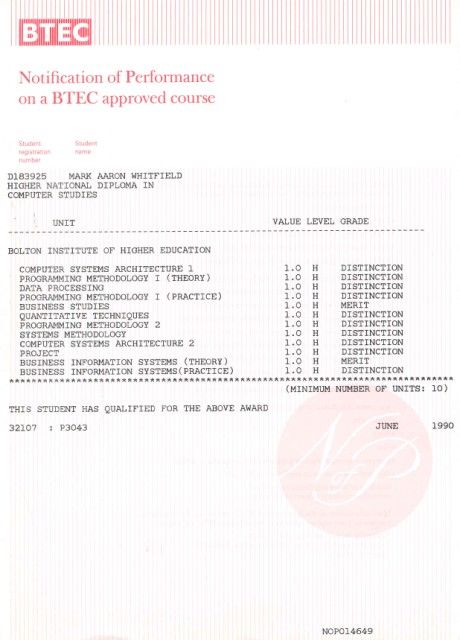
Higher National Diploma HND in Computer Studies (1)

The Contemporary Era: Frameworks and Global Standard (2010s–Present)

  • 2013–2014: Despite a decline in public sector colleges due to the rise of Foundation Degrees, HND student numbers at private providers grew from 13,000 to 30,000 in just one year.
  • 2018: Major global curriculum updates were implemented to integrate digital literacy, sustainability, and entrepreneurship into traditional vocational subjects.
  • 2020s: Current HNDs are positioned at Level 5 on the Regulated Qualifications Framework (RQF) and are delivered in over 60 countries. 

Key Characteristics of the HND

  • Academic Standing: Equivalent to Level 5 (Year 2 of a Degree).
  • Progression: Over 95% of UK universities allow HND graduates to “top up” to a full bachelor’s degree, often entering directly into the final year.
  • Assessment: Focuses on practical projects, case studies, and work placements rather than just theoretical exams. 

HND Higher National Diploma Overview and Historical Timeline by Year

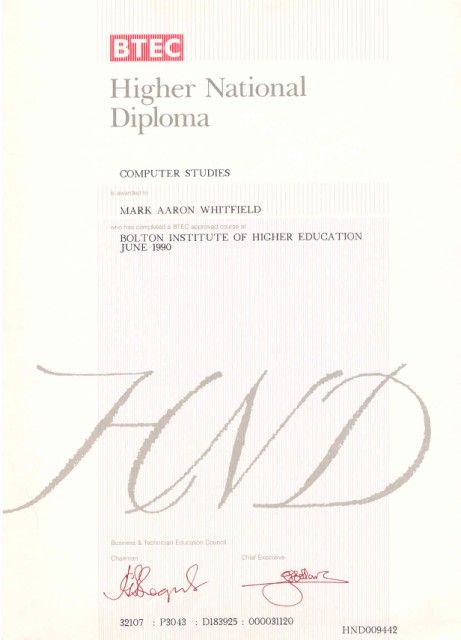
Higher National Diploma HND in Computer Studies (2)

HP NonStop Tandem Overview and Timeline History by year

HP NonStop is a series of fault-tolerant server computers designed for online transaction processing (OLTP) and mission-critical applications that require 100% uptime. Originally introduced by Tandem Computers Inc. in 1976, the platform uses a proprietary, integrated hardware and software stack known as NonStop OS (formerly Guardian) to eliminate single points of failure through massive redundancy and “fail-fast” logic

Historical Timeline by Era

1. The Tandem Founding Era (1974–1981) 

  • 1974: Tandem Computers Inc. is founded by James (Jimmy) Treybig and a team from Hewlett-Packard’s HP 3000 division.
  • 1976: The first system, the Tandem/16 (later NonStop I), is shipped to Citibank.
  • 1977: Tandem systems gain early traction as intelligent front-end processors for bank ATM networks. 

2. The Stack Machine Expansion (1981–1990) 

  • 1981: NonStop II is introduced, adding 32-bit addressing capabilities and replacing magnetic core memory with battery-backed DRAM.
  • 1983: NonStop TXP (Transaction Processing) launches as the first new implementation of the architecture, featuring cache memory and 2.0 MIPS performance.
  • 1986: Introduction of NonStop VLX (Very Large eXpansion) and NonStop SQL, the first fault-tolerant relational database designed for linear scalability.
  • 1987: NonStop CLX launches as a lower-cost, compact minicomputer for remote office environments.
  • 1989: NonStop Cyclone is released for high-end mainframe markets, featuring superscalar CPUs and fiber optic interconnects. 

3. The MIPS RISC Transition & Acquisitions (1991–2003)

  • 1991: Cyclone/R (or CLX/R) marks the move to MIPS R3000 RISC processors, using object code translation to maintain backward compatibility.
  • 1993: Himalaya K-series is released using MIPS R4400 processors.
  • 1995: Open System Services (OSS) is added to the NonStop Kernel to provide a POSIX/Unix-like environment.
  • 1997: Compaq acquires Tandem Computers. The Himalaya S-Series introduces ServerNet, which later becomes the InfiniBand industry standard.
  • 2002/2003: HP merges with Compaq, bringing the NonStop line under Hewlett-Packard. 

4. The HP Integrity & x86 Era (2005–Present)

  • 2005: HP Integrity NonStop (TNS/E) is introduced, migrating the platform to Intel Itanium microprocessors.
  • 2014: NonStop X (TNS/X) launches, shifting the architecture to Intel x86-64 processors for greater industry-standard alignment.
  • 2015: Following the HP corporate split, NonStop becomes part of Hewlett Packard Enterprise (HPE).
  • 2020: Sales of Itanium-based systems officially end in July 2020.
  • 2024–2025: HPE expands the platform with Virtualized NonStop Software for private clouds and consumption-based models via HPE GreenLake.

HP NonStop Tandem Overview and Timeline History by year

HPE NonStop (formerly Tandem and Compaq NonStop) is a family of fault-tolerant, integrated hardware and software systems designed for mission-critical enterprise workloads. Since its introduction in 1976, it has served as the backbone for high-volume transaction environments like banks, stock exchanges, and payment systems, offering 100% continuous uptime

Core Architecture and Features

The platform is defined by its “shared-nothing” architecture, where every component is redundant to eliminate single points of failure. 

  • Continuous Availability: If a hardware or software component fails, a backup takes over immediately without disrupting the application, a process often managed through process pairs (primary and hot backup processes).
  • Linear Scalability: You can add capacity (CPUs, memory) seamlessly without downtime. Systems can scale from a few processors to clusters of over 4,000 CPUs while maintaining a single-system image for management.
  • Integrated Stack: Unlike standard servers, NonStop includes a fully integrated stack of hardware, the NonStop OS (a proprietary kernel), a relational database (NonStop SQL), and middleware.
  • Fail-Fast Design: Modules are self-checking; they stop immediately upon detecting an error to prevent data corruption, allowing the redundant backup to resume processing from the last known good state. 

Current Hardware and Deployment

While historically based on proprietary or Itanium processors, modern NonStop systems (NonStop X) utilize industry-standard Intel Xeon processors and high-speed InfiniBand interconnects. 

  • High-End Systems: Models like the NS9 X5 are built for the most demanding high-volume transaction processing (OLTP).
  • Mid-Range/Entry Systems: Models like the NS5 X5 offer fault tolerance for smaller enterprises or development environments.
  • Virtualization & Cloud: HPE Virtualized NonStop Software allows the platform to run on standard private cloud infrastructure (e.g., VMware, OpenStack), and it is also available via HPE GreenLake as a consumption-based, pay-as-you-go service. 

Software and Security

  • Database: Supports NonStop SQL/MX and SQL/MP for multi-tenant, fault-tolerant data management.
  • Development: Supports modern languages like Java, C++, Python, COBOL, and the TACL scripting language. Developers can use the Eclipse-based IDE for building and debugging applications.
  • Security: Built with Zero Trust principles, including hardware-level vulnerability mitigations (e.g., against Spectre/Meltdown) and real-time threat detection. 

Detailed Architecture

HPE NonStop architecture is a fault-tolerant, shared-nothing, massively parallel computing platform designed for 100% operational continuity. Originally developed by Tandem Computers, it is engineered so that no single hardware or software failure can bring down the system. 

Core Architectural Pillars

  • Shared-Nothing Architecture: Each processor has its own dedicated memory, I/O bus, and copy of the HPE NonStop Operating System (NSK). This eliminates resource contention and single points of failure found in shared-memory systems.
  • Massive Scalability: Systems scale linearly by adding more processors. A single node can support up to 16 CPUs, and multiple nodes can be clustered to support over 4,000 CPUs.
  • Fault Tolerance (Process Pairs): Software availability is maintained through “process pairs”—a primary process and a passive backup process. If the primary fails, the backup immediately takes over without losing data or state.
  • Fail-Fast Design: Hardware and software modules are designed to stop immediately upon detecting an error (“fail-stop”) to prevent data corruption from propagating. 

Hardware Components

  • Compute Nodes: Modern HPE NonStop X systems use standard Intel Xeon x86-64 processors but implement fault tolerance through specialized system interconnects.
  • System Interconnect (Fabric):
    • InfiniBand: Used in NonStop X systems for high-speed, low-latency communication between CPUs and I/O devices (up to 56 Gbps).
    • ServerNet: The legacy high-speed, point-to-point switched fabric used in older S-series and Integrity i-series systems.
  • CLIMs (Cluster I/O Modules): Specialized offload engines for networking (IP CLIM), storage (Storage CLIM), and telco protocols. They handle I/O processing to free up the main host CPUs. 

Integrated Software Stack

The NonStop platform is a “tightly coupled” environment where hardware and software are integrated for availability. 

  • NonStop OS (NSK): A message-based operating system that manages the distributed resources as a single system image.
  • HPE NonStop SQL/MX: A distributed, fault-tolerant relational database that provides ANSI SQL compliance and automatic load balancing across the cluster.
  • HPE Pathway (TS/MP): An application server and middleware framework that manages workload distribution, load balancing, and automatic process restarts.
  • TMF (Transaction Monitoring Facility): Ensures database integrity by managing atomic transactions; if an update fails, TMF automatically rolls back the changes. 

Modern Deployment Options

  • HPE Virtualized NonStop (vNS): The complete software stack decoupled from proprietary hardware, allowing it to run as a set of virtual machines on industry-standard x86 servers within a private cloud (VMware).
  • HPE GreenLake: A consumption-based model providing NonStop capabilities as a cloud-like service. 

BASIC programming language timeline history by year

BASIC (Beginner’s All-purpose Symbolic Instruction Code) was designed to make computing accessible to non-scientists, evolving from a simple teaching tool into the foundational language of the personal computer revolution. 

The Academic Era (1964–1974)

  • 1964: Invention at Dartmouth. John Kemeny and Thomas Kurtz created BASIC at Dartmouth College to allow students in non-technical fields to use computers.
  • 1964: First Execution. The first BASIC program ran on 1 May 1964, on a GE-225 mainframe.
  • Philosophy of Simplicity. It featured an intuitive, English-like syntax and was originally a “compile-and-run” language rather than a slow interpreter.
  • Time-Sharing. BASIC was designed for the Dartmouth Time-Sharing System (DTSS), allowing multiple users to program simultaneously from different terminals. 

The Home Computer Revolution (1975–1980s) 

  • 1975: Altair BASIC. Bill Gates and Paul Allen developed a BASIC interpreter for the MITS Altair 8800, which became Microsoft’s first product.
  • The “De Facto” Standard. By the late 1970s, BASIC was pre-installed in the ROM of almost every major home computer, including the Apple II, Commodore PET, and TRS-80.
  • Interpreted vs. Compiled. To save memory (often limited to 4KB), these versions were typically “interpreted,” meaning the computer translated code line-by-line during execution.
  • Hobbyist Culture. Magazines and books published “type-in” programs, allowing millions of users to learn coding by manually entering BASIC code. 

The Professionalization & Decline (Mid-1980s–1990)

  • Structured Evolution. Microsoft released QuickBASIC (1985), which introduced structured syntax (removing the need for line numbers) and a compiler for faster performance.
  • Rise of C and Pascal. Professional developers began shifting toward more powerful languages like C and Pascal as hardware became capable of supporting them.
  • Shift to Applications. As pre-written commercial software became common, the average user stopped writing their own programs in BASIC. 

The Visual & Enterprise Era (1991–Present)

  • 1991: Visual Basic (VB). Microsoft combined BASIC with a graphical user interface (GUI) designer, allowing developers to “drag and drop” buttons and forms.
  • Dominance in Business. By 1998, an estimated two-thirds of Windows business applications were built using Visual Basic 6.0.
  • 2002: Visual Basic .NET. Microsoft transitioned the language to the .NET framework, turning it into a fully object-oriented language.
  • Modern Status. While C# has surpassed it in popularity, VB.NET remains a stable, maintained language used heavily for maintaining legacy systems and Office automation. 

BASIC programming language timeline history by year

Microsoft Dynamics 365 Timeline History by Year

Microsoft Dynamics 365 as it exists today is the result of decades of acquisitions and rebranding, primarily involving four Enterprise Resource Planning (ERP) systems and one Customer Relationship Management (CRM) platform. 

The Pre-Microsoft Era (1980s – 2001)

The foundations of Dynamics were built by independent companies before being acquired by Microsoft. 

  • 1980: Solomon Software is founded (later becomes Dynamics SL).
  • 1983: Great Plains Software is founded by Doug Burgum (later becomes Dynamics GP).
  • 1983: Damgaard Data is founded in Denmark (later becomes Dynamics AX).
  • 1984: PC&C A/S is founded (later becomes Dynamics NAV).
  • 1998: Damgaard and IBM release Axapta 1.0.
  • 2000: Damgaard merges with Navision Software to form NavisionDamgaard.
  • 2001: Microsoft acquires Great Plains Software (including Solomon) for $1.1 billion. 

The Early Microsoft Dynamics Era (2002 – 2011)

During this period, Microsoft unified its business applications under the “Dynamics” brand. 

  • 2002: Microsoft acquires Navision A/S, gaining the Axapta and Navision products.
  • 2003: Microsoft releases its first home-grown CRM, Microsoft CRM 1.0.
  • 2005: The Microsoft Dynamics brand is officially launched to harmonize the ERP and CRM offerings.
  • 2008Dynamics CRM Online is launched, marking Microsoft’s first major step into cloud-based business apps.
  • 2011Dynamics CRM 2011 and Dynamics AX 2012 are released, introducing a more modern “Ribbon” interface. 

The Transition to the Cloud (2012 – 2015)

Microsoft shifted toward a “cloud-first” strategy and rapid release cycles. 

  • 2013Dynamics CRM 2013 debuts with a new UI that removes pop-up windows and introduces a flatter design.
  • 2015Dynamics NAV 2016 introduces native integration with Azure SQL and a dedicated phone client. 

The Dynamics 365 Era (2016 – Present)

Microsoft unified CRM and ERP into a single cloud ecosystem. 

  • 2016Microsoft Dynamics 365 is officially released on November 1, 2016.
    • Dynamics AX 7 is rebranded as Dynamics 365 for Operations.
    • CRM is split into specialized apps like SalesCustomer Service, and Field Service.
  • 2018Dynamics 365 Business Central is released as the cloud successor to Dynamics NAV.
  • 2019: Power Platform (Power BI, Power Apps, Power Automate) becomes deeply integrated, allowing users to extend Dynamics 365 without code.
  • 2020: Dynamics 365 for Operations is split into Dynamics 365 Finance and Dynamics 365 Supply Chain Management.
  • 2023: Re-integration of Dynamics 365 Human Resources back into the Finance and Operations infrastructure.
  • 2024–2025: The introduction of Microsoft Copilot across all Dynamics 365 apps, adding generative AI for summaries and automated tasks.

Microsoft Dynamics 365 Timeline History by Year