Timeline for The Software Partnership / Deluxe Data International Operations, sp/ARCHITECT-BANK

The Software Partnership (TSP) was co-founded in 1985 by Nigel Walsh to build fault-tolerant electronic banking software, evolving through major US acquisitions into Deluxe Data, eFunds, and ultimately Fidelity National Information Services (FIS).

Headquartered primarily in Runcorn, Cheshire, the software house pioneered desktop corporate banking and automated telephone banking on Tandem NonStop mainframes before the commercial internet became mainstream.
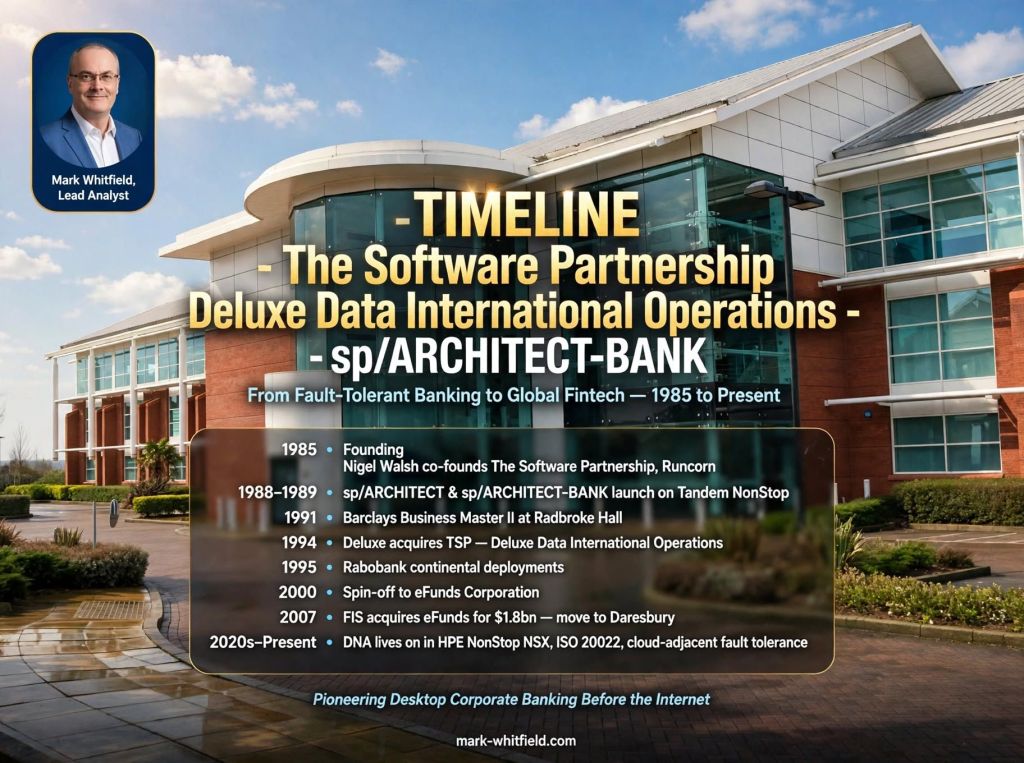
Timeline, The Software Partnership / Deluxe Data International Operations, sp/ARCHITECT-BANK
Timeline – The Software Partnership / Deluxe Data International Operations, sp/ARCHITECT-BANK

Corporate & Operational Timeline

Era 1: Inception and Independent Growth (1985–1993)

During its independent years, TSP built a specialized niche engineering high-availability banking applications for major UK and European clearing banks.

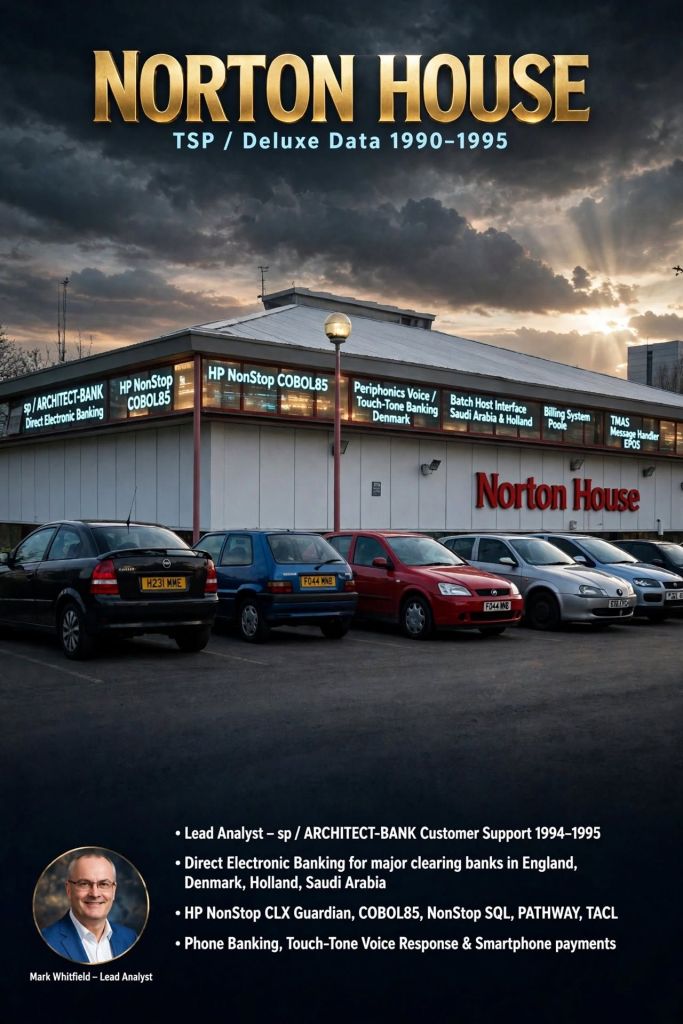
  • 1985 – Founding: Nigel Walsh co-founds The Software Partnership, initially operating from Wingate Drive in Timperley before establishing its main base at Norton House in Crowngate, Runcorn.
  • 1988–1989 – Core Product Launch: The company establishes sp/ARCHITECT and its flagship module sp/ARCHITECT-BANK. Designed specifically for Tandem Computers’ Guardian operating system and PATHWAY transaction monitor, the package enables corporate and home-office direct electronic banking.
  • 1990 – Engineering Scale-Up: The team expands to build standardized releases written in COBOL85 utilizing NonStop SQL databases. Engineers also create proprietary testing harnesses such as sp/TESTBED to simulate PC-to-mainframe interfaces.
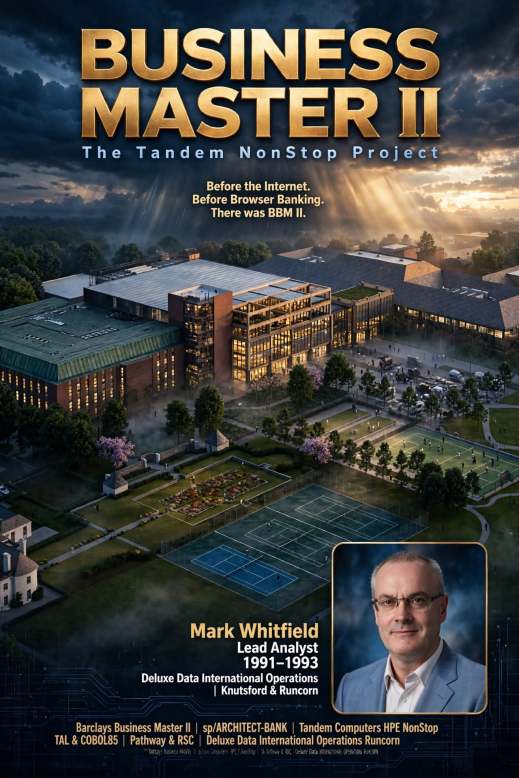
  • 1991 – Major UK Bank Rollouts: TSP deploys on-site engineering teams to Barclays at Radbroke Hall in Knutsford to deliver the Barclays Business Master II (BBM II) corporate desktop banking system.
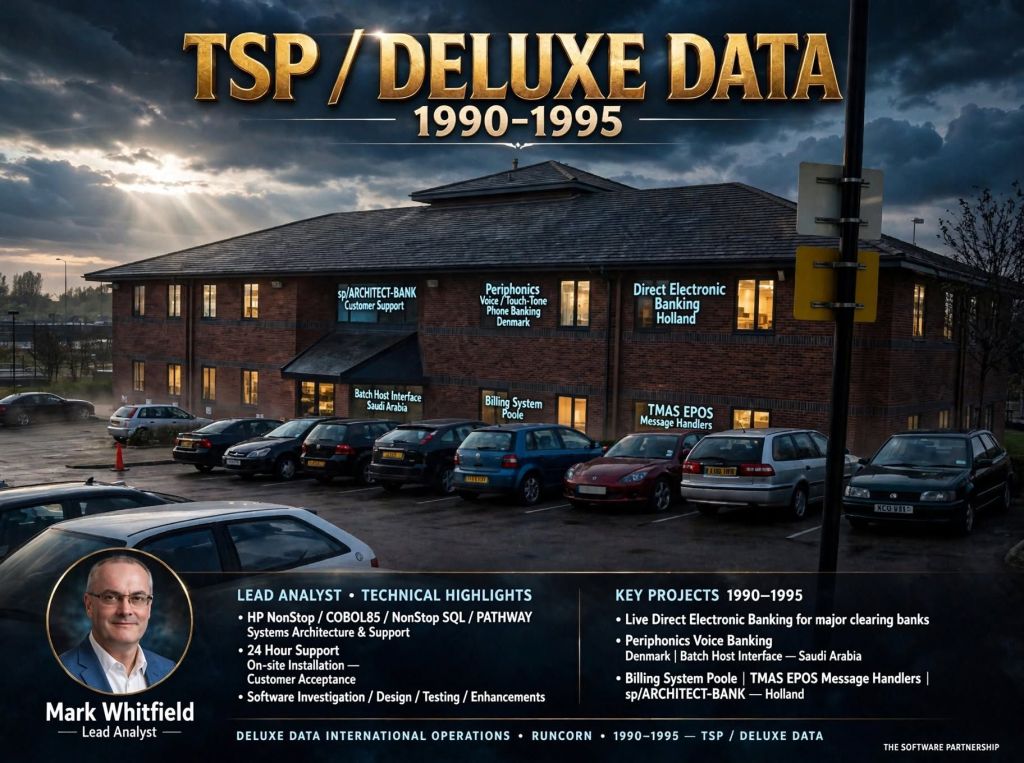
  • 1992 – Relocation & European Expansion: Growing headcount prompts a move to larger Runcorn offices at Wingate House on Northway. Engineers build a dedicated batch billing and invoicing suite for Barclays in Poole while expanding deployments across continental Europe.
  • 1993 – Voice & Clearing Giants: TSP develops an automated touch-tone Interactive Voice Response (IVR) banking system for Girofon in Denmark using Periphonics hardware. Concurrently, sp/ARCHITECT handles desktop money transfers and early smartphone/electronic banking interfaces for TSB, Bank of Scotland, and a major clearing bank in Saudi Arabia.

Era 2: Deluxe Data International Operations (1994–1999)

To capture TSP’s European banking footprint and pair it with US electronic funds transfer (EFT) technology, American payment giant Deluxe Corporation acquired the firm.

  • 1994 – US Acquisition: Deluxe Electronic Payment Systems (a division of Deluxe Corporation) purchases TSP. The Runcorn site is reorganized as Deluxe Data International Operations.
  • 1995 – Continental Deployments: Following intensive code optimization and customer acceptance testing, the Runcorn team rolls out direct electronic banking systems for major Dutch institutions, notably Rabobank.
  • 1996–1997 – Hybrid Enterprise Networking: Engineers update sp/ARCHITECT with custom TCP/IP interfaces to bridge mid-range UNIX servers (such as IBM RS/6000) with core Tandem mainframes. Using Tandem’s Remote Server Call (RSC) facility, the platform also enables Windows NT workstations to request live host financial data.
  • 1998 – Automated SWIFT Transfers: The team integrates native, multi-process file transfer protocols using Connect:Direct transport layers to securely move corporate SWIFT financial data files.

Era 3: eFunds & Corporate Consolidation (2000–2006)

At the turn of the millennium, Deluxe spun off its electronic payments and software divisions into a standalone public company.

  • 2000 – Spin-Off to eFunds: Deluxe Electronic Payment Systems merges with related divisions to form eFunds Corporation (EFD), placing the Runcorn-built sp/ARCHITECT suite at the center of its international banking portfolio.
  • 2002–2004 – CONNEX Alignment: Engineers refactor sp/ARCHITECT’s underlying communication routing to align with CONNEX, eFunds’ market-leading EFT and ATM/POS switching engine.
  • 2005–2006 – Web Portal Transition: The legacy client-server software layers are re-engineered into secure, browser-based corporate banking portals, forming the foundation for the CONNEX Advantage banking solution.

Era 4: FIS Integration & Legacy Modernization (2007–Present)

Further fintech consolidation absorbed the Runcorn operation into one of the world’s largest financial technology providers.

  • 2007 – FIS Acquisition & Daresbury Move: Fidelity National Information Services (FIS) acquires eFunds Corporation for approximately $1.8 billion. The remaining Runcorn operations are integrated into FIS and relocated nearby to Aegon House in Daresbury, Warrington.
  • 2010–2018 – Global Standards & Refactoring: FIS fully absorbs the remaining codebase into its institutional payment infrastructure, refactoring legacy code into C++ and Java modules while adding support for Service-Oriented Architecture (SOA) and ISO 20022 financial messaging standards.
  • 2020s–Present – Cloud-Adjacent Fault Tolerance: While modern banks increasingly adopt microservices and open-banking APIs, the architectural DNA of sp/ARCHITECT-BANK remains active in high-volume institutional payment systems running on virtualized x86 HPE NonStop (NSX) environments.

Summary of Corporate & Technical
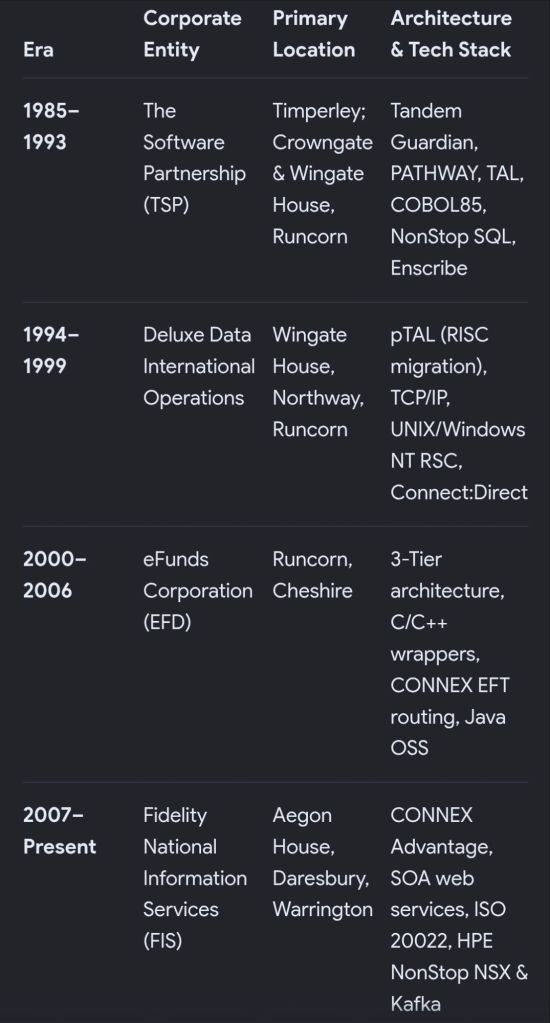
Timeline for The Software Partnership / Deluxe Data International Operations, sp/ARCHITECT-BANK
Timeline for The Software Partnership /
Deluxe Data International Operations,
sp/ARCHITECT-BANK

For first-hand engineering records, project histories, and archival photos from this period, see the sp/ARCHITECT-BANK historical archive and the TSP & Deluxe Data project logs.
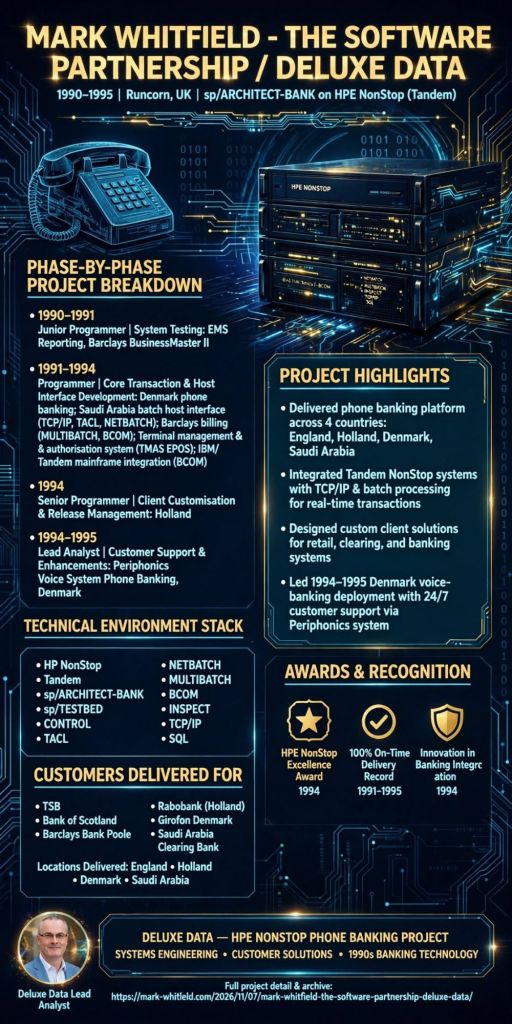
Mark Whitfield, project work at The Software Partnership / Deluxe Data

During the early stages of his IT career from 1990 to 1995, Senior IT Project Manager Mark Whitfield worked at The Software Partnership (later acquired in 1994 by Deluxe Data International Operations) based in Runcorn, UK.

It is important to note a key factual clarification: during this specific tenure (1990–1995), Mark Whitfield did not yet hold the title of IT Project Manager. Instead, he worked as a Junior Programmer, Programmer, Senior Programmer, and Lead Analyst, laying his technical foundations on highly resilient electronic banking systems before transitioning into senior project management later in his career.

Mark Whitfield - project work at The Software Partnership / Deluxe Data
Mark Whitfield | project work at The Software Partnership / Deluxe Data

Below is the comprehensive chronological breakdown of the IT projects, technical architectures, and delivery duties he fulfilled at the Runcorn office.


Phase-by-Phase Project Breakdown (1990 – 1995)

1. Lead Analyst | Customer Support & Enhancements (1994 – 1995)

  • Application Focus: Supporting live sp/ARCHITECT-BANK Direct Electronic Banking applications across major clearing banks in England, Holland, Denmark, and Saudi Arabia.
  • Periphonics Voice System: Managed the Customer Acceptance phase and production installation of phone-banking software enhancements for a major clearing bank in Denmark. The integration layered a Periphonics touch-tone voice response unit over an HP NonStop host database to provide balance inquiries and statement ordering.
  • Core Responsibilities: Resolving critical system failures, tracking diagnostic performance errors, deploying patches, and providing 24/7 on-call technical infrastructure support.

2. Senior Programmer | Client Customisation & Release Management (1994)

  • Application Focus: System modifications for a prominent clearing bank based in Holland.
  • Core Responsibilities: Supervising code base updates triggered by client acceptance criteria. He utilized the version control environment CONTROL to regulate builds, managed technical release documentation, and simulated incoming PC interfaces via the sp/TESTBED harness utility.

3. Programmer | Core Transaction & Host Interface Development (1991 – 1994)

  • Denmark Phone Banking (1994): Independently coded new transactional handler engines on the HP NonStop server architecture, extending remote banking functionalities.
  • Saudi Arabia Batch Host Interface (1993 – 1994): Architected and coded file-transfer batch automation jobs utilizing TCP/IP connections between HP NonStop environments and corporate host bank mainframes. Programmed automated TACL scripting configurations inside NETBATCH schedules to refresh core SQL tables with balance sheet, security, calendar, and transaction payloads.
  • Standard Product Standardisation (1993): Evaluated code repositories from previously deployed architectures to isolate viable standalone software modules, constructing a unified baseline product release for future development teams.
  • Barclays Billing System Deployment (1993): Completed a 3-month on-site development deployment for Barclays Bank in Poole, Dorset. Designed and deployed a batch analytics and report infrastructure utilizing MULTIBATCH and BCOM communication protocols to calculate customer account utility fees and file transfer billing metrics.
  • Terminal Management & Authorisation System (TMAS) (1993): Coded front-end message processing scripts to handle real-time merchant electronic point of sale (EPOS) financial handshakes.
  • IBM/Tandem Mainframe Integration (1991 – 1992): Designed multi-platform batch file integrations between HP NonStop modules and backend IBM mainframe environments using BCOM. Wrote internal logic checks to audit high-value domestic and cross-border commercial bank payments prior to host clearance.

4. Junior Programmer | System Testing & Initial Builds (1990 – 1991)

  • Reporting & Event Management System (EMS) (1990 – 1991): Programmed audit reports extracting localized banking system logs using structural programming language logic linked to custom event filtering arrays.
  • Barclays BusinessMaster II System Testing (1990): Executed end-to-end integration scripts for the bank’s administrative interface screens, utilizing INSPECT tools to debug data pathways across system components during client acceptance reviews.

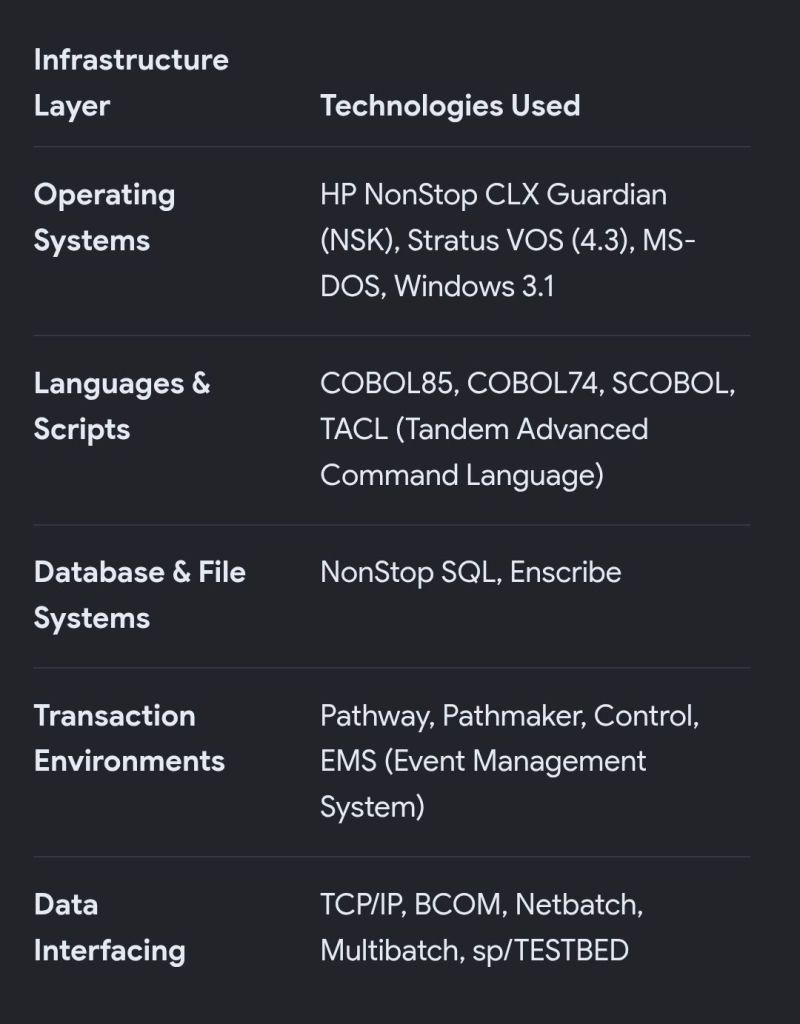
Technical Environment Stack

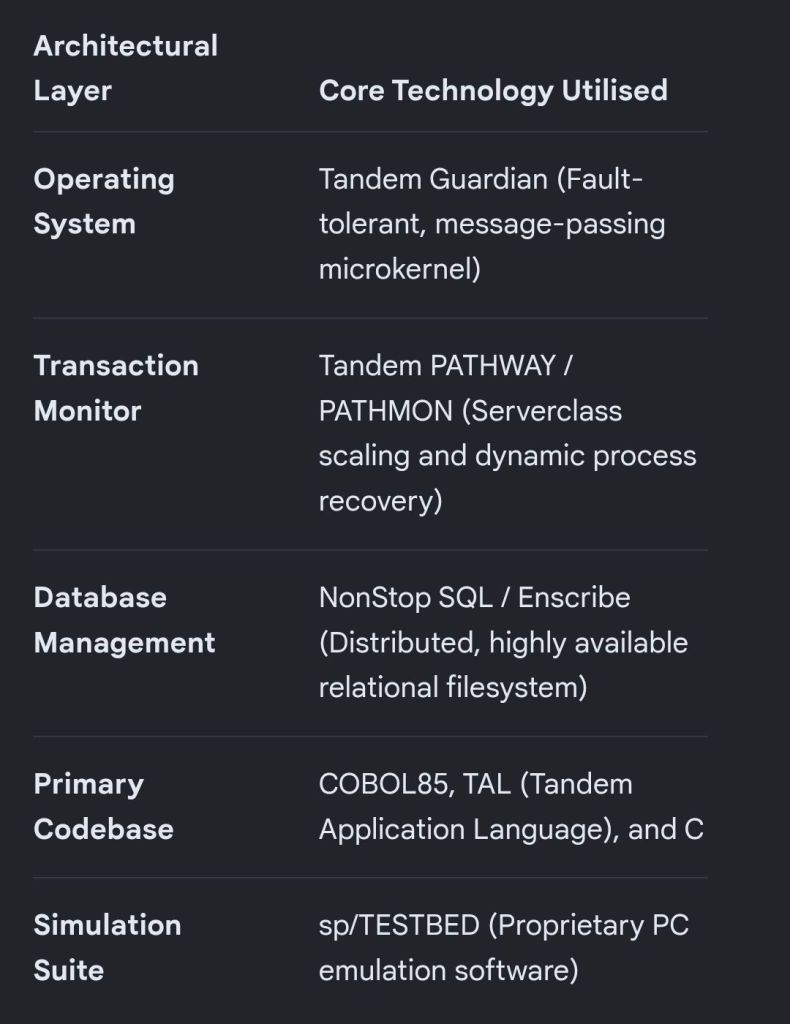
The mission-critical banking architectures delivered out of the Runcorn location utilized a specialized, high-availability platform stack:

Mark Whitfield project work at The Software Partnership, Deluxe Data
Mark Whitfield | Project work at The Software Partnership / Deluxe Data | Norton House, Crowngate, Runcorn
Mark Whitfield, Project work at The Software Partnership / Deluxe Data, Wingate House, Northway, Runcorn
Mark Whitfield | Project work at The Software Partnership / Deluxe Data | Wingate House, Northway, Runcorn

Mark Whitfield, project work at The Software Partnership / Deluxe Data above

Corporate history of The Software Partnership (TSP) and its acquisition by Deluxe Data International

The corporate history of The Software Partnership (TSP), its acquisition by Deluxe Data International, and its subsequent integrations form a foundational timeline in early UK fintech and mission-critical corporate remote banking.

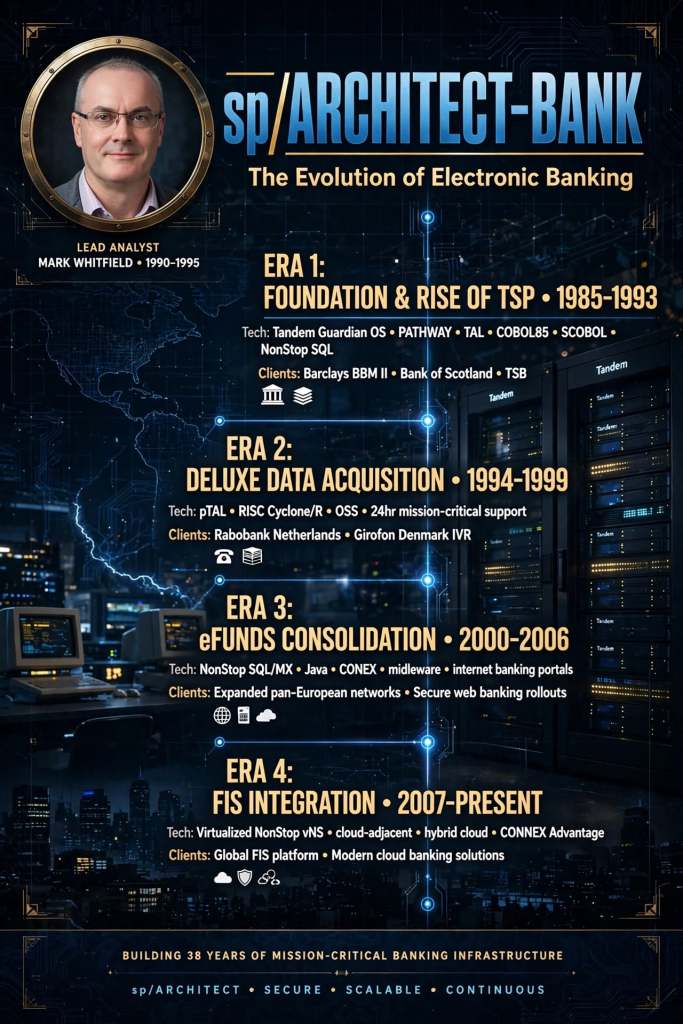
Mark Whitfield Lead Analyst for sp/ARCHITECT-BANK 1990 thru 1995
Mark Whitfield | Lead Analyst for sp/ARCHITECT-BANK 1990 thru 1995

The detailed historical timeline by era and year for the Runcorn-based software house is structured below:

🌅 Era 1: The Foundation and Rise of TSP (1985–1993)

This era covers the establishment of the independent software house, moving from early terminal solutions into specialized development on Tandem Computers fault-tolerant architectures (now HPE NonStop).

  • 1985: The Software Partnership (TSP) is co-founded by Nigel Walsh. The office begins its lifespan at Wingate Drive in Timperley before eventually establishing its core headquarters at Norton House, Crowngate, and subsequently Wingate House in Runcorn, Cheshire.
  • 1986–1989: Development focuses heavily on terminal-to-mainframe corporate banking solutions. Initial conceptual designs emerge for standard financial messaging and ledger interfaces.
  • 1990: Development scales heavily around sp/ARCHITECT-BANK, a highly specialized desktop banking integration platform. It bridges corporate accountants securely to back-end ledger platforms.
  • 1991–1993: Major client deployments expand across tier-1 UK and international institutions, including Barclays Bank (BBM II – Barclays Business Master II), Bank of Scotland, and TSB. Technical stacks rely on monolithic Transaction Application Language (TAL), COBOL85, and SCOBOL green screens running over Tandem Guardian OS pathways.

🤝 Era 2: Deluxe Data Acquisition and Global Remote Banking (1994–1999)

This period marks the transition to a global subsidiary model, driving early remote electronic corporate banking solutions.

  • 1994: Deluxe Data International acquires The Software Partnership. The Runcorn office rebrands operations under Deluxe Data, coupling local development with global financial networks.
  • 1994 (Technical): Architectures begin moving away from monolithic TAL foundations toward distributed client-server frameworks and pTAL migrations to support evolving RISC architectures (like Tandem Cyclone/R systems).
  • 1995: Major expansion into European markets. The Runcorn office delivers software design, coding, and 24-hour mission-critical support for key global accounts like Rabobank (Netherlands) and interactive voice menu (IVR) gateways for Girofon (Denmark).
  • 1996–1999: High-volume transaction frameworks mature. Client installations shift configurations toward early open-system compliance as Tandem introduces Open System Services (OSS) frameworks.

🚀 Era 3: The eFunds & Corporate Consolidation Era (2000–2006)

A period of intense corporate consolidation as internet banking begins replacing classical dedicated corporate dial-up desk terminals.

  • 2000: Deluxe Data’s broader software arms are synthesized into eFunds Corporation. Runcorn’s legacy code assets scale to modern middleware, integrating NonStop SQL/MX databases.
  • 2001–2006: Migration programs transition legacy platforms toward Java and web-adjacent internet banking infrastructures. The core banking engines originally written at TSP remain operational beneath corporate frameworks due to their structural fault tolerance.

🏢 Era 4: The FIS Integration and Legacy Modernisation Era (2007–Present)

The final stage of integration into global fintech conglomeration and cloud architectures.

  • 2007: Fidelity National Information Services (FIS) acquires eFunds for $1.8 billion, fully absorbing the intellectual property, client contracts, and product lines evolved from the original sp/ARCHITECT platform.
  • 2010s–2020s: The core application logic moves into virtualized, cloud-adjacent, and hybrid cloud infrastructures (such as Virtualized NonStop / vNS architectures), decoupling the legacy fintech capabilities from physical mainframe stacks.

The product lifecycle of the sp/ARCHITECT banking platform (specifically sp/ARCHITECT-BANK) is a landmark case study in early electronic home and corporate desktop banking.

Originally engineered by The Software Partnership (TSP) in Runcorn, Cheshire, the platform was custom-built to exploit the native fault-tolerant infrastructure of Tandem NonStop mainframes.

The detailed timeline of the sp/ARCHITECT platform is broken down below by operational era and year:


1. The Foundational & Conceptual Era (1985–1989)

This era focused on the structural architecture design of custom online financial engines, transitioning banking services from terminal-to-mainframe environments into standardized software modules.

  • 1985: The Software Partnership (TSP) is co-founded by Nigel Walsh. The engineering team begins design blueprints for a standard, high-availability product architecture built explicitly to run within the Tandem Computers Guardian OS and PATHWAY transaction processing monitor environments.
  • 1986–1987: Heavy development maps terminal-to-mainframe pathways. Initial conceptual frameworks for standard electronic financial message routing and parsing modules are drafted.
  • 1988–1989: The product line is formally established under the sp/ARCHITECT brand banner. Its landmark module, sp/ARCHITECT-BANK, is positioned as a premier, high-volume client-server base package for remote corporate and home-office electronic desktop banking.

2. The Systematic Framework & Production Scaling Era (1990–1993)

During this period, the product was fully engineered into a rigorous, production-grade standard release, utilizing fault-tolerant databases and specialized back-end simulation tools.

  • 1990: The engineering division scales up significantly. Structured, systematic framework engineering begins on sp/ARCHITECT-BANK to process high-volume, real-time banking requests natively on Tandem NonStop computers. The engineering team develops sp/TESTBED, a proprietary testing utility used to simulate physical PC-to-mainframe interfaces.
  • 1991: Code optimization migrates heavily toward COBOL85 and NonStop SQL relational databases to execute high-performance transactional back-ends. Major commercial deployments begin, notably building the complex, functional back-end modules for the Barclays Business Master II (BBM II) desktop corporate application.
  • 1992: TSP expands out of its original Norton House office into massive new headquarters at Wingate House in Runcorn to house the expanding product engineering teams.
  • 1993: Dedicated batch host interfaces, automated file balancing, and system logic designs are integrated into the primary sp/ARCHITECT standard product release. Concurrently, developers write an integrated sp/ARCHITECT-BANK Billing System module used to handle automated batch-billing pipelines for commercial customer accounts.

3. The Acquisition & Enterprise Integration Era (1994–1995)

The platform matures into an internationally recognized corporate banking suite, attracting cross-border mergers and acquisitions.

  • 1994: Due to the global success of the sp/ARCHITECT system architecture, Deluxe Data International acquires The Software Partnership. The codebase is integrated into Deluxe Data’s international software catalogue.
  • 1994–1995: The product’s deployment reach scales across several top-tier global financial institutions. Modified, multi-language variants of the sp/ARCHITECT platform are successfully delivered to international clients, including TSB, Bank of Scotland, Rabobank (Netherlands), and Girofon (Denmark).

Technical Architecture Overview

The reason sp/ARCHITECT remained resilient throughout its timeline was its direct dependency on the Tandem/HPE NonStop architecture:

sp/ARCHITECT-BANK is a landmark case study in early electronic home and corporate desktop banking
sp/ARCHITECT-BANK is a landmark case study in early electronic home & corporate desktop banking