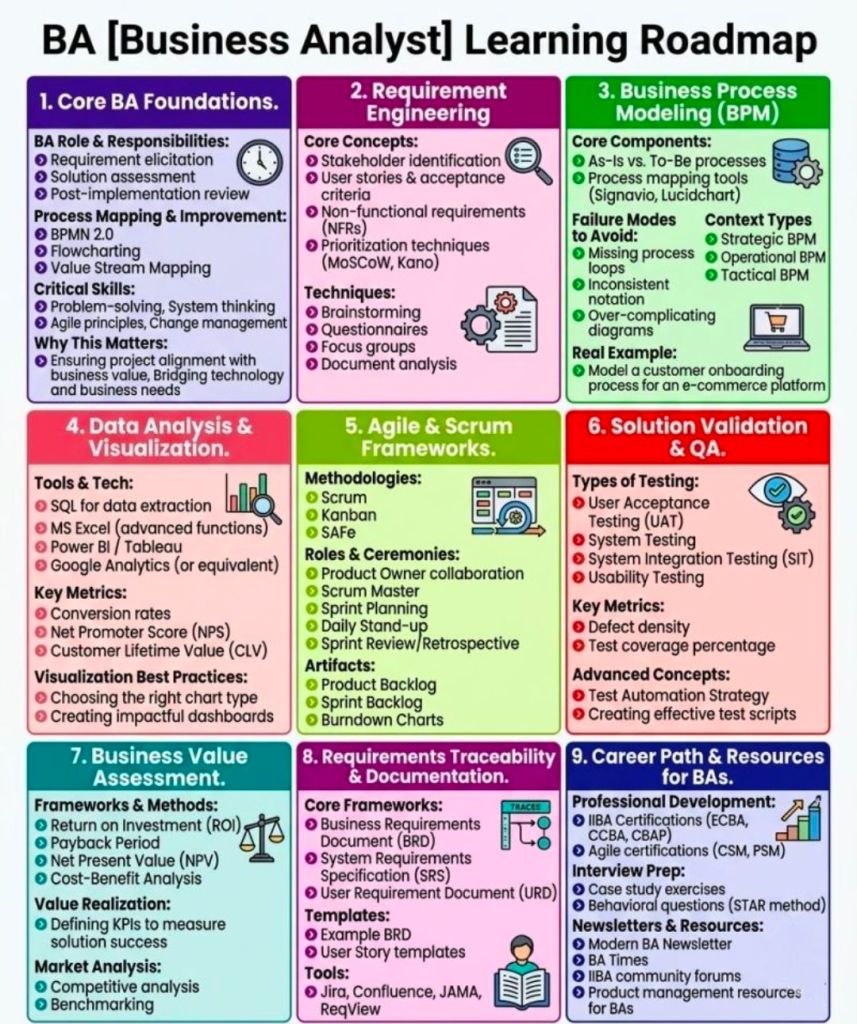
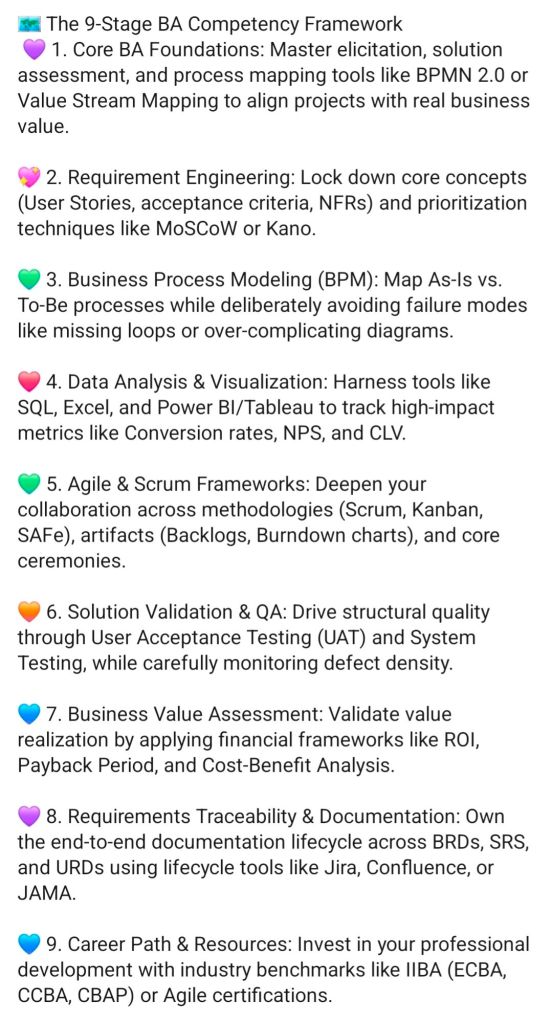
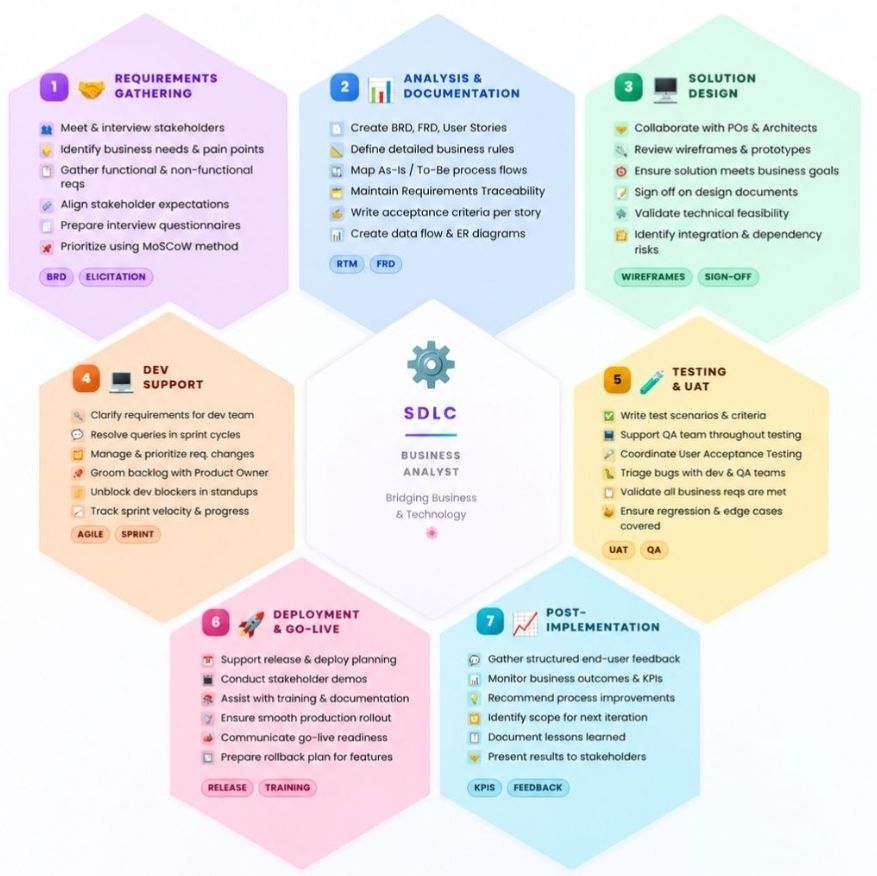
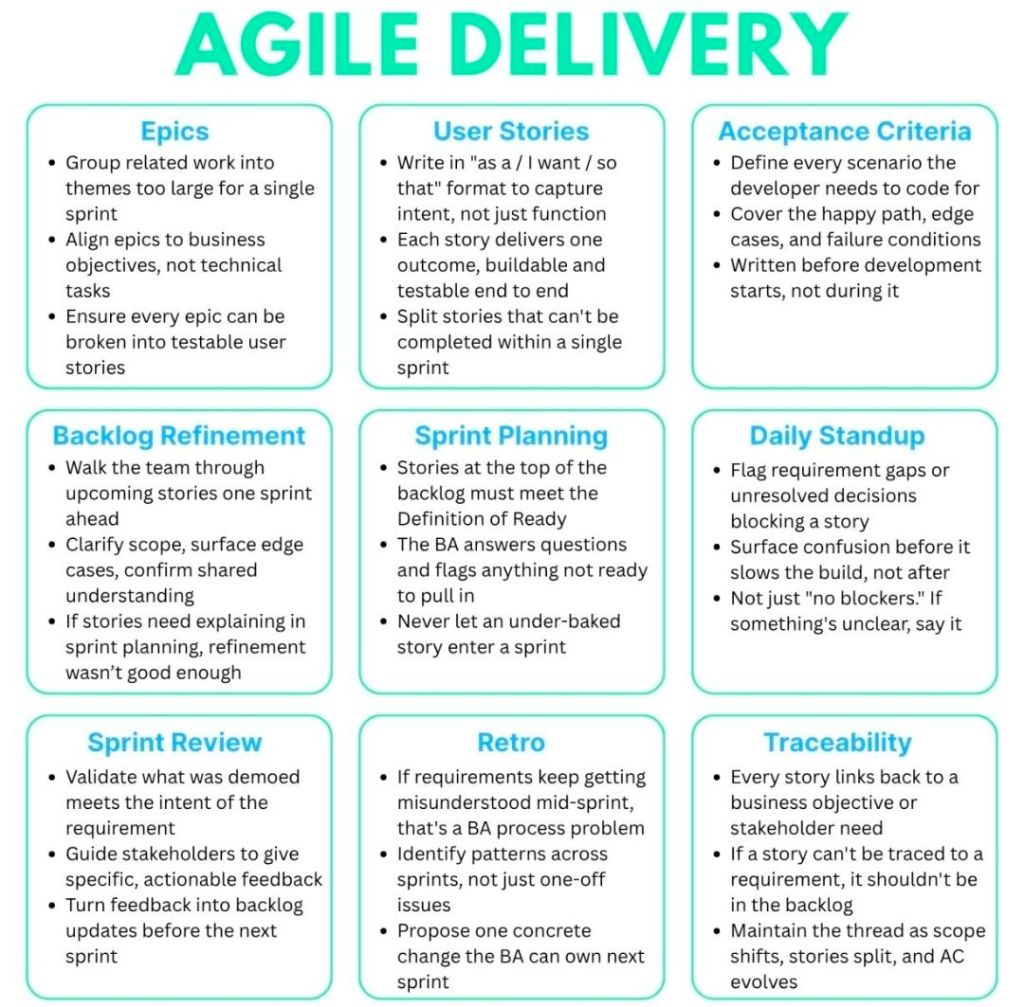
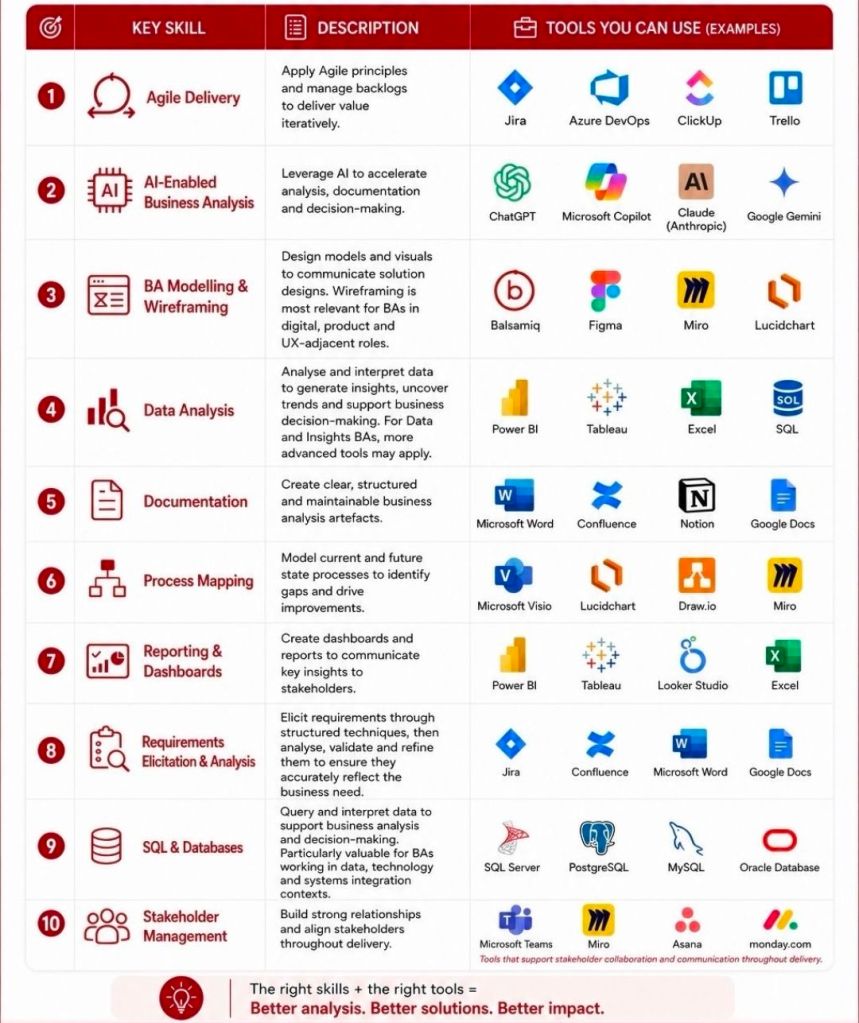
Essential Business Analyst Skills & the Tools that Power Them

Essential Business Analyst Skills & the Tools that Power Them
Essential Business Analyst Skills
& the Tools that Power Them

Role of a Business Analyst BA in API Integration

Role of a Business Analyst BA in API Integration
Role of a Business Analyst BA
in API Integration

A Business Analyst (BA) acts as the critical bridge between business stakeholders and technical teams. In API integration, the BA translates strategic business goals into clear technical requirements. They ensure systems communicate seamlessly, align with business rules, and support the overall customer journey.

Core responsibilities for a BA in API integration include:

  • Requirement Gathering: Translating business needs into precise functional and non-functional requirements, such as payload data requirements, expected response times, and security protocols.
  • Data Mapping: Defining exactly how data fields correspond across different systems (e.g., matching a CRM’s “Client Name” to a billing system’s “Customer”) and determining data transformation rules.
  • Defining Scenarios: Detailing the API’s behavior for both standard workflows and edge cases, such as handling invalid login attempts, rate limiting, and system timeouts.
  • Documentation & Modeling: Using sequence diagrams and flowcharts to visually map out how systems interact, and producing clear Interface Control Documents (ICD).
  • User Stories & Acceptance Criteria: Writing integration-focused user stories for Agile backlogs, including specific HTTP methods, request/response formats, and error codes.
  • Facilitating Collaboration: Bridging the communication gap by translating technical constraints to non-technical stakeholders and business objectives to developers.
  • Testing & UAT Support: Assisting the QA team in validating API endpoints using tools like Postman, and ensuring requirements are met during User Acceptance Testing (UAT).

To deepen your understanding of this role, comprehensive guidelines and methodologies can be explored via LinkedIn’s API for Analysts or Business Analyst Community Integration Guides.

Role of a Business Analyst BA in API Integration

Planning Phase Business Analyst BA Deliverables

Planning Phase Business Analyst BA Deliverables

In the project planning phase, a Business Analyst (BA) focuses on establishing the project’s strategic alignment, defining the baseline scope, mapping stakeholders, and structuring the business analysis methodology.

The critical BA deliverables generated during this phase ensure clarity and alignment across technical and business teams before execution begins.

Strategic & Scope Foundations

  • Business Problem Statement: Defines the core issue being addressed, why it matters to the organisation, and the downstream impact if no action is taken.
  • Business Case: Outlines the shortlisted, viable operational choices alongside a comprehensive cost-benefit analysis to justify financial investment.
  • Project Vision & Scope: A high-level description outlining system boundaries, project objectives, and structural constraints to prevent eventual scope creep.

Stakeholder & Communication Frameworks

  • Stakeholder Map: Visually identifies all internal and external parties who are involved in, impacted by, or influential to the initiative.
  • Stakeholder Analysis Matrix: Assesses stakeholder interest and decision-making power to customize communication and engagement strategies.
  • Business Glossary: A standardized registry defining critical business terminology to maintain consistent vocabulary across different teams.

Process & Data Models

  • Current State Discovery (“As-Is” Models): A structured overview detailing exactly how today’s workflows, processes, and operating models currently function.
  • High-Level Context Diagram: Maps the structural boundaries of the proposed project, showing how the internal system will interact with external users and data systems.
  • Data Flow Diagram (DFD): Illustrates how information travels visually across different processes, storage points, actors, and functional areas.

BA Execution Planning

  • Business Analysis Approach: Outlines the core delivery methodology (e.g., Predictive/Waterfall or Adaptive/Agile), specifying the timelines, techniques, and governance processes to be used.
  • Requirements Management Plan: Defines the tools for managing requirements, access protocols, configuration control, and how changes to the baseline will be systematically approved.

Business Analyst and Sprint Planning focus

Business Analyst and Sprint Planning focus

In Agile and Scrum frameworks, the Business Analyst (BA) bridges the gap between high-level business vision and tactical development execution. During Sprint Planning, a BA’s primary focus is to ensure that the development team has absolute requirement clarity, eliminating assumptions before a single line of code is written.

The exact focus areas of an Agile Business Analyst are divided into pre-planning readiness, active session support, and look-ahead risk management.

1. Requirements Readiness (Definition of Ready)

The primary pre-planning objective for a BA is ensuring that the top of the Product Backlog satisfies the team’s “Definition of Ready” (DoR).

  • INVEST Criteria: Verifying that each Product Backlog Item (PBI) is Independent, Negotiable, Valuable, Estimable, Small, and Testable.
  • Acceptance Criteria: Drafting robust, edge-case-tested functional parameters (often using the Given-When-Then format) to govern testing.
  • Business Rules & Models: Mapping complex data models, workflows, and process rules so developers have clear visuals alongside text.

2. Guarding the Business Value and Sprint Goal

While the Product Owner (PO) sets the priority, the BA confirms that the selected sprint backlog items align logically to form a cohesive target.

  • Sprint Goal Formulation: Supporting the PO in defining a functional, clear objective for the iteration rather than a random collection of tickets.
  • Value Justification: Serving as the “voice of the user,” reminding the technical team why a feature is being built and how it affects the end-user journey.

3. Technical and Functional Bridging

During the actual planning meeting, developers break down stories into sub-tasks and estimate effort. The BA provides live context.

  • Assumption Removal: Answering immediate clarifications regarding data constraints, legacy dependencies, or UI expectations.
  • Sizing Support: Assisting the team during story-point estimation by highlighting hidden functional complexities that impact effort.
  • Scope Trimming: Helping break down massive User Stories (Epics) into bite-sized, single-sprint tasks if an item is deemed too large.

4. Dependency and Risk Mitigation

A critical focus for the BA is ensuring the upcoming sprint does not get blocked by outside factors.

  • Cross-Team Alignment: Identifying if a story relies on an API or data feed managed by an external team, ensuring those pieces are unblocked.
  • Non-Functional Requirements (NFRs): Catching frequently missed parameters, such as specific security protocols, compliance standards, or localization requirements, before work kicks off.

Facilitating Workshops as a Business Analyst BA

Facilitating Workshops as a Business Analyst BA
Facilitating Workshops as a Business Analyst
Facilitating Workshops as a Business Analyst BA

As a Business Analyst (BA), facilitating workshops is a core competency used to elicit requirements, align cross-functional teams, and achieve stakeholder consensus. Success hinges on meticulous pre-session planning, active moderation of group dynamics during the session, and timely post-workshop documentation.

A proven framework for facilitating impactful BA workshops involves three critical phases:

1. Preparation

Planning is the most important step for a successful workshop. Poorly planned sessions waste valuable stakeholder time.

  • Define the Objective: Identify exactly what needs to be achieved (e.g., process mapping, feature prioritization, or user story mapping).
  • Select Participants: Invite subject matter experts (SMEs), decision-makers, and end-users. Keep the group size manageable, usually between 5 to 10 people to ensure productivity.
  • Create a Clear Agenda: Break the time down into specific activities. Allocate time for introductions, the core activity, breaks (if >1 hour), and a summary.
  • Prepare Materials: Set up whiteboards (physical or digital like Miro/Mural) and prepare your facilitation techniques (e.g., brainstorming, MoSCoW prioritization).

2. Execution (In the Session)

Your role is to act as a neutral guide, keeping the team focused on the objective rather than getting bogged down in implementation details.

  • Set Ground Rules: Establish parameters early, such as one conversation at a time, keeping devices put away, and respecting everyone’s input.
  • Manage Group Dynamics: Encourage quieter participants to speak up while politely reigning in dominant voices.
  • Use a ‘Parking Lot’: Create a designated section on a whiteboard for off-topic ideas, out-of-scope concerns, or unresolved questions to prevent the meeting from derailing.
  • Visual Collaboration: Use process flows, mockups, or sticky notes to give the conversation a focal point. This triggers ideas and helps maintain stakeholder attention.

3. Post-Workshop

The work doesn’t end when the meeting concludes. You must synthesize the information gathered to ensure it translates into actionable project deliverables.

  • Consolidate Documentation: Clean up notes, digitize whiteboard sessions, and format the elicited requirements.
  • Distribute and Align: Send a clear, written summary to participants outlining decisions made, parking lot items that need resolution, and agreed-upon next steps (who is doing what and by when).

Resources and Best Practices

  • For structured, globally recognized techniques and study material, explore the International Institute of Business Analysis (IIBA).
  • To learn practical workshop formats like user story mapping and discovery, watch this BA Requirements Workshop Guide on YouTube.

Questions every Business Analyst should ask before writing requirements

Questions a Business Analyst should ask before writing the requirements
Questions every Business Analyst should ask before writing requirements

Business Analyst vs Agile Business Analyst

Business Analyst vs Agile Business Analyst

Requirements Traceability Matrix RTM & Business Analyst BA

Requirements Traceability Matrix RTM & Business Analyst BA

A Requirements Traceability Matrix (RTM) is a structured project management document that links user and stakeholder requirements directly to their corresponding design elements, development deliverables, and verification test cases.

Acting as a living checklist throughout the project life cycle, its primary purpose is to ensure 100% test coverage, validate that all client requests are fulfilled, and prevent scope creep by identifying undocumented work.

The visual layout of a typical RTM template maps individual requirement rows against critical validation milestones.

🔄 Three Main Types of Traceability

The configuration of an RTM depends heavily on the direction of tracking needed for the project:

  • Forward Traceability: Tracks requirements forward into design, code, and test cases. It ensures the project executes every requested feature and that nothing gets left behind.
  • Backward (Backward-Looking) Traceability: Traces test cases and final deliverables back to the original requirement. It checks for scope creep, confirming that no extra, unauthorized features were added.
  • Bidirectional Traceability: Combines both approaches. It links requirements from origin to destination and vice versa, providing clear visibility during change management or troubleshooting.

📋 Structured Breakdown of RTM Content

A standard RTM is formatted as a multidimensional table. Below is the foundational structure, broken down into its logical data components:

1. Core Requirement Parameters

  • Requirement ID: A distinct alphanumeric identifier (e.g., REQ-001, BRD-102) for quick cross-referencing.
  • Requirement Type: Classifies the item (e.g., Business, Functional, Technical, UI, Security, or Regulatory Compliance).
  • Requirement Description: A concise textual explanation defining exactly what the feature or system must achieve.
  • Source/Origin: The document, stakeholder, client request, or meeting minutes where the requirement originated.
  • Priority Level: The urgency ranking of the item, usually categorized as High, Medium, or Low (or via MoSCoW ranking).

2. Design and Development Artifacts

  • Functional Specification ID: Links the requirement to the specific section of the functional design document.
  • Technical Design/Architecture Module: Points to the code packages, database tables, or system architectural components implementing the requirement.

3. Verification & Validation (Testing) Data

  • Test Case ID: The unique ID of the specific test cases designed to validate the feature (e.g., TC-101, TC-102).
  • Test Case Description/Objective: A snapshot of what the test case actually checks.
  • User Acceptance Testing (UAT) ID: Specific ID linking to end-user validation scenarios.

4. Execution & Quality Control Tracking

  • Test Execution Status: The real-time health indicator of the testing suite (e.g., Passed, Failed, Blocked, Not Run).
  • Defect/Bug ID: If a test fails, this column logs the active issue tracker ID (e.g., Jira ticket BUG-404) linked to the breakdown.
  • Current Deployment Status: Defines the project readiness stage (e.g., In Progress, Dev, QA, Production).

💡 Core Benefits of Maintaining an RTM

  • Prevents Missed Features: Verifies that every business requirement translates into clean code and valid testing cycles before software deployment.
  • Streamlines Change Management: If a client alters a feature, developers can quickly scan the RTM row to see exactly which code modules and test scripts need updates.
  • Simplifies Compliance Audits: Serves as regulatory proof in safety-critical landscapes (like medical devices or automotive software) that every target function passed validation.

Requirements Traceability Matrix RTM & Business Analyst BA