

ACI XPNET (Exchange Protocol Network)—often distributed within the NET24-XPNET suite—is a proprietary, mission-critical Message-Oriented Middleware (MOM) and network management infrastructure developed by ACI Worldwide.
Engineered primarily for fault-tolerant HPE NonStop (formerly Tandem) servers, XPNET serves as the foundational communications backbone for ACI’s flagship electronic funds transfer (EFT) platforms, BASE24 and BASE24-eps.
Comprehensive Architectural & Technical Description
XPNET acts as a high-speed abstraction layer between physical telecommunications hardware, terminal devices, external payment schemes, and internal banking application processes. It decouples business logic from low-level network protocols, allowing financial institutions to process hundreds of millions of daily transactions without interruption.
1. Core Architectural Components
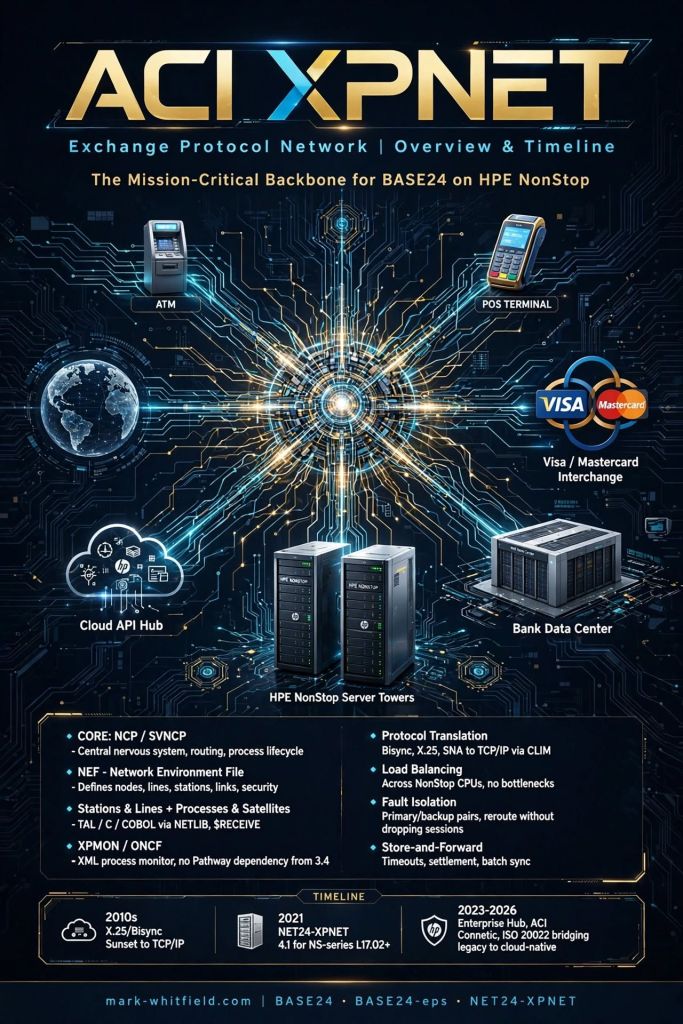
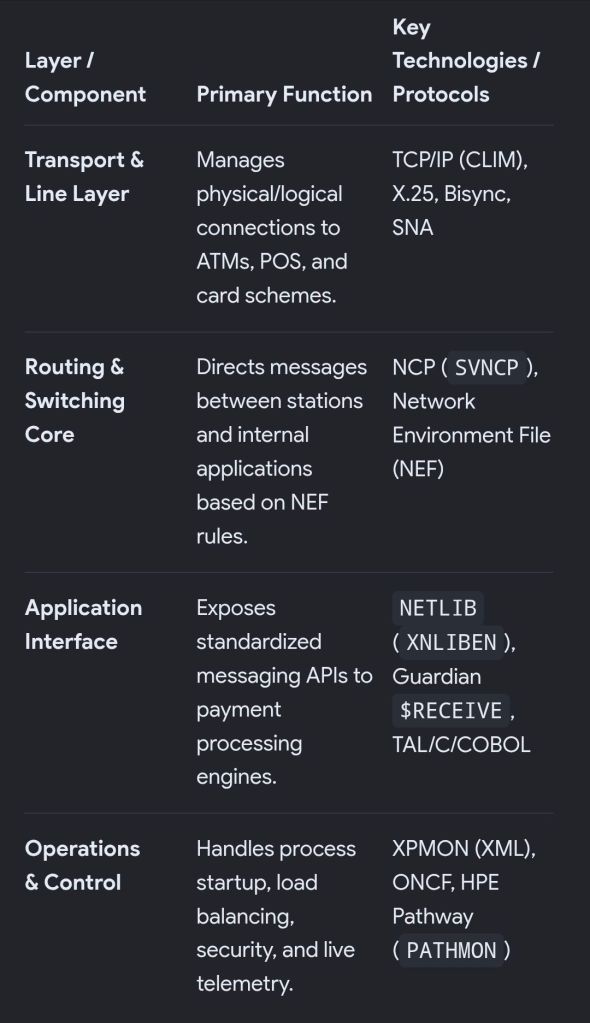
- Network Control Process (NCP / SVNCP): The central nervous system of an XPNET node. It manages process lifecycles, monitors network topology, enforces routing tables, and coordinates communication between local and remote nodes.
- Network Environment File (NEF): A centralized configuration repository (historically stored in Tandem’s Enscribe database) that defines every logical and physical element of an XPNET deployment—including nodes, lines, stations, processes, links, and security parameters.
- Process & Satellite Architecture: XPNET abstracts external endpoints and internal worker routines into logical objects:
- Stations & Lines: Represent physical or logical external connections (e.g., an ATM controller, a POS concentrator, or a Visa/Mastercard interchange link).
- Processes & Satellites: Internal application programs (written in TAL, pTAL, C, or COBOL) that communicate with the XPNET router via the HPE Guardian
$RECEIVEfile system and theNETLIBAPI library (netlib_init(),netlib_read_rcv()).
- Command and Control (ONCF / XPMON): Historically, NET24 relied on HP Pathway (
PATHMON) and Online Network Control Facility (ONCF) to manage files, security, and server processes. Starting with XPNET 3.4, ACI introduced XPMON (an XML-configured process monitor) to eliminate mandatory third-party Pathway licensing solely for XPNET operations.
2. Key Operational Capabilities
- Protocol Translation & Line Management: Natively handles disparate legacy and modern telecommunications protocols—including Bisync, X.25, SNA, and TCP/IP (via HPE CLIM stacks)—translating raw wire frames into standardized internal XPNET message headers.
- Dynamic Load Balancing & CPU Distribution: Uniformly distributes incoming message queues across multiple NonStop CPUs and parallel worker processes, preventing single-processor bottlenecks during peak retail surges.
- Fault Isolation & NonStop Resiliency: Utilizes primary/backup process pairs and distributed node monitoring. If a communication line drops or a processor fails, XPNET isolates the fault, reroutes traffic to backup links, and preserves in-flight transaction states without dropping active sessions.
- Transaction Timing & Store-and-Forward: Enforces strict message timeout windows (critical for real-time ATM/POS authorization) and provides disk-backed store-and-forward queuing for settlement and batch synchronization.
Detailed Evolution Timeline (1975 – Present)
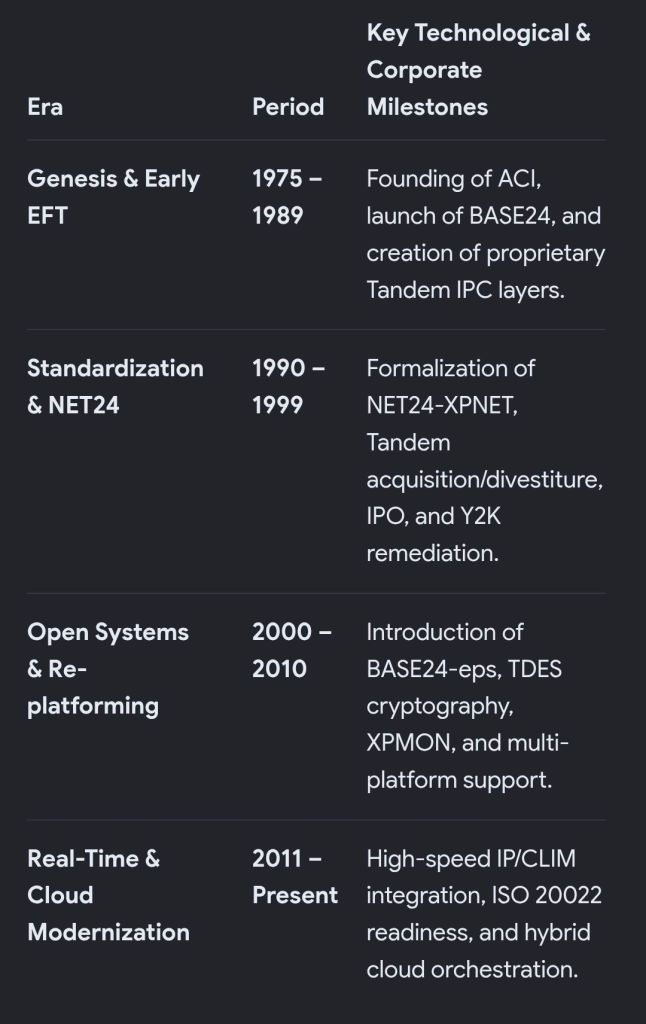
- 2010s – X.25/Bisync Sunset & Native TCP/IP: Financial networks phase out legacy X.25 and Bisync leased lines in favor of encrypted TCP/IP networks. XPNET evolves to leverage HPE NonStop Cluster I/O Module (CLIM) TCP/IP stacks, significantly reducing network latency and CPU overhead.
- 2021 – NET24-XPNET 4.1 Release: ACI releases XPNET 4.1 tailored for modern x86-based HPE NonStop NS-series systems (OS L17.02+), introducing enhanced internal TCP/IP stack integrations, updated
SKELapplication libraries, and streamlined XML-based XPMON process management. - 2023–2026 – Enterprise Hub Integration & Cloud-Native Coexistence: As ACI rolls out cloud-native orchestration platforms like the ACI Enterprise Payments Platform and ACI Connetic (2025) to unify card and account-to-account (ISO 20022) rails, XPNET continues to serve as the mission-critical edge switch for Tier-1 banks running mission-critical HPE NonStop environments—bridging legacy card rails with modern API-driven payment ecosystems.
Summary of Core Architectural Roles
ACI XPNET Exchange Protocol Network Overview & Timeline above


