

Modern cloud development spans several architectural layers, deployment strategies, and provider ecosystems, giving teams the flexibility to balance infrastructure control against development speed.
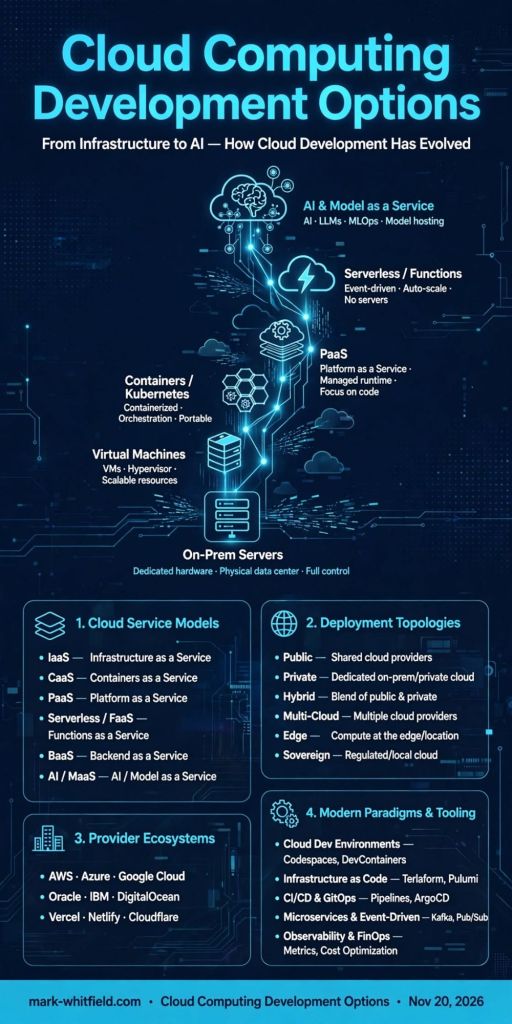
1. Cloud Service Models (The Abstraction Stack)
The foundational choice in cloud development is deciding how much of the underlying technology stack you want to manage versus outsource to the cloud provider.
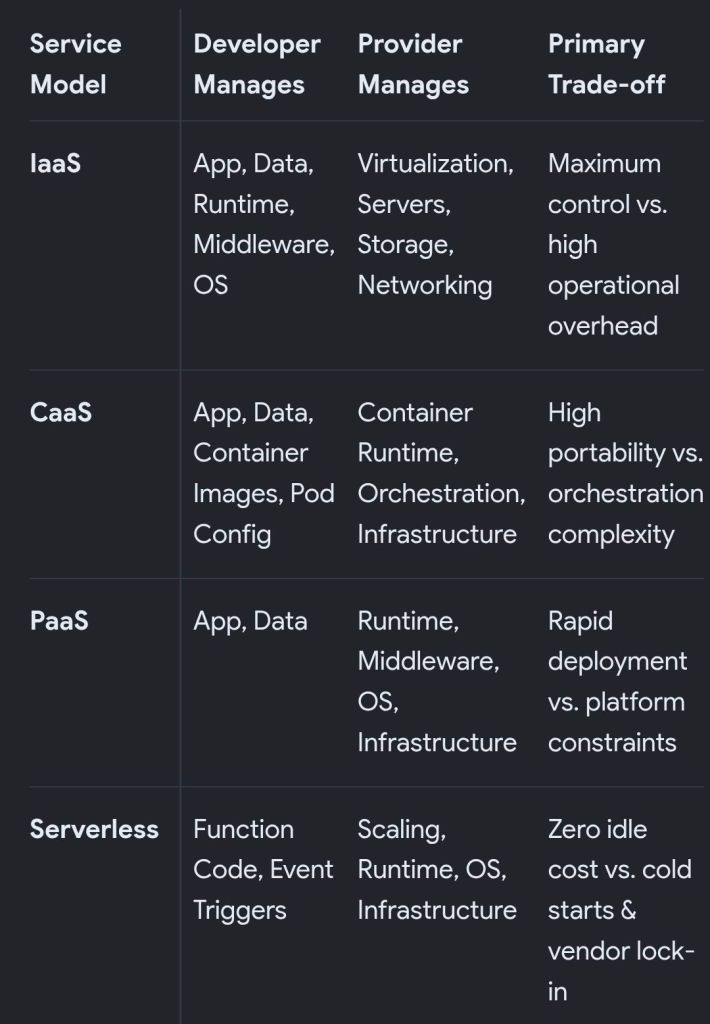
- Infrastructure as a Service (IaaS). Provides raw virtualized computing resources over the internet, including virtual machines (VMs), block storage, and virtual networks. You manage the operating system, runtime, middleware, and application code, offering maximum control.
- Containers as a Service (CaaS). Bridges the gap between IaaS and PaaS by allowing developers to package applications and their dependencies into isolated, portable containers (e.g., Docker) orchestrated at scale (e.g., Kubernetes) without managing underlying physical servers.
- Platform as a Service (PaaS). Supplies a managed environment for building, testing, and deploying applications. The provider handles OS patching, server maintenance, and scaling, allowing developers to focus strictly on code and data.
- Serverless & Function as a Service (FaaS). Abstracts server management entirely. Developers write discrete, event-driven functions that execute on demand, scale automatically to zero when idle, and bill strictly per execution millisecond rather than for provisioned capacity.
- Backend as a Service (BaaS). Provides pre-built backend components—such as authentication, real-time databases, push notifications, and cloud storage—accessible directly via SDKs and APIs for rapid web and mobile app development.
- AI & Model as a Service (MaaS). A rapidly expanding layer offering managed access to foundation models, vector databases, and inference endpoints, enabling developers to integrate generative AI and agentic workflows without training models from scratch.
2. Cloud Deployment Topologies
Where your cloud resources live dictates data residency, latency, compliance, and disaster recovery capabilities.
- Public Cloud. Infrastructure is owned and operated by a third-party provider and shared across multiple tenants over the public internet. It offers massive elasticity, global reach, and pay-as-you-go pricing.
- Private Cloud. Dedicated infrastructure operated exclusively for a single organization, hosted either on-premises or in a dedicated third-party data centre. It provides strict isolation, custom hardware configurations, and granular security controls for regulated industries.
- Hybrid Cloud. Connects private infrastructure with public cloud environments using encrypted networking and unified management planes. Organizations use this to keep sensitive data local while bursting compute-heavy workloads to the public cloud.
- Multi-Cloud. Utilizing services from two or more public cloud providers simultaneously. Teams adopt multi-cloud strategies to cherry-pick best-of-breed tools (e.g., using one provider for data analytics and another for enterprise software) and mitigate vendor lock-in.
- Distributed & Edge Cloud. Extends cloud compute and storage closer to end-users or IoT devices (such as 5G cell towers or retail branches) to achieve ultra-low latency and real-time local data processing.
- Sovereign Cloud. Specialized cloud regions designed to comply with strict national data residency, privacy, and governance laws—such as UK public sector mandates requiring data to remain within specific domestic jurisdictions.
3. Major Cloud Provider Ecosystems
The cloud market is anchored by hyperscalers offering comprehensive service catalogues alongside specialized developer-centric platforms.
- Hyperscalers.
- Amazon Web Services (AWS): The largest ecosystem by breadth of services, featuring foundational tools like EC2 (IaaS), EKS (Kubernetes), Elastic Beanstalk (PaaS), Lambda (Serverless), and Bedrock (AI).
- Microsoft Azure: Deeply integrated with enterprise Windows environments, Active Directory, and GitHub, offering Azure Virtual Machines, AKS, App Service, and Azure Functions.
- Google Cloud Platform (GCP): Renowned for data analytics, Kubernetes leadership (GKE), and AI infrastructure (Vertex AI), alongside Compute Engine, Cloud Run, and Cloud Functions.
- Enterprise & Regional Leaders: Providers like Oracle Cloud Infrastructure (OCI) (favoured for high-performance database workloads), IBM Cloud (focused on hybrid enterprise architectures), and Alibaba Cloud dominate specific enterprise or regional markets.
- Developer-First & Edge Platforms.
- Simplified Cloud Providers: Platforms like DigitalOcean, Linode (Akamai), and Vultr strip away enterprise complexity in favour of predictable pricing and straightforward VMs and managed databases.
- Frontend & Edge PaaS: Platforms such as Vercel, Netlify, and Cloudflare Workers specialize in modern web frameworks, global edge caching, and instant Git-based deployments.
4. Modern Cloud Development Paradigms & Tooling
Building effectively in the cloud relies on standardized automation and architectural practices rather than manual server configuration.
- Cloud Development Environments (CDEs). Browser-based or remote workspaces (e.g., GitHub Codespaces, Gitpod) that spin up pre-configured, containerized dev environments in seconds, eliminating local hardware bottlenecks and “works on my machine” discrepancies.
- Infrastructure as Code (IaC). Defining and provisioning cloud resources using declarative configuration files (e.g., Terraform, OpenTofu, Pulumi, AWS CloudFormation) so infrastructure is version-controlled, repeatable, and auditable.
- CI/CD & GitOps. Automated pipelines (e.g., GitHub Actions, GitLab CI, ArgoCD) that test, build, and deploy code or infrastructure changes automatically whenever a developer pushes updates to a Git repository.
- Microservices & Event-Driven Architecture. Breaking monolithic applications into loosely coupled services that communicate via REST/gRPC APIs or asynchronous message brokers (e.g., Apache Kafka, RabbitMQ, AWS EventBridge) for independent scaling and fault isolation.
- Observability & FinOps. Integrating distributed tracing, metrics, and centralized logging (e.g., OpenTelemetry, Prometheus, Datadog) alongside FinOps practices to monitor real-time cloud spend and optimize resource utilization.
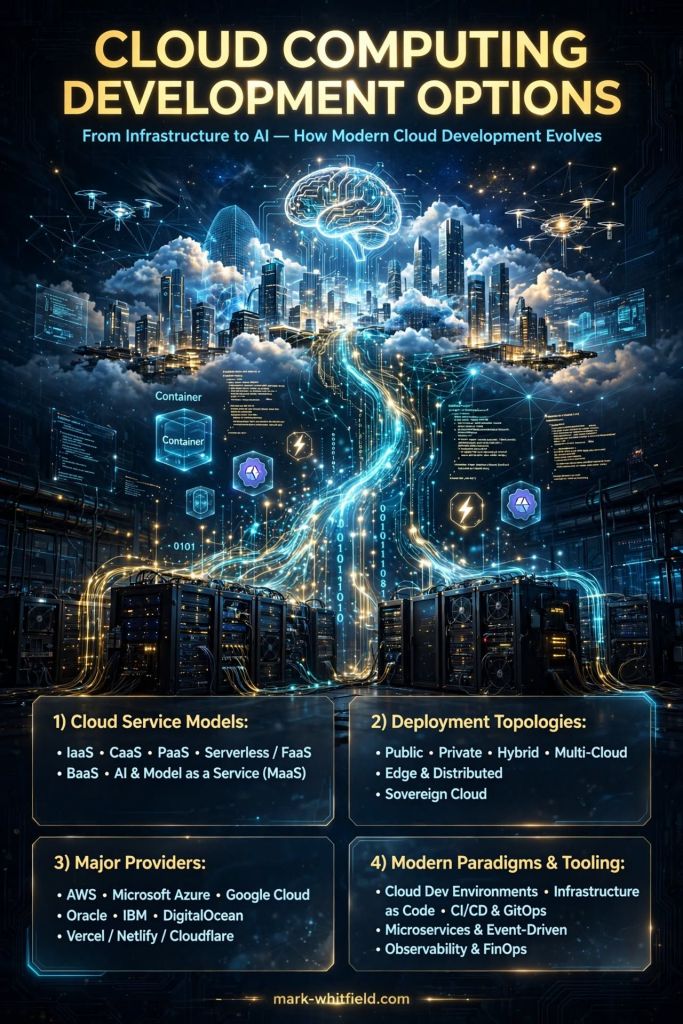
Cloud Computing Development Options above


