

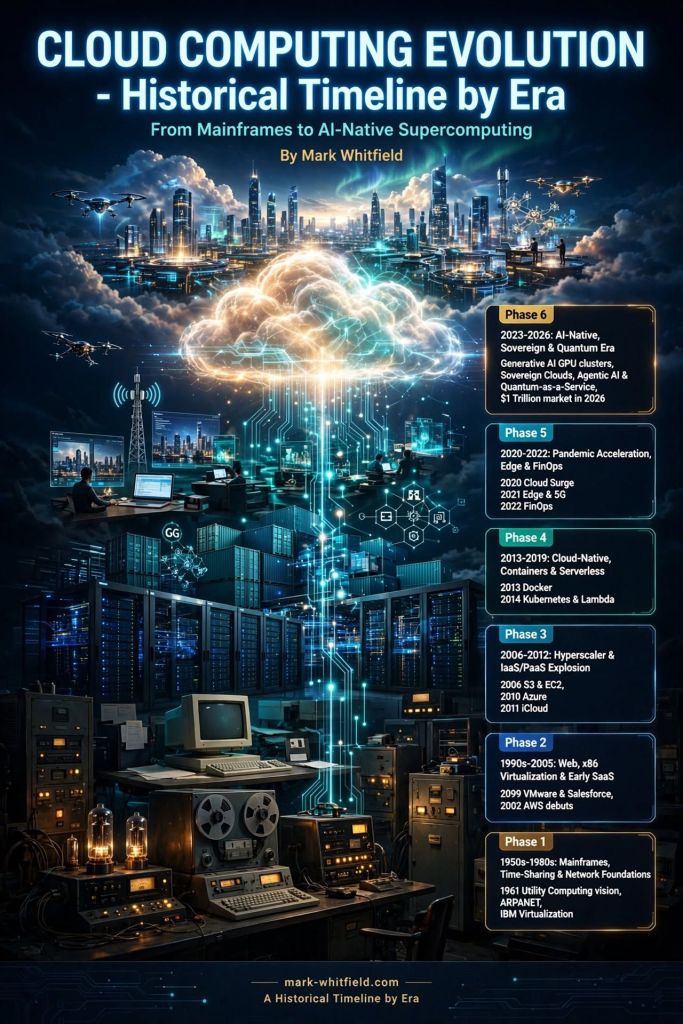
Phase 1: Mainframes, Time-Sharing & Network Foundations (1950s–1980s)
Before the internet existed, computing power was centralized in massive, prohibitively expensive mainframes. The core economic and technical concepts of the cloud were born here.
- 1950s – Mainframe Time-Sharing: Organizations used “dumb terminals” (screens and keyboards with no local processing power) to share access to a single central mainframe, maximizing expensive hardware utilization.
- 1961 – The “Utility Computing” Vision: Computer scientist John McCarthy publicly proposed at MIT’s centennial celebration that computing could one day be organized and sold as a public utility, much like electricity or water.
- 1963 – DARPA Project MAC: DARPA awarded MIT $2 million to develop Project MAC, creating one of the earliest systems allowing multiple remote users to interact with a computer simultaneously.
- 1967–1972 – Hardware Virtualization: IBM pioneered early hypervisor technology (CP-40 and CP-67) and released the IBM System/370 with VM/370 (1972), proving one physical machine could run multiple isolated virtual operating systems simultaneously.
- 1969 – ARPANET & The “Intergalactic Computer Network”: Building on J.C.R. Licklider’s vision of globally interconnected data, the US Department of Defense launched ARPANET, laying the packet-switching foundation for the modern internet.
- 1970s–1980s – Network Symbols & Protocols: Telecom engineers began drawing a cloud symbol in network diagrams to represent the unknown, complex infrastructure between endpoints. By 1983, TCP/IP became the standard internet protocol, followed by Sun Microsystems’ Network File System (NFS) in 1984.
Phase 2: The Web, x86 Virtualization & Early SaaS (1990s–2005)
The commercialization of the internet and breakthroughs in commodity server virtualization turned theoretical utility computing into a viable business model.
- 1991 – The World Wide Web: Tim Berners-Lee’s invention went public, creating a universal browser interface capable of delivering remote applications.
- 1996–1997 – Coining “Cloud Computing”: The exact phrase “cloud computing” appeared in a 1996 Compaq internal business plan. In 1997, Professor Ramnath Chellappa gave the first academic definition, describing a paradigm where computing boundaries are determined by economic rationale rather than technical limits.
- 1999 – x86 Virtualization & The SaaS Breakthrough:
- VMware released VMware Workstation (and ESX Server in 2001), bringing enterprise-grade virtualization to cheap, standard x86 servers—the foundational technology of modern cloud data centers.
- Salesforce launched as the first major enterprise Software-as-a-Service (SaaS) platform, delivering CRM software entirely through a web browser without local installation.
- 2002 – Amazon Web Services (AWS) Debuts: Amazon launched an early suite of web-accessible developer tools and APIs to monetize its massive internal e-commerce infrastructure.
Phase 3: The Hyperscaler & IaaS/PaaS Explosion (2006–2012)
In the mid-2000s, tech giants realized they could rent out elastic compute and storage on a pay-as-you-go basis, igniting the modern cloud era.
- 2006 – The Birth of Modern IaaS: AWS launched Simple Storage Service (S3) and Elastic Compute Cloud (EC2), allowing anyone with a credit card to rent virtual servers by the hour. Google also launched Google Docs the same year, mainstreaming consumer cloud productivity.
- 2007 – Cloud-Native Scale: Netflix began migrating its DVD-rental infrastructure to AWS to launch its video streaming service, proving the cloud could handle massive global consumer workloads.
- 2008 – PaaS & Open-Source Private Clouds:
- Google App Engine launched, establishing Platform-as-a-Service (PaaS) where developers deployed code without managing underlying servers.
- NASA and Rackspace began work on Nebula (later OpenStack in 2010), while OpenNebula emerged to let enterprises build private clouds.
- 2010 – Microsoft Azure & OpenStack: Microsoft officially launched Windows Azure (later Microsoft Azure), turning the cloud market into a fierce three-way hyperscaler race alongside AWS and Google.
- 2011–2012 – Enterprise & Consumer ubiquity: Apple launched iCloud (2011), IBM introduced SmartCloud (2011), and Oracle launched Oracle Cloud (2012). The US government established FedRAMP in 2011 to standardize security for public-sector cloud adoption.
Phase 4: Cloud-Native, Containers & Serverless (2013–2019)
As organizations moved past simply “lifting and shifting” virtual machines, software architecture evolved to become modular, automated, and portable.
- 2013 – The Container Revolution: Docker popularized lightweight OS-level virtualization (containers), allowing developers to package applications with all dependencies so they ran identically anywhere.
- 2014 – Kubernetes & Serverless Computing:
- Google open-sourced Kubernetes, which quickly became the industry standard for orchestrating containers at scale.
- AWS launched AWS Lambda, pioneering Function-as-a-Service (FaaS) or “serverless” computing, where code executes in response to events without provisioning servers.
- 2015–2018 – DevOps, FinOps & Global Expansion: Cloud spending surged past $180 billion (2015) as Infrastructure-as-Code (Terraform), CI/CD pipelines, and microservices became standard. Alibaba Cloud, Tencent, and Huawei drove massive hyperscale expansion across Asia.
- 2019 – Hybrid & Multi-Cloud Maturity: Facing vendor lock-in and latency needs, enterprises adopted multi-cloud strategies. Providers released hybrid hardware/software bridges like AWS Outposts, Azure Arc, and Google Anthos to extend cloud control planes into on-premises data centers.
Phase 5: Pandemic Acceleration, Edge & FinOps (2020–2022)
Global disruptions forced immediate digital transformation while exposing the true operational costs of unregulated cloud sprawl.
- 2020 – The COVID-19 Cloud Surge: Lockdowns compressed years of enterprise cloud migration into months. Collaboration platforms (Zoom, Microsoft Teams, Slack) scaled exponentially overnight.
- 2021 – Edge Computing & 5G Convergence: Driven by IoT sensors, autonomous vehicles, and real-time analytics, compute pushed outward from centralized data centers to network edges (e.g., AWS Wavelength, Cloudflare Workers).
- 2022 – Cloud Cost Optimization (FinOps): Economic headwinds prompted enterprises to audit runaway cloud bills, cementing FinOps (Cloud Financial Management) as a core discipline alongside repatriation of predictable workloads.
Phase 6: The AI-Native, Sovereign & Quantum Era (2023–2026)
Today, cloud computing has transformed from general-purpose IT hosting into specialized supercomputing factories for artificial intelligence, geopolitical compliance, and post-classical physics.
- 2023–2024 – The Generative AI Infrastructure Pivot: Following the explosion of Large Language Models (LLMs), hyperscalers pivoted capital expenditures toward massive GPU clusters (NVIDIA H100/Blackwell) and custom AI silicon (AWS Trainium, Google TPU, Microsoft Maia). Managed AI platforms like Amazon Bedrock, Google Vertex AI, and Azure OpenAI Service became the fastest-growing cloud workloads.
- 2024–2025 – Data Sovereignty & Sovereign Clouds: Strict regulations (such as the EU AI Act, GDPR enforcement, and national security mandates) led hyperscalers to launch isolated Sovereign Clouds (e.g., AWS European Sovereign Cloud, Microsoft Cloud for Sovereignty) where data, encryption keys, and operations remain strictly within national borders.
- 2025–2026 – Agentic AI Fabrics & Quantum-as-a-Service (QaaS):
- Agentic Infrastructure: Cloud platforms evolved beyond hosting single-prompt chatbots to orchestrating autonomous AI agents capable of multi-step reasoning, API execution, and cross-system memory.
- Hybrid Quantum-Classical Cloud: Marking a decade since IBM put the first quantum processor online in 2016, cloud providers (IBM Quantum, Amazon Braket, Azure Quantum) now integrate utility-scale quantum processors alongside classical HPC clusters, paired with widespread Post-Quantum Cryptography (PQC) rollouts.
- Market Scale & Sustainability: Global cloud market spending surpassed $1 trillion in 2026. Because AI data centers consume unprecedented power, hyperscalers increasingly invest in liquid-cooled racks, nuclear power agreements (including Small Modular Reactors), and carbon-aware workload scheduling.
Summary of Cloud Evolution by Era
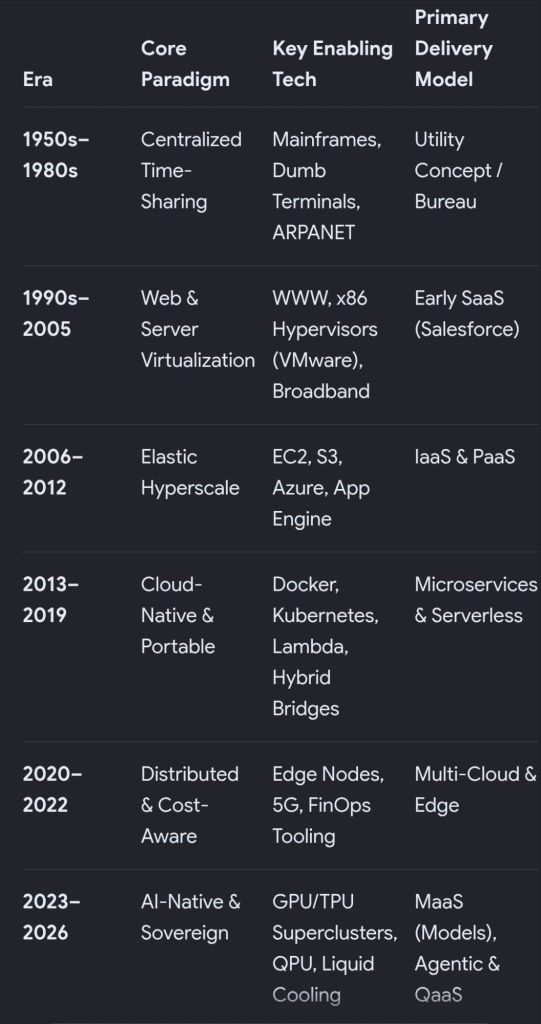
Timeline by Era
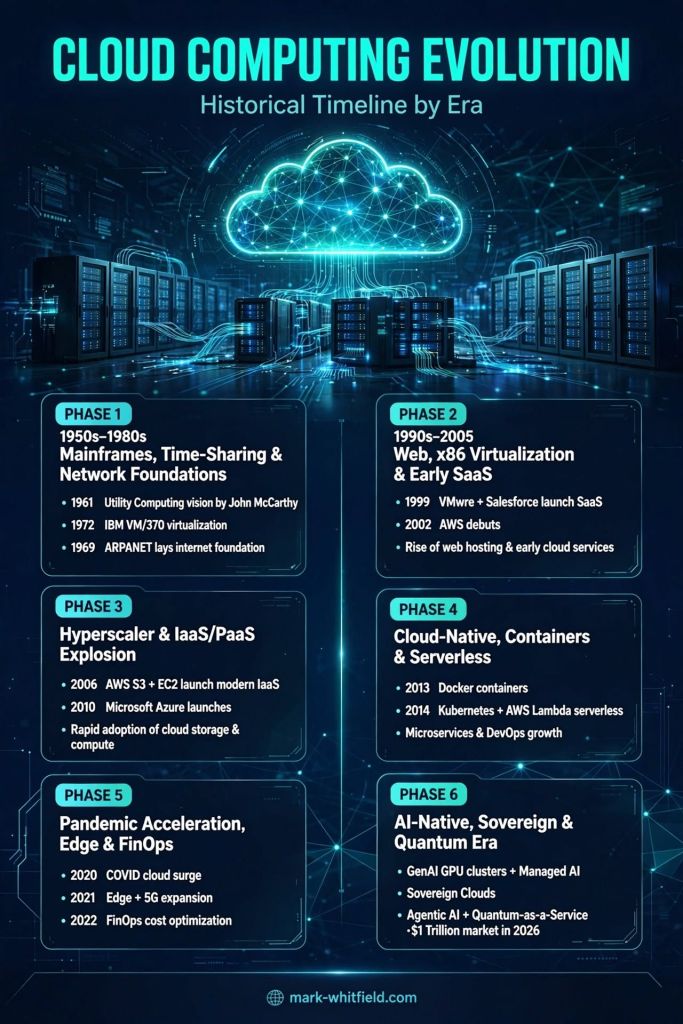
Historical Timeline by Phase
Cloud Computing Evolution Historical Timeline by Era above


