

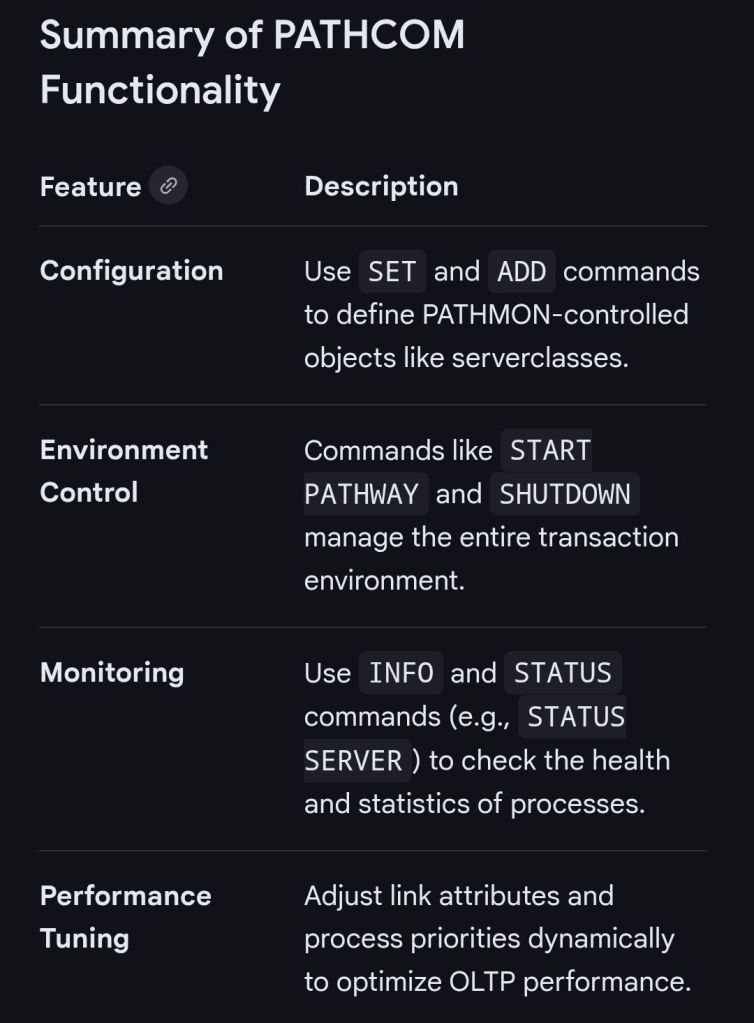
HPE NonStop PATHCOM is the interactive management interface for the Pathway transaction processing environment. It allows administrators to configure, monitor, and control PATHMON-governed objects such as serverclasses, TCPs (Terminal Control Processes), and links.
Historical Timeline: The Evolution of Pathway & PATHCOM
The history of PATHCOM is inseparable from the Tandem NonStop platform, which pioneered fault-tolerant Online Transaction Processing (OLTP).
The Tandem Era (1974 – 1997)
- 1974 – 1976: Tandem Computers is founded. The first NonStop I system ships in 1976.
- 1983: Tandem introduces Pathway software alongside the Transaction Monitoring Facility (TMF). This milestone removes the requirement for developers to manually code fault tolerance into applications, as the Pathway infrastructure (managed via PATHCOM) handles it automatically.
- Early 1990s: The platform migrates from proprietary stack machines to MIPS RISC processors (TNS/R architecture). PATHCOM evolves to manage more complex distributed environments.
- 1994: Open System Services (OSS) is introduced, allowing NonStop to support a Unix-like POSIX environment.
The Compaq & Early HP Era (1997 – 2014)
- 1997: Compaq acquires Tandem.
- 2002: HP merges with Compaq.
- 2005: Migration from MIPS to Intel Itanium (Integrity NonStop) begins.
- 2010s: Pathway evolves into HPE NonStop Pathway with TS/MP (Transaction Services/Massive Parallelism), enabling near-linear scalability for massive OLTP workloads.
The Modern HPE Era (2014 – Present)
- 2014: NonStop X is introduced, migrating the architecture to Intel x86-64 processors.
- 2015: Hewlett-Packard splits; the platform continues under Hewlett Packard Enterprise (HPE).
- 2020 – 2024: Focus shifts toward virtualisation and hybrid cloud. Modern Pathway/TS environments now support massive scaling up to 24,480 cores in a single system image.
Future of NonStop Pathway
HPE’s roadmap for NonStop focuses on integrating mission-critical reliability with modern data centre technologies:
- Modernisation: Support for Kubernetes Helm deployments and cloud-native frameworks.
- Hardware Advancements: New NS9 X5 and NS5 X5 platforms offer double the memory capacity and 2x faster system interconnects.
- Open Integration: Continued emphasis on open application development environments and open-source frameworks.
- Hybrid Cloud: Positioning NonStop as a key component of HPE GreenLake for mission-critical workloads in the cloud.
HPE NonStop PATHCOM, interactive management interface, Pathway transaction processing environment


