

During his 18-year tenure (1995–2013) at Insider Technologies Limited (ITL) in Salford Quays, UK, Mark Whitfield transitioned from a core technical engineer into strategic project management. He specialized in high-volume transaction monitoring, infrastructure optimization, and service management utilities built heavily for critical financial and corporate frameworks.
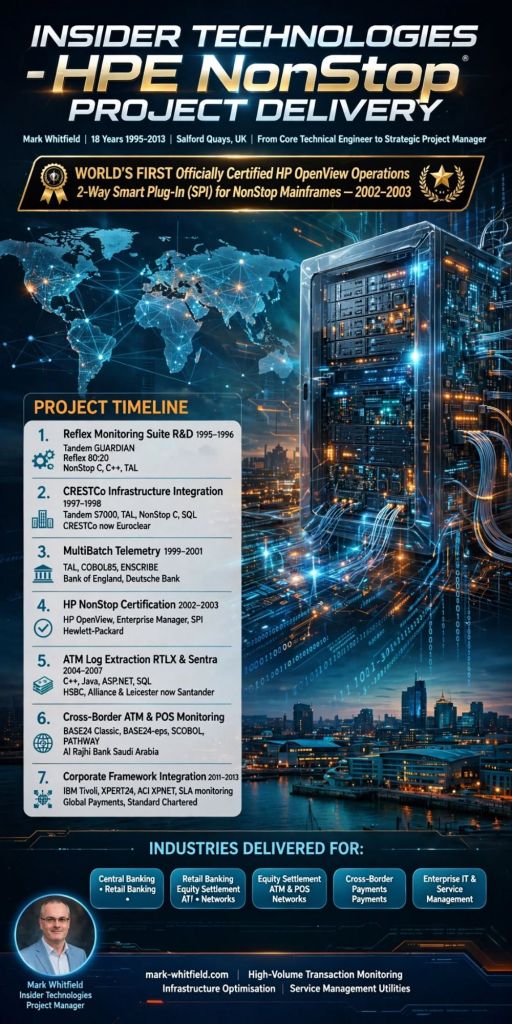
A detailed breakdown of his core IT project delivery timeline at Insider Technologies includes the following key initiatives:
1. Reflex Monitoring Suite R&D (1995–1996)
- Technology & Platform: Tandem GUARDIAN O/S, Reflex tracking console (Reflex 80:20), automated system diagnostics.
- Languages Used: NonStop C, C++, TAL (Transaction Application Language).
- Client & Budget: Internal ITL Product R&D Capital Expenditure.
- Overview: Focused on foundational software design and the development of early-stage platform health metrics, diagnostic tools, and transaction monitoring modules.
- Key Achievements: Co-developed the foundational diagnostic plug-in tracking architectures for ITL’s flagship monitoring console suite.
- Landscape: Driven by early globalization and expanding commercial banking needs, shifting code architectures from isolated local tools to client-server diagnostics.
2. CRESTCo Infrastructure Integration (1997–1998)
- Technology & Platform: Tandem S7000 processing hardware nodes, volume stress-testing utilities.
- Languages Used: TAL, NonStop C, SQL.
- Client: CRESTCo (now Euroclear).
- Overview: Acted as a technical infrastructure consultant tasked with evaluating, benchmarking, and optimizing software performance on newly deployed mainframe processing arrays.
- Key Achievements: Ran rigorous volume benchmark code and strict system stress-testing across live processing nodes to protect critical equity settlement pathways.
- Landscape: Pushed by accelerated European financial integration and the urgency to securely standardize cross-border equity settlements.
3. MultiBatch Telemetry & Tracking Protocols (1999–2001)
- Technology & Platform: MultiBatch scheduling architectures, real-time automated file monitors, transaction log extraction pipelines.
- Languages Used: TAL, COBOL85, ENSCRIBE.
- Client: Bank of England and Deutsche Bank.
- Overview: Project managed multi-organizational real-time telemetry deployments to secure critical path settlement systems.
- Key Achievements: Oversaw the technical delivery and deployment of automated job scheduling utilities and file monitoring systems across distinct cross-border central banking platforms.
- Landscape: Shaped by the launch of the Euro currency zone, which required massive scaling and tight auditing of cross-border financial transactions.
4. Hewlett-Packard (HP) NonStop Certification Initiative (2002–2003)
- Technology & Platform: HP OpenView Operations (OVO), Enterprise Manager, Smart Plug-In (SPI) framework for HPE NonStop mainframes.
- Languages Used: NonStop C, C++, Java.
- Client: Hewlett-Packard (HP).
- Overview: Managed the complex compliance, verification, and engineering lifecycle required to gain enterprise ecosystem validation for ITL software.
- Key Achievements: Secured the world’s first officially certified HP OpenView Operations 2-way Smart Plug-In (SPI) built specifically for NonStop mainframes.
- Landscape: Marked by the consolidation of corporate enterprise IT frameworks, pushing hardware vendors to offer “single-pane-of-glass” tracking tools across legacy platforms.
5. ATM Log Extraction Deployments — RTLX & Sentra (2004–2007)
- Technology & Platform: RTLX (Real-Time Log eXtraction) Reactor, Sentra, browser-enabled monitoring consoles.
- Languages Used: C++, Java, ASP.NET, SQL.
- Client: HSBC and Alliance & Leicester (now Santander).
- Overview: Implementation of automated real-time transaction log extraction and audit protocols across massive retail banking environments.
- Key Achievements: Scaled data collection pipelines into unified browser dashboards, protecting high-volume, critical consumer cash-machine networks from systemic gaps.
- Landscape: Fueled by the explosion of point-of-sale (POS) card transactions and physical cash machine usage, forcing banks to implement strict regulatory audit trails.
6. Cross-Border ATM & POS Monitoring Expansion (2008–2010)
- Technology & Platform: BASE24 Classic, BASE24-eps, high-volume transaction telemetry engines.
- Languages Used: SCOBOL, PATHWAY, C++, SQL.
- Client: Al Rajhi Bank (Saudi Arabian Retail Bank).
- Overview: Appointed as Project Manager overseeing a complex international rollout of high-volume transaction tracking software.
- Key Achievements: Successfully deployed infrastructure-wide monitoring capabilities for multi-thousand node POS and ATM environments abroad.
- Landscape: Driven by rapid technological development and economic expansion in the Gulf region, creating a demand for localized, modern financial stability tools. [1]
7. Corporate Framework Integration Projects (2011–2013)
- Technology & Platform: IBM Tivoli, XPERT24, ACI’s XPNET framework, Service Level Agreement (SLA) monitoring suites.
- Languages Used: NonStop C, C++, Java.
- Client: Global Payments and Standard Chartered.
- Overview: Managed software integration pipelines connecting native ITL payment transaction monitors with external multi-platform enterprise corporate frameworks.
- Key Achievements: Bridged historically siloed legacy monitoring environments into consolidated ITIL dashboards, ensuring complete visual oversight over critical payment pipelines.
- Landscape: Influenced by the post-2008 financial crisis, forcing financial organizations to prove absolute monitoring over failure risks and operational resilience.
Mark Whitfield, IT project work at Insider Technologies, Salford Quays above

