Salford Quays Overview and Comprehensive Timeline by Era

Salford Quays is a major waterfront destination in Greater Manchester, originally the site of the Manchester Docks. After the docks closed in 1982, the area underwent one of the UK’s most ambitious urban regeneration projects, transforming from a derelict industrial zone into a vibrant cultural, commercial, and residential hub. It is now home to landmarks such as The LowryImperial War Museum North, and the MediaCityUK media cluster. 

Comprehensive Historical Timeline

The history of Salford Quays is defined by three distinct eras: the rise of the Manchester Docks, a period of industrial decline, and its modern rebirth through regeneration. 

I. The Industrial Era (1887–1960s)

This era saw the construction and peak of the Manchester Docks, which turned Manchester into an inland port despite being 40 miles from the sea. 

  • 1887: Construction of the Manchester Ship Canal begins to bypass high charges from Liverpool’s docks.
  • 1893: The canal is flooded in November, preparing for its opening.
  • 1894: Queen Victoria officially opens the Manchester Ship Canal and Salford Docks on 21 May.
  • 1905: King Edward VII opens No. 9 Dock, the largest in Salford, on the former site of the Manchester racecourse.
  • 1920: Employment peaks with approximately 16,000 labourers working at the docks.
  • 1927: Official Dock offices open on Trafford Road.
  • 1950s: The docks reach their peak traffic, annually seeing over 16 million tons of cargo and 5,000 ships.

II. The Era of Decline (1960s–1982) 

Technological shifts in shipping and industrial unrest led to the eventual closure of the port. 

  • 1966: A 47-day strike by the National Union of Seamen leads to a significant loss of customer confidence.
  • 1969: The vessel Manchester Courage hits the Irlam lock gates, trapping ships in the docks for five weeks.
  • 1970s: The rise of containerisation makes the Ship Canal too narrow for modern, larger ships, causing a rapid decline in trade.
  • 1982: The docks officially close, resulting in the loss of 3,000 jobs and leaving the area derelict and polluted. 

III. The Regeneration Era (1983–Present) 

Salford City Council and private partners began transforming the abandoned docks into a modern “urban living” quarter. 

  • 1983: Salford City Council acquires the derelict docks from the Manchester Ship Canal Company.
  • 1984: The area is officially rebranded as Salford Quays.
  • 1985: The Salford Quays Development Plan is published, outlining a mix of housing, offices, and leisure.
  • 1986: Regeneration work officially begins; the MGM Canon Cinema (the first new building) opens in December.
  • 1987: The Copthorne Hotel opens. A compressed air mixing system is introduced to oxygenate the water, allowing 12,000 fish to be introduced.
  • 1989: Mariner’s Canal is opened by the Duke of York.
  • 1991: The Anchorage office complex is completed, becoming a major commercial landmark.
  • 1994: The Centenary Walkway is opened by Princess Anne to commemorate the canal’s 100th anniversary.
  • 1999: The Metrolink tram extension to the Quays opens.
  • 2000: The Lowry arts centre is officially opened by Queen Elizabeth II on 28 April.
  • 2001: The Lowry Outlet Mall (now Quayside) and the Salford Watersports Centre open.
  • 2002: Imperial War Museum North, designed by Daniel Libeskind, opens its doors.
  • 2007: Construction begins on MediaCityUK after the BBC proposes moving several departments from London.
  • 2011: The BBC completes its move to MediaCityUK; the University of Salford opens its satellite campus there.
  • 2013: Coronation Street moves its production and iconic cobbles to a new site at MediaCity.
  • 2021: MediaCityUK buildings become the first in the UK to achieve net zero carbon status.
  • 2023: High-rise developments continue with the completion of the 29-storey Eda (Erie Dock Apartments).

Salford Quays Overview and Comprehensive Timeline by Era

Agile Development Overview and Detailed Timeline by Era

Agile development is an iterative and incremental approach to project management and software delivery that prioritises flexible planning, frequent delivery of working software, and rapid response to change. At its core, Agile seeks to shorten work cycles to deliver value to customers quickly while using frequent feedback to improve quality. 

Core Overview

The foundation of modern Agile is defined by the Agile Manifesto (2001), which establishes four central values: 

  • Individuals and interactions over processes and tools.
  • Working software over comprehensive documentation.
  • Customer collaboration over contract negotiation.
  • Responding to change over following a plan. 

The Agile life cycle typically moves through six phases: Concept, Inception, Iteration, Release, Maintenance, and Retirement


Comprehensive Timeline of Agile Development

Agile did not emerge in a vacuum; it evolved from early 20th-century industrial concepts and decades of experimentation in software engineering. 

Era 1: The Industrial & Theoretical Roots (1910s – 1960s)

This era established the foundational concepts of efficiency, waste reduction, and iterative cycles that would later inform Agile frameworks. 

  • 1911: Frederick Taylor publishes The Principles of Scientific Management, advocating for managers to analyse and adopt worker-led process improvements.
  • 1930s: Walter Shewhart at Bell Labs develops the Plan-Do-Check-Act (PDCA) cycle, a groundbreaking iterative methodology for quality control.
  • 1948: Toyota formalises the Toyota Production System (Lean), introducing concepts like Kaizen (continuous improvement) and Just-in-Time manufacturing.
  • 1957: Gerald Weinberg and others at IBM begin using incremental development on projects.
  • 1958: NASA’s Project Mercury uses half-day iterations and test-first development, marking one of the earliest high-stakes uses of iterative cycles.

Era 2: Evolutionary Alternatives to Waterfall (1970s – 1980s) 

As the rigid Waterfall model became dominant, practitioners began developing “lightweight” alternatives to handle complex, shifting requirements. 

  • 1970s: Barry Boehm proposes Wideband Delphi, an early forerunner to Planning Poker.
  • 1976: Tom Gilb publishes the Evolutionary Delivery Model (Evo), perhaps the first explicitly named incremental alternative to Waterfall.
  • 1980: Toyota introduces Visual Control, the predecessor to Agile “information radiators” like Kanban boards.
  • 1986: Hirotaka Takeuchi and Ikujiro Nonaka publish “The New New Product Development Game” in Harvard Business Review, introducing the “rugby” approach that inspired the Scrum framework.
  • 1988: Barry Boehm formalises the Spiral Model, an iterative model focused on identifying and reducing risks. 

Era 3: The Proliferation of Frameworks (1990 – 2000) 

This decade saw a “crisis” in software development where traditional methods failed to keep up with the personal computing boom, leading to the birth of modern frameworks. 

  • 1991: James Martin publishes Rapid Application Development (RAD), formalising the use of timeboxing and iterations.
  • 1993: Jeff Sutherland and team at Easel Corporation first implement Scrum as a formal process.
  • 1994: The Dynamic Systems Development Method (DSDM) is created as a non-profit consortium to provide a framework for RAD.
  • 1995: Ken Schwaber and Jeff Sutherland co-present the Scrum methodology at the OOPSLA conference.
  • 1996: Kent Beck creates Extreme Programming (XP) while working on the Chrysler Comprehensive Compensation (C3) project.
  • 1997: Jeff De Luca introduces Feature-Driven Development (FDD).
  • 1999: Kent Beck publishes Extreme Programming Explained, popularising many engineering practices like pair programming.

Era 4: The Manifesto & Mainstream Adoption (2001 – 2010)

Agile shifted from a niche experimental approach to a global industry standard. 

  • 2001 (Feb): 17 developers meet at Snowbird, Utah, and author the Manifesto for Agile Software Development.
  • 2001 (Post): The Agile Alliance is formed to promote the manifesto’s values.
  • 2003: Mary and Tom Poppendieck publish Lean Software Development, formally linking Lean manufacturing principles to Agile.
  • 2005: Mike Cohn introduces Planning Poker in Agile Estimating and Planning.
  • 2007: The Scaled Agile Framework (SAFe) is introduced by Dean Leffingwell to apply Agile to large enterprises.
  • 2009: The concept of DevOps emerges, seeking to bridge the gap between Agile development and IT operations. 

Era 5: Scale, Transformation, and Modern Evolution (2011 – Present)

Agile has expanded beyond software into marketing, HR, and education, becoming a “culture” rather than just a tool. 

  • 2011: The Project Management Institute (PMI) introduces the Agile Certified Practitioner (PMI-ACP).
  • 2012–2015: Agile adoption surpasses 50% in the development world as success metrics become undeniably clear.
  • 2017: AXELOS updates PRINCE2 to make agility a core focus of the project management standard.
  • 2020s: Continued evolution toward “Business Agility,” where entire organisations adopt Agile mindsets to survive rapidly changing market conditions. 

Agile Development Overview and Detailed Timeline by Era

AI history of artificial intelligence by era

The history of artificial intelligence is defined by cycles of extreme optimism followed by “winters” of reduced funding and interest. It has evolved from a theoretical branch of mathematics into a pervasive modern technology. 

The Foundations (Pre-1950)

Before AI was a formal field, it existed in science fiction and early mechanical concepts. 

  • 1921: The term “robot” is coined by Karel Čapek in the play Rossum’s Universal Robots.
  • 1943: Warren McCulloch and Walter Pitts publish the first mathematical model of a neural network.
  • 1949: Edmund Berkeley’s book Giant Brains proposes that machines can think. 

The Birth of AI (1950–1956)

This era shifted AI from mythology to a serious academic discipline. 

  • 1950Alan Turing publishes “Computing Machinery and Intelligence,” introducing the Turing Test to measure machine intelligence.
  • 1952Arthur Samuel creates the first self-learning checkers program.
  • 1955-1956John McCarthy coins the term “Artificial Intelligence” during the proposal for the Dartmouth Workshop, which officially launched the field. 

The Golden Years & First AI Winter (1957–1979) 

Initial successes led to over-promising and a subsequent crash. 

  • 1958Frank Rosenblatt develops the Perceptron, the foundation for modern neural networks.
  • 1966Joseph Weizenbaum creates ELIZA, the first “chatterbot”.
  • 1973-1974: The Lighthill Report in the UK and subsequent funding cuts by DARPA lead to the First AI Winter due to limited computing power and unmet expectations.

The Expert Systems Boom & Second Winter (1980–1993)

AI found commercial success through specialized knowledge bases before another decline. 

  • 1980XCON (expert configurer) becomes the first commercially successful expert system, saving Digital Equipment Corporation millions.
  • 1981: Japan launches the Fifth Generation Computer project with $850 million to create human-level reasoning.
  • 1987-1993: The Second AI Winter occurs as specialized AI hardware (Lisp machines) becomes obsolete compared to cheaper personal computers from Apple and IBM. 

The Age of Agents & Narrow AI (1993–2011) 

AI began achieving superhuman performance in specific, “narrow” tasks. 

  • 1997: IBM’s Deep Blue defeats world chess champion Garry Kasparov.
  • 2002: iRobot releases the Roomba, bringing autonomous AI into the home.
  • 2011: IBM’s Watson wins Jeopardy! against human champions, and Apple releases Siri

The Deep Learning Revolution (2012–2021)

A massive surge in data and GPU power transformed the field. 

  • 2012AlexNet wins the ImageNet competition, proving the power of deep convolutional neural networks.
  • 2016: Google DeepMind’s AlphaGo defeats world Go champion Lee Sedol.
  • 2017: Researchers at Google propose the Transformer architecture, which becomes the backbone of modern large language models. 

The Generative AI Boom (2022–Present)

AI has entered the mainstream, moving toward Agentic AI that can plan and act autonomously. 

  • 2022: OpenAI releases ChatGPT, sparking global interest in generative AI.
  • 2023-2024: Focus shifts toward Multimodal AI (images, video, and text) and Agentic AI capable of completing complex workflows across multiple tools. 

AI history of artificial intelligence by era

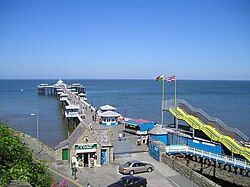
Llandudno Pier Overview and Historical Timeline by Era

Llandudno Pier, often called the “Queen of Welsh Piers”, is the longest pier in Wales at 2,295 feet (700 metres). It is a Grade II* listed structure renowned for its Victorian and Edwardian elegance, featuring ornate ironwork and classic kiosks. 

Llandudno Pier, often called the “Queen of Welsh Piers”, is the longest pier in Wales

Historical Timeline by Era

Early Origins (The Pre-Pier Era)

  • 1858: A short wooden pier (242 ft) was built by the St George’s Harbour and Railway Company to export limestone.
  • 1859: This original structure was severely damaged by the “Royal Charter Storm”.
  • 1860–1875: Though repaired, the wooden pier was too short for steamships except at high tide. 

Victorian Era: Construction and Growth

  • 1875: The Llandudno Pier Company was formed to build a new, modern structure.
  • 1876: Construction began in June/July. The first pile was driven on 16 September 1876.
  • 1877: The pier officially opened on 1 August, initially measuring 1,234 feet.
  • 1878: Construction was fully completed; the first steamboat (Prince Arthur) landed in May.
  • 1884: A landward extension was added, bringing the pier to its current length of 2,295 feet.
  • 1886: The Pier Pavilion opened on 16 September as a 2,000-seat theatre and concert hall.
  • 1887: Renowned conductor Jules Rivière took charge of the pier’s orchestra, which eventually grew to symphony proportions.
  • 1891: A new landing stage was added to accommodate increased steamship traffic. 

Edwardian and Mid-20th Century

  • 1905: A pier-head pavilion was constructed.
  • 1910: Extensive improvements were made, including widening most of the pier.
  • 1938: Major alterations were carried out on the landing stage.
  • 1968: The pier was purchased by the Trust House Forte Group.
  • 1969: The landing stage was totally rebuilt in concrete and steel to handle large Isle of Man steamers. 

Modern Era: Challenges and Restoration

  • 1983: The pier became part of the First Leisure Corporation.
  • 1984: The Pier Pavilion theatre closed.
  • 1994: A major fire destroyed the Pier Pavilion on 13 February, leaving only the iron supports.
  • 1998: Purchased by Leisure Parks Ltd (Trevor Hemmings) along with several other UK piers.
  • 2005: Voted “Pier of the Year” by the National Piers Society.
  • 2015: Purchased by local entrepreneur Adam Williams (Tir Prince Leisure Group) for £4.5 million.
  • 2021: Adam Williams purchased the derelict Pavilion site to protect the pier’s future.
  • 2025: Voted “Pier of the Year” for the second time following major restoration efforts. 

Llandudno Pier Overview and Historical Timeline by Era