

HPE NonStop (originally Tandem NonStop) is a fault-tolerant, shared-nothing distributed computing architecture engineered to eliminate single points of failure and deliver continuous availability (99.999% to 99.9999% uptime). Across five decades and four processor generations—proprietary CISC, MIPS RISC, Intel Itanium, and Intel x86-64—the platform has preserved binary and source-level application compatibility while powering global financial networks, stock exchanges, payment switches, and telecom infrastructure.
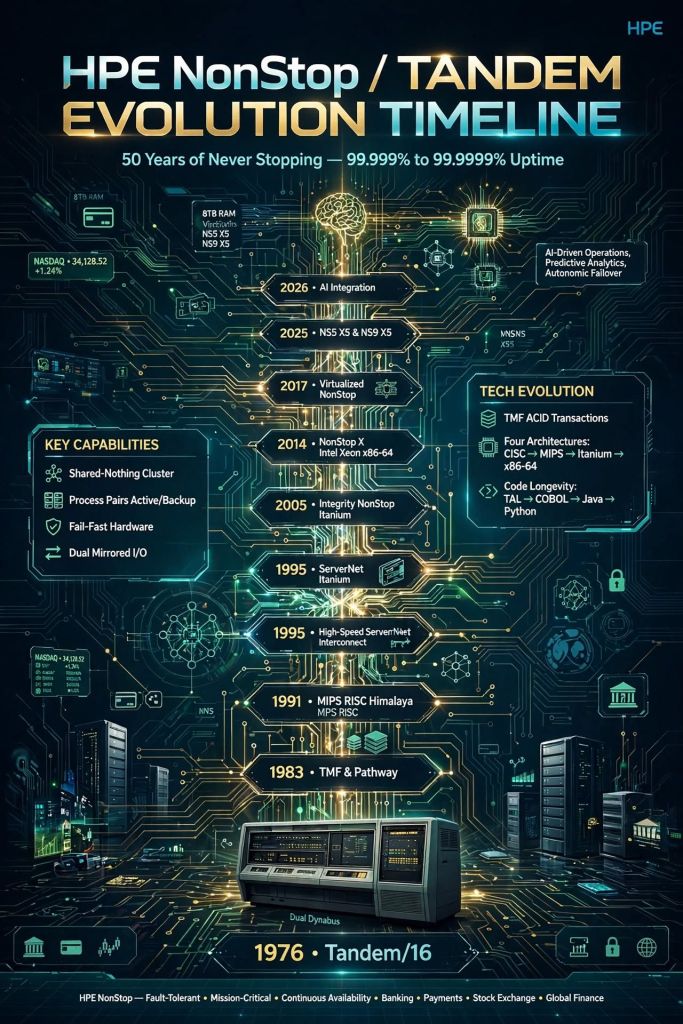
1. Core Architectural Pillars
Unlike conventional symmetric multiprocessing (SMP) servers that share memory and an operating system kernel across CPUs, HPE NonStop operates as a loosely coupled, shared-nothing cluster inside a single system image.
Hardware & Interconnect Topology
- Shared-Nothing Compute Nodes. Each CPU module contains its own dedicated processor, private RAM, independent operating system instance, and dedicated I/O channels. A memory corruption or kernel panic in one CPU is strictly isolated and cannot propagate to adjacent processors.
- Dual High-Speed Inter-Processor Fabrics. Processors communicate exclusively via message passing over redundant, active-active interconnects. Historically implemented as the dual Dynabus (1976), evolved into ServerNet (1995)—which pioneered switched-fabric I/O and inspired InfiniBand—and today utilizes InfiniBand and RDMA over Converged Ethernet (RoCE) on NonStop X systems.
- Fail-Fast Hardware Verification. Hardware subsystems employ lockstep execution or parity/ECC checking at every bus boundary. If a component detects an internal inconsistency, it immediately halts (“fails fast”) rather than propagating corrupted state to disk or network buffers.
- Dual-Ported I/O & Mirrored Storage. Every disk drive, storage controller, network adapter, and power supply is duplicated and cross-wired to separate CPUs and independent power rails. Storage volumes operate as hardware/software mirrored pairs across distinct controllers.
Software & Operating System Stack
- NonStop OS (Guardian & OSS). Originally named the Guardian operating system, the kernel was refactored in the 1990s into the NonStop Kernel (NSK) supporting two concurrent personalities:
- Guardian: The native, message-based, real-time OS environment optimized for deterministic Online Transaction Processing (OLTP).
- Open System Services (OSS): A full POSIX/UNIX-compliant personality providing standard file hierarchies, shells, and APIs for C/C++, Java, Python, and open-source middleware.
- Process Pairs (Active/Backup Checkpointing). Every critical OS service and application process runs as a Process Pair—a Primary process on CPU A and a Backup process on CPU B. The Primary periodically sends state checkpoints (or executes in lockstep via NonStop Advanced Architecture) to the Backup. If CPU A fails, the Backup seamlessly assumes the process identity and open file/socket handles within milliseconds without dropping active transactions.
- Transaction Management Facility (TMF). Introduced in 1983, TMF provides distributed ACID transaction semantics across heterogeneous databases and network nodes using two-phase commit (2PC) and Write-Ahead Logging (WAL) audit trails, removing the need for developers to write manual checkpointing code.
- Pathway (TS/MP). NonStop’s native transaction monitor and middleware layer separates terminal/network presentation (traditionally SCOBOL, now REST/JSON, Kafka, and ISO 8583 gateways) from stateless, dynamically scaled server pools (serverclasses) that automatically load-balance and restart upon failure.
- Enscribe & NonStop SQL. Data persistence relies on Enscribe (a high-speed, record-oriented hierarchical/key-sequenced file system) and NonStop SQL—available as SQL/MP (tightly integrated with Guardian) and SQL/MX (an ANSI-compliant, massively parallel relational engine supporting JDBC/ODBC and linear scale-out across nodes).
2. Comprehensive Chronological Timeline (1973–2026)
Phase I: Founding & The Proprietary CISC Era (1973–1990)
- 1973–1974 — Inception: Former HP marketing manager Jimmy Treybig, backed by venture capitalist Tom Perkins (Kleiner Perkins), founds Tandem Computers in Cupertino, California. Drawing engineers from Hewlett-Packard’s HP 3000 division, Tandem sets out to build a fault-tolerant computer priced comparably to standard mainframes/minicomputers.
- 1975–1976 — Tandem/16 (NonStop I): Tandem announces the T/16 in December 1975 and ships the first commercial system to Citibank in May 1976. Featuring 2 to 16 independent CPUs connected via dual Dynabuses, programmed in TAL (Transaction Application Language, derived from HP SPL), it introduces hardware-level single-fault tolerance.
- 1981 — NonStop II: Expands logical addressing from 16-bit to 32-bit virtual memory and replaces magnetic core memory with battery-backed DRAM to support rapidly growing banking and ATM networks.
- 1983 — TXP, TMF & Pathway: Tandem launches the NonStop TXP (introducing hardware cache memory and multi-board TTL/PAL logic) alongside two landmark software releases: Pathway (client/server transaction middleware) and the Transaction Monitoring Facility (TMF), eliminating the requirement for application developers to code manual process-pair checkpoints.
- 1986–1987 — NonStop VLX & NonStop SQL: Tandem introduces the ECL-based NonStop VLX and releases NonStop SQL—the industry’s first distributed, fault-tolerant relational database capable of linear transaction scaling across clustered nodes and online table partitioning without downtime.
- 1989 — NonStop Cyclone: Tandem’s flagship high-end CISC mainframe rival, introducing superscalar pipelining and fiber-optic inter-processor links capable of scaling to hundreds of processors.
Phase II: RISC Transition, ServerNet & Compaq Acquisition (1991–2001)
- 1991 — Cyclone/R & TNS/R Migration: Recognizing the limits of proprietary CISC silicon, Tandem begins migrating to MIPS RISC processors (R3000/R4400). To protect customer investments without requiring immediate source code rewrites, Tandem engineers an object-code translator (Accelerator) alongside pTAL (Portable TAL).
- 1993 — Himalaya K-Series & NonStop Kernel (NSK): Tandem launches the Himalaya K-Series (using MIPS R4400 chips) and splits Guardian into the NonStop Kernel (NSK), adding Open System Services (OSS) to provide a native POSIX/UNIX environment alongside Guardian.
- 1995–1997 — ServerNet & Himalaya S-Series: Tandem debuts ServerNet, a revolutionary low-latency, wormhole-routed switched fabric that replaces legacy buses and allows processors, storage, and I/O devices to communicate directly with hardware-enforced isolation. In June 1997, Compaq Computer Corporation acquires Tandem Computers for $3 billion in stock.
Phase III: HP Merger & The Itanium Era (2002–2014)
- 2002 — HP-Compaq Merger: Hewlett-Packard merges with Compaq, bringing the NonStop division into HP’s Enterprise Systems Group.
- 2005 — Integrity NonStop (TNS/E) on Intel Itanium: HP transitions NonStop from MIPS to Intel Itanium 2 processors with the Integrity NonStop NS-Series (NS1000 through NS16000). Because Itanium lacked hardware lockstep execution, HP introduces NonStop Advanced Architecture (NSAA)—a software/firmware innovation that runs multiple processor cores in logical lockstep via voting and state synchronization at the ServerNet boundary.
- 2008–2012 — BladeSystem NonStop (NB-Series): HP adapts NonStop to standard HP BladeSystem c-Class enclosures (NB50000c, NB54000c), reducing data center footprint and power draw while rolling out NonStop SQL/MX 3.x and modern Java/Python runtimes.
Phase IV: x86-64 Transformation, Virtualization & HPE (2014–2026)
- 2014–2015 — NonStop X (TNS/X) & HPE Corporate Split: HP announces NonStop X, migrating the architecture onto standard Intel Xeon x86-64 processors and replacing proprietary ServerNet hardware with high-speed InfiniBand interconnects. Following HP’s split in November 2015, the platform becomes part of Hewlett Packard Enterprise (HPE).
- 2017 — Virtualized NonStop (vNS): HPE decouples the NonStop software stack from dedicated bare-metal appliances, launching Virtualized NonStop to run on standard x86 servers under VMware ESXi and KVM hypervisors with InfiniBand or RoCE interconnects.
- 2020 — End of Itanium Sales: In July 2020, HPE officially ends sales of Itanium-based Integrity NonStop systems, completing the platform’s full consolidation onto x86-64.
- 2021–2024 — NS4/NS8 X4 & HPE GreenLake: HPE releases the fourth-generation x86 platforms (NS4 X4 and NS8 X4), integrates consumption-based cloud economics via HPE GreenLake Flex for NonStop, and celebrates the 50th anniversary of Tandem’s founding in 2024.
- June 2025 — HPE NonStop Compute NS5 X5 & NS9 X5: HPE launches its fifth-generation bare-metal x86 platforms—the entry-level NS5 X5 (powered by Intel Xeon Bronze 3400 series) and flagship NS9 X5 (powered by Intel Xeon Gold 6400 series). The NS9 X5 doubles maximum system memory capacity to 8 TB of RAM, more than doubles networking bandwidth, delivers up to 15% higher transactional throughput over the NS8 X4, and introduces native OS-level Multifactor Authentication (MFA) for PCI-DSS and GDPR compliance.
- 2026 — AI Integration & Modern DevOps: At the 2026 NonStop Technology & Business Conference (TBC), HPE formalizes its enterprise AI strategy around three pillars—AI for NonStop (GenAI tooling for TAL/COBOL code comprehension and operations), AI with NonStop (real-time streaming of NonStop transactional data to external AI/fraud models), and AI on NonStop (running deterministic inference workloads directly alongside core OLTP)—alongside native GitOps release pipelines (NSGit) and post-quantum crypto-agility updates.
3. Application Portability & Code Longevity
A defining engineering feat of HPE NonStop is source and execution continuity across four distinct CPU architectures (CISC → MIPS → Itanium → x86-64):
- TNS Code Migration: Legacy 1980s TAL, COBOL85, and SCOBOL binaries compiled for the original TNS stack can still execute on modern x86-64 NS9 X5 systems via dynamic/static object-code translation (OCA), or be recompiled natively using modern LLVM/GCC-backed compilers (xTAL, xCOBOL, C/C++).
- Polyglot Interoperability: A single modern NonStop transaction frequently traverses a Java, Python, or Node.js REST/Kafka microservice running in the OSS personality, invokes a legacy pTAL/C++ Pathway serverclass, and commits atomically across both Enscribe files and NonStop SQL/MX tables under a single TMF transaction ID.
HPE NonStop Tandem Evolution Timeline above


