

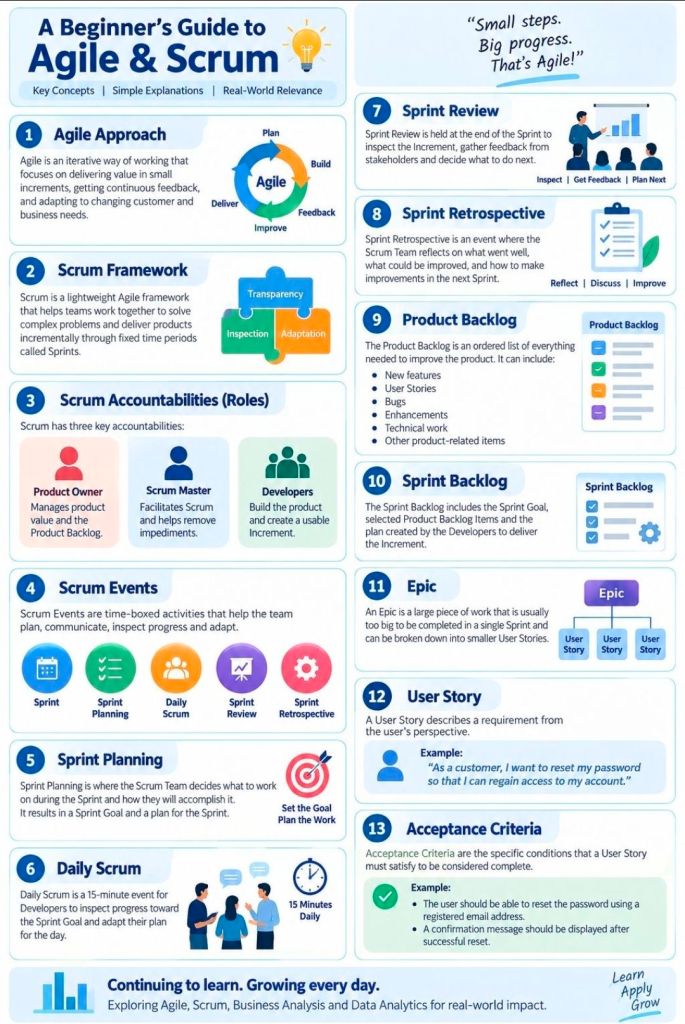
💡 Understanding the Core: Agile vs. Scrum
It is common to hear people use “Agile” and “Scrum” interchangeably, but they refer to two distinct concepts:
- Agile is a guiding philosophy and mindset. It values flexibility, collaboration, and delivering value to users incrementally rather than all at once.
- Scrum is a specific framework used to put Agile principles into practice. It provides a structured set of roles, meetings, and deliverables to get the work done.
Think of Agile as a healthy lifestyle, while Scrum is the specific workout routine you follow to stay in shape.
🔎 The Agile Philosophy
Traditional project management (often called the Waterfall model) relies on fixed, sequential phases: you plan everything upfront, build it, and test it at the very end. If customer needs change halfway through, pivoting is incredibly difficult.
Agile flips this by breaking a large project into smaller, manageable chunks. The core benefits include:
- Adaptability: Teams can easily pivot based on new feedback.
- Faster Delivery: Instead of waiting months or years for a final release, usable increments are delivered continuously.
- Continuous Feedback: Stakeholders review the progress regularly to ensure the project stays on track.
📋 The Scrum Framework Breakdown
Scrum provides structure to the Agile philosophy by dividing work into short, time-boxed blocks called Sprints (typically lasting 1 to 4 weeks). To run Scrum, a team relies on three pillars: Roles, Artifacts, and Events.
1. Scrum Roles 👥
A typical Scrum team is cross-functional, self-organising, and consists of three specific roles:
- Product Owner: Represents the customer or business. They are responsible for defining what needs to be built and prioritizing the work.
- Scrum Master: Acts as a coach and facilitator. They ensure the team understands Scrum principles and clear away any obstacles or blockers preventing the team from working.
- Developers/Team Members: The professionals who actually build the product (e.g., engineers, designers, writers). They decide how to execute the work.
2. Scrum Artifacts 🗒
Artifacts are the core deliverables or tracking tools used during a project:
- Product Backlog: A master, living list of all features, requirements, and tasks needed for the project, ordered by priority.
- Sprint Backlog: The subset of tasks chosen from the Product Backlog that the team commits to finishing during the current Sprint.
- Increment: The actual usable, working portion of the product completed by the end of a Sprint.
3. Scrum Events (The Workflow) 🔄
- Sprint Planning: At the start of a Sprint, the team meets to determine what items from the Product Backlog they can realistically complete.
- Daily Scrum (Standup): A quick, 15-minute daily meeting where the team syncs on what they did yesterday, what they will do today, and any roadblocks they face.
- Sprint Review: Held at the end of the Sprint. The team demonstrates the finished working increment to stakeholders to gather feedback.
- Sprint Retrospective: The final meeting of the cycle. The team looks inward to evaluate their workflow and identify ways to improve the process for the next Sprint.
📖 Highly Rated Reading Material for Beginners
If you want to dive deeper into implementing these frameworks, here are highly regarded introductory books on Agile and Scrum:
- Agile Scrum: Your Quick Start Guide with Step-by-Step Instructions by Scott M. Graffius: An award-winning, user-friendly paperback that guides beginners through the exact steps needed to implement Scrum from scratch.
- Learn Agile and Scrum in 2 Hours by Kieran Morgan and Luke Pivac: An ultra-concise audiobook version that cuts through technical jargon to deliver an immediate “Agile 101” overview.
- Agile Essentials You Always Wanted To Know by Vibrant Publishers: A comprehensive self-learning guide focused heavily on Agile planning, execution, and foundational methodologies.


