

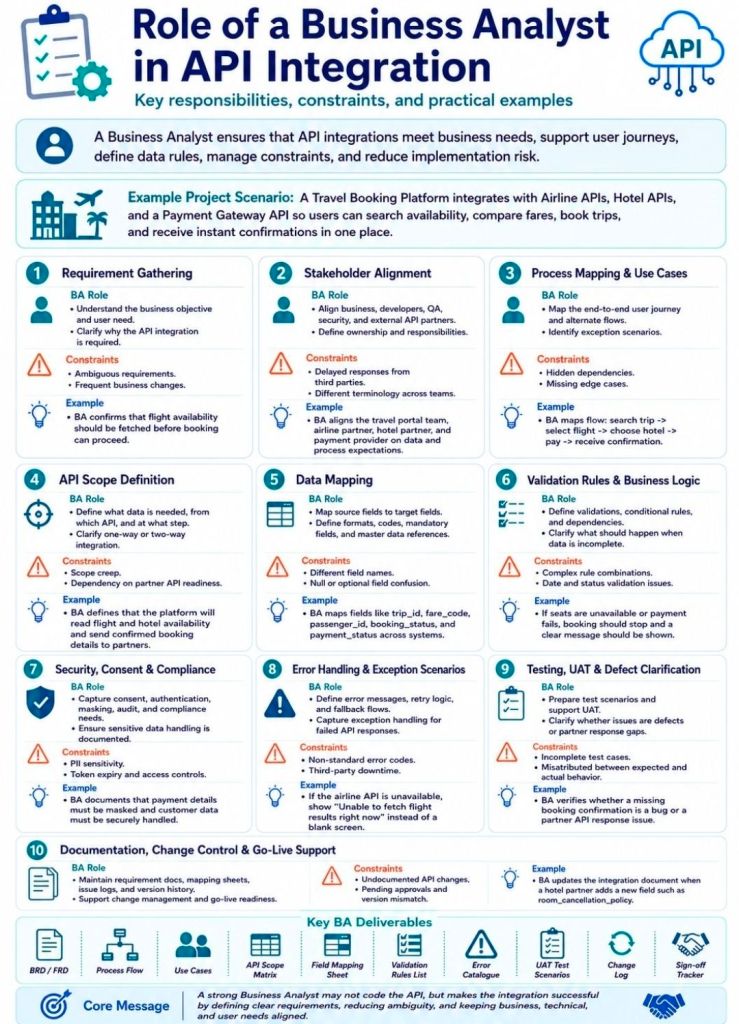
in API Integration
A Business Analyst (BA) acts as the critical bridge between business stakeholders and technical teams. In API integration, the BA translates strategic business goals into clear technical requirements. They ensure systems communicate seamlessly, align with business rules, and support the overall customer journey.
Core responsibilities for a BA in API integration include:
- Requirement Gathering: Translating business needs into precise functional and non-functional requirements, such as payload data requirements, expected response times, and security protocols.
- Data Mapping: Defining exactly how data fields correspond across different systems (e.g., matching a CRM’s “Client Name” to a billing system’s “Customer”) and determining data transformation rules.
- Defining Scenarios: Detailing the API’s behavior for both standard workflows and edge cases, such as handling invalid login attempts, rate limiting, and system timeouts.
- Documentation & Modeling: Using sequence diagrams and flowcharts to visually map out how systems interact, and producing clear Interface Control Documents (ICD).
- User Stories & Acceptance Criteria: Writing integration-focused user stories for Agile backlogs, including specific HTTP methods, request/response formats, and error codes.
- Facilitating Collaboration: Bridging the communication gap by translating technical constraints to non-technical stakeholders and business objectives to developers.
- Testing & UAT Support: Assisting the QA team in validating API endpoints using tools like Postman, and ensuring requirements are met during User Acceptance Testing (UAT).
To deepen your understanding of this role, comprehensive guidelines and methodologies can be explored via LinkedIn’s API for Analysts or Business Analyst Community Integration Guides.
Role of a Business Analyst BA in API Integration


