

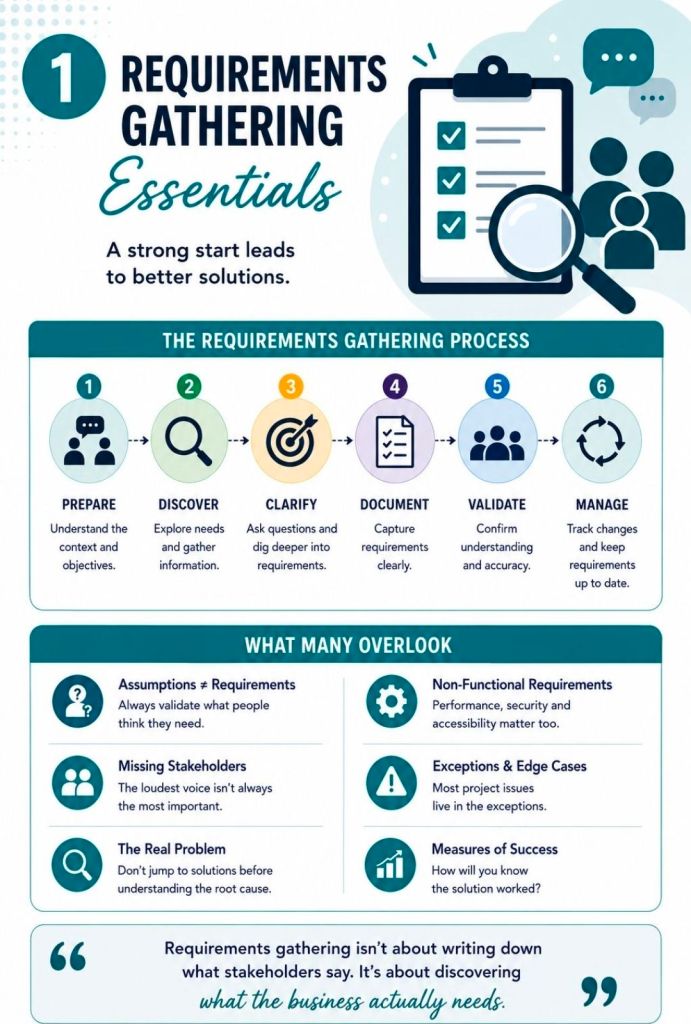
Gathering Essentials
Requirements gathering is the foundational process of identifying, documenting, and managing what a project must achieve to deliver maximum business value. According to the Project Management Institute (PMI), nearly 70% of project failures are directly attributed to poor requirements collection, highlighting its role as the ultimate “scope anchor” for project managers.
Below is an overview of the core steps, techniques, classification categories, and tracking methods needed to establish an airtight requirement framework.
The 6-Step Requirements Gathering Process
Executing a structured lifecycle ensures that raw client requests are transformed into precise, measurable technical blueprints.
- Identify and Analyze Stakeholders
- Map out every individual invested in the project baseline.
- Separate them into internal (executives, developers) and external entities (vendors, customers).
- Utilize a stakeholder register to analyze their influence and prioritize conflicting needs early.
- Establish Goals and Alignment
- Define overarching high-level business milestones before hunting for product features.
- Separate broad targets (goals) from specific deliverables or tasks (objectives).
- Filter out scope proposals that fail to directly support these core goals.
- Elicit Stakeholder Requirements
- Conduct interactive discovery sessions tailored to user availability and project context.
- Use direct one-on-one sessions for specific detail validation.
- Use data gathering structures for broader user bases.
- Document and Categorize
- Translate conversational feedback into clear, unambiguous definitions.
- Store information inside a centralized, accessible collaborative hub.
- Record relevant project assumptions and hard technical boundaries.
- Prioritize and Validate
- Organize requests into strict low, mid, or high urgency classifications.
- Apply prioritization frameworks like MoSCoW (Must-have, Should-have, Could-have, Won’t-have).
- Conduct structured internal reviews to confirm value connection back to the business.
- Baseline Sign-off and Change Control
- Request formal verification from the main project sponsors.
- Set a fixed baseline to prevent unauthorized project feature updates.
- funnels all future adaptations through a strict change control system.
Core Categories of Requirements
To prevent scope gaps, information must be analyzed from a 360-degree technical and strategic perspective.
- Business Requirements: Define the ultimate overarching problem or strategic objective the business needs to resolve.
- Stakeholder Requirements: Capture the specific desires, expectations, and operational pain points of the end users.
- Functional Requirements: Spell out exactly what the target solution must execute or how a user interacts with it.
- Non-Functional Requirements: Specify system traits such as performance, data security parameters, and growth scalability.
- Technical Requirements: Detail the internal IT setups, environments, and languages the project must operate inside.
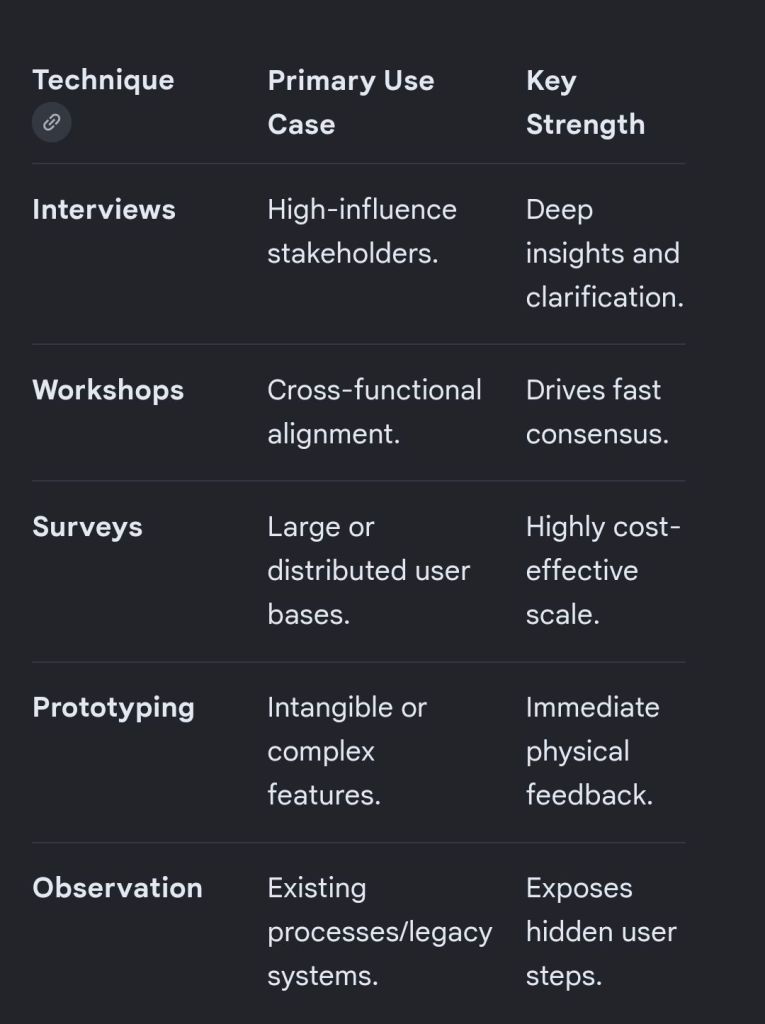
Essential Gathering Techniques
Choosing the right collection methodology depends on the size of your audience and the technical complexity of the work.
Scope Governance: The Traceability Matrix
Once requirements are baselined, they are tracked using a Requirements Traceability Matrix (RTM). This tool links every approved feature back to its source stakeholder and forward into production and testing.
- Bi-Directional Tracking: Traces forward from need to test case, and backward from code to initial business authorization.
- Eliminates Scope Creep: Ensures that development engineering teams only spend resources on validated features.
- Prevents Orphaned Elements: Flags code built without initial business justification, or targets missing a test plan.


