

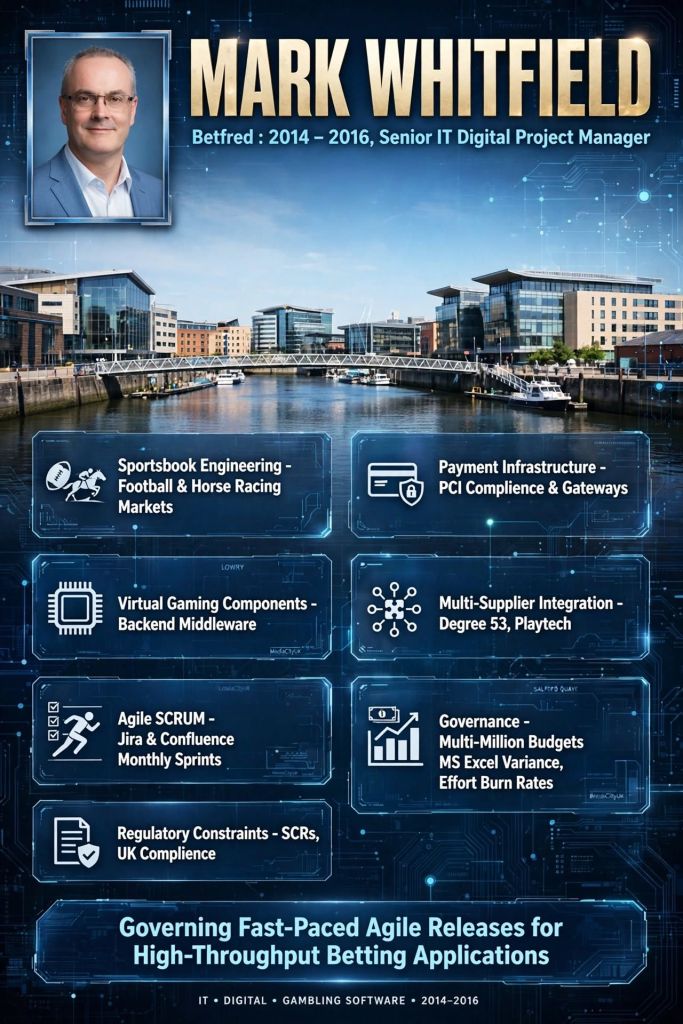
From December 2014 to January 2016, Mark Whitfield served as a Senior IT Digital Project Manager within the Online and Mobile Division at Betfred’s UK Head Office in Wigan, Lancashire. Operating in the highly competitive Gambling and Casinos industry, his role centered on governing fast-paced, end-to-end agile software releases for core, high-throughput web and mobile betting applications.
An in-depth breakdown of his technical scope, supplier ecosystem, regulatory landscape, and performance feedback illustrates his delivery footprint at Betfred.
Core Project Portfolios & Engineering Scope
Whitfield deployed the Agile SCRUM framework with rolling monthly sprint cycles to lead development across three foundational gaming pillars:
- Sportsbook Engineering: Orchestrated core feature rollouts and update loops for high-volume football and horse racing markets.
- Payment Infrastructure: Supervised the integration, expansion, and security of frontend payment methods and high-velocity transactional payment gateways.
- Virtual Gaming Components: Managed the complex backend integration and middleware required to power online, computer-generated virtual casino products.
The technical environment demanded managing native software application stacks concurrently across three main consumer ecosystems: iOS, Android, and Windows Mobile.
Multi-Supplier Integration Ecosystem
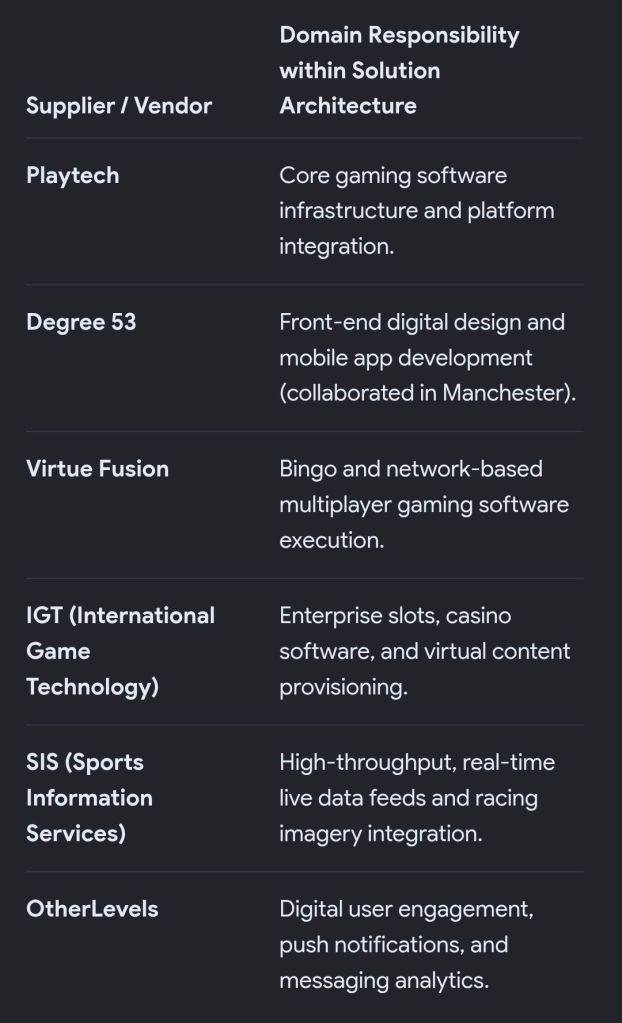
A massive portion of Whitfield’s role involved cross-functional supplier management. Because individual platform layers were built by separate third-party providers, he served as the central point of integration, managing UK- and EU-based delivery teams across several major industry suppliers:
Project Governance & Financial Control
Whitfield handled multi-million rolling digital operational and R&D budgets. Rather than relying on automated corporate budgeting suites, his methodology focused heavily on granular variance tracking:
- Effort Burn Rates: He took direct ownership of the weekly effort burn rates across distributed internal and external software teams, tracking exact resource consumption against forecasts via Custom MS Excel Variance Frameworks.
- Delivery Infrastructure: Everyday Agile sprint workflows, backlog grooming, and cross-supplier alignment were facilitated directly through Jira and Confluence.
Regulatory Constraints & The Political Landscape
The delivery environment was heavily influenced by aggressive UK mobile entertainment deregulation and compliance updates. Whitfield was tasked with protecting Betfred’s operational licensing by responding to unexpected compliance mandates:
- System Change Requests (SCRs): He structured rapid update loops to push compliance edits through production on minimal notice.
- Directives Compliance: Industry auditors and compliance analysts commended his engineering oversight for maintaining strict adherence to mandatory industry directives, including rigorous PCI compliance protocols for financial processing streams.
Feedback & Professional Endorsements
Assessments from his tenure at Betfred and across his overarching tech career highlight a few recurring themes from peers, clients, and auditors:
- Risk Mitigation under Pressure: Praised for his capability to handle complex “political landscapes” where changing regulatory goals frequently threatened project timelines. He successfully bridged the gap between strict compliance deadlines and flexible agile execution.
- Supplier Synchronization: Commended by cross-functional teams for his ability to hold external software shops (like Degree 53 and Playtech) accountable to a unified release schedule.
- Hybrid Delivery Prowess: Recognized for seamlessly blending strict financial reporting models (like PRINCE2 metrics) with fast-paced software loops (SCRUM sprints)—a structural approach he eventually popularized in the broader IT community through his Project Management Templates Gallery.

