

As of 2026, the latest version of the framework is PRINCE2 Version 7 (maintained by PeopleCert), which modernizes the method by shifting focus toward people management, digital tools, and sustainability alongside core governance.
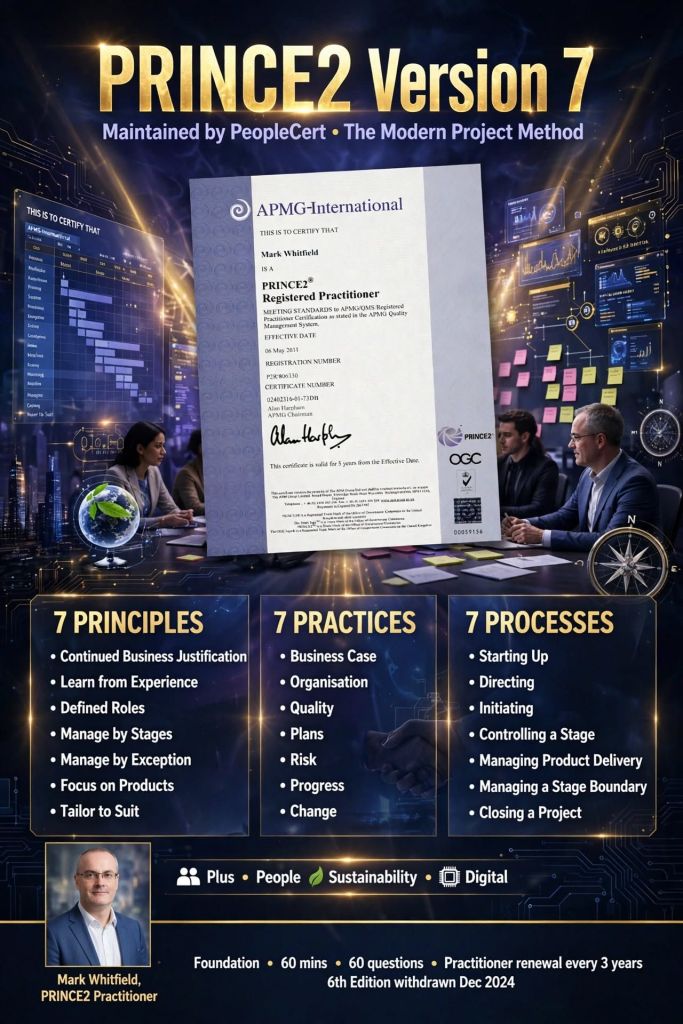
(maintained by PeopleCert)
Core Breakdown of PRINCE2 Version 7
The framework is structured around five integrated elements, with key terminology updates from older editions (such as renaming “themes” to “practices”):
1. The 7 Principles (Why PRINCE2 is used)
- Continued Business Justification: The project must have a valid and ongoing business case.
- Learn from Experience: Project teams actively record and apply lessons learned.
- Defined Roles and Responsibilities: Clear organizational structure and accountability.
- Manage by Stages: Projects are planned, monitored, and controlled on a stage-by-stage basis.
- Manage by Exception: Tolerances are set for cost, time, quality, scope, risk, and benefits, giving managers empowerment within limits.
- Focus on Products: Emphasis is placed on the definition and delivery of quality products (deliverables).
- Tailor to Suit the Project: The method is customized to match the scale, environment, and complexity of the project.
2. The 7 Practices (Formerly Themes)
- Business Case: How the project delivers value and remains viable.
- Organisation: The roles, responsibilities, and people structure.
- Quality: What the project’s products must look like and how to verify them.
- Plans: The steps, resources, and schedules required to deliver products.
- Risk: Identifying and managing uncertainties that could impact objectives.
- Progress: Measuring actual performance against the plan.
- Change: Managing how changes to scope, baseline, or requirements are handled.
3. The 7 Processes (The Project Lifecycle)
- Starting Up a Project (SU): The very first lightweight check to see if the project is worth pursuing.
- Directing a Project (DP): The Project Board’s governance and decision-making throughout.
- Initiating a Project (IP): Establishing firm foundations and creating the Project Initiation Documentation (PID).
- Controlling a Stage (CS): Day-to-day management and monitoring by the Project Manager.
- Managing Product Delivery (MP): Ensuring work between the Project Manager and Team Managers/specialists is delivered.
- Managing a Stage Boundary (SB): Assessing stage performance and planning the next stage.
- Closing a Project (CP): Controlled wrap-up, formal sign-off, and post-project evaluation.
4. The People Element (New in Version 7)
- Unlike older editions that treated project management purely as a set of mechanical processes, Version 7 places an explicit, dedicated focus on leadership, culture, collaboration, and change management.
5. Sustainability and Digital/Data
- Sustainability: Treated as a core project performance target (alongside cost, time, quality, scope, risk, and benefits).
- Data and Digital: Modern guidance on utilizing digital tools, data governance, and hybrid/agile ways of working.
Key Exam & Certification Facts
- PRINCE2 6th Edition exams were withdrawn by PeopleCert in December 2024; all current certifications operate on Version 7.
- Foundation Exam: 60-minute, 60 multiple-choice questions, requiring a 55% or 60% passing score depending on the specific accredited testing body guidelines (closed-book).
- Validity: Foundation certificates are valid for life, while Practitioner certifications require maintenance/renewal every 3 years.
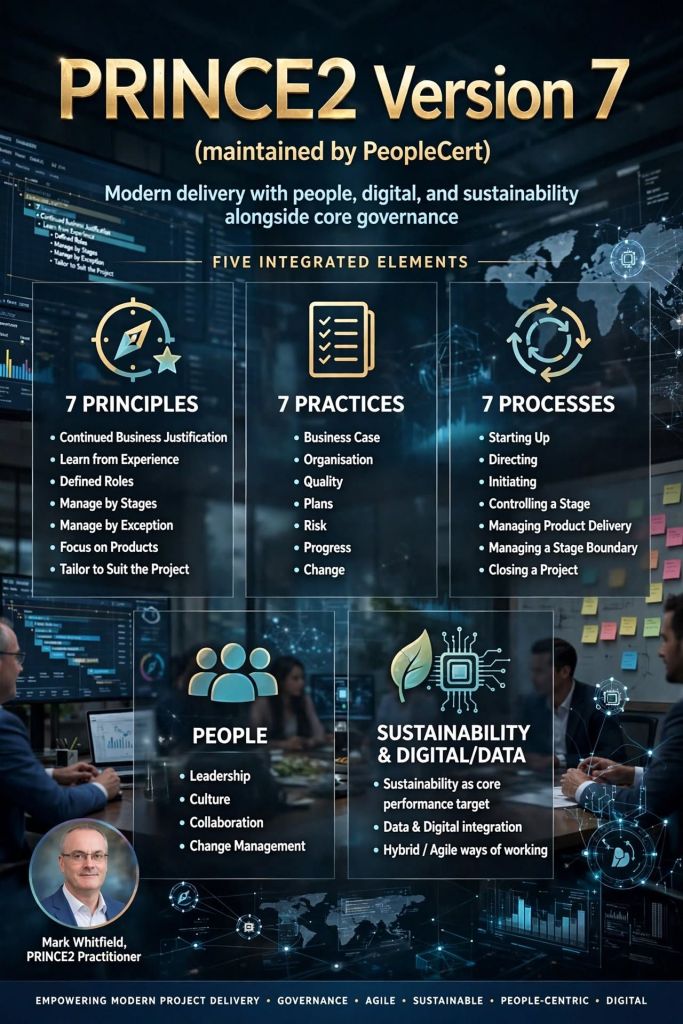
(maintained by PeopleCert), Mark Whitfield
PRINCE2 Version 7 (maintained by PeopleCert) above

