

Mark Whitfield is an SC-cleared Senior IT Project and Engagement Manager based in Greater Manchester, UK, with over 35 years of experience delivering high-availability financial, cloud, and digital transformation projects.
His career maps an evolutionary trajectory from deep technical engineering on HPE NonStop (Tandem) mainframe systems in the 1990s to managing multimillion-pound retail banking software migrations, digital gambling application rollouts, and secure cloud migrations (AWS, Azure, and MuleSoft integrations).
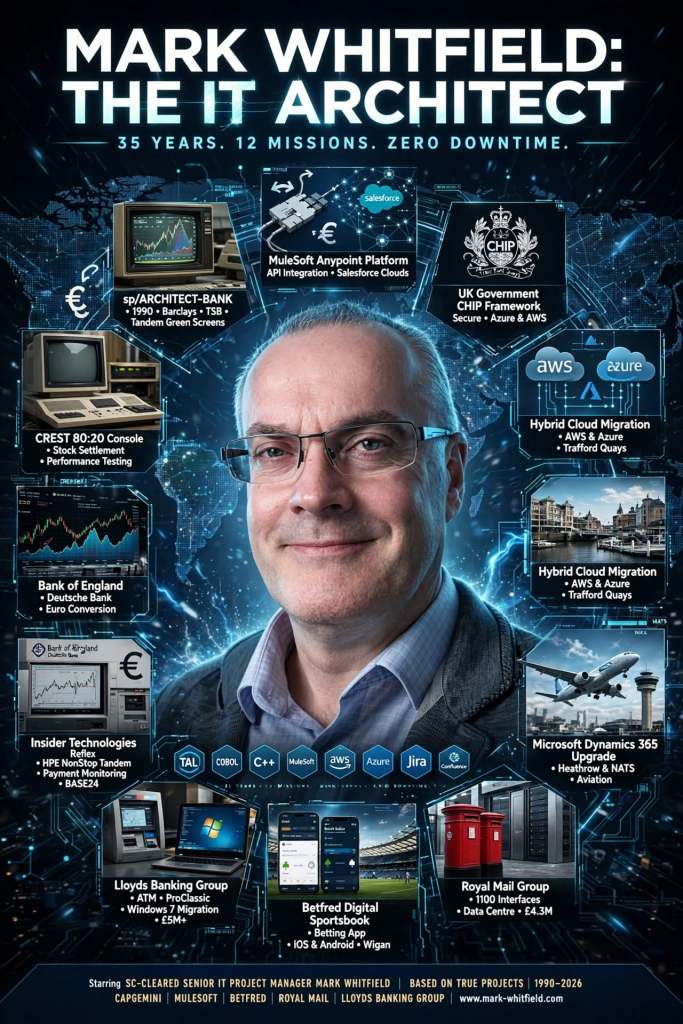
Below is the exhaustive, project-by-project reverse chronological deep-dive breakdown of his career history spanning 2026 down to 1990.
Project 1: MuleSoft Portfolio & API-Led Integration Delivery (2024 – 2026)
- Project Number: 1
- Year: 2024 – 2026
- Project Name: MuleSoft Account Integration & Anypoint Platform Delivery
- Project Length: 2 Years
- Company: Capgemini UK (Augmented into MuleSoft / Salesforce)
- Location: London / Greater Manchester, UK
- IT Role: Delivery Manager
- Customer: MuleSoft UK Enterprise Accounts Portfolio
- Suppliers: Salesforce Core Engineering & Partner SI Networks
- Focus Area Detail: API-led connectivity solutions, enterprise middleware, hybrid deployment models.
- Project Description: Managed a broad portfolio of enterprise accounts utilizing the Anypoint Platform, ensuring time management, expectation setting, and translation of API visions into strict blueprints.
- Technology: Anypoint Platform, CloudHub, Runtime Fabric.
- IT Tools/Languages: Mule Runtime, Java, XML, DataWeave.
- Budget: Multi-million pound billable enterprise accounts.
- Methodology: MuleSoft Outcome Based Delivery (OBD) and Agile Scrum.
- Political Landscape: Heightened corporate demands for rapid digital data liquidity across legacy software barriers without incurring architecture bloat.
- Project Highlights: Successfully extended contract duration three times based on high performance; mastered internal services revenue recognition pipelines.
- Feedback Received: Highly commended for proactive leadership in staffing accounts for extensions and consecutive Statements of Work (SOWs).
Project 2: UK Government CHIP Framework (2023 – 2024)
- Project Number: 2
- Year: 2023 – 2024
- Project Name: UK Government CHIP Project Integration
- Project Length: 1 Year
- Company: Capgemini UK
- Location: Manchester / London (Hybrid)
- IT Role: SC-Cleared Engagement Manager
- Customer: UK Public Sector / Central Government Department
- Suppliers: Capgemini Onshore & Offshore Bespoke Engineering Teams
- Focus Area Detail: Secure public sector data consolidation and system compliance governance.
- Project Description: Led a secure custom application integration framework for public infrastructure, requiring strict regulatory alignment and verification loops.
- Technology: Public Cloud (Microsoft Azure / AWS), Secure Gateways.
- IT Tools/Languages: Microsoft Project, Jira, Confluence, Power Platform.
- Budget: Confidential / Tier-1 Public Sector Funding.
- Methodology: Scaled Agile Framework (SAFe) / Agile Scrum.
- Political Landscape: High-compliance environment under strict government scrutiny regarding national security data processing rules.
- Project Highlights: Seamlessly maintained active Security Clearance (SC) constraints while coordinating a blended onshore/offshore team without data incident.
- Feedback Received: Praise from client stakeholders for rigorous governance, transparent progress metrics, and excellent risk mitigation.
Project 3: Public Sector Enterprise Application Estate Migration (2020 – 2023)
- Project Number: 3
- Year: 2020 – 2023
- Project Name: Hybrid Cloud Core Infrastructure Migration
- Project Length: 3 Years
- Company: Capgemini UK
- Location: Trafford Quays, Greater Manchester, UK
- IT Role: Engagement Project Manager
- Customer: High-Profile UK Public Sector Entities
- Suppliers: Specialized Third-Party Cloud Solution Providers
- Focus Area Detail: Legacy decompiling, cloud landing zones, cross-system dependency mappings.
- Project Description: Chaired end-to-end structural migration plans shifting multi-tier localized server frameworks into dynamic cloud infrastructure environments.
- Technology: Amazon Web Services (AWS), Azure, Hybrid Architecture Stacks.
- IT Tools/Languages: DevOps Pipeline Suites, MS Office/Excel Burn-Trackers.
- Budget: Large Enterprise Scale Transformation Capital.
- Methodology: Hybrid (Waterfall for infrastructure gates, Agile for code releases).
- Political Landscape: Pandemic-driven demand for robust remote cloud access coupled with strict public finance efficiency audits.
- Project Highlights: Directed multiple successful system migration windows without impacting live public operations or services.
- Feedback Received: Recipient of the C&CA UK’s Communications & Engagement Award (2022) within the Cloud & Custom Applications division.
Project 4: Microsoft Dynamics Enterprise Platform Upgrade (2018 – 2020)
- Project Number: 4
- Year: 2018 – 2020
- Project Name: MS Dynamics 365 Shared Architecture Transformation
- Project Length: 2 Years
- Company: Capgemini UK
- Location: Manchester, UK
- IT Role: Senior IT Project Manager
- Customer: Major UK Transport and Commercial Aviation Stakeholders (e.g., Heathrow/NATS)
- Suppliers: Microsoft Enterprise Services and Internal App Teams
- Focus Area Detail: Application discovery, costing, statements of work, and dynamic infrastructure alignment.
- Project Description: Governed a dual-phase (Discovery and Migration) program to lift 12 distinct Microsoft Dynamics 2016 applications from legacy 8.2 infrastructure into a shared cloud architecture.
- Technology: Microsoft Dynamics 365 Online Cloud Platform.
- IT Tools/Languages: Microsoft Project, Advanced Costing Blueprints.
- Budget: £400,000 (Discovery Phase).
- Methodology: Structured Waterfall Phase Gates transitioning to iterative migrations.
- Political Landscape: Demands for minimized single points of failure across critical transportation commerce platforms.
- Project Highlights: Authored definitive blueprinting documents, architectural exit plans, and unified migration models adopted as business standards.
- Feedback Received: Highly positive reviews following a series of technical stakeholder alignment workshops.
Project 5: Royal Mail Group Core Interface Migration (2016 – 2018)
- Project Number: 5
- Year: 2016 – 2018
- Project Name: RMG Dual Data Centre Integration Overhaul
- Project Length: 2 Years
- Company: Capgemini UK
- Location: Salford / London, UK
- IT Role: Client-Facing Engagement Manager
- Customer: Royal Mail Group (RMG)
- Suppliers: Core Onshore/Offshore Engineering and testing cohorts.
- Focus Area Detail: Data centre interface migrations, legacy decommissioning, high-throughput delivery.
- Project Description: Directed a massive engineering effort to securely migrate over 1,100 interfaces connecting internal applications and B2B trading partners between two data centres.
- Technology: Enterprise Application Integration (EAI) Hubs, Middleware.
- IT Tools/Languages: Java, Integration Middleware platforms, MS Project.
- Budget: £4.3 Million.
- Methodology: Waterfall Delivery Lifecycles with strict regression routines.
- Political Landscape: Faced an immoveable deadline to finish before October to bypass the organization’s high-stakes “Peak Trading” annual change freeze.
- Project Highlights: Led a massive workforce of 90 to 100+ Capgemini staff to deliver on time, completely preserving national commerce continuity.
- Feedback Received: Won the Capgemini Project Recognition / Group Delivery Excellence recognition for preserving operational integrity during crucial timelines.
Project 6: Betfred Digital Sportsbook & Virtual Gaming Releases (2014 – 2016)
- Project Number: 6
- Year: Late 2014 – Early 2016
- Project Name: Online & Mobile Gaming Release Stream
- Project Length: ~1.5 Years
- Company: Betfred Limited
- Location: Betfred UK Head Office, Wigan, Lancashire, UK
- IT Role: Senior IT Digital Project Manager (Online and Mobile Division)
- Customer: Betfred Online Consumer Base
- Suppliers: Playtech, Degree53, Virtue Fusion, IGT, SIS, OtherLevels.
- Focus Area Detail: Payment gateways, sportsbooks (football/horse racing), virtual gaming integration.
- Project Description: Governed end-to-end agile releases for core high-throughput web and mobile betting applications, establishing fast-paced update loops.
- Technology: Native iOS, Android, and Windows Mobile Application stacks.
- IT Tools/Languages: Agile Scrum, Jira, Confluence, Excel Variance Tracking.
- Budget: Multi-million rolling digital operational and R&D budgets.
- Methodology: Agile Scrum framework with rolling monthly sprint cycles.
- Political Landscape: Adapting to aggressive UK mobile entertainment deregulation requirements and demanding rapid compliance edits via System Change Requests (SCRs).
- Project Highlights: Successfully streamlined third-party middleware data feeds (Onionsack, SIS, StreamUK) into cohesive real-time push apps.
- Feedback Received: Commended by executives for keeping product burn rates completely aligned with board room forecasts.
Project 7: Lloyds Banking Group Self-Service Software Overhaul (2013 – 2014)
- Project Number: 7
- Year: 2013 – 2014
- Project Name: Self-Service Software Replacement (SSSR) Programme
- Project Length: 1 Year
- Company: Wincor Nixdorf (Banking Division)
- Location: Woking, UK / Client sites
- IT Role: Agile IT Project Manager (Professional Services)
- Customer: Lloyds Banking Group (LBG)
- Suppliers: Wincor Nixdorf International Delivery Units & Off-shore Labs.
- Focus Area Detail: ATM estate operating system upgrades and architectural driving transitions.
- Project Description: Managed the professional services workstream to deploy ProClassic Enterprise and replace multi-vendor hardware terminal systems across thousands of active endpoints.
- Technology: ProClassic Enterprise (PC/E), Oracle, AIX Platform, Windows 7.
- IT Tools/Languages: BASE24 Classic interface tracking, ITIL quality engines.
- Budget: £5+ Million.
- Methodology: Wincor PM Framework integrated with Agile/ITIL alignment.
- Political Landscape: Post-2008 financial crash regulatory tightening required rapid retirement of Windows XP systems to eliminate operational liabilities.
- Project Highlights: Transferred ATM driving dependency away from legacy BASE24 on mainframes to AIX architectures, updating the client’s fleet to Windows 7.
- Feedback Received: Conferred the Wincor Nixdorf Project Recognition Award and “Above and Beyond” award for outstanding commitment to client excellence.
Project 8: Insider Technologies Reflex Core R&D and Payment Auditing (2004 – 2013)
- Project Number: 8
- Year: 2004 – 2013
- Project Name: Reflex ONE24 & Transaction Log Extraction (RTLX) Frameworks
- Project Length: 9 Years
- Company: Insider Technologies Limited
- Location: Salford Quays, Manchester, UK
- IT Role: Technical Project Manager / Product Manager
- Customer: European and Middle Eastern Financial Institutions (e.g., Alliance & Leicester, HSBC).
- Suppliers: Internal R&D Engineering Units
- Focus Area Detail: POS/ATM electronic payment monitoring, real-time message log intercepts.
- Project Description: Supervised full-lifecycle software delivery streams for the payment telemetry modules, intercepting data strings inside high-volume banking back-ends.
- Technology: HPE NonStop (NSK), ACI BASE24 Classic, XPNET.
- IT Tools/Languages: NonStop TAL, C, C++, COBOL85, SQL, TACL.
- Budget: Tier-1 Bank Technical Procurement Allocations.
- Methodology: PRINCE2 transitioning to early Agile Scrum components.
- Political Landscape: Massive expansion of international debit/credit transaction volume requiring continuous SLA uptime visibility.
- Project Highlights: Delivered critical pre-sales demonstrations and implementation validation across major European financial institutions.
- Feedback Received: Excellent internal milestones achieved; recognized for navigating complex cross-team technical interdependencies.
Project 9: Central Bank Path Telemetry Initiatives (1999 – 2001)
- Project Number: 9
- Year: 1999 – 2001
- Project Name: MultiBatch Automation & Central Path Telemetry
- Project Length: 2 Years
- Company: Insider Technologies Limited
- Location: London / Salford Quays, UK
- IT Role: Senior Developer / Project Team Lead
- Customer: Bank of England & Deutsche Bank
- Suppliers: Core Systems Architecture Groups
- Focus Area Detail: Batch job scheduling utilities, real-time file monitoring pipelines.
- Project Description: Managed multi-organisational technical rollouts to secure critical path clearance architectures across key banking institutions.
- Technology: MultiBatch Scheduling Engine, ENSCRIBE File Frameworks.
- IT Tools/Languages: TAL, COBOL85, TACL.
- Budget: Tier-1 corporate banking technical delivery funding.
- Methodology: Traditional Structured Project Lifecycles / Waterfall.
- Political Landscape: The literal rollout of the Euro currency zone requiring tight, uncompromised audit controls for cross-border conversions.
- Project Highlights: Deployed real-time automated telemetry modules that synchronized distinct international accounting networks securely.
- Feedback Received: Achieved strict regulatory sign-offs from both central financial authorities without variance.
Project 10: CRESTCo High-Availability Infrastructure Benchmarking (1997 – 1998)
- Project Number: 10
- Year: 1997 – 1998
- Project Name: CREST Stock Settlement Performance Validation
- Project Length: 1 Year
- Company: Insider Technologies Limited
- Location: CRESTCo Facility, St. Katharine’s Dock, London, UK
- IT Role: On-site Technical Consultant / Infrastructure Engineer
- Customer: CRESTCo (now Euroclear)
- Suppliers: Compaq / Tandem Systems Engineering Division.
- Focus Area Detail: Stress testing, system capacity thresholds, performance diagnostics.
- Project Description: Brought in to design custom volume stress-testing engines to validate performance maximums of the UK’s core stock settlement application.
- Technology: S7000 G-Series HPE NonStop Nodes.
- IT Tools/Languages: TAL, C, Guardian OS Performance Evaluators.
- Budget: Specialized High-Availability Infrastructure Funding.
- Methodology: Iterative Stress-Test Scripts / Structured Waterfall Labs.
- Political Landscape: Demands for absolute fault-tolerant verification before migrating national stock settlement architectures to newly unboxed computing configurations.
- Project Highlights: Successfully identified performance limitations, confirming architecture viability before live cutover.
- Feedback Received: Highly commended by CRESTCo operations directors for technical exactness and thorough data mapping.
Project 11: Insider Technologies Reflex Flagship Console Creation (1995 – 1996)
- Project Number: 11
- Year: 1995 – 1996
- Project Name: Reflex 80:20 Tracking Platform Core R&D
- Project Length: 1 Year
- Company: Insider Technologies Limited
- Location: Salford Quays, Manchester, UK
- IT Role: Core Senior Programmer
- Customer: Global Tandem Mainframe Enterprise User Base
- Suppliers: Insider Tech Product Management
- Focus Area Detail: Operating system diagnostics, automated filtering dashboards, telemetry collectors.
- Project Description: Recruited as a core developer to design and write the foundational console health modules, event filtering components, and status monitoring layers.
- Technology: Tandem Computers Guardian OS Architecture.
- IT Tools/Languages: TAL (Transaction Application Language), COBOL, C.
- Budget: Internal R&D Capital Investment.
- Methodology: Structured Product Lifecycle Engineering.
- Political Landscape: Growth in high-volume processing highlighted a total lack of unified, visual operations management consoles for Tandem mainframes.
- Project Highlights: Co-authored the “Status Monitor” and “Console EMS” plugins, which went on to become standard components of the Reflex suite globally.
- Feedback Received: Celebrated internally for rapid development turnaround and optimizing code loops for low system overhead.
Project 12: sp/ARCHITECT-BANK Core Engineering & Client Rollouts (1990 – 1995)
- Project Number: 12
- Year: 1990 – 1995
- Project Name: sp/ARCHITECT-BANK Desktop Banking Integration
- Project Length: 5 Years
- Company: The Software Partnership (acquired by Deluxe Data International in 1994)
- Location: Runcorn (HQ) / Client deployments at Knutsford & Poole, UK
- IT Role: Programmer / Lead Analyst
- Customer: Barclays Bank, TSB, Bank of Scotland, Rabobank, Girofon (Denmark)
- Suppliers: Deluxe Data Corporate Core Systems
- Focus Area Detail: Electronic bookkeeping, inter-account money transfers, IVR balance gateways.
- Project Description: Developed and updated back-end modules for the Barclays Business Master II (BBM II) software and authored voice menu balance retrieval integrations for Denmark’s Girofon.
- Technology: Tandem Mainframe Architecture, Fault-Tolerant Application Pathways.
- IT Tools/Languages: COBOL85, TAL, NonStop SQL, PATHWAY, SCOBOL (Green Screens).
- Budget: Early Fintech Enterprise R&D Funding.
- Methodology: Traditional Iterative Development & Structured Waterfall Lifecycles.
- Political Landscape: Pre-widespread internet era; granting corporate accountants interactive terminal access directly to back-end banking ledgers was highly novel and strictly controlled.
- Project Highlights: Successfully bridged Periphonics interactive touch-tone voice hardware arrays with core mainframe database platforms for Girofon.
- Feedback Received: Exceptional praise from client engineers during physical on-site integrations at the Barclays Knutsford and Poole processing centres.

