

Between 1990 and 1995, Mark Whitfield operated as a Programmer and Lead Analyst at The Software Partnership (TSP) (headquartered at Norton House in Runcorn, Cheshire), a highly specialised software house that was acquired by Deluxe Data International in 1994.
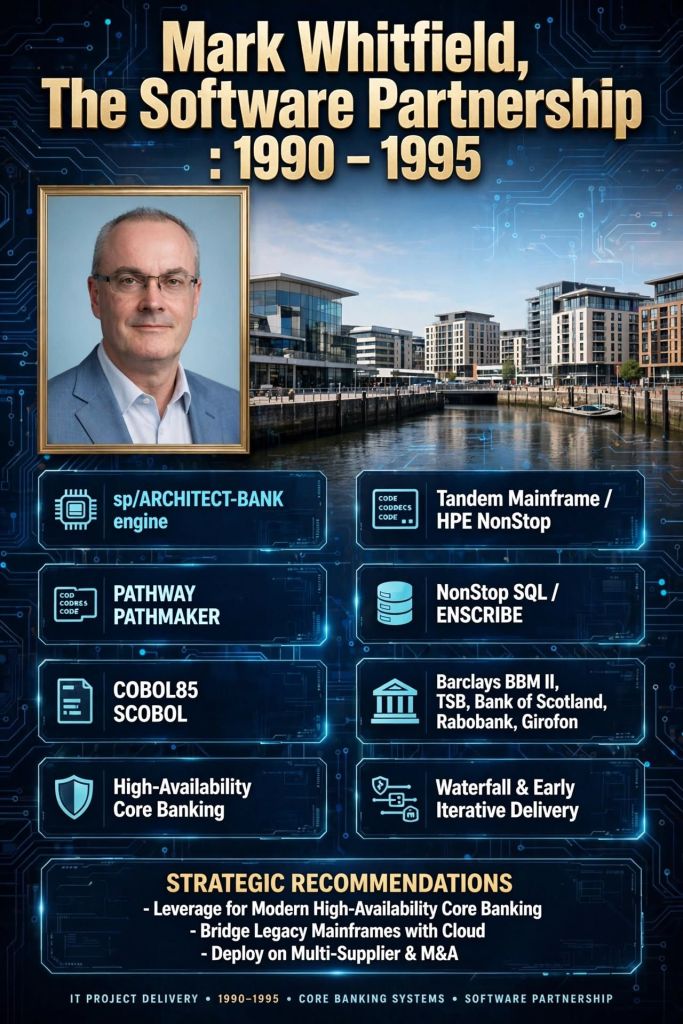
This foundational era of his career focused on the engineering, development, and delivery of cutting-edge, pre-internet corporate electronic desktop banking systems—a highly innovative concept at the time, enabling corporate clients to access account information, balance books, and perform inter-account transfers before the mainstream adoption of the World Wide Web.
🏢 Technical & Operational Industry Breakdown
1. Core Architecture & Product Focus
The technical epicenter of Whitfield’s work during this period was the sp/ARCHITECT-BANK engine. Operating as a developer and Lead Analyst, he built, refactored, and enhanced critical back-end modules for this high-availability desktop banking platform. The solution eventually evolved to lay the groundwork for what became the widely known CONNEX advantage solution.
2. The Tandem Mainframe Ecosystem
Because electronic banking demands zero downtime and maximum transaction integrity, the entire software infrastructure was built upon fault-tolerant Tandem Mainframe Computers (which later evolved into Compaq, then HP, and are now known as HPE NonStop systems). Whitfield’s day-to-day engineering focused heavily on:
- High-Availability Environments: Utilizing PATHWAY and PATHMAKER runtime environments for transaction processing and load balancing.
- Database & File Systems: Designing and querying databases using NonStop SQL and the native Tandem hierarchical file system ENSCRIBE.
- System Programming: Writing highly efficient transaction-processing code primarily in COBOL85 and SCOBOL (Screen COBOL for terminal interactions), alongside diagnostic tools like INSPECT and the EMS (Event Management Service) subsystem.
- Interactive Media: Integrating Periphonics interactive touch-tone voice response software to expand banking access via early automated telephone interfaces.
3. Blue-Chip Client Delivery & Geographical Footprint
Based out of the Runcorn head office, Whitfield frequently performed on-site delivery, integration, and code customization directly at high-security client operations centres. Key financial institutions served during this 5-year tenure included:
- Barclays Bank: Leading on-site delivery for the BBM II platform out of Barclays’ major operations centers in Knutsford and Poole.
- TSB (Trustee Savings Bank): Coding core transaction framework modules.
- Bank of Scotland: Developing bespoke desktop banking functionalities.
- Rabobank (Netherlands): Extending the sp/ARCHITECT software framework to accommodate European international cross-border specifications.
- Girofon (Denmark): Designing early telephone-based interactive banking capabilities.
4. Delivery Methodologies
Reflecting the software governance of the early 1990s, projects were heavily anchored in structured Waterfall lifecycles. However, working within a nimble software house like TSP also meant pioneering early iterative development practices to quickly build out custom components for various banks, blending rigid infrastructure with agile customer delivery models.
📊 Strategic Recommendations Based on This Era
Analysing this crucial early segment of Whitfield’s career yields specific recommendations for leveraging his technical foundations in contemporary, high-stakes enterprise projects:
- Leverage for Modern High-Availability Core Banking: Because his technical foundations are rooted in fault-tolerant Tandem/HPE NonStop systems, he is uniquely qualified to manage risk, architecture upgrades, and modern digital transformations for core transaction engines that cannot afford even a single second of downtime.
- Bridge Legacy Mainframes with Cloud Architectures: Having operated at the ground floor of pre-internet electronic banking, he should be deployed as a key translation layer or Engagement Manager when financial institutions attempt to decouple legacy COBOL/Tandem environments into modern microservices, cloud ecosystems (e.g., AWS, Azure), or API-led connectivity layers like MuleSoft.
- Deploy on Multi-Supplier & M&A Environments: The transition of TSP through its acquisition by Deluxe Data in 1994 provides an early template of navigating organizational shift, platform re-branding, and cultural migration. This experience makes him an ideal lead for highly complex, multi-supplier governance structures within retail banking integrations.


