

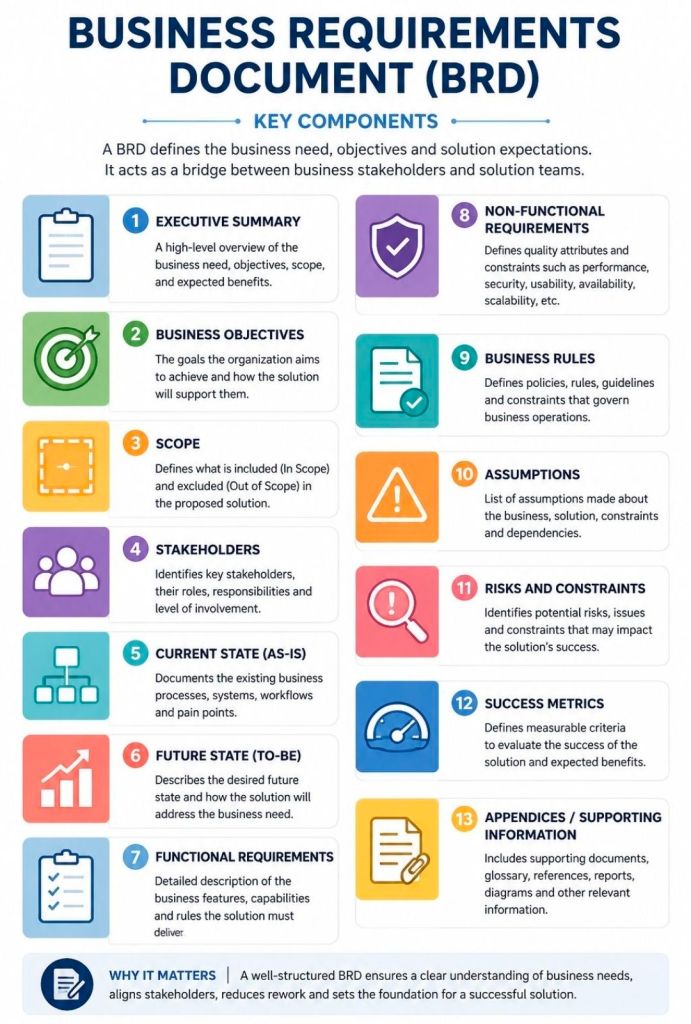
A Business Requirements Document (BRD) details what a project must accomplish and why it matters to the organization, acting as a bridge between business stakeholders and technical execution teams.
Here is a summary of the core sections required to construct a comprehensive BRD:
1. Document Control
- Version History: Tracks changes, authors, and dates to ensure everyone uses the current iteration.
- Approvals: Formal sign-off section where stakeholders authorize moving the project forward.
2. Executive Summary
- Project Overview: A brief one-page overview stating the essence and main purpose of the project.
- Needs Statement: Outlines the core business challenges or opportunities the project solves.
3. Project Scope & Objectives
- Project Objectives: High-level, measurable targets aligned with company goals, often using SMART criteria.
- In-Scope: Clear boundaries stating exactly what deliverables or processes are included.
- Out-of-Scope: Explicit list of features or tasks intentionally left out to prevent scope creep.
4. Stakeholder Analysis
- Key Stakeholders: Identifies project sponsors, department heads, and end-users.
- Roles & Responsibilities: Maps out who provides requirements, who reviews them, and who receives deliverables.
5. Process Specifications
- Current State (AS-IS): Maps current operational workflows to illustrate existing bottlenecks.
- Future State (TO-BE): Details the desired future process after implementing the solution.
6. Core Requirements
- Business Requirements: The high-level operational goals and capabilities the system must offer.
- Functional Requirements: Descriptions of specific system tasks or behaviours from a business user perspective.
- Non-Functional Requirements: Standards for performance, system security, and scalability.
7. Financial & Strategic Analysis
- Cost-Benefit Analysis: Compares estimated financial expenses against anticipated business gains.
- Success Metrics: Defines Key Performance Indicators (KPIs) and expected Return on Investment (ROI).
8. Project Dynamics & Risk Management
- Assumptions: Unverified elements assumed to be true for the project to progress.
- Constraints: Fixed limitations such as budget, time, technology, or legal compliance.
- Risks & Mitigation: Potential threats to project delivery paired with backup action plans.
- Dependencies: External factors or other projects that this initiative relies on to succeed.
9. Supporting Documentation
- Acceptance Criteria: The standards and conditions required for stakeholders to accept the final delivery.
- Glossary: Clear definitions of industry terms and acronyms used throughout the document.


