

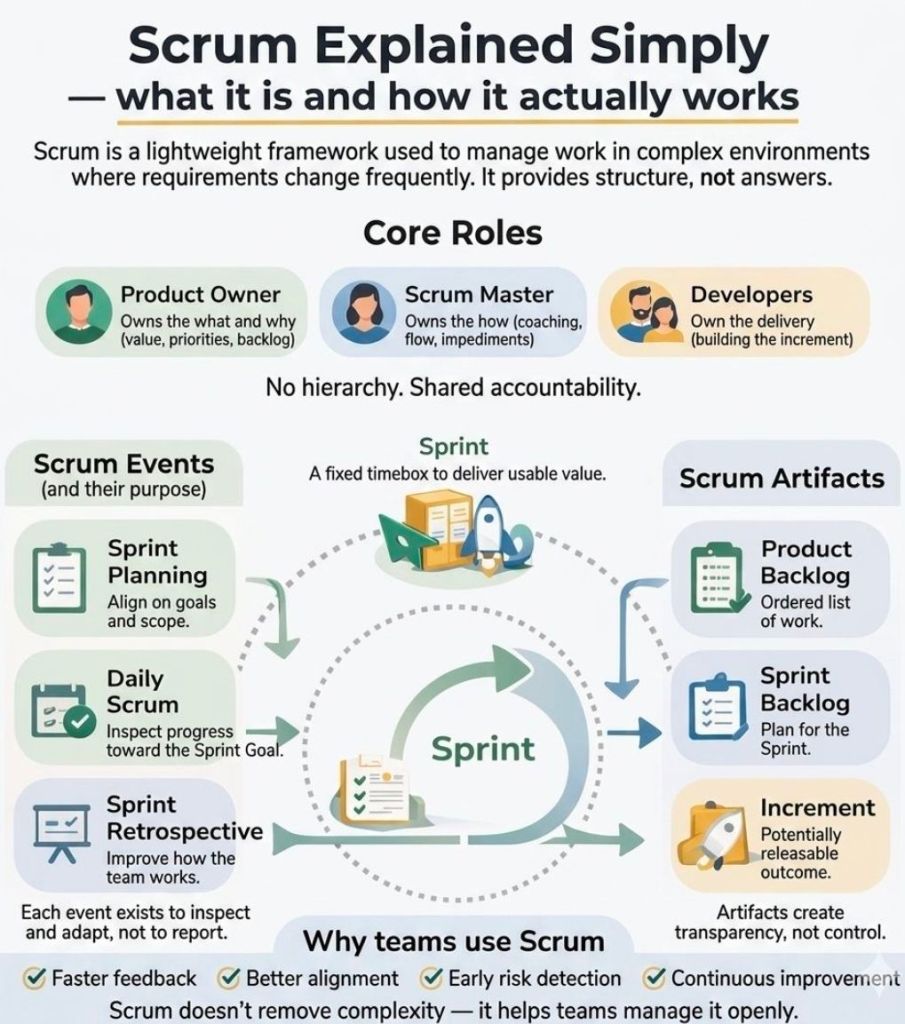
Agile is a project management philosophy, while Scrum is the structured, real-world framework used to put that philosophy into action. Think of Agile as a commitment to healthy living, and Scrum as the specific daily workout routine you follow to stay fit. Instead of planning a massive project from start to finish upfront, Scrum breaks the work down into small, manageable pieces delivered in short cycles.
The easiest way to understand Scrum is through the 3-5-3 Rule: 3 Roles, 5 Events, and 3 Artifacts.
👥 The 3 Roles
A standard Scrum team is small, cross-functional, and self-managing, meaning they have all the skills needed to complete the work without relying on outsiders.
- Product Owner: The visionary. They understand customer needs, decide what needs to be built, and maintain the master to-do list.
- Scrum Master: The coach. They do not manage the team; instead, they protect them from distractions, facilitate meetings, and clear roadblocks.
- Developers: The builders. This includes the engineers, designers, or writers who do the hands-on work and decide how to build it.
📦 The 3 Artifacts
Artifacts are simply the tangible items or lists used to maintain transparency across the project.
- Product Backlog: The ultimate master list of features, fixes, and requirements needed for the product, prioritized by value.
- Sprint Backlog: The specific subset of items selected from the master list that the team commits to finishing during the current cycle.
- Increment: The final, working piece of the product delivered at the end of a cycle that meets the team’s “Definition of Done”.
📅 The 5 Events (Ceremonies)
Scrum operates in time-boxed blocks called Sprints, which usually last 1 to 4 weeks. Each Sprint includes four distinct meetings:
- The Sprint: The time-box itself where the actual building happens.
- Sprint Planning: A meeting at the start of a Sprint where the team decides what they can realistically achieve and creates a plan.
- Daily Scrum (Stand-up): A quick, 15-minute daily meeting where developers sync on progress, plan the next 24 hours, and flag blockers.
- Sprint Review: A showcase held at the end of the Sprint to demo the working increment to stakeholders and gather feedback.
- Sprint Retrospective: An internal team meeting to review what went well, what went wrong, and how to improve the process for the next Sprint.
🏗️ Why Does Scrum Work?
Scrum relies entirely on Empiricism, meaning making decisions based on real-world evidence rather than guesswork. It stands firmly on three pillars:
- Transparency: Everyone involved sees exactly what is happening.
- Inspection: The team frequently stops to check the quality of the product and progress.
- Adaptation: If something goes off-course, the team shifts direction immediately rather than blindly following an outdated plan.

