The transition from massive, industrial room-sized mainframes to the “home computer” was driven by the invention of the microprocessor in the early 1970s.
The Pre-Home Era (1971–1976)
Before “home computers” existed as off-the-shelf products, they were sold as DIY kits for electronics hobbyists.
- 1971: Intel releases the 4004, the first commercial single-chip microprocessor.
- 1974: The MITS Altair 8800 is featured in Popular Electronics; it is widely considered the spark of the personal computer revolution.
- 1976: Apple Computer is founded. The Apple I goes on sale as a hand-soldered board for $666.66.
- 1976: MOS Technology releases the KIM-1, the first single-board computer kit.
The “1977 Trinity” & Early Adoption
In 1977, three computers were released that targeted ordinary consumers rather than just hobbyists.
- Apple II: Features colour graphics and eight expansion slots, becoming a standard for schools and early home users.
- Commodore PET 2001: The first “all-in-one” home computer with a built-in monitor and tape drive.
- TRS-80 Model I: Sold through Radio Shack stores, making computers accessible on the high street for $399.
The 1980s Boom
This decade saw fierce competition between manufacturers and the rise of gaming and office productivity.
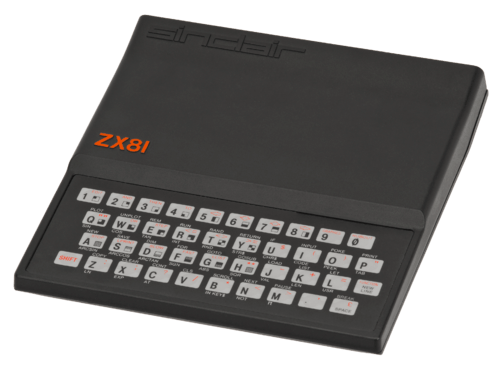
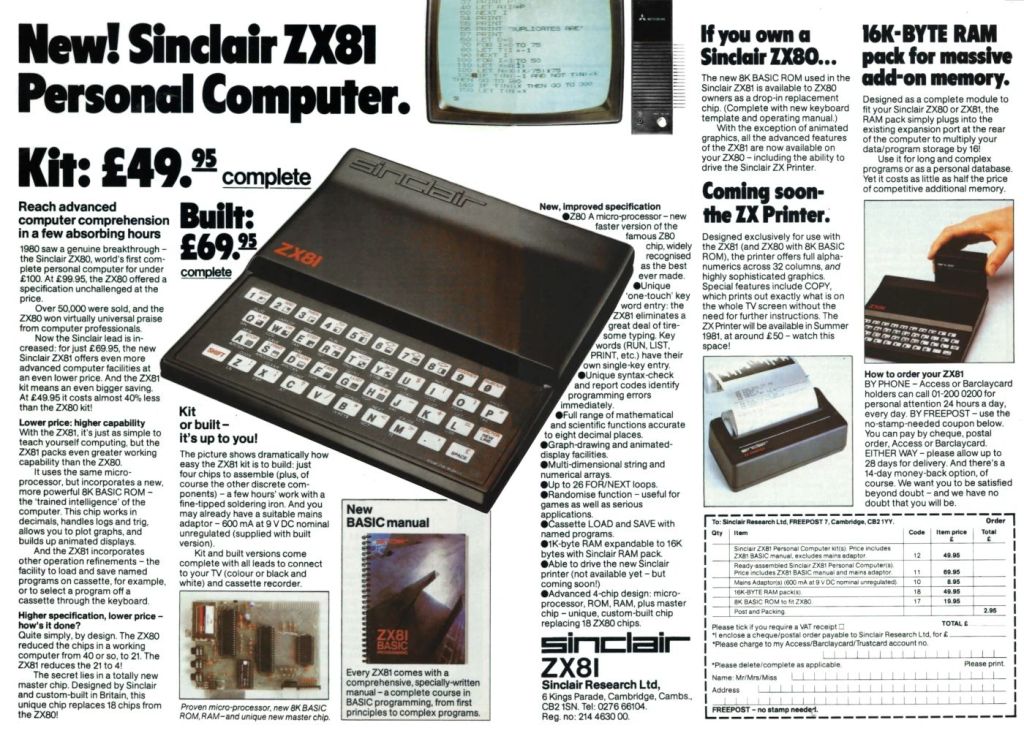
- 1980: Sinclair ZX80 launches in the UK as a very low-cost entry point into computing.
- 1981: The IBM PC is released, creating the “PC-compatible” standard that still dominates today.
- 1981: The Commodore VIC-20 becomes the first computer to sell over one million units.
- 1982: The Commodore 64 launches and eventually becomes the best-selling single computer model of all time.
- 1984: Apple launches the Macintosh, the first successful mass-market computer with a Graphical User Interface (GUI) and a mouse.
- 1985: The Amiga 1000 and Atari ST bring advanced multimedia and multitasking to the home.
Standardisation & The Modern Age (1990s–Present)
The market shifted away from proprietary “home computers” toward standardized “PCs” and portable devices.
- 1990: Microsoft Windows 3.0 is released, making GUI computing standard on IBM-compatible PCs.
- 1995: Windows 95 launches, moving the PC away from its MS-DOS roots and integrating internet support.
- 1998: The Apple iMac revitalizes Apple’s consumer line with an integrated, colourful design and USB ports.
- 2010: The Apple iPad introduces the “tablet” as a primary home computing device for many users.
- 2012: The Raspberry Pi launches, bringing home computing back to its DIY and educational roots.
The history of the home computer evolved from large, room-sized mainframes into the diverse, interconnected devices used today. This timeline categorises the evolution by era and key annual milestones.
The Pre-Home Era: Mainframes & Minicomputers (1940s–1960s)
Before computers could fit in a home, they were massive machines used by governments and corporations.
- 1945: ENIAC (Electronic Numerical Integrator and Computer) is completed as the first general-purpose electronic digital computer.
- 1951: UNIVAC I is delivered to the US Census Bureau, becoming the first commercial computer produced in the US.
- 1960: DEC PDP-1 is introduced, representing the first “minicomputer” that was smaller than its predecessors.
- 1965: The DEC PDP-8 launches, becoming the first commercially successful minicomputer.
The Hobbyist Era: The First Personal Computers (1970–1976)
The invention of the microprocessor allowed computers to become small enough for individuals to own, though they often required manual assembly.
- 1971: Intel 4004, the first single-chip microprocessor, is released.
- 1974: The MITS Altair 8800 appears on the cover of Popular Electronics, sparking the hobbyist revolution.
- 1976: The Apple I, a single-board computer kit designed by Steve Wozniak, is released.
The “1977 Trinity” & The Home Boom (1977–1983)
This era saw the transition from kits to fully assembled, consumer-ready “home computers”.
- 1977: The “1977 Trinity” launches: the Apple II (with colour graphics), the Commodore PET, and the Tandy TRS-80.
- 1980: Sinclair ZX80 is released as one of the first low-cost home computers in the UK.
- 1981: The IBM PC is released, setting the industry standard for hardware and software compatibility.
- 1981: The Osborne 1 is released as the first commercially successful portable computer.
- 1982: The Commodore 64 launches; it eventually becomes the best-selling single computer model of all time.
- 1982: The ZX Spectrum is released, becoming a cultural icon in Europe.
The Graphical User Interface (GUI) Era (1984–1994)
Computers moved away from text-based commands toward visual icons and mice.
- 1984: The Apple Macintosh launches, popularising the mouse and Graphical User Interface (GUI).
- 1985: The Commodore Amiga 1000 and Atari ST launch, bringing advanced multimedia and multitasking capabilities.
- 1990: Tim Berners-Lee creates the World Wide Web, fundamentally changing how home computers would be used.
- 1994: PowerPC processors are introduced by Apple, significantly increasing processing speed.
The Internet & Mobility Era (1995–Present)
Home computing shifted focus toward connectivity, portability, and eventually, the cloud.
- 1995: Windows 95 is released, integrating internet support and making PCs user-friendly for the masses.
- 1998: The Apple iMac launches, ditching the floppy drive and embracing USB.
- 2000s: Laptops begin to outsell desktops as portable computing gains momentum.
- 2010: The Apple iPad pioneers the modern tablet market, creating a new “casual computing” category.
- 2012: The Raspberry Pi is released, re-engaging a new generation in hobbyist computer building.
- 2020s: The rise of Cloud Computing and AI Integration (like the Apple M1 chip) shifts the focus from local storage to remote applications and machine learning.


 PROject Templates