Llandudno Pier Overview and Historical Timeline by Era

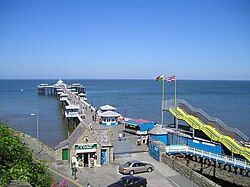
Llandudno Pier, often called the “Queen of Welsh Piers”, is the longest pier in Wales at 2,295 feet (700 metres). It is a Grade II* listed structure renowned for its Victorian and Edwardian elegance, featuring ornate ironwork and classic kiosks. 

Llandudno Pier, often called the “Queen of Welsh Piers”, is the longest pier in Wales

Historical Timeline by Era

Early Origins (The Pre-Pier Era)

  • 1858: A short wooden pier (242 ft) was built by the St George’s Harbour and Railway Company to export limestone.
  • 1859: This original structure was severely damaged by the “Royal Charter Storm”.
  • 1860–1875: Though repaired, the wooden pier was too short for steamships except at high tide. 

Victorian Era: Construction and Growth

  • 1875: The Llandudno Pier Company was formed to build a new, modern structure.
  • 1876: Construction began in June/July. The first pile was driven on 16 September 1876.
  • 1877: The pier officially opened on 1 August, initially measuring 1,234 feet.
  • 1878: Construction was fully completed; the first steamboat (Prince Arthur) landed in May.
  • 1884: A landward extension was added, bringing the pier to its current length of 2,295 feet.
  • 1886: The Pier Pavilion opened on 16 September as a 2,000-seat theatre and concert hall.
  • 1887: Renowned conductor Jules Rivière took charge of the pier’s orchestra, which eventually grew to symphony proportions.
  • 1891: A new landing stage was added to accommodate increased steamship traffic. 

Edwardian and Mid-20th Century

  • 1905: A pier-head pavilion was constructed.
  • 1910: Extensive improvements were made, including widening most of the pier.
  • 1938: Major alterations were carried out on the landing stage.
  • 1968: The pier was purchased by the Trust House Forte Group.
  • 1969: The landing stage was totally rebuilt in concrete and steel to handle large Isle of Man steamers. 

Modern Era: Challenges and Restoration

  • 1983: The pier became part of the First Leisure Corporation.
  • 1984: The Pier Pavilion theatre closed.
  • 1994: A major fire destroyed the Pier Pavilion on 13 February, leaving only the iron supports.
  • 1998: Purchased by Leisure Parks Ltd (Trevor Hemmings) along with several other UK piers.
  • 2005: Voted “Pier of the Year” by the National Piers Society.
  • 2015: Purchased by local entrepreneur Adam Williams (Tir Prince Leisure Group) for £4.5 million.
  • 2021: Adam Williams purchased the derelict Pavilion site to protect the pier’s future.
  • 2025: Voted “Pier of the Year” for the second time following major restoration efforts. 

Llandudno Pier Overview and Historical Timeline by Era
Golf Historical Timeline Overview

The history of golf is broadly categorised into five distinct eras that track its evolution from a forbidden Scottish pastime to a multi-billion dollar global industry. 

1. The Foundation Years (Pre-1400s – 1899)

This era established the basic rules, the 18-hole standard, and the first major championships. 

  • 1457: King James II of Scotland bans golf and football because they distract young men from archery and military training.
  • 1502: King James IV lifts the ban and becomes a golfer himself, leading to the sport’s popularity among royalty.
  • 1744: The first official golf club, the Honourable Company of Edinburgh Golfers, is formed and establishes the first 13 rules of golf.
  • 1764: The Old Course at St Andrews reduces its round from 22 holes to 18 holes, setting the global standard for course length.
  • 1848: The “Guttie” ball (made of gutta-percha) is introduced, making the game more affordable and durable than the original feather-filled leather balls.
  • 1860: The first Open Championship (British Open) is held at Prestwick, won by Willie Park Snr.
  • 1894: The United States Golf Association (USGA) is founded to govern the sport in America.
  • 1895: The first U.S. Open and U.S. Women’s Amateur championships are held. 

2. The Golden Era (1900 – 1945)

This period saw the rise of legendary players, the formalisation of the professional tour, and the transition to steel equipment. 

  • 1916: The PGA of America is founded, and the PGA Championship is inaugurated.
  • 1920s: Steel shafts are patented and eventually legalised by the USGA (1924) and R&A (1929), replacing hickory.
  • 1927: The first Ryder Cup match is played between teams from the United States and Great Britain.
  • 1930Bobby Jones achieves the “Grand Slam” by winning the U.S. Open, U.S. Amateur, British Open, and British Amateur in a single year.
  • 1934: The first Masters Tournament is held at Augusta National, founded by Bobby Jones.
  • 1945Byron Nelson sets a record by winning 11 consecutive tournaments (18 total in the year).

3. The Television Boom (1946 – 1980s)

Broadcast sports turned golf into a global phenomenon, fueled by the rivalry between Jack Nicklaus and Arnold Palmer

  • 1950: The LPGA Tour is officially formed.
  • 1968: The PGA Tour is formally established as a separate entity from the PGA of America.
  • 1971: Astronaut Alan Shepard hits a golf ball on the moon during the Apollo 14 mission.
  • 1970s: Graphite shafts and metal-headed woods (drivers) begin to replace traditional wooden clubs. 

4. The Tiger Era (1990s – 2010) 

The arrival of Tiger Woods sparked a massive surge in popularity, prize money, and athletic training. 

  • 1991: Callaway introduces the Big Bertha driver, popularising oversized metalwood heads.
  • 1997Tiger Woods wins the Masters at age 21 by 12 strokes, becoming the youngest champion and sparking a global “Tiger Boom”.
  • 2009Tiger Woods becomes the first athlete to surpass $1 billion in career earnings. 

5. The Modern Game (2011 – Present)

This era is defined by extreme data analysis (Launch Monitors), advanced technology, and shifting tours. 

  • 2016: Golf returns to the Olympic Games after a 112-year absence.
  • 2022: The launch of LIV Golf introduces a significant competitive landscape shift in professional golf.
  • 2026: A planned “golf ball rollback” is scheduled to manage the increasing distances professional players are hitting the ball.

Golf Historical Timeline Overview