

BASE24 evolved from a 1982 fault-tolerant ATM switching system on Tandem NonStop servers into ACI Worldwide’s multi-platform, cloud-ready enterprise payments engine (BASE24-eps).
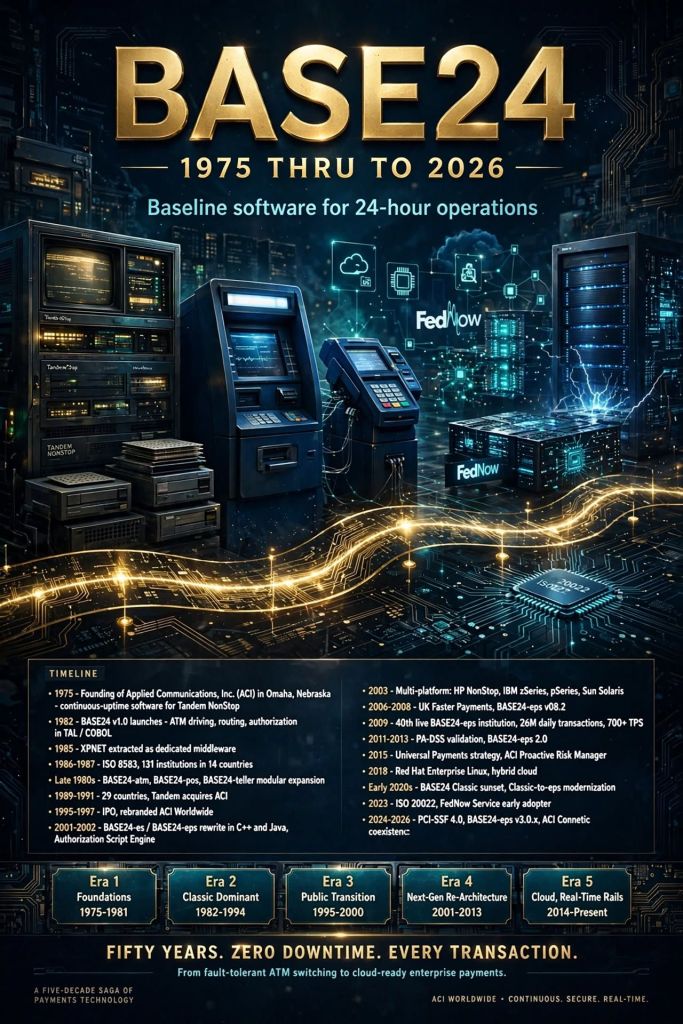
Below is an annotated, chronological breakdown of the platform’s architectural, corporate, and market milestones from its inception in 1975 through 2026.
Era 1: Foundations & Fault-Tolerant Inception (1975–1981)
- 1975 – Founding of Applied Communications, Inc. (ACI). Founded in Omaha, Nebraska, ACI Worldwide (originally Applied Communications, Inc.) began developing continuous-uptime software for the newly invented Tandem NonStop fault-tolerant servers. Early custom engineering focused on connecting nascent Automated Teller Machines (ATMs) to core bank mainframes without batch-processing downtime.
- 1976–1980 – Prototyping Continuous Availability. Engineers built foundational messaging drivers and Transaction Monitoring Facility (TMF) workflows using Tandem Screen COBOL and low-level communication protocols, proving that parallel-processing hardware paired with resilient software could eliminate single points of failure.
- 1981 – First International Deployment. ACI secured its first overseas customer—an Australian bank—validating that its continuous-availability electronic funds transfer (EFT) architecture could scale beyond U.S. regional networks.
Era 2: The BASE24 “Classic” Dominant Era (1982–1994)
- 1982 – Official Launch of BASE24 v1.0. ACI packaged its custom EFT work into its first standardized global product: BASE24 (standing for Baseline software for 24-hour operations). Written primarily in TAL (Tandem Application Language) alongside COBOL, v1.0 focused on ATM driving, routing, and authorization.
- 1985 – Extraction of XPNET. ACI spun out XPNET from its shared-memory messaging code into a dedicated middleware layer. This allowed BASE24 to manage multi-protocol communication lines (such as Bisync and Async) dynamically without requiring core application restarts.
- 1986–1987 – ISO 8583 & Rapid Global Scaling. By 1986, BASE24 powered 131 financial institutions across 14 countries. In 1987, ACI embedded native ISO 8583 financial messaging engines into the core routing layer, enabling seamless interbank network switching, and earned the U.S. President’s “E” Award for Excellence in Export.
- Late 1980s – Modular Expansion (ATM, POS, & Banking). As electronic payments expanded beyond cash withdrawals, BASE24 bifurcated into specialized modules:
- BASE24-atm: Dedicated ATM network control, device driving, and stored-value processing.
- BASE24-pos: Point-of-Sale merchant acquiring, terminal management, and debit/credit authorization.
- BASE24-teller & RBSI: Branch teller integration and Interactive Voice Response (IVR) telebanking support.
- 1989–1991 – Global Backbone & Tandem Acquisition. By 1989, BASE24 operated in 29 countries (generating over half of ACI’s revenue internationally). In 1991, hardware partner Tandem Computers acquired ACI following a period of private ownership under US West.
Era 3: Public Transition & Architectural Limits (1995–2000)
- 1995–1997 – IPO & Rebranding to ACI Worldwide. ACI spun out and went public on the NASDAQ in 1995 (originally under ticker TSA), officially adopting the name ACI Worldwide in 1997.
- 1996–2000 – Rise of E-Commerce & Platform Bottlenecks. While BASE24 Classic processed roughly half of the world’s electronic card transactions, its tight coupling to proprietary HP/Compaq NonStop hardware (Guardian OS, Enscribe databases, and TAL/C codebases) made rapid web-channel integration costly. Banks demanded open-systems portability (UNIX, Linux, IBM mainframes) and object-oriented customization.
Era 4: Next-Gen Re-Architecture — BASE24-eps (2001–2013)
- 2001–2002 – Introduction of BASE24-es (Enterprise Services). To overcome Classic’s hardware lock-in, ACI engineered a ground-up rewrite in C++ and Java using Object-Oriented Analysis and Design (OOAD). Initially branded BASE24-es and soon renamed BASE24-eps (Enterprise Payments System), it replaced hard-coded TAL modifications with a configurable Authorization Script Engine.
- 2003 – Multi-Platform Portability Live. BASE24-eps went live across HP NonStop, IBM zSeries (z/OS), IBM pSeries (AIX), and Sun Solaris, marking the end of NonStop exclusivity.
- 2006–2008 – UK Faster Payments & System z Optimization. In 2006, ACI adapted BASE24-eps to support the UK Faster Payments Service, enabling real-time account-to-account clearing. In July 2008, ACI launched BASE24-eps Release 1 (v08.2), optimizing IBM’s “blue stack” (DB2, WebSphere MQ, RACF) and introducing early PCI-DSS compliance frameworks.
- 2009 – Global Scale Validation. By May 2009, ACI announced its 40th live BASE24-eps institution (including ING, ABSA, and five major UK Faster Payments banks), proving single-system capacities exceeding 26 million daily transactions and 700+ transactions per second (TPS).
- 2011–2013 – PA-DSS Validation & Version 2.0. In March 2011, BASE24-eps, BASE24-atm, and BASE24-pos achieved PCI PA-DSS validation. In 2012, ACI released v11.1, followed in 2013 by BASE24-eps 2.0, which introduced the “Customer Component” and service-oriented architecture (SOA) wrappers to accelerate digital channel launches.
Era 5: Cloud, Real-Time Rails & Classic Sunset (2014–Present)
- 2015 – Universal Payments (UP) Strategy. Marking its 40th anniversary, ACI positioned BASE24-eps at the core of its Universal Payments (UP) framework, tightly integrating real-time fraud scoring via ACI Proactive Risk Manager (PRM).
- 2018 – Linux & Hybrid Cloud Enablement. ACI certified BASE24-eps for Red Hat Enterprise Linux (RHEL) across public and private cloud environments, allowing tier-1 banks to lower total cost of ownership (TCO) while maintaining active-active high availability.
- Early 2020s – BASE24 Classic Strategic Sunset. ACI formally placed BASE24 Classic into sunset/maintenance-only status. While ACI committed to ongoing 24/7 support and mandatory card-scheme compliance updates for existing Classic licensees, no new feature releases were developed, driving global banks toward multi-year Classic-to-eps modernization programs.
- 2023 – ISO 20022 & Federal Reserve FedNow. Modernized BASE24-eps deployments natively adopted ISO 20022 messaging and went live as an early-adopter engine for the U.S. Federal Reserve’s FedNow Service, bridging legacy card rails with 24/7 instant account-to-account payments.
- 2024–2026 – PCI-SSF 4.0, Version 3.0.x & Connetic Coexistence. In 2024–2025, ACI rolled out BASE24-eps v3.0.x featuring full PCI Software Security Framework (PCI-SSF / PCI DSS 4.0) compliance, real-time analytics extracts, and optimization for next-generation mainframes (such as IBM Telum II/z17). Following the 2025 launch of ACI Connetic (ACI’s cloud-native unified payments hub), BASE24-eps continues to serve as the mission-critical, ultra-high-volume acquiring and switching backbone for Tier-1 banks worldwide.
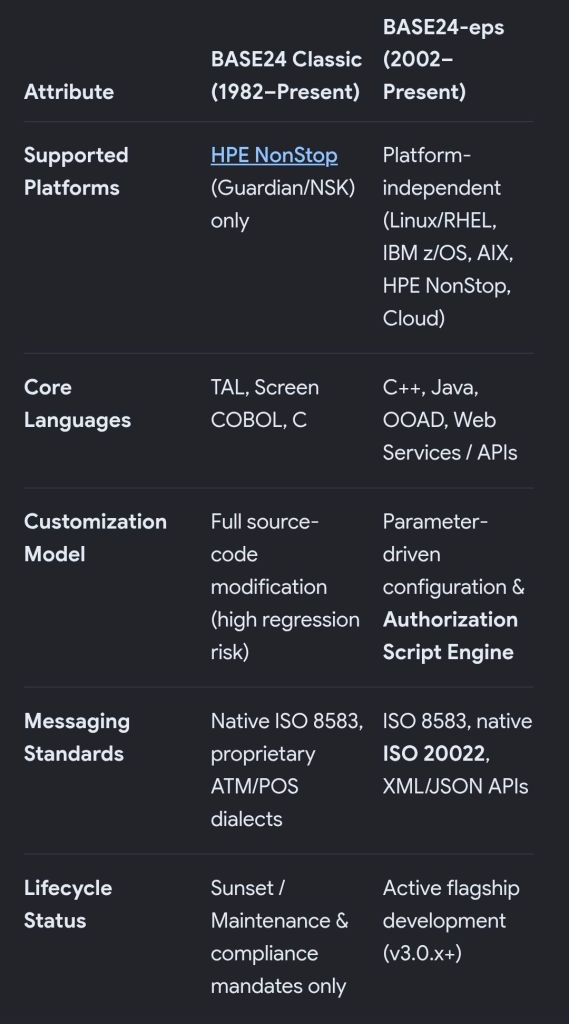
Architectural Summary: BASE24 Classic vs. BASE24-eps
BASE24 product timeline from 1975 thru to 2026 above

