

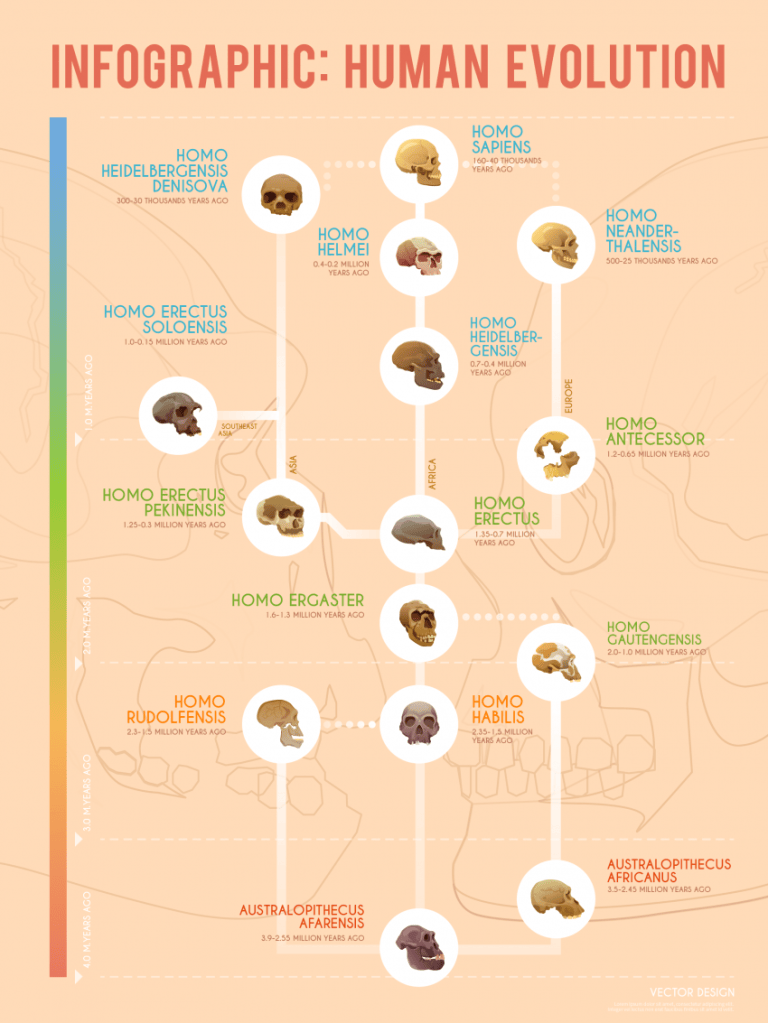
Modern humans (Homo sapiens) emerged in Africa approximately 300,000 years ago after millions of years of gradual primate and hominin evolution.
Early Beginnings and Primate Roots
- 85 million years ago (mya): Primates diverge from other mammalian groups during the Late Cretaceous period.
- 55 mya: Earliest true primate fossils appear in the Paleocene epoch.
- 15–20 mya: The ape superfamily diverges from gibbons and other primate lines, leading to early apes like Dryopithecus.
- 6–7 million years ago (mya): The human lineage (hominins) splits from the ancestors of modern chimpanzees and bonobos in Africa. Sahelanthropus represents one of the earliest known species to begin walking upright (bipedalism).
The Rise of Australopithecines
- 4–3 mya: Australopithecus species (such as Australopithecus afarensis) thrive in the grasslands of eastern and southern Africa. They walk fully on two legs but retain small, ape-like brain sizes.
- 3.3 mya: Earliest known stone tool manufacturing begins in Kenya, predating the appearance of the modern human genus (Homo).
The Emergence of the Genus Homo
- 2.8–2.5 mya: Homo habilis (the “handyman”) appears in Africa. They feature larger brains and systematically manufacture sharp stone flakes and core tools (Oldowan technology).
- 1.9–1.8 mya: Homo erectus emerges with taller, modern-like body proportions (longer legs, shorter arms). They are the first hominins to migrate out of Africa into Eurasia, master controlled fire, and build basic shelters.
Transition to Modern Humans
- 700,000–350,000 years ago (kya): Homo heidelbergensis spreads across Africa and Europe. They act as the common ancestral root that branches into Neanderthals in Eurasia and Homo sapiens in Africa.
- 315,000 years ago: The oldest known anatomical remains of Homo sapiens (including skull fragments and a jawbone) are fossilized in Jebel Irhoud, Morocco. These early modern humans possess near-modern facial features alongside robust skeletal builds.
- 50,000–40,000 years ago: The Upper Paleolithic revolution sees Homo sapiens develop advanced symbolic behavior, complex art, sophisticated blade toolkits, and widespread global expansion.

