The Infinity Stones (formerly known as Infinity Gems) are six primeval artifacts representing different aspects of the universe

The Infinity Stones in the Marvel Cinematic Universe (MCU) are six ancient singularities that existed before the dawn of creation. Following the Big Bang, these singularities were forged into concentrated crystals—the Stones—each embodying and controlling an essential aspect of existence: Space, Mind, Reality, Power, Time, and Soul. Thanos sought to collect all six to balance the universe by eradicating half of all life, a goal he achieved in 2018 before destroying the Stones. 
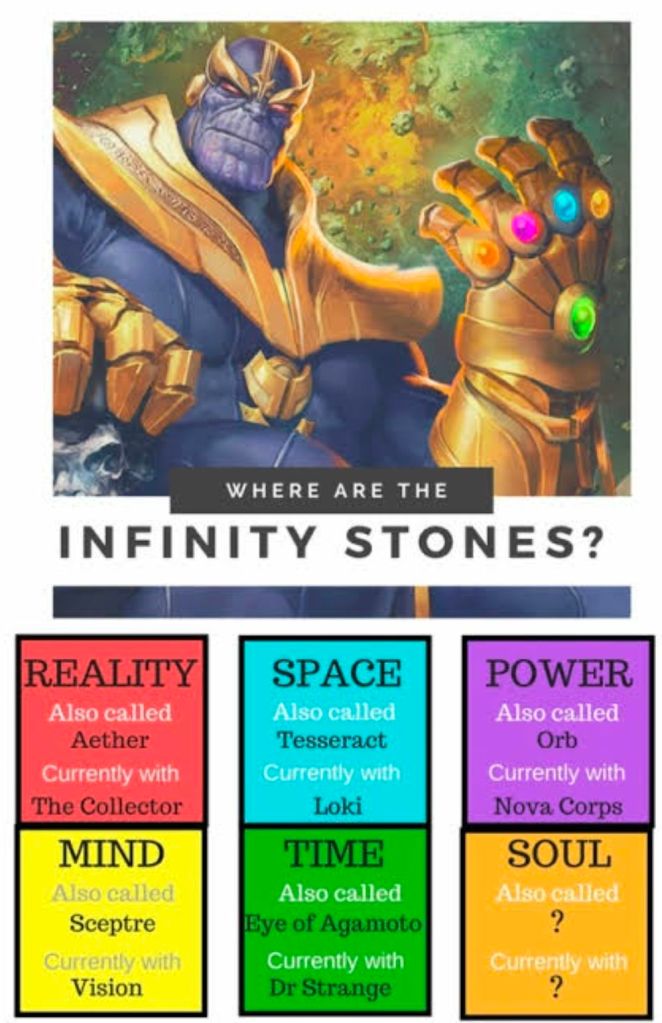
The Infinity Stones are six primeval artifacts representing different aspects of the universe

Overview of the Stones

  • Space Stone (Blue): Allows for instantaneous travel anywhere in the universe. Housed within the Tesseract.
  • Mind Stone (Yellow): Grants control over the minds of others and enhances mental abilities. Initially housed in Loki’s scepter, later placed in Vision’s forehead.
  • Reality Stone (Red): Enables the wielder to alter physics and reality itself. Known as the Aether.
  • Power Stone (Purple): Grants unlimited access to all forms of energy and can destroy entire planets. Housed in an orb.
  • Time Stone (Green): Gives total control over time, including speeding it up, reversing it, or creating time loops. Housed in the Eye of Agamotto.
  • Soul Stone (Orange): Controls life and death, allowing the user to manipulate souls and access the “Soul World”. Located on Vormir. 

Historical Textual Timeline

This timeline follows the stones from their creation to their destruction, based on MCU events. 

Era: Pre-Universe (Before Time)

  • Creation: Six singularities exist representing different aspects of existence.
  • The Big Bang: The universe is formed, and the singularities are forged into the six Infinity Stones and scattered across the cosmos. 

Era: Ancient History

  • Circa 965 A.D.: Odin, King of Asgard, brings the Space Stone (Tesseract) to Earth for safekeeping, hiding it in Tønsberg, Norway.
  • Undated: The Dark Elves, led by Malekith, attempt to use the Reality Stone (Aether) to return the universe to darkness during a convergence. Odin’s father, Bor, defeats them and hides the Aether.
  • Undated: The Power Stone is used by the Celestials to judge and destroy civilizations. It is eventually hidden away on the planet Morag. 

Era: World War II (1940s)

  • 1942: Johann Schmidt (Red Skull) locates and steals the Tesseract from Norway to weaponize it for Hydra.
  • 1943: During a confrontation with Captain America, the Tesseract is damaged, activating a portal that transports Red Skull to Vormir, where he becomes the guardian of the Soul Stone.
  • 1945: The Tesseract falls into the Arctic Ocean. Howard Stark recovers it shortly after. 

Era: Late 20th Century

  • 1989: Dr. Wendy Lawson (Mar-Vell) experiments on the Tesseract for S.H.I.E.L.D., accidentally granting Carol Danvers (Captain Marvel) her powers.
  • 1995: The Tesseract is briefly swallowed by the Flerken Goose, who later vomits it onto Nick Fury’s desk.

Era: Modern Age (MCU Phase 1 & 2)

  • 2010/2011: Nick Fury shows the Tesseract to Dr. Erik Selvig for research.
  • 2012 (The Avengers): Loki uses the Space Stone (in the Tesseract) to open a portal for the Chitauri invasion of New York. The Avengers defeat him, and Thor returns the Tesseract to Asgard.
  • 2013 (Thor: The Dark World): The Aether (Reality Stone) is found by Jane Foster. It is secured by the Collector after the Dark Elves are defeated.
  • 2014 (Guardians of the Galaxy): Star-Lord retrieves the Power Stone from Morag. After a conflict with Ronan the Accuser, the Guardians entrust the stone to the Nova Corps on Xandar for safekeeping.
  • 2015 (Avengers: Age of Ultron): The Avengers recover the Mind Stone from a Hydra base. Tony Stark and Bruce Banner use it to create Vision, who acts as its protector. 

Era: The Infinity War (2018) 

  • 2018: Thanos decimates Xandar and takes the Power Stone.
  • 2018: Thanos attacks the Asgardian refugee ship and takes the Space Stone from Loki.
  • 2018: Thanos visits the Collector and takes the Reality Stone.
  • 2018: Thanos takes the Soul Stone from Vormir after sacrificing his daughter, Gamora.
  • 2018: Thanos takes the Time Stone from Doctor Strange on Titan.
  • 2018: Thanos kills Vision to take the Mind Stone in Wakanda.
  • 2018 (The Snap): Thanos activates the Gauntlet, erasing half of all life in the universe. He later uses the stones a second time to destroy them, reducing them to atoms. 

Era: Post-Snap (2023)

  • 2023 (Avengers: Endgame): The Avengers travel back in time to 2012, 2013, and 2014 to borrow the stones from alternate timelines.
  • 2023: The Avengers use the borrowed stones to reverse Thanos’ snap.
  • 2023: Captain America returns the borrowed stones to their original timelines to prevent the creation of dark alternate realities. 

The Infinity Stones are six primeval artifacts representing different aspects of the universe
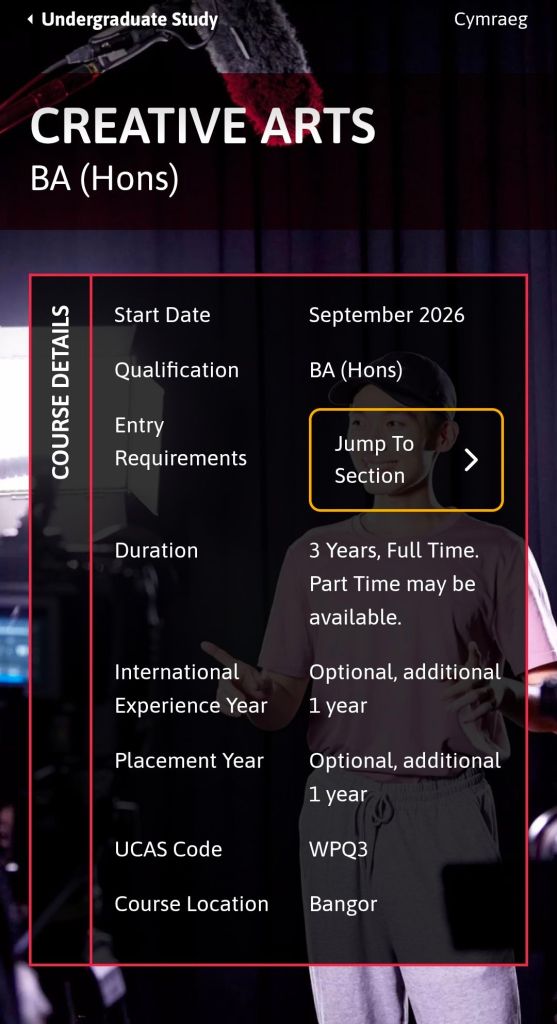
Creative Arts BA (Hons) at Bangor University is a full-time course that integrates film, media, journalism, and creative writing

The Creative Arts BA (Hons) at Bangor University is a three-year, full-time course (UCAS code: WPQ3) that integrates film, media, journalism, and creative writing. It is designed to balance theoretical study with practical, hands-on production. 

Creative Arts BA (Hons) at Bangor University is a full-time course that integrates film, media, journalism, and creative writing

Year 1: Foundations

In the first year, students must complete 120 credits to build a base in both creative practice and academic theory. 

  • Compulsory Modules: A primary core module is Adventures in the Creative Arts (20 credits), which introduces multidisciplinary approaches to the field.
  • Core Skills: You will begin developing production techniques in areas such as audio and visual production, print journalism, and digital media.
  • Theoretical Grounding: Introductory modules cover film theory and cultural studies to enrich your research and analytical skills. 

Year 2: Specialisation & Development

The second year allows for deeper engagement with specific creative industries. 

  • Elective Choice: Students can tailor their studies to their interests, choosing between practice-based modules (e.g., screenwriting, documentary filmmaking, journalism practice) or academic-focused modules (e.g., media regulation, history of film).
  • Professional Engagement: You are encouraged to build professional networks through regular visits from filmmakers, journalists, and designers.
  • Optional Years: After Year 2, you may opt to take an International Experience Year or a Placement Year to work with a professional organisation. 

Year 3: Synthesis & Final Project

The final year focuses on high-level production and a significant independent project. 

  • Final Year Project: Instead of a traditional long-form essay, you can demonstrate your progress through creative outputs such as a fictionalised response, an online exhibition, a vlog, or a professional portfolio.
  • Advanced Practice: Modules continue to cover specialized topics like digital journalism, visual culture, and global media.
  • Professional Showcase: Students often participate in the annual media showcase held at the Pontio Arts and Innovation Centre, providing exposure for their work. 

Teaching & Facilities

  • Learning Methods: Instruction is delivered through lectures, small seminar groups, interactive workshops, and one-to-one supervision.
  • Facilities: Students have access to industry-standard equipment via an extensive loan service (video/stills cameras, digital recorders) and dedicated creative spaces.
  • Assessment: Progress is measured via coursework, presentations, essays, and practical submissions (e.g., short films, scripts, or digital media pieces).

Creative Arts BA (Hons) at Bangor University is a full-time course that integrates film, media, journalism, and creative writing

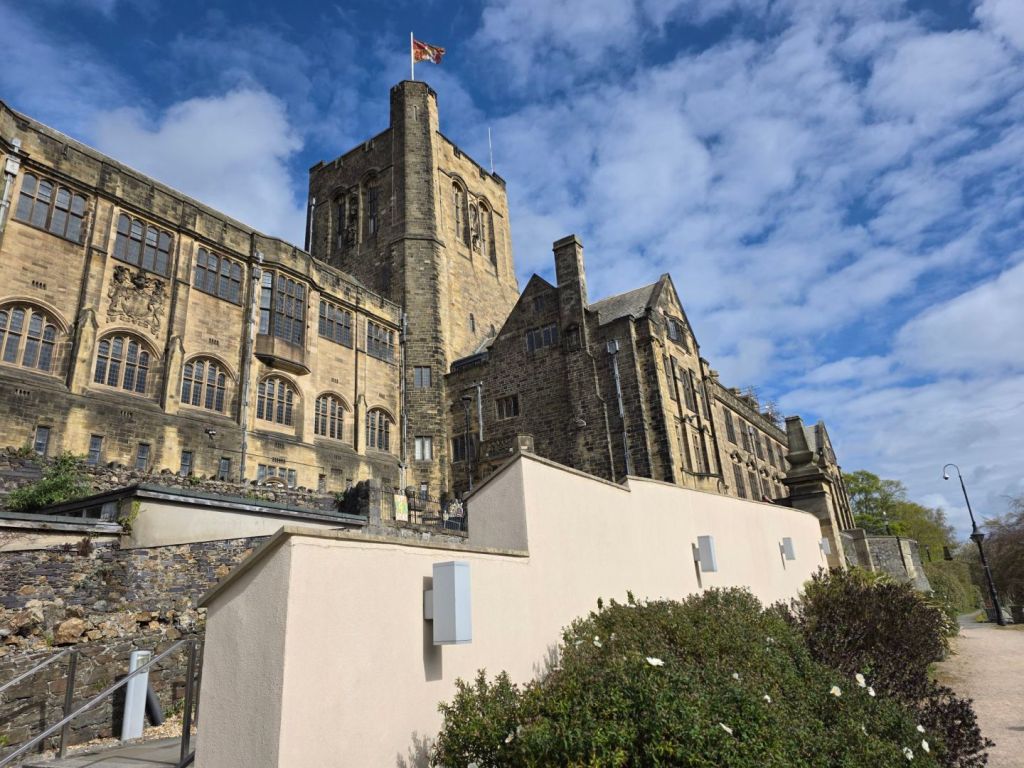
Bangor University History Timeline by Era and Year

Bangor University (Welsh: Prifysgol Bangor) is a public research university in North Wales, originally founded as the University College of North Wales (UCNW) on 18 October 1884. Established through a historic public campaign, its foundation was uniquely funded by local quarrymen and farmers who contributed their own wages to ensure access to higher education for the people of North Wales. 

Today, it is a prominent institution with over 10,000 students and 2,000 staff members, recognised for its research excellence and strong Welsh cultural identity. 

Comprehensive Timeline of Bangor University

Era 1: Foundation & Early Years (1881–1899) 

  • 1881: The Aberdare Report recommends creating two university colleges in Wales, one for the south and one for the north.
  • 1883: A committee selects Bangor over 12 other towns (including Wrexham and Rhyl) to host the new college.
  • 1884 (18 October): The University College of North Wales officially opens in the Penrhyn Arms, an old coaching inn, with 58 students and 10 staff members.
  • 1884Mary Ellen Williams becomes the first student to enrol; female students notably make up one-third of the initial population.
  • 1885: The institution receives its Royal Charter.
  • 1893: Bangor becomes a founding constituent college of the federal University of Wales, ending its initial practice of conferring degrees through the University of London. 

Era 2: The College on the Hill (1900–1939) 

  • 1903: The city of Bangor donates a 10-acre site at Penrallt for a new building.
  • 1907King Edward VII lays the foundation stone for the “Main Arts” building.
  • 1911: The iconic Main Arts Building (the “College on the Hill”) is officially opened by King George V.
  • 1926: The Science Departments, which had remained at the old Penrhyn Arms, move to new purpose-built facilities funded by the North Wales Heroes Memorial

Era 3: Wartime & Mid-Century Expansion (1940–1999) 

  • 1940s (WWII): The university’s Prichard-Jones Hall is used to safeguard national art gallery paintings from enemy bombing.
  • 1942Neuadd Reichel, a hostel for male students designed by Percy Thomas, opens on the Ffriddoedd site.
  • 1960s: Rapid expansion follows the Robbins Report, including the completion of the “New Arts” wing (1968) and the establishment of new departments like Social Theory (1966).
  • 1967: The Bangor Normal College hosts lectures by the Maharishi Mahesh Yogi, attended by The Beatles.
  • 1977St Mary’s College, a women’s teacher training college, merges with the university.
  • 1996: The Normal College (founded 1858) officially merges with the university, which is renamed University of Wales, Bangor

Era 4: Independence & Modern Era (2000–Present)

  • 2003Storm FM, the official student radio station, begins broadcasting.
  • 2007: The institution gains independent university status and adopts its current name, Bangor University.
  • 2009: The university celebrates its 125th anniversary and begins awarding its own degrees independently of the University of Wales.
  • 2015: The Pontio Arts and Innovation Centre and St Mary’s Student Village open.
  • 2018: The M-SParc science park on Anglesey is completed.
  • 2024: The university celebrates its 140th anniversary and opens its independent North Wales Medical School with its first intake of 80 students.
  • 2025: A £10.5 million donation leads to the redevelopment and renaming of the Albert Guday Business School

War Machine 2026, with Alan Ritchson, on Netflix

War Machine with Alan Ritchson

New… War Machine on Netflix… with Alan Ritchson of Reacher fame… a little like the first Predator movie (but with a giant transformer type robot) with a touch of Aliens in the last segment… not bad… hectic but ‘not bad’… conclusion… don’t make Predator sequels… re-imagine the original but differently… good fun at least… 😀

War Machine 2026, with Alan Ritchson, on Netflix