

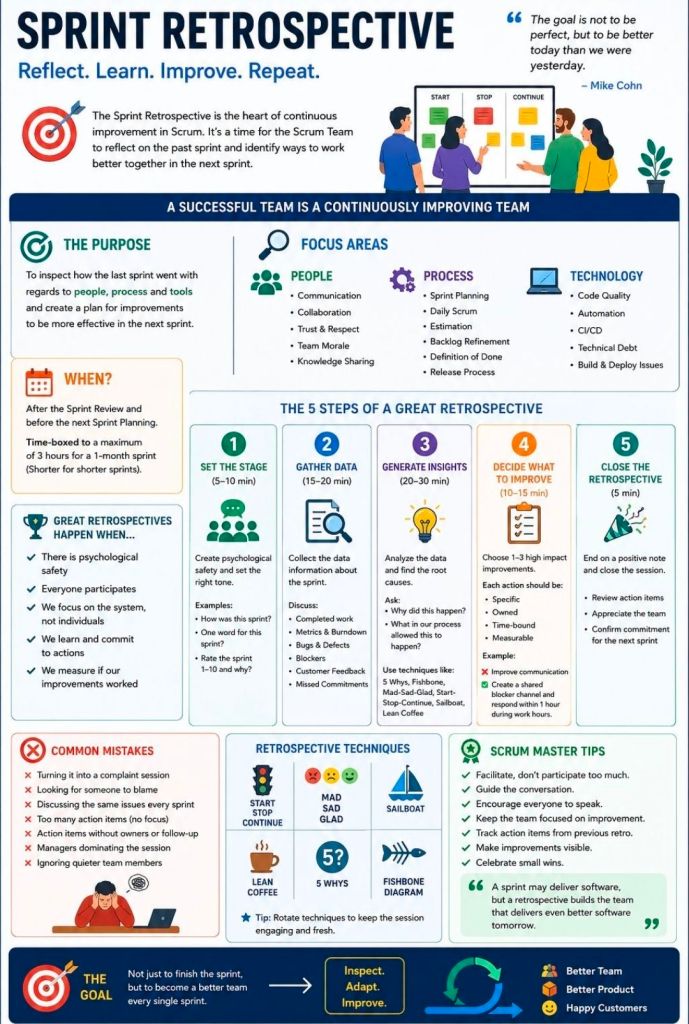
A Sprint Retrospective is a structured, time-boxed meeting held at the end of an Agile or Scrum sprint. Its primary purpose is to allow the core team (Developers, Scrum Master, and Product Owner) to reflect on the recently completed sprint and agree on actionable process improvements for future sprints.
For a quick visual breakdown of the Sprint Retrospective’s purpose and its role in team improvement, watch this short video:
Sprint Retrospective in a Nutshell3.8k views · 3 years agoYouTube · Kaizenko
The Core Goal
While the Sprint Review looks outward at what the team built (the product), the Retrospective looks inward at how the team worked (the processes, tools, and team dynamics). It follows the rule of inspect and adapt to prevent repeating the same mistakes and to continuously improve engineering productivity and team morale.
The 5 Standard Phases
Experienced facilitators (like Scrum Masters) usually structure the meeting into five key steps to ensure it remains a productive working session rather than a complaint session:
- Set the Stage: Create a psychologically safe and blameless environment. Ground rules are established so the focus remains on process, not people.
- Gather Data: Collaboratively pool observations, facts, and experiences from the previous sprint.
- Generate Insights: Look for underlying patterns or root causes of why things happened, rather than just listing symptoms.
- Decide What to Do: Select the most critical 1 to 2 high-priority improvements and commit to actionable next steps.
- Close the Retrospective: Summarize the action items, confirm individual ownership (assign specific names), and end on time.
Common Frameworks
Teams often use specific templates to keep the conversation fresh and engaging. Some of the most popular include:
- Start, Stop, Continue: Identify what actions to begin doing, stop doing, and continue doing in the next sprint.
- Mad, Sad, Glad: Focuses on how team members felt during the sprint, helping to surface frustrations and team morale issues.
- The 4 Ls: Asks team members to discuss what they Loved, Loathed, Learned, and Longed for.
- Sailboat Exercise: A visual metaphor where the team maps out their goals (the island), the wind in their sails (what helped them), and the anchors (what slowed them down).
Best Practices for Success
- Keep it strictly team-only: To encourage candour and psychological safety, stakeholders should generally not be present.
- Make action items accountable: Action items should be assigned to specific individuals and prioritized for the very next sprint’s backlog.
- Timebox appropriately: The meeting’s duration scales with the sprint length. A 1-week sprint might warrant a 45-minute retro, while a month-long sprint might need up to 3 hours.

