

The James Bond franchise spans over seven decades, beginning with Ian Fleming’s 1953 debut novel Casino Royale and extending through 25 official films (plus a 26th in production starring Robert Pattinson).
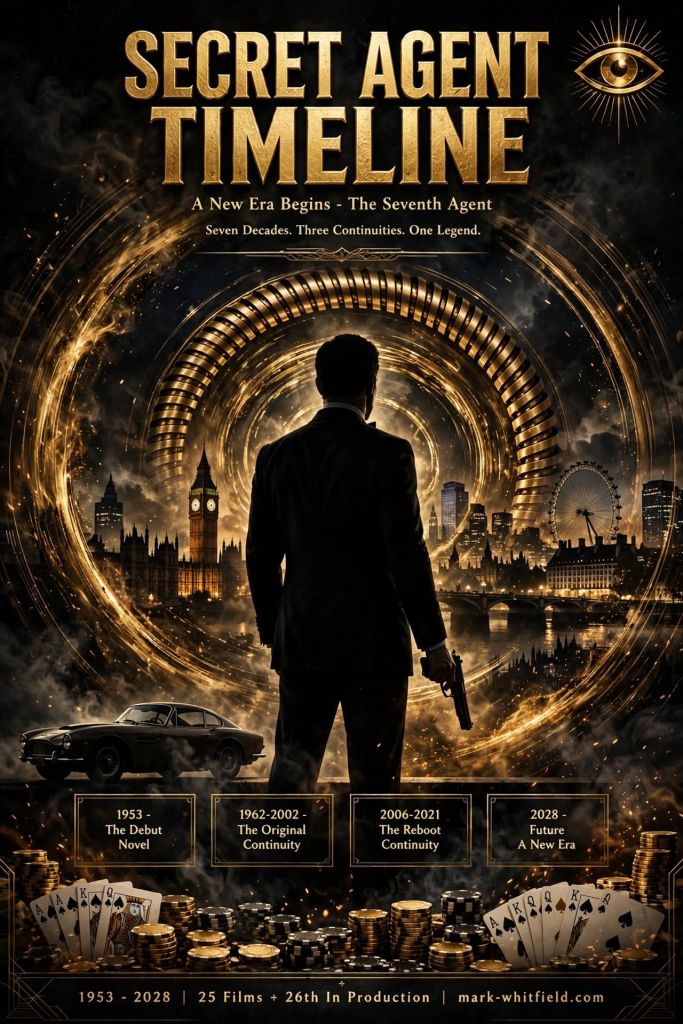
Because 007 exists across both literature and cinema—with distinct continuities and reboots—the timeline is divided into three main parts: the Literary Timeline, the Cinematic Release Timeline, and the In-Universe Film Continuities.
1. The Literary Timeline (Ian Fleming & Continuation Authors)
Ian Fleming wrote twelve novels and two short-story collections at his Jamaican estate, Goldeneye. Following his death in 1964, Ian Fleming Publications commissioned several authors to continue the official canon.
The Original Ian Fleming Era (1953–1966)
- 1953: Casino Royale introduces 007 as he faces SMERSH paymaster Le Chiffre at baccarat.
- 1954: Live and Let Die pits Bond against Mr. Big across Harlem, Florida, and Jamaica.
- 1955: Moonraker follows Bond investigating industrialist Sir Hugo Drax’s nuclear missile project in Kent.
- 1956: Diamonds Are Forever sends Bond undercover into an international diamond-smuggling pipeline.
- 1957: From Russia, with Love sees SMERSH target Bond in a honeytrap aboard the Orient Express.
- 1958: Dr. No sends a recovering Bond to Jamaica to investigate missing MI6 agents and Dr. Julius No.
- 1959: Goldfinger tracks Auric Goldfinger’s plot to rob the Fort Knox bullion depository.
- 1960: For Your Eyes Only collects five short stories, including “From a View to a Kill” and “Risico“.
- 1961: Thunderball introduces Ernst Stavro Blofeld and the terrorist syndicate SPECTRE.
- 1962: The Spy Who Loved Me is told from the first-person perspective of a young Canadian woman, Vivienne Michel.
- 1963: On Her Majesty’s Secret Service concludes with Bond’s marriage to Teresa “Tracy” di Vicenzo and her murder by Blofeld.
- 1964: You Only Live Twice follows a grieving Bond to Japan to assassinate Blofeld, ending with Bond suffering amnesia.
- 1965: The Man with the Golden Gun, published posthumously, sees a brainwashed Bond attempt to assassinate M before hunting Francisco Scaramanga.
- 1966: Octopussy and The Living Daylights collects Fleming’s final short stories, later expanded to include “The Property of a Lady” and “007 in New York”.
Major Continuation Eras (1968–Present)
- 1968: Kingsley Amis (writing as Robert Markham) publishes Colonel Sun, picking up directly after Fleming’s novels.
- 1981–1996: John Gardner updates Bond to the contemporary 1980s and 1990s across 14 original novels, starting with License Renewed and ending with COLD.
- 1997–2002: Raymond Benson pens six original novels (beginning with Zero Minus Ten) alongside film novelisations.
- 2005–2009: Charlie Higson launches the Young Bond series, chronicling Bond’s 1930s schoolboy years at Eton College.
- 2008–2013: Standalone period and modern novels are released by Sebastian Faulks (Devil May Care, 2008), Jeffery Deaver (Carte Blanche, 2011), and William Boyd (Solo, 2013).
- 2015–2022: Anthony Horowitz writes a trilogy utilising unpublished Ian Fleming material: Trigger Mortis (2015), Forever and a Day (2018, a prequel to Casino Royale), and With a Mind to Kill (2022).
- 2023–2026: Charlie Higson returns for adult Bond stories with On His Majesty’s Secret Service (2023) and King Zero (2026).
2. The Cinematic Release Timeline (1954–2028)
While Eon Productions produces the official film canon, three non-Eon live-action adaptations also exist due to early rights splits.
Early Television & Non-Eon Adaptations
- 1954: American actor Barry Nelson portrays “Jimmy” Bond in a live CBS television adaptation of Casino Royale on the anthology series Climax!.
- 1967: Columbia Pictures releases the satirical comedy Casino Royale starring David Niven as an ageing Sir James Bond.
- 1983: Sean Connery returns outside Eon in Never Say Never Again, a legal remake of Thunderball stemming from a court battle over script rights.
3. In-Universe Film Continuities (How the Story Connects)
Unlike modern cinematic universes, the Eon films operate on a floating timeline across three distinct narrative continuities:
- The Original Continuity (1962–2002 | Connery through Brosnan):
- Despite spanning 40 years and five actors, these 20 films treat James Bond as a single man who does not age alongside real-world decades.
- Continuity Anchors: The murder of Bond’s wife Tracy in On Her Majesty’s Secret Service (1969) is directly referenced across eras—by Roger Moore visiting her grave in For Your Eyes Only (1981), by Felix Leiter noting Bond was married once in Licence to Kill (1989), and via props in The World Is Not Enough (1999).
- Soft Reset in 1995: GoldenEye acts as a soft continuity bridge, acknowledging the end of the Cold War and introducing a new female M (Judi Dench) who explicitly calls Bond a “sexist, misogynist dinosaur” left over from previous decades.
- The Daniel Craig Reboot Continuity (2006–2021):
- Casino Royale (2006) completely resets the universe. Bond earns his “00” licence at the start of the film, has not yet met Blofeld, and has never been married.
- Unlike the loose episodic nature of earlier eras, Craig’s five films form one continuous, serialized narrative. Every film builds directly on the fallout of the previous entry—from Vesper Lynd’s betrayal and Quantum (Casino Royale / Quantum of Solace), to the fall of M (Skyfall), the revelation of Franz Oberhauser as Blofeld (Spectre), and Bond’s ultimate sacrifice to save Madeleine Swann and their daughter Mathilde (No Time to Die).
- The Amazon MGM / Robert Pattinson Era (2028–Future):
- Following Amazon’s acquisition of MGM and creative control of the franchise, Robert Pattinson was officially cast as the seventh Eon 007 in November 2026, launching a fresh narrative continuity after the definitive ending of Craig’s storyline.
James Bond Timeline above

