

The evolution of the BASE24 platform by ACI Worldwide represents a five-decade transformation from a specialized, hardware-locked ATM switcher into a cross-platform, enterprise payment hub. The comprehensive historical timeline below outlines its development across distinct technical and corporate eras.
I worked on BASE24 / BASE24-eps transaction tracking and XPNET monitoring at Insider Technologies Limited (ITL) in the early part of the millennium. See also HP NonStop Connection Journal article in 2013.
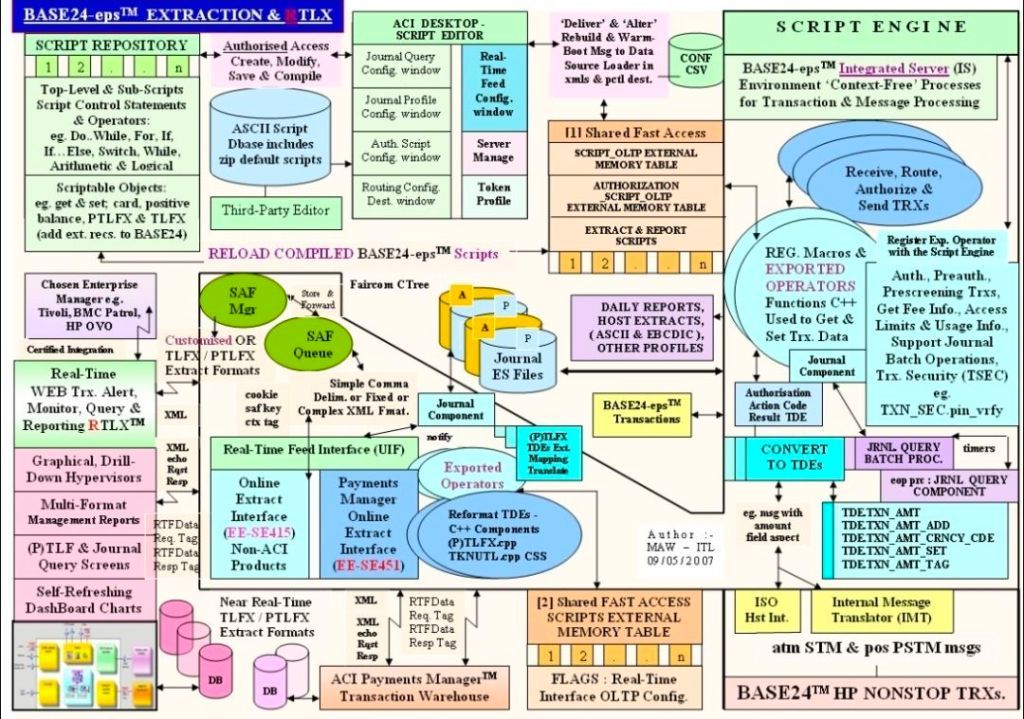
BASE24-eps extraction
and ITLs RTLX (in 2007)
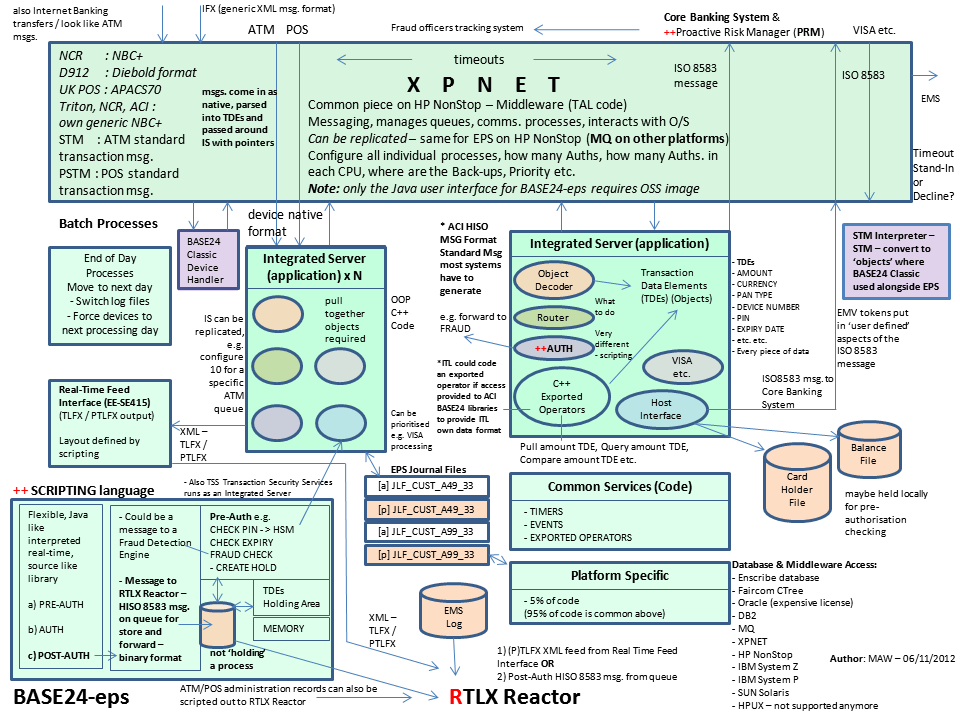
RTLX Reactor (in 2012) for tracking
BASE24-eps & BASE24 XPNET transactions
🧱 Era 1: Foundations & The Rise of BASE24 Classic (1975–1994)
This era established high-availability software tailored specifically to the fault-tolerant, parallel processing architecture of Tandem NonStop server hardware to ensure “always-on” electronic transactions.
- 1975: Applied Communications, Inc. (ACI) is founded in Omaha, Nebraska. Early projects focus on foundational communication routines mapping the first generation of automated teller machines (ATMs) to core banking ledgers.
- 1981: ACI wins its first international client—an Australian bank—initiating its footprint in global electronic funds transfer (EFT) operations.
- 1982: BASE24 is officially launched with the debut of BASE24-atm 1.0. The system is built utilizing the Tandem Application Language (TAL) and the native high-speed, unstructured hierarchical file database, Enscribe.
- 1986: Functional expansions create BASE24-pos and customized bank branch software modules. The global customer base scales to 131 clients distributed across 14 nations.
🌐 Era 2: Public Market Transition & Digital Expansion (1995–2000)
During this stage, the platform adapted to accommodate the birth of internet commerce, diverse alternate networks, and the expansion of hardware environments.
- 1995: The firm launches its initial public offering on NASDAQ under the name Transaction Systems Architects (TSA).
- 1996: ACI expands into alternative retail instruments, processing stored-value smart cards deployed at the Summer Olympic Games using the BASE24 core framework.
- 1997: The operating organization officially adopts the global commercial brand name ACI Worldwide.
- 1998–1999: A massive global remediation program introduces Y2K compliance frameworks. Engineering teams update binary-coded decimal (BCD) variables and expand data storage limits natively throughout legacy Enscribe database nodes.
⚙️ Era 3: Architectural Migration & Open Systems (2001–2010)
A strategic re-architecture broke rigid vendor lock-in by re-platforming the legacy code into an object-oriented system capable of running seamlessly across heterogeneous open server environments.
- 2001–2002: Infrastructure-wide cryptographic adaptations roll out, systematically enforcing Triple DES (TDES) encryption standards across all active automated teller and point-of-sale endpoints.
- 2003: ACI launches BASE24-eps (Enterprise Payments System). This marks a shift away from old TAL/pTAL programming languages toward a modular architecture written in C++ and Java, enabling native execution across IBM z/OS, AIX, Linux, and HP NonStop kernels.
- 2006: A specialized gateway version is rolled out via the ACI Worldwide Investor Relations Portal to support the UK’s near real-time Faster Payments scheme, offering scripting-driven transaction authorization.
- 2008: In partnership with IBM, ACI drops Release 1 Version 08.2, introducing full native stack optimization for the IBM System z platform, integrating IBM’s “blue stack” security components and middleware.
- 2009: ACI announces the general availability of Version 09.2, adding advanced risk handling layers such as match-and-hold processing alongside structural upgrades for check handling workflows.
🔒 Era 4: Modern Compliance, Security & Enterprise Integration (2011–Present)
Recent iterations prioritize strict global regulatory compliance, enterprise cloud orchestration, and managing multi-billion transaction volumes.
- 2011: The principal suite components—including BASE24-eps, BASE24-atm, and BASE24-pos—achieve comprehensive validation under the global PA-DSS (Payment Application Data Security Standard).
- 2012: BASE24-eps Version 11.1 is deployed worldwide, expanding support for localized electronic clearing house configurations and advanced interactive endpoint designs.
- Modern Era Transitions: ACI formally introduces a strategic maintenance sunset for the legacy BASE24 Classic product tier. This standardizes maintenance pricing to guide international banking enterprises away from “green-screen” configuration consoles toward unified, microservices-driven cloud capabilities natively orchestrated within modern BASE24-eps environments.


